Automation Software Market Size and Growth Opportunities and Forecast till 2026 - 2035
Automation Software Market Size, Share & Trends Report, 2026–2035
LAST UPDATED: OCTOBER 2026
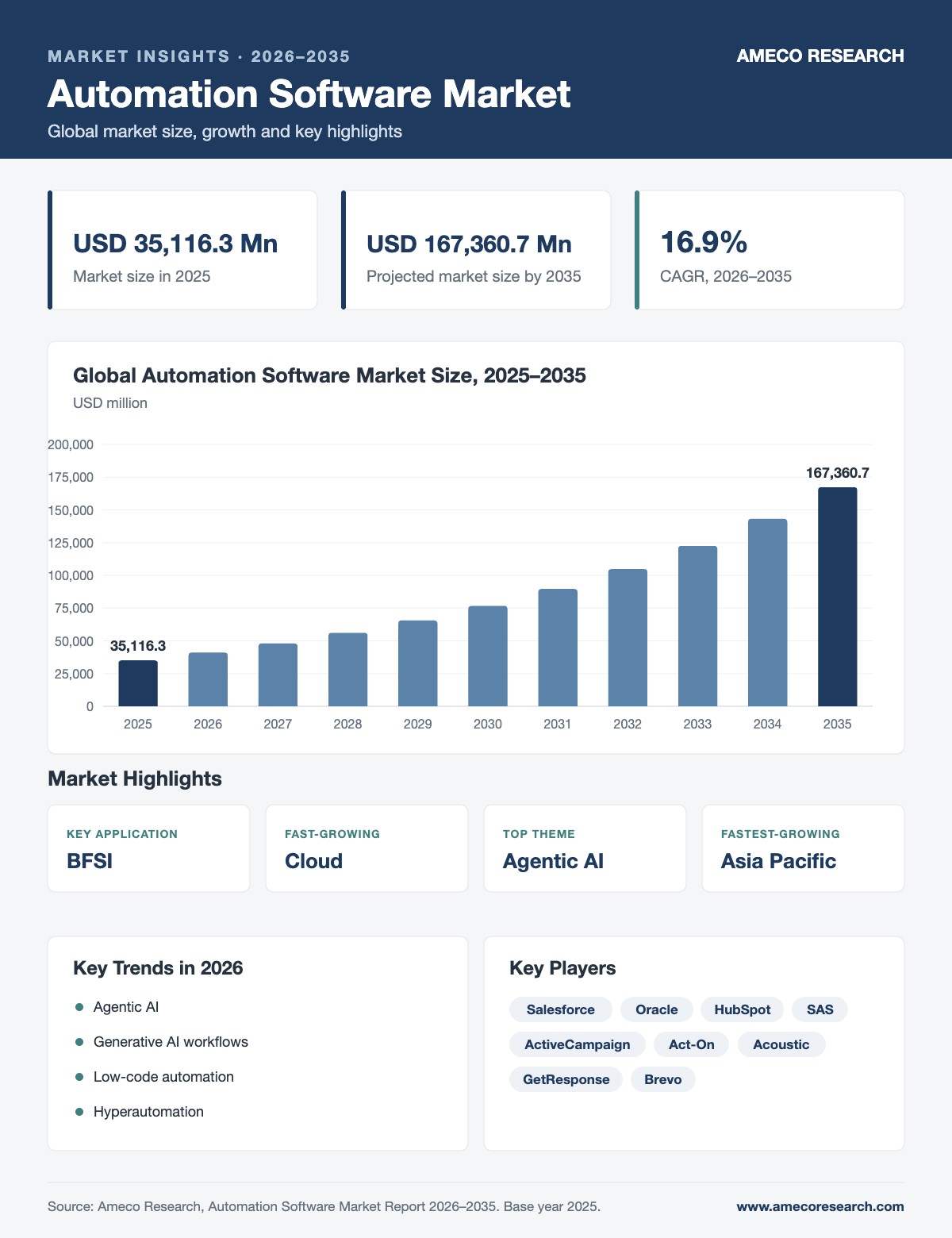
The global Automation Software Market size was valued at USD 35,116.3 million in 2025 and is projected to reach USD 167,360.7 million by 2035, growing at a CAGR of 16.9% from 2026 to 2035. Growth is driven by digital transformation, robotic process automation (RPA) combined with AI and machine learning, generative AI agents that handle multi-step tasks, marketing and customer engagement automation, and cloud platforms that make automation accessible to small and mid-sized businesses.
Automation software uses rules, workflows, bots and artificial intelligence to carry out business tasks with little or no human input. It includes robotic process automation, workflow and business process automation, intelligent document processing, and marketing and customer engagement automation that manages email campaigns, lead scoring, customer journeys and CRM updates. Solutions are deployed in the cloud or on-premises across industries such as banking, manufacturing, telecom, retail and healthcare.
Automation Software Market Key Takeaways
Automation Software Market Report Scope
| Report Attribute | Details |
| Automation Software Market Size in 2025 | USD 35,116.3 Million |
| Automation Software Market Forecast by 2035 | USD 167,360.7 Million |
| Automation Software Market CAGR (2026–2035) | 16.9% |
| Analysis Period | 2023–2035 |
| Base Year | 2025 |
| Forecast Period | 2026–2035 |
| Segments Covered | by Product, by Application, and By Region |
| Regional Scope | North America, Europe, Asia Pacific, Latin America, and Middle East & Africa |
| Key Companies Profiled | Salesforce, Oracle, HubSpot, SAS, ActiveCampaign, Act-On Software, Acoustic, ClickDimensions, GetResponse, and Brevo (formerly Sendinblue) |
| Report Coverage | Market Trends, Drivers, Restraints, Opportunities, Competitive Analysis, Player Profiling, Regulation Analysis |
Automation Software Market Size Forecast, 2023–2035
Figures for 2025–2035 extend the earlier 2021 baseline of USD 18,804 million at the report's 16.9% CAGR.
| Year | Market Size (USD Million) |
| 2023 (historical) | 25,696.8 |
| 2024 (historical) | 30,039.6 |
| 2025 (base year) | 35,116.3 |
| 2026 (forecast) | 41,051.0 |
| 2027 (forecast) | 47,988.6 |
| 2028 (forecast) | 56,098.6 |
| 2029 (forecast) | 65,579.3 |
| 2030 (forecast) | 76,662.2 |
| 2031 (forecast) | 89,618.1 |
| 2032 (forecast) | 104,763.5 |
| 2033 (forecast) | 122,468.5 |
| 2034 (forecast) | 143,165.7 |
| 2035 (forecast) | 167,360.7 |
Latest Automation Software Market Trends (2026)
Agentic AI
Software vendors are adding AI agents that can plan and carry out multi-step tasks across applications, moving automation beyond fixed rules to handling exceptions and unstructured requests.
Generative AI in workflows
Generative AI is built into automation and marketing platforms to draft emails, summarize documents, extract data and personalize content at scale.
Low-code and citizen automation
Low-code tools let business users build their own automations, widening adoption beyond IT teams while increasing the need for governance.
Hyperautomation
Companies combine RPA, process mining, document processing, integration and AI to automate end-to-end processes rather than single tasks.
Marketing and customer engagement automation
Marketing teams use automation for email, SMS, lead scoring, segmentation and customer journeys, increasingly tied to CRM and customer data platforms.
Governance and security
As automation and AI agents access more systems and data, companies focus on access controls, audit trails, data privacy and responsible AI policies.
Automation Software Market Dynamics
Growth drivers
- Digital transformation and replacement of inefficient legacy processes
- Demand for RPA combined with AI and machine learning
- Need to cut costs and reduce repetitive, error-prone work
- Growth of cloud-based automation platforms
- Marketing teams' need to personalize and scale customer engagement
Restraints and challenges
- High cost of integrating automation with existing systems
- Shortage of experienced automation and AI professionals
- Limited digital infrastructure in some emerging countries
- Data privacy, security and AI governance concerns
Opportunities
Key opportunities include AI agents for business processes, automation for SMEs, industry-specific solutions for healthcare and finance, government training programs, and partnerships between regional and global providers.
Automation Software Market Segment Analysis
By product
The market is segmented into cloud and on-premises. On-premises remains important for regulated industries that need full control of data, while cloud deployment is growing fastest because of lower upfront costs and easier scaling.
By application
Applications include BFSI, manufacturing, IT & telecom, retail and consumer goods, healthcare and life sciences, travel and hospitality, education, media and entertainment, and others. BFSI is a significant segment, while healthcare and retail are growing quickly.
Automation Software Market Regional Analysis
North America is a major market, home to many automation and marketing software vendors and early enterprise adopters.
Asia Pacific is likely to grow fastest, supported by high government infrastructure spending and digital transformation in China, India, Japan and Southeast Asia. Europe is a significant market shaped by data protection and AI rules.
Latin America and the Middle East & Africa are growing markets with rising cloud adoption.
Automation Software Market Segmentation
Automation Software Market Leading Companies
The automation software market includes enterprise software companies, marketing automation specialists and RPA and AI platform providers. Companies compete on AI capabilities, ease of use, integrations, scalability, pricing and data security. Key players profiled in this report include Salesforce, Oracle, HubSpot, SAS, ActiveCampaign, Act-On Software, Acoustic, ClickDimensions, GetResponse, and Brevo (formerly Sendinblue).
SalesforceOracleHubSpotSASActiveCampaignAct-On SoftwareAcousticClickDimensionsGetResponseBrevo (formerly Sendinblue)
Key Questions Answered in This Report
- What is the size of the automation software market in 2025, and how large will it be by 2030 and 2035?
- What are the main growth drivers, restraints and opportunities through 2035?
- Which by product and by application segments will grow the fastest?
- Which regions and countries offer the largest and fastest-growing opportunities?
- How are agentic AI, generative AI and low-code tools shaping automation software in 2026?
- Who are the leading companies, and what strategies are they using to compete?
Research Methodology
Ameco Research built this forecast from a mix of primary and secondary research. Analysts spoke with automation and marketing software vendors, enterprise users, system integrators and industry publications to validate pricing, volumes and demand trends, and reviewed company filings, trade statistics, regulatory documents and industry publications. The automation software market size was estimated with bottom-up and top-down approaches and validated through data triangulation, with 2025 as the base year and forecasts for 2026–2035.
Related Reports
- Anti-Allergic Drugs Market Report
- COVID-19 Vaccine Delivery Devices Market - Size, Industry Trends, Competitive Landscape, and Opportu... Report
- Vegan Supplements Market Report
- Micromachining Market Report
- MRO Distribution Market - Size, Industry Trends, Competitive Landscape, and Opportunities and Foreca... Report
Automation Software Market: Frequently Asked Questions
How big is the automation software market?
The global automation software market was valued at USD 35,116.3 million in 2025 and is expected to reach USD 167,360.7 million by 2035.
What is the growth rate of the automation software market?
The automation software market is projected to grow at a CAGR of 16.9% from 2026 to 2035.
What will the automation software market be worth in 2030?
The automation software market is projected to reach about USD 76,662.2 million in 2030, growing at a CAGR of 16.9%.
What is driving growth in the automation software market?
Key drivers are digital transformation, RPA combined with AI, cost reduction, cloud platforms and demand for personalized customer engagement.
What is automation software?
Automation software uses rules, bots and AI to carry out business tasks such as data processing, workflows and marketing campaigns with little human input.
Which region leads the automation software market?
North America is a major market, while Asia Pacific is likely to grow fastest.
Which segment holds the largest share of the automation software market?
BFSI is a significant application, and cloud deployment is growing fastest.
What are the latest trends in the automation software market?
The main 2026 trends are agentic AI, generative AI in workflows, low-code and citizen automation, hyperautomation, marketing and customer engagement automation and governance and security.
What are the main challenges in the automation software market?
The main challenges are integration costs, a shortage of skilled professionals, limited infrastructure in some regions and data privacy and AI governance.
What is agentic AI in automation?
Agentic AI refers to AI agents that can plan and carry out multi-step tasks across applications, handling exceptions and decisions that traditional rule-based automation cannot.
Who are the key players in the automation software market?
Leading companies include Salesforce, Oracle, HubSpot, SAS, ActiveCampaign, Act-On Software, Acoustic, ClickDimensions, GetResponse, and Brevo (formerly Sendinblue).