Physical AI Market Size and Growth Opportunities and Forecast till 2026 - 2035
The global physical AI market size accounted for USD 5,021.2 million in 2025 and is estimated to achieve a market size of USD 82,790.9 million by 2035 growing at a CAGR of 32.8% from 2026 to 2035.
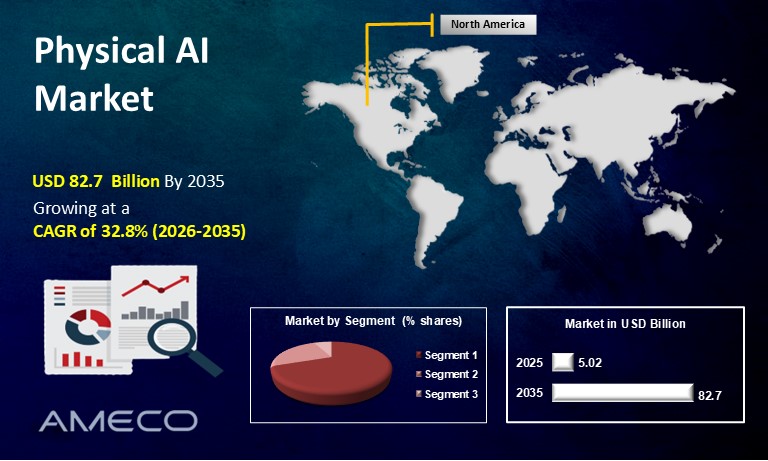
Physical AI systems are transforming industrial automation, with over 4.2 million operational robots installed globally in 2025 and nearly 70% of new warehouse facilities integrating AI-powered robotics for material handling and predictive maintenance. In healthcare and mobility, more than 500,000 AI-enabled surgical procedures and over 35 million kilometers of autonomous vehicle testing were recorded worldwide in 2025, highlighting the accelerating real-world deployment of physical AI technologies.
Physical AI Market Major Highlights:
• By region, North America dominated the Physical AI market by capturing approximately 40.6% of the global market share in 2025, driven by early adoption of industrial automation, strong investment in AI-powered robotics, and the presence of major innovators such as NVIDIA, Boston Dynamics, and Tesla, Inc.
• By region, Asia Pacific accounted for approximately 30.6% market share in 2025 and is projected to expand at the fastest CAGR of 34.6% from 2026 to 2035, fueled by aggressive industrial automation, smart factory investments, and rising robotics deployment across China, Japan, South Korea, and India.
• By component, the hardware occupied 57.4% of market share owing to its crucial role in facilitating physical interaction, perception, and action in robot frameworks, underpinned by an installed base exceeding 4.4 million industrial robots globally, with over 620k robots deployed annually and necessitating high-cost sensors and actuations.
• By component, the software comprised the next largest share 30.6% with its role in powering key intelligent layers like perception, reinforcement learning, and digital twin capabilities that are being widely adopted across robots which analyze operational data in real-time and at scale.
• By deployment, the on-device deployment option accounted for 52.0% of share with the capability forreal-time, ultra-low-latency decision-making; in the ecosystem, over 68% of industrial robots and more than 74% of surgical robots are deployed with on-device edge architecture.
• By deployment, cloud-based deployment stood at 48.0% with its benefit of scalable and centralized training of AI models and command and control for robots processing more than 82 ZBs of IoT data in a year.
• By technology, computer vision captured 42.4% of the share with more than 80% of industrial robots leveraging vision systems for navigation, inspection, and object recognition, thereby reducing defect rate by 35%.
• By technology, speech/NLP captured 21.9% of share fueled by over 28 million speech-enabled robots for machine-human communication, spanning across different industries.
• By robot type, industrial robots constituted a majority share of 38.6% supported by a robot density of 162 robots per 10,000 workers, improving overall productivity by as much as 30% for various manufacturing applications.
• By robot type, service robots secured 14.3% of share on the back of over 220,000 robots shipped in 2025 with nearly 50% deployment within the healthcare industry.
• By application, manufacturing and automotive took center stage with a 23.1% share through deployment of as many as 1200 robots per plant with over 55% of industrial robots globally operating within these segments.
• By application, the healthcare industry commanded a share of 18.0% driven by over 600k robot-assisted surgeries performed annually, thereby improving recovery efficiency by nearly 20%.
Physical AI Market Report Coverage
|
Parameter |
Physical AI Market |
|
Physical AI Market Size in 2025 |
US$ 5,021.2 Million |
|
Physical AI Market Forecast By 2035 |
US$ 82,790.9 Million |
|
Physical AI Market CAGR During 2026 – 2035 |
32.8% |
|
Physical AI Market Analysis Period |
2023 – 2035 |
|
Physical AI Market Base Year |
2025 |
|
Physical AI Market Forecast Data |
2026 – 2035 |
|
Segments Covered |
By Component, By Deployment, By Technology, By Robot Type, By Application, and By Region |
|
Physical AI Market Regional Scope |
North America, Europe, Asia Pacific, Latin America, and Middle East & Africa |
|
Key Companies Profiled |
NVIDIA, Tesla, Inc., Waymo, Boston Dynamics, ABB Ltd., FANUC Corporation, KUKA AG, Universal Robots, Agility Robotics, Figure AI, Amazon, and Google |
|
Report Coverage |
Market Trends, Drivers, Restraints, Competitive Analysis, Player Profiling, Regulation Analysis |
What is Physical AI & How is it the Market Transforming in 2026?
Physical AI is the intelligent integration of machine learning with the real physical world. In 2026, Physical AI is finally being extracted from pure software into our real world to revolutionize the way machines interact with their environments. It is making impact in manufacturing, automotive, logistics, healthcare, agriculture and aerospace. Physical AI is considered to be a top technology infrastructure layer across geographies as industries invest in solutions that enable machines to move, sense, and physically adapt.
There are projected 41 billion internet-connected IoT devices running worldwide by the end of 2026, generating more than 79 Zettabytes of data. This is helping to fuel physical AI with rich real time insights so machine decisioning can be made, processed and performed in the immediate present. The convergence of edge computing power, robotics capabilities, and new specialized chips for running AI directly in machines, robots and other connected hardware are collectively ushering in this new physical layer to automation.
Physical AI in 2026: Applications, Innovations, and Industry Impact
• In 2026, the number of deployed industrial robotics units worldwide exceeded 4.4 million units, with over 640,000 new installations each year.
• Manufacturing remains the largest industry for Physical AI adopters, as leading companies such as ABB Ltd and Fanuc Corporation continue to build AI integrated robotics systems.
• Nearly 78% of smart factories around the world deploy AI assisted machine vision systems to detect defects and perform predictive maintenance of equipment.
• The total number of physical AI powered warehouse robotics installations reached over 1.2 million units by the mid of 2026.
• Close to 72% of major warehouses implemented AI assisted Autonomous Mobile Robots (AMRs), reducing picking errors by 40%, and boosting order throughput by 30%.
• The agriculture industry deployed over 250,000 AI driven autonomous tractors and harvesters resulting in increased yields between 20-30% and an 18% reduction in fertilizer waste.
• Physical AI drone adoption currently makes up 35% of global industrial inspections performed on a large scale, primarily in energy, construction, and defense industries, driving down cost of inspections by as much as 50%.
Industry-wise Physical AI Deployment
| Industry | Core Physical AI Application | Major Global Companies |
| Automotive | Autonomous driving, humanoid robotics, predictive maintenance | Tesla, Inc., Waymo, Mercedes-Benz Group |
| Manufacturing | Industrial robotics, machine vision, smart factories | ABB Ltd., Fanuc Corporation, Siemens AG |
| Healthcare | Surgical robots, rehabilitation systems, AI diagnostics | Intuitive Surgical, Medtronic plc, Johnson & Johnson |
| Logistics & Warehousing | Autonomous picking, AMRs, inventory intelligence | Amazon, Ocado Group, KUKA AG |
| Agriculture | Autonomous tractors, harvesting robots, crop monitoring | John Deere, CNH Industrial, Trimble Inc. |
| Aerospace & Defense | Autonomous drones, surveillance robotics, battlefield systems | Lockheed Martin, Northrop Grumman, Anduril Industries |
| Retail & Service Robotics | Delivery bots, customer interaction robots, store automation | SoftBank Robotics, Samsung Electronics, Panasonic Holdings |
Physical AI Market Drivers
Rising Industrial Automation and Real-Time Edge AI Adoption in Physical AI Market
The market for physical AI is seeing rapid growth and traction due to the quick escalation of robotics and automation, particularly within the manufacturing and automobile sectors, with over half of industrial robots’ global deployment from these sectors. Currently, the industrial robot’s total base exceeds four million active robots and has grown to an annually addition of over 620,000 robots, with this increased number of robots creating a robust environment for physical AI adoption.
The physical AI adoption is most evident within high precision areas such as manufacturing’s assembly line, automotive industry’s welding and inspection activities. The need for instantaneous, self-operating decision-making brought about by edge and mobile robotics technologies is another major cause for physical AI growth and deployment on device is accounting for over 50% of Physical AI applications, to be used for important tasks such as robotic surgery and autonomous driving.
Physical AI Market Restraints
High Initial Investment and Operational Complexity
Physical AI market has many impediments to wide adoption despite widespread hype The market for physical AI has seen high adoption of its technology. Though high adoption of its tech the physical AI market does have several impediments to the commercial adoption. Physical AI solutions necessitate massive capital investment which poses the major impediments. Such a deployment requires high investment in the robotics technology, artificial intelligence processors, sensors, actuators, and safety equipment to successfully implement it.
A physical AI is reliant on the hardware parts, artificial intelligence models, and the systems that are linked to real time sensors. The complexity of maintaining physical AI a simple task of calibrating an inch here and there can be the result in operational problems or safety issues in the healthcare or automobile sector, and with a legacy machine in the old industry set up.
Physical AI Market Opportunities
Humanoid Robotics Growth and Emerging Economy Expansion Driving Physical AI Opportunities
There are enormous opportunities arising for physical AI due to ongoing tech convergence and extension of the scope of physical AI across multiple verticals. One of the most significant physical AI opportunities arise with the hyper-growth of humanoid and collaborative robots.
Physical AI has already proliferated at a level of approx 18,000 units of commercial humanoids and the ability for human robot collaboration is growing across warehouse, retail and service sectors allowing firms to augment their workforce at safer and more productive levels.
Physical AI opportunities will be prevalent in emerging economics notably across the Asia Pacific region as industrial automation, smart manufacturing and infrastructure modernisations continues apace with the rising deployment of robots and will broaden physical AI addressable market in excess of that of only developing economics, especially in cost sensitive manufacturing setups.
Physical AI Market Segmental Insights:
By Component
How Did Hardware Dominate the Physical AI Market in 2025?
In 2025 the hardware segment led the global market and secured a share of 57.4%, the large market share was mainly attributed to the basic dependency of the Physical AI machines on the costly physical elements which incorporate; high resolution cameras, LiDAR, radar components, robotic hardware, robotic AI chips, GPUs and controllers. The physical AI system also heavily relies on complex mechanical devices with real-time sensing, interpretation and interaction. Hardware segment with physical-machine that is robot-centric is crucial as these systems may perform robotic behaviors.
The software segment share reached 30.6% in 2025, thus coming second in the global physical AI market share value due to growing importance of the highly intelligent AI perceptual systems, reinforcement learning machines and digital twin technology which allow robots and machines to autonomously make decisions and interact intelligently with the real environment.
By Deployment
Why Did On-Device Deployment Lead the Physical AI Market in 2025?
The on-device deployment segment captured a 52.0% share of the physical AI market in 2025, primarily due to the requirement of ultra-low latency, high reliability, and instant decision-making, especially for applications like self-driving cars, surgical robots, and smart manufacturing. Over 68% of industrial robots and approximately 74% of AI-powered surgeries rely on their on-device architecture to provide dependable functionality with little reliance on connectivity. It can also bring significant improvement to security and eliminate risks of high latency for all mission-critical applications.
The cloud-based deployment segment accounted for a 48.0% share due to access to vast amounts of data, centralized training of AI models, and coordinating across fleets of robots/systems. As IoT ecosystems produce more than 82 zettabytes of data every year on a global scale, data collection and AI system monitoring, and training through the cloud are still vital, promoting the segment's expansion.
By Technology
Why Did Computer Vision Dominate the Physical AI Market in 2025?
Computer vision technology accounted for a whopping 42.4% share of the physical AI market in 2025, serving as the underlying perception layer to essentially all robot and autonomous systems. This technology enables robot systems to recognize, detect, and track object features; map environments; perform autonomous navigation; identify and fix anomalies in a manufacturing assembly line; enable awareness in various environments.
The perception technology has, so far, powered the implementation of vision systems into over 80% of industrial robot bodies worldwide and has also helped cut down manufacturing defect rates by nearly 35%, in the form of visual inspection with machine vision technology.
Speech/NLP took over the second spot on the podium with a share of 21.9%, on account of growing deployments of voice-enabled industrial machines, industrial human-machine interface devices, conversational robotic applications, etc. Worldwide and has driven the deployment of a more than 28-million-unit figure of voice-enabled robot machines globally.
By Robot Type
How Did Industrial Robots Dominate the Physical AI Market in 2025?
The physical AI market for industrial robots commanded an extensive share of 38.6% in 2025. Widespread penetration in automotive, electronics, and heavy industrial sectors aided this sector, with the international density of industrial robots reaching 162 per 10,000 employees. As industrial automation pervades worldwide economies and with increased penetration, productivity efficiency ranges of 30 percent are achieved with reduced errors of around twenty-four percent by employing industrial robots.
In second place, the service robots sector gained 14.3% share. The growing usage of service robots in the medical industry, retail and the hospitability industry as well as the logistics business, where an aggregate of over 220,000 units sold within the year of 2025, nearly fifty percent was related to medical use cases, fueled this sector’s increase.
Humanoid and social robots captured 13.8% market share, boosted via tremendous advancement with deployments reaching eighteen thousand commercial-ready units worldwide with 26% increase in deployments from 2023 to 2025, mostly the application for customer engagement and elderly care industry.
By Application
Why Did Manufacturing & Automotive Dominate the Physical AI Market in 2025?
The manufacturing and automotive segment accounted for the largest market share of 23.1% of the physical AI market in 2025 due to its increasing use of industrial robots, collaborative robots, AI-powered quality inspection solutions and fully automated lines. Additionally, automotive plants are now deploying up to 1,200 robots per facility, significantly increasing productivity, precision, and operational efficiency in large-scale production environments.
Industrial robots usage stood at over 55.0% for the segment where a high-volume automobile factory use nearly 1,200 robotic systems in their facility. Physical AI based on industrial robotic arms helped in reduced unplanned downtime by 30-40% due to adoption of intelligent predictive maintenance solutions.
Healthcare segment came in as the second largest segment and is expected to contribute 18.0% share in 2025. Factors include high growth in demand for robotic assisted surgery and rehabilitation systems and the need for automated healthcare solutions which are leveraging the potential of artificial intelligence.
• More than 600,000 surgeries have been carried out using robotic assistance in the world in 2025 and intelligent diagnostic systems have improved detection rates by upto 22% and reduced patient recovery times by around 20%.
Physical AI Market Regional Analysis
What Made North America Dominate the Physical AI Market in 2025?
North America accounted for the largest share of physical AI market in 2025, with 40.6% of the global market size due to its advanced robotic infrastructure, developed AI ecosystem, and extensive early adoption of intelligent automation by industries. North America played a prominent role in developing Physical AI through robotics, transportation systems, healthcare, and logistics. Strong presence of dominant tech players such as Boston Dynamics, NVIDIA, Amazon, Tesla, Inc., etc, contributed to North America's market share.
The United States is a top growth player with the widespread use of industrial robots and warehouse automation in the region. In 2025, the region’s industrial robot installations totaled more than 44,000, a statistic supported by significant automation growth, especially in the production of automobiles, electronics and semiconductors.
The automotive industry continues to contribute the most, representing close to 31% of all industrial robots installed across the globe. Production lines in high-volume plants across the United States continue to incorporate physical AI in welding, assembling, inspecting, and painting, while industrial robots’ density is on the increase.
What Makes Asia Pacific the Fastest Growing Marketplace for Physical AI?
Asia Pacific held the second largest share in the market with a 30.6% share in 2025. It is expected to register the fastest CAGR of 34.6% from 2026 to 2035, with accelerated industrialization, large manufacturing centers, and wide-scale adoption of robots. The Asia Pacific region has evolved as the world's leading manufacturing hub and remains central in the automotive, semiconductor, electronics, and industrial machinery industry, which constitutes a solid basis for demand.
In industrial robot installations, it stands as number one in the world; over 70% of the annual global robot installation takes place in China, Japan, and South Korea. The former installs around 250,000 industrial robots each year alone, making it the world's top robotics market. Increased labor costs, factory modernization, and the substantial investment in smart manufacturing are responsible for its expansion.
• Japanese robot sector continues to take the top rank globally. Home to top robotics companies such as Fanuc Corporation and Yaskawa Electric Corporation, Japan’s humanoids, precision automation systems, and industrial robots with integrated AI make it a preferred location for high-end electronics and high-value manufacturing.
• South Korea presents the world’s highest industrial robot density; the region installs more than 1,000 industrial robots for every 10,000 employees in the manufacturing industry, making it the most automation-intensive economy globally.
What are Recent Breakthroughs in Physical AI Industry?
• During the GTC 2026 in March, NVIDIA expanded the physical AI ecosystem of COSMOS, a new generation of world-models for AI to make it easier to generate data from, Isaac GR00T, an integrated robot training for humanoid robots and Alpamayo, an architecture for the training of robotic and automotive driving intelligence for simulation. NVIDIA also added training features to its robotics platforms where robots can train much faster with the help of a synthetic dataset.
• In June 2026, the startup Genesis AI revealed first general purpose Physical AI robots that would run under the “Eno” name. The logistics, manufacturing and service robots have a wheeled design with arm modules rather than humanoid shape and intend to scale faster in existing industrial settings.
Top Global Companies in the Physical AI Market:
• NVIDIA
• Tesla, Inc.
• Waymo
• Boston Dynamics
• ABB Ltd.
• FANUC Corporation
• KUKA AG
• Universal Robots
• Agility Robotics
• Figure AI
• Amazon
Physical AI Market Segmentation
By Component
• Hardware
• Software
• Services
By Deployment
• Cloud-based AI
• On-device
By Technology
• Computer Vision
• Speech / NLP
• Gesture / Movement Recognition
• Reinforcement Learning & Control Systems
• Others (multi-modal AI, biomimetic robotics)
By Robot Type
• Industrial Robots
• Service Robots
• Humanoids/Social Robots
• Cobots
• Exoskeletons/Prosthetics
• Mobile Robots/Drones
By Application
• Healthcare
• Manufacturing & Automotive
• Logistics & Warehousing
• Retail & Hospitality
• Defense & Security
• Agriculture
• Education & Research
• Others
By Region
• North America
o U.S.
o Canada
• Europe
o U.K.
o Germany
o France
o Spain
o Rest of Europe
• Asia-Pacific
o India
o Japan
o China
o Australia
o South Korea
o Rest of Asia-Pacific
• Latin America
o Brazil
o Mexico
o Rest of LATAM
• The Middle East & Africa
o South Africa
o GCC Countries
o Rest of the Middle East & Africa (ME&A)