AI Data Center Market Size, Share, Trends & Growth Opportunities Forecast to 2026 - 2035
AI Data Center Market Size, Share & Trends Report, 2026–2035
LAST UPDATED: OCTOBER 2026
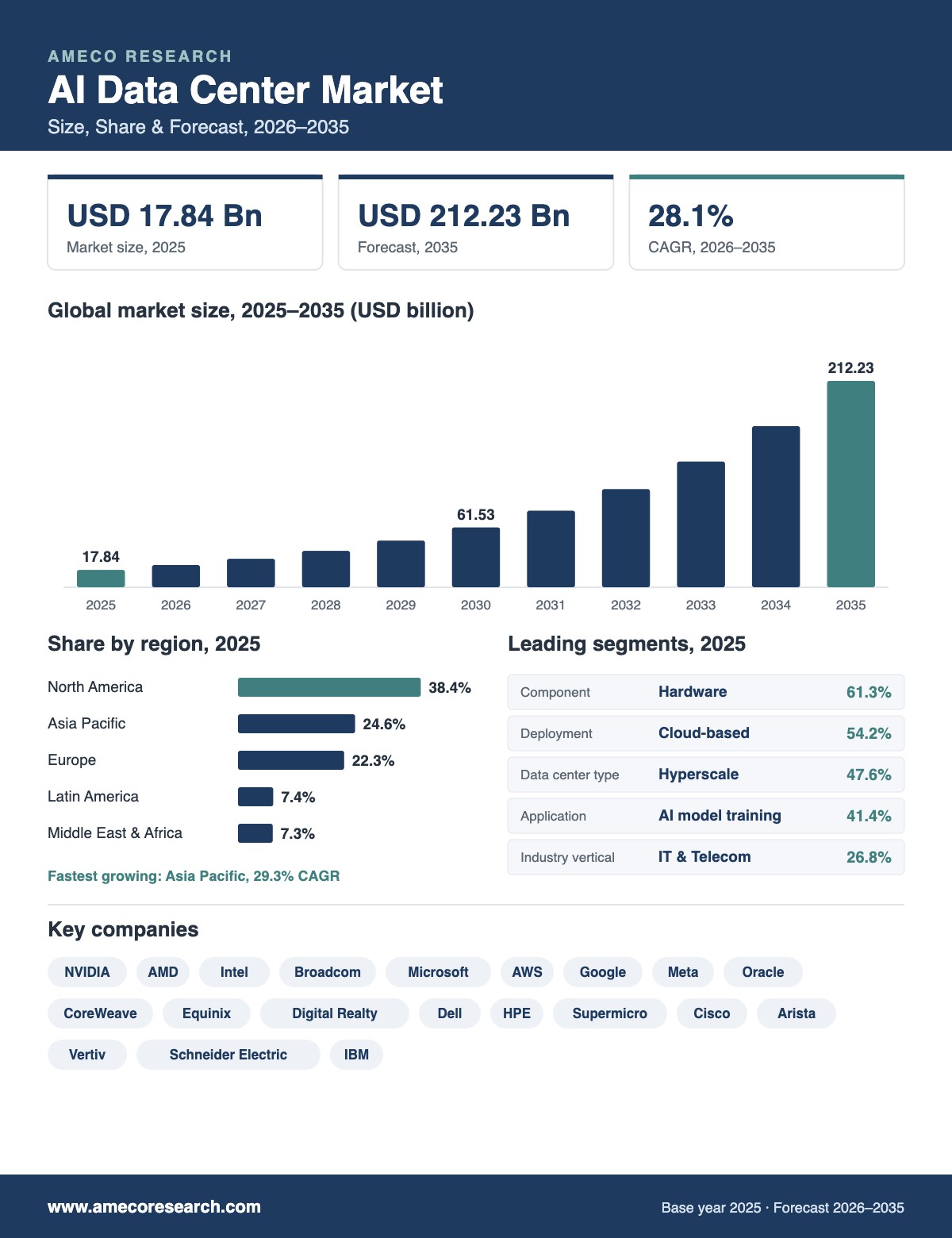
The global AI data center market size was valued at USD 17.84 billion in 2025 and is projected to reach USD 212.23 billion by 2035, growing at a CAGR of 28.1% from 2026 to 2035. The market is estimated at USD 22.85 billion in 2026, with North America holding the largest share and Asia Pacific registering the fastest growth.
An AI data center is a facility purpose-built to train and run artificial intelligence models. It combines dense clusters of GPUs, TPUs and custom AI accelerators with high-bandwidth, low-latency networking, liquid cooling and large-scale power infrastructure, so that hyperscalers, cloud providers, enterprises and research institutions can process the massive datasets behind generative AI, large language models (LLMs), computer vision and real-time analytics.
The market is moving from a build-out phase dominated by model training toward a mixed training and inference economy. Rack densities are climbing from tens of kilowatts toward several hundred kilowatts, gigawatt-scale campuses are coming online in the United States, India and the Middle East, and access to electricity has become the single biggest factor deciding where new capacity is built.
AI Data Center Market Key Takeaways
AI Data Center Market Report Scope
| Report Attribute | Details |
| AI Data Center Market Size in 2025 | USD 17.84 Billion |
| AI Data Center Market Size in 2026 | USD 22.85 Billion |
| AI Data Center Market Forecast by 2035 | USD 212.23 Billion |
| AI Data Center Market CAGR (2026–2035) | 28.1% |
| Historical Data | 2021–2024 |
| Base Year | 2025 |
| Forecast Period | 2026–2035 |
| Largest Region | North America (38.4% share in 2025) |
| Fastest-Growing Region | Asia Pacific (29.3% CAGR) |
| Segments Covered | Component, Deployment, Data Center Type, Application, Industry Vertical and Region |
| Regional Scope | North America, Europe, Asia Pacific, Latin America, and Middle East & Africa |
| Key Companies Profiled | NVIDIA, AMD, Intel, Broadcom, Microsoft, Amazon Web Services, Google, Meta, Oracle, CoreWeave, Equinix, Digital Realty, Dell Technologies, Hewlett Packard Enterprise, Super Micro Computer, Cisco Systems, Arista Networks, Vertiv, Schneider Electric and IBM |
| Report Coverage | Market size and forecast, trends, drivers, restraints, opportunities, segment and regional analysis, competitive landscape, recent developments |
How Big Is the AI Data Center Market in 2026?
Ameco Research estimates the AI data center market at USD 22.85 billion in 2026, up roughly 28% from USD 17.84 billion in 2025, and expects it to pass USD 61 billion by 2030 before reaching USD 212.23 billion in 2035.
| Year | AI Data Center Market Size (USD Billion) |
| 2025 | 17.84 |
| 2026 | 22.85 |
| 2028 | 37.49 |
| 2030 | 61.53 |
| 2032 | 100.96 |
| 2035 | 212.23 |
Latest AI Data Center Market Trends 2026
Hyperscaler spending reaches record levels
Alphabet, Amazon, Microsoft and Meta together guided to roughly USD 700 billion of capital expenditure for 2026, compared with about USD 410 billion in 2025, with most of it directed at AI servers, data centers, power and cooling. Meta alone raised its 2026 guidance to USD 125–145 billion in April 2026.
Gigawatt-scale AI campuses become the new benchmark
As of September 2026, xAI’s Colossus 2 was the largest operating AI data center at roughly 946 MW of IT power, with the Anthropic-Amazon campus in Indiana close behind. Planned sites such as Microsoft Fairwater in Wisconsin and OpenAI’s Stargate locations target 1.5–2.3 GW each.
Liquid cooling moves from option to default
NVIDIA’s Vera Rubin platform, in full production since early 2026, is 100% liquid-cooled at 45°C supply temperatures, removing the need for mechanical chillers in most climates. Rack power is rising to around 200 kW in 2026 and toward 600 kW with the Kyber rack expected in 2027.
800 VDC power architecture gains momentum
Operators including CoreWeave, Oracle Cloud Infrastructure, Nebius and Lambda are designing facilities for 800-volt direct current power distribution, while ABB, Eaton, Schneider Electric, Siemens and Vertiv have launched compatible power shelves, busbars and energy storage systems.
Power availability becomes the binding constraint
The IEA projects global data center electricity use will more than double from about 415 TWh in 2024 to around 945 TWh by 2030, with AI-focused facilities growing fastest. Grid connection times now drive site selection, and some hubs, including Loudoun County, Virginia, paused new data center applications in September 2026.
Sovereign AI and India emerge as growth engines
Governments are funding domestic AI compute to keep sensitive data local. In India, Google’s USD 15 billion, 1 GW Visakhapatnam hub and an USD 11 billion Reliance-Brookfield-Digital Realty AI campus are positioning the country as a regional AI infrastructure hub.
AI Data Center Market Dynamics
Growth drivers
- Generative AI and LLM adoption: training frontier models and serving billions of daily inference requests requires far more compute density than conventional cloud infrastructure can provide.
- Record cloud and hyperscaler investment: AWS, Microsoft Azure, Google Cloud, Meta and Oracle are expanding AI-optimized capacity as AI revenue scales, with Google Cloud and Microsoft reporting fast-growing AI backlogs in 2026.
- Accelerator innovation: each new generation of GPUs, TPUs and custom ASICs raises performance per rack and pushes operators to refresh facilities for higher power and liquid cooling.
- Enterprise and industry AI use cases: fraud detection in BFSI, medical imaging and genomics in healthcare, recommendation engines in retail and network automation in telecom all generate sustained demand for AI compute.
- Data sovereignty rules: regulations in the EU, India and the Middle East encourage local AI processing, adding new national and regional AI data center projects.
Restraints and challenges
- High capital intensity: AI-ready facilities cost about twice as much per megawatt as standard builds, and GPU fit-out can push the total well beyond USD 30 million per MW, which limits participation by smaller operators.
- Grid capacity and energy costs: long interconnection queues, rising electricity prices and local moratoriums are delaying projects in several established hubs.
- Sustainability pressure: higher electricity and water use is drawing scrutiny from regulators and communities, raising the bar for renewable sourcing and efficiency.
- Supply chain and skills constraints: shortages of high-bandwidth memory, transformers, switchgear and skilled data center engineers can stretch build timelines.
- Return-on-investment uncertainty: investors are watching whether AI revenue grows fast enough to justify current capital spending levels.
Opportunities
- Energy-efficient and green AI data centers using warm-water liquid cooling, heat reuse, on-site renewables, nuclear power purchase agreements and small modular reactors.
- Inference and edge AI capacity located closer to users for low-latency applications such as autonomous systems, smart cities, industrial IoT and real-time analytics.
- Emerging markets across India, Southeast Asia, the Gulf states and Latin America, where AI adoption is accelerating and capacity remains limited.
- Modular and prefabricated AI data centers that cut deployment time from years to months for enterprises, governments and neocloud GPU providers.
How Much Does It Cost to Build an AI Data Center?
Construction economics are a major factor shaping the AI data center market. Global average shell-and-core construction cost reached about USD 11.3 million per MW in 2026, up from roughly USD 7.7 million in 2020. AI-optimized facilities with liquid cooling and higher-capacity electrical systems typically cost USD 20 million per MW or more, and once GPUs, servers and networking are included the fully loaded figure can reach USD 30–40 million per MW.
| Facility Type | Typical Cost per MW (2026) |
| Standard shell and core | About USD 11.3 million |
| AI-optimized, liquid-cooled facility | USD 20 million or more |
| Fully loaded AI facility with IT equipment | USD 30–40 million |
AI Data Center Market Segment Analysis
By component: Why does hardware dominate the AI data center market?
Hardware generated 61.3% of AI data center revenue in 2025, worth about USD 10.9 billion. Spending is concentrated on GPU and accelerator servers, high-bandwidth memory, InfiniBand and Ethernet switching, and liquid cooling and power systems needed for LLM training and inference. Services are the fastest-growing component as enterprises rely on partners for design, integration, managed AI operations and GPU-as-a-service.
| Component | Share (2025) | Key Highlights |
| Hardware | 61.3% | GPUs, AI accelerators, servers, networking, liquid cooling and power infrastructure |
| Services | 20.6% | Fastest-growing; integration, consulting, managed AI operations and GPU-as-a-service |
| Software | 18.1% | AI workload orchestration, DCIM, scheduling and data management platforms |
By deployment: Why is cloud-based deployment the leading model?
Cloud-based deployment held 54.2% of the market in 2025 because hyperscalers give organizations on-demand access to the latest accelerators without large upfront capital. Hybrid deployment is the fastest-growing model as regulated industries keep sensitive data on premises while bursting large training jobs to the cloud.
| Deployment | Share (2025) | Key Highlights |
| Cloud-Based | 54.2% | Scalable access to AI compute via AWS, Microsoft Azure, Google Cloud and Oracle |
| On-Premises | 25.6% | Preferred where data control, security and compliance are critical |
| Hybrid | 20.2% | Fastest-growing; combines on-premises control with cloud scalability |
By data center type: Why do hyperscale facilities lead?
Hyperscale data centers accounted for 47.6% of revenue in 2025, as the largest technology companies build campuses with hundreds of thousands of GPUs. Edge AI data centers are growing fastest as low-latency inference spreads to autonomous vehicles, factories, retail and telecom networks.
| Data Center Type | Share (2025) | Key Highlights |
| Hyperscale Data Centers | 47.6% | Massive GPU clusters and continuous investment by global cloud and AI leaders |
| Enterprise Data Centers | 18.3% | Dedicated AI infrastructure for internal workloads and data security |
| Colocation Data Centers | 14.4% | Outsourced high-density capacity for neoclouds and enterprises |
| Edge Data Centers | 11.9% | Fastest-growing; real-time inference close to users and devices |
| Modular & Portable Data Centers | 7.8% | Rapid deployment for remote, temporary or capacity-constrained sites |
By application: Why does AI model training account for the largest share?
AI model training led with 41.4% share in 2025 because frontier LLM and multimodal model development requires the largest GPU clusters and fastest interconnects. Inference is gaining share every year as deployed AI applications scale, and natural language processing is the fastest-growing application on the back of chatbots, AI agents and conversational AI.
| Application | Share (2025) | Key Highlights |
| AI Model Training | 41.4% | Compute-intensive LLM and deep learning training |
| AI Model Inference | 20.7% | Real-time AI services across enterprises, retail and telecom |
| Big Data Analytics | 15.3% | Large-scale data processing for forecasting and automation |
| Computer Vision Processing | 10.2% | Surveillance, quality inspection and autonomous vehicles |
| Natural Language Processing (NLP) | 7.8% | Fastest-growing; chatbots, AI agents and voice assistants |
| Autonomous Systems & Robotics | 2.9% | Smart factories, automotive and defense |
| Cybersecurity & Fraud Detection | 1.7% | Real-time threat and fraud detection models |
By industry vertical: Which industries use AI data centers most?
IT and telecom held the largest share at 26.8% in 2025, driven by cloud services, 5G network automation and AI platforms. Healthcare is the fastest-growing vertical as AI expands across diagnostics, medical imaging, genomics and drug discovery.
| Industry Vertical | Share (2025) | Key Highlights |
| IT & Telecom | 26.8% | Cloud computing, 5G, network automation and AI services |
| BFSI | 14.2% | Fraud detection, risk modeling and algorithmic trading |
| Healthcare | 11.7% | Fastest-growing; imaging, genomics, diagnostics and drug discovery |
| Retail & E-commerce | 10.3% | Personalization, recommendation engines and demand forecasting |
| Manufacturing | 9.1% | Predictive maintenance, robotics and quality control |
| Government & Defense | 7.8% | Sovereign AI, cybersecurity and smart infrastructure |
| Media & Entertainment | 6.9% | Generative content, VFX and streaming optimization |
| Automotive | 6.7% | Autonomous driving and ADAS model development |
| Energy & Utilities | 5.8% | Grid optimization and renewable integration |
| Others | 0.7% | Education, research and other sectors |
AI Data Center Market Regional Analysis
| Region | Share (2025) | Outlook |
| North America | 38.4% | Largest market; gigawatt AI campuses in Texas, Georgia, Ohio, Louisiana, Wisconsin and Tennessee |
| Asia Pacific | 24.6% | Fastest-growing at a 29.3% CAGR; China, India, Japan, South Korea, Singapore, Malaysia |
| Europe | 22.3% | Growth shaped by sovereign AI, the EU AI Act and energy-efficiency rules |
| Latin America | 7.4% | Emerging hubs in Brazil, Mexico and Chile |
| Middle East & Africa | 7.3% | Gulf sovereign AI campuses in the UAE and Saudi Arabia |
Why does North America dominate the AI data center market?
North America accounted for about 38.4% of global revenue in 2025. The United States hosts the headquarters of the leading hyperscalers, AI labs and chipmakers, as well as the world’s largest AI campuses, including xAI Colossus 2 in Memphis, OpenAI and Oracle’s Stargate site in Abilene, Meta’s Prometheus in Ohio and Hyperion in Louisiana, and Microsoft’s Fairwater sites in Georgia and Wisconsin. Deep capital markets and early adoption of liquid cooling keep the region ahead, although grid constraints are pushing new builds toward Texas, the Midwest and the Southeast.
What makes Asia Pacific the fastest-growing AI data center market?
Asia Pacific held 24.6% share in 2025 and is forecast to grow at a 29.3% CAGR through 2035. China continues to build domestic AI compute, Japan and South Korea are investing in sovereign AI, and Singapore, Malaysia and Indonesia are attracting regional hyperscale and colocation projects.
India is one of the region’s most important growth stories. Google laid the foundation stone for its USD 15 billion, 1 GW AI hub in Visakhapatnam in April 2026, and in July 2026 Reliance Industries, Brookfield and Digital Realty announced an USD 11 billion, 1 GW AI-native campus in the same city. India’s data center capacity is expected to more than triple to about 4.5 GW by 2030.
How are Europe and the Middle East developing?
Europe represented about 22.3% of the market in 2025, with growth centered on Frankfurt, London, Amsterdam, Paris, Dublin and the Nordics, and on sovereign AI programs. Tight grid connections and strict energy-efficiency rules are steering new capacity toward regions with renewable power. In the Middle East, Gulf states are financing large AI campuses to diversify their economies and serve regional demand.
Largest AI Data Centers in the World (2026)
| AI Data Center | Location | Scale |
| xAI Colossus 2 | Memphis, Tennessee, U.S. | About 946 MW IT power operating (Sept 2026) |
| Anthropic-Amazon campus | New Carlisle, Indiana, U.S. | About 910 MW IT power operating |
| Microsoft Fairwater | Atlanta, Georgia, U.S. | About 636 MW IT power operating |
| OpenAI / Oracle Stargate | Abilene, Texas, U.S. | About 1.2 GW campus |
| Microsoft Fairwater | Wisconsin, U.S. | About 2.3 GW planned by 2028 |
| Meta Hyperion | Richland Parish, Louisiana, U.S. | Multi-gigawatt campus under development |
| Google AI Hub | Visakhapatnam, India | 1 GW, USD 15 billion investment |
AI Data Center Market Segmentation
AI Data Center Market Leading Companies
The AI data center market brings together chipmakers, cloud hyperscalers, colocation operators, server and networking vendors, and power and cooling specialists. NVIDIA remains the reference platform for AI compute, while AMD, Broadcom and the hyperscalers’ own custom chips are gaining share. Competition increasingly centers on time to power, rack density, energy efficiency and the ability to deliver complete AI factories rather than individual components.
NVIDIA · AMD · Intel · Broadcom · Microsoft · Amazon Web Services · Google · Meta · Oracle · CoreWeave · Equinix · Digital Realty · Dell Technologies · Hewlett Packard Enterprise · Super Micro Computer · Cisco Systems · Arista Networks · Vertiv · Schneider Electric · IBM
Recent developments
- Sept 2026: Loudoun County, Virginia, the world’s largest data center hub, voted to pause new data center applications, underlining how grid capacity now shapes where AI facilities are built.
- Sept 2026: xAI’s Colossus 2 became the largest tracked AI data center in operation at roughly 946 MW of IT power.
- July 2026: Reliance Industries, Brookfield and Digital Realty announced an USD 11 billion joint venture to develop 1 GW of AI data center capacity in Visakhapatnam, India.
- July 2026: Anthropic signed a 20-year, USD 19 billion lease with TeraWulf for a data center campus in Kentucky.
- April 2026: Google laid the foundation stone for its USD 15 billion, 1 GW AI hub in Visakhapatnam, its largest AI investment outside the United States.
- April 2026: Meta raised its 2026 capital expenditure guidance to USD 125–145 billion, citing higher component and data center costs.
- January 2026: NVIDIA confirmed at CES 2026 that its fully liquid-cooled Vera Rubin platform had entered full production, with customer availability in the second half of 2026.
AI Data Center Market: Frequently Asked Questions
How big is the AI data center market?
The global AI data center market was valued at USD 17.84 billion in 2025 and is estimated at about USD 22.85 billion in 2026. Ameco Research projects it to reach USD 212.23 billion by 2035, expanding at a CAGR of 28.1% from 2026 to 2035.
What is the growth rate of the AI data center market?
The AI data center market is forecast to grow at a CAGR of 28.1% between 2026 and 2035, roughly a twelvefold increase in value over the decade, driven by generative AI model training, real-time inference and record hyperscaler capital spending.
What is driving growth in the AI data center market?
Key drivers are surging demand for large language model training and inference, hyperscaler capital expenditure of roughly USD 700 billion in 2026, rapid GPU and accelerator innovation, sovereign AI programs, and enterprise adoption of AI across IT and telecom, BFSI, healthcare and retail.
Which region leads the AI data center market?
North America leads with about 38.4% of global revenue in 2025, supported by gigawatt-scale campuses from Microsoft, Meta, Google, Amazon, OpenAI and xAI. Asia Pacific is the fastest-growing region, with an expected CAGR of 29.3% through 2035, led by China, India, Japan, South Korea and Singapore.
Which segment holds the largest share of the AI data center market?
Hardware is the largest component with 61.3% share in 2025, hyperscale facilities are the largest data center type at 47.6%, cloud-based deployment leads with 54.2%, and AI model training is the largest application at 41.4%.
What are the biggest AI data centers in the world?
As of September 2026, xAI’s Colossus 2 in Memphis was the largest operating AI data center at roughly 946 MW of IT power, followed by the Anthropic-Amazon campus in New Carlisle, Indiana, and Microsoft’s Fairwater site in Atlanta. Planned multi-gigawatt projects include Microsoft Fairwater Wisconsin, OpenAI Stargate sites and Meta Hyperion in Louisiana.
How much does it cost to build an AI data center per MW?
Shell-and-core construction averages about USD 11.3 million per MW globally in 2026. AI-optimized, liquid-cooled facilities typically cost USD 20 million per MW or more, and the fully loaded cost including GPUs, servers and networking can exceed USD 30 to 40 million per MW.
Does India have AI data centers?
Yes. India is one of the fastest-growing AI data center markets. Google laid the foundation for a USD 15 billion, 1 GW AI hub in Visakhapatnam in April 2026, and a Reliance, Brookfield and Digital Realty joint venture announced an USD 11 billion, 1 GW AI campus in the same city in July 2026. India’s total data center capacity is expected to reach about 4.5 GW by 2030.
How is an AI data center different from a traditional data center?
AI data centers are built around dense GPU and accelerator clusters, with rack densities of 100 kW to over 200 kW versus roughly 10 kW in traditional facilities. They require direct-to-chip or immersion liquid cooling, high-bandwidth low-latency networking, and far larger and more reliable power connections.
Who are the key players in the AI data center market?
Leading companies include NVIDIA, AMD, Intel, Broadcom, Microsoft, Amazon Web Services, Google, Meta, Oracle, CoreWeave, Equinix, Digital Realty, Dell Technologies, Hewlett Packard Enterprise, Super Micro Computer, Cisco Systems, Arista Networks, Vertiv, Schneider Electric and IBM.
Related ICT and Media Market Reports
- Physical AI Market Size and Growth Opportunities and Forecast till 2026 - 2035
- Corporate eLearning Market Size, Share, Trends & Growth Opportunities Forecast to 2026 - 2035
- Over the Top (OTT) Services Market Growth Opportunities and Forecast till 2032
- Predictive Analytics Market Size and Growth Opportunities and Forecast till 2026 - 2035
- Deep Learning Market Growth Opportunities and Forecast till 2032