AI in Asset Management Market Size, Share, Trends & Growth Opportunities Forecast to 2026 - 2035
AI in Asset Management Market Size, Share & Trends Report, 2026–2035
LAST UPDATED: OCTOBER 2026
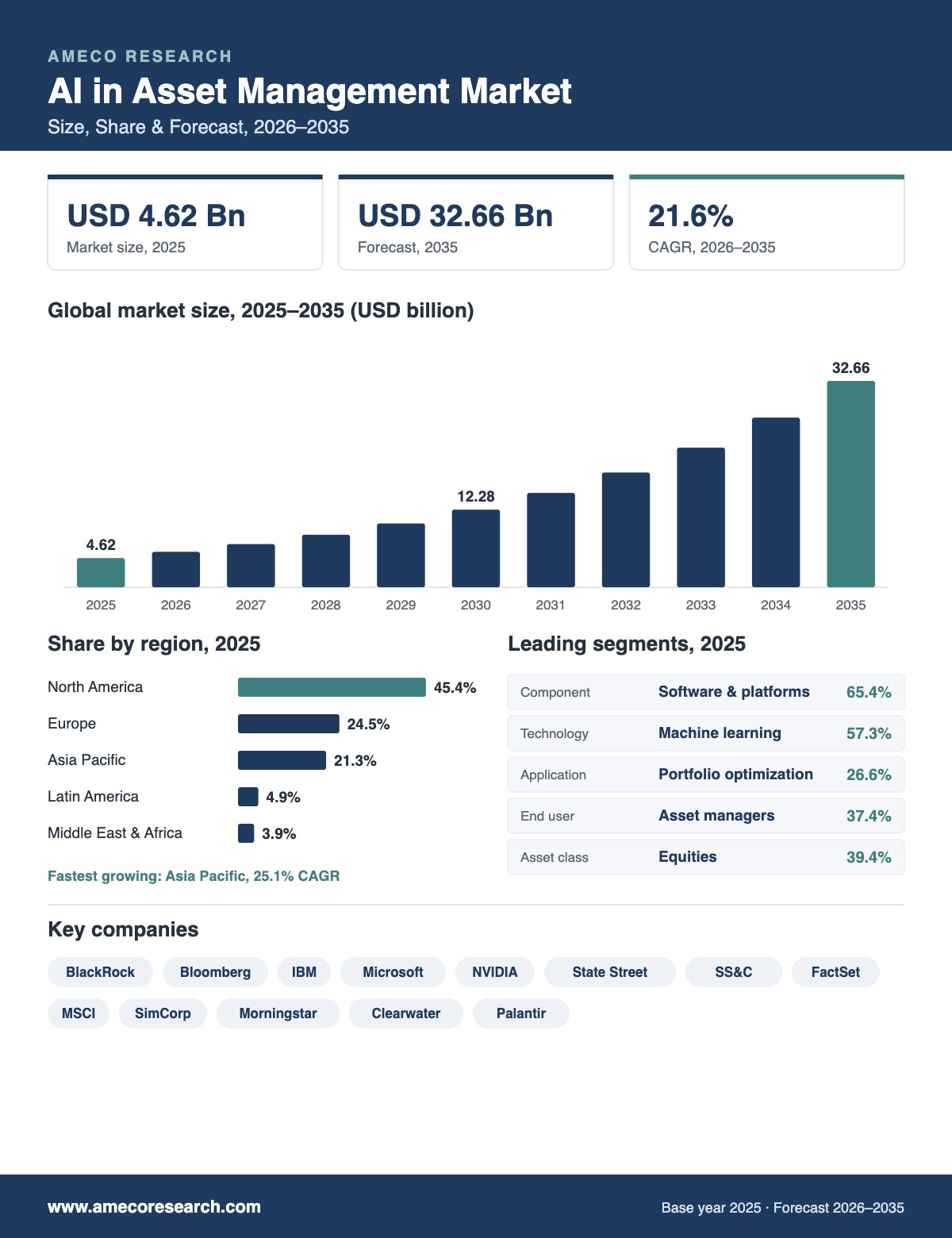
The global AI in asset management market size was valued at USD 4.62 billion in 2025 and is projected to reach USD 32.66 billion by 2035, growing at a CAGR of 21.6% from 2026 to 2035. The market is estimated at USD 5.62 billion in 2026, with North America holding the largest share and Asia Pacific registering the fastest growth.
AI in asset management refers to the use of artificial intelligence, including machine learning, natural language processing, generative AI and AI agents, by investment firms to research markets, build and rebalance portfolios, manage risk, execute trades, meet compliance requirements, run back-office operations and serve clients. The market covers AI software and platforms, managed services and professional services sold to asset managers, hedge funds, wealth managers, pension funds, insurers and private market firms.
Investment firms face fee pressure, growing data volumes and rising client expectations for personalized, transparent service. AI helps them process vast amounts of market and alternative data, find signals faster, automate manual workflows and scale advice. Adoption has moved from experimental quant strategies into mainstream operations, with generative AI copilots and AI agents now spreading across research, portfolio management and client reporting.
AI in Asset Management Market Key Takeaways
 Infographic: AI in Asset Management Market Size, Share, Trends & Growth Opportunities Forecast to 2026 - 2035 | Ameco Research
AI in Asset Management Market Report Scope
| Report Attribute | Details |
| AI in Asset Management Market Size in 2025 | USD 4.62 Billion |
| AI in Asset Management Market Size in 2026 | USD 5.62 Billion |
| AI in Asset Management Market Forecast by 2035 | USD 32.66 Billion |
| AI in Asset Management Market CAGR (2026–2035) | 21.6% |
| Historical Data | 2021–2024 |
| Base Year | 2025 |
| Forecast Period | 2026–2035 |
| Largest Region | North America (45.4% share in 2025) |
| Fastest-Growing Region | Asia Pacific (25.1% CAGR) |
| Segments Covered | Component, Technology, Deployment, Application, End User, Asset Class, Organization Size (AUM) and Region |
| Regional Scope | North America, Europe, Asia Pacific, Latin America, and Middle East & Africa |
| Key Companies Profiled | BlackRock (Aladdin), Bloomberg, IBM, Microsoft, NVIDIA, State Street (Charles River Development), SS&C Technologies, FactSet, MSCI, SimCorp, Morningstar, Clearwater Analytics and Palantir Technologies |
| Report Coverage | Market size and forecast, trends, drivers, restraints, opportunities, segment and regional analysis, regulatory landscape, competitive landscape, recent developments |
How Big Is the AI in Asset Management Market in 2026?
Ameco Research estimates the AI in asset management market at USD 5.62 billion in 2026, up about 22% from USD 4.62 billion in 2025. The market is expected to reach about USD 12.28 billion by 2030 and USD 32.66 billion by 2035, as firms move AI from pilots into core investment, risk and operations workflows and shift platforms to the cloud.
| Year | AI in Asset Management Market Size (USD Billion) |
| 2025 | 4.62 |
| 2026 | 5.62 |
| 2028 | 8.31 |
| 2030 | 12.28 |
| 2032 | 18.16 |
| 2035 | 32.66 |
Latest AI in Asset Management Market Trends 2026
AI agents enter investment platforms
Platform vendors are embedding AI agents directly into front-to-back investment systems. In April 2026, SimCorp launched Agent Launchpad, an ecosystem that lets investment managers find and deploy pre-built AI agents for portfolio management, corporate actions and risk analysis inside SimCorp One, with humans keeping final decision accountability.
AI moves into core investment processes
A 2026 Mercer survey of 131 asset managers found that 55% had integrated AI into at least one investment process and another 27% were piloting it. Large managers are building in-house tools, such as BlackRock’s Asimov virtual research analyst, which scans filings, research notes and emails to surface portfolio insights.
Generative AI transforms research and reporting
Large language models are summarizing filings, earnings calls and news in seconds, drafting client commentaries and RFP responses, and helping quants write and test code. Generative AI is the fastest-growing technology segment, at about a 31.8% CAGR.
Data quality and legacy systems are the main bottlenecks
Data quality or access was a material obstacle for 69% of managers in the Mercer survey, and a 2026 BlackRock survey found that 72% of investment decision-makers use eight or more platforms across the fund lifecycle, with 56% citing legacy technology as a major constraint. This is driving investment in unified data platforms.
Rapid shift to cloud deployment
Cloud-based AI accounted for about 43.6% of revenue in 2025 and is growing at around a 26.8% CAGR, as firms adopt SaaS investment platforms, cloud data warehouses and scalable GPU compute for model training and generative AI.
Regulators set AI governance rules
Financial regulators are formalizing expectations for AI. The Monetary Authority of Singapore issued AI Risk Management Guidelines for financial institutions on October 7, 2026, taking effect in October 2027, with further guidance on agentic AI expected. The EU AI Act and other rules are pushing firms to strengthen model governance, testing and explainability.
AI in Asset Management Market Dynamics
Growth drivers
- Data-driven investment decisions: AI helps managers analyze market prices, fundamentals, news, sentiment and alternative data at a scale no human team can match.
- Fee pressure and efficiency: shrinking margins and the shift to passive investing push firms to automate research, operations and reporting.
- Portfolio automation: AI-driven optimization, rebalancing, tax management and direct indexing make customized portfolios economical at scale.
- Alternative data growth: satellite imagery, web traffic, card transactions and ESG data require machine learning to turn into investment signals.
- Client personalization: wealth managers and robo-advisors use AI to tailor advice, communication and products to individual investors.
Restraints and challenges
- Data privacy and cybersecurity: sensitive client and trading data must be protected as AI tools access more systems.
- High implementation costs: data infrastructure, integration with legacy platforms and specialist talent require significant investment.
- Model explainability: regulators, boards and clients need to understand why AI models make investment recommendations.
- Algorithmic bias and model risk: models trained on past data can fail in new market regimes or amplify biases.
- Regulatory accountability: firms remain responsible for AI-supported decisions under fiduciary and conduct rules.
Opportunities
- Personalized wealth management through AI advisors, direct indexing and hyper-personalized portfolios for mass-affluent investors.
- AI-enabled risk and compliance monitoring for real-time surveillance, stress testing and regulatory reporting.
- Generative AI for investment research that cuts analysis time and expands coverage of companies and markets.
- Private markets where AI can digitize deal sourcing, due diligence, valuation and portfolio monitoring.
- Small and mid-sized managers adopting cloud AI platforms that were previously affordable only for the largest firms.
AI in Asset Management Market Segment Analysis
By component: Why do software platforms lead?
Software and platforms accounted for 65.4% of revenue in 2025, covering AI-enabled investment management systems, analytics, research tools and model development platforms. Professional services held 22.3%, while managed services, at 12.3%, are the fastest-growing component at about a 24.3% CAGR, as firms outsource data management and AI operations.
| Component | Share (2025) | Key Highlights |
| Software & Platforms | 65.4% | Investment platforms, analytics, research and AI development tools |
| Professional Services | 22.3% | Consulting, integration, data engineering and model validation |
| Managed Services | 12.3% | Fastest-growing at 24.3% CAGR; outsourced data and AI operations |
By technology: How fast is generative AI growing?
Machine learning, including deep learning, held the largest share at 57.3% in 2025, powering quantitative signals, risk models and portfolio optimization. Natural language processing held 18.2%, while generative AI and LLMs, including AI agents, accounted for 14.6% and are the fastest-growing technology at about a 31.8% CAGR.
| Technology | Share (2025) | Key Highlights |
| Machine Learning & Deep Learning | 57.3% | Quant signals, forecasting, risk and optimization |
| Natural Language Processing | 18.2% | Sentiment, news and document analysis |
| Generative AI & LLMs (incl. AI Agents) | 14.6% | Fastest-growing at 31.8% CAGR; research, reporting and agents |
| Others | 9.9% | Computer vision, robotic process automation and knowledge graphs |
By deployment
On-premises deployment accounted for 56.4% of revenue in 2025, reflecting large firms’ in-house systems and data security requirements. Cloud-based deployment held 43.6% and is growing at about a 26.8% CAGR, expected to become the dominant model well before 2035.
| Deployment | Share (2025) | Key Highlights |
| On-Premises | 56.4% | In-house systems with tight data control |
| Cloud-Based | 43.6% | Faster-growing at 26.8% CAGR; SaaS platforms and scalable compute |
By application: Where is AI used most in asset management?
Portfolio optimization and construction led with 26.6% of revenue in 2025, followed by risk management and compliance at 19.4% and investment research and analytics at 16.8%. Client engagement and advisory, at 10.4%, is the fastest-growing application at about a 25.7% CAGR, driven by AI advisors and personalized reporting.
| Application | Share (2025) | Key Highlights |
| Portfolio Optimization & Construction | 26.6% | Allocation, rebalancing, tax and direct indexing |
| Risk Management & Compliance | 19.4% | Risk forecasting, surveillance and regulatory reporting |
| Investment Research & Analytics | 16.8% | Signal generation, alternative data and document analysis |
| Trading & Execution | 13.1% | Algorithmic execution and transaction cost analysis |
| Client Engagement & Advisory | 10.4% | Fastest-growing at 25.7% CAGR; AI advisors and reporting |
| Operations & Others | 13.7% | Reconciliation, fund accounting, ESG and fraud detection |
By end user
Traditional asset managers, including mutual fund and ETF providers, accounted for 37.4% of demand in 2025. Hedge funds held 17.2% and wealth managers 15.8%, while private equity and alternative asset managers, at 8.3%, are the fastest-growing end users at about a 24.3% CAGR as they digitize deal sourcing and portfolio monitoring.
| End User | Share (2025) | Key Highlights |
| Traditional Asset Managers | 37.4% | Mutual funds, ETFs and institutional mandates |
| Hedge Funds | 17.2% | Quant strategies and alternative data |
| Wealth Managers & Robo-Advisors | 15.8% | Personalized portfolios and AI-assisted advice |
| Pension Funds & Insurers | 13.6% | Liability-driven investing and risk analytics |
| Private Equity & Alternatives | 8.3% | Fastest-growing at 24.3% CAGR; deal sourcing and monitoring |
| Others | 7.7% | Sovereign wealth funds, endowments and family offices |
By asset class
Equities accounted for the largest share at 39.4% in 2025, given the depth of available data and the long history of quantitative equity strategies. Fixed income held 22.4%, while alternatives, at 16.3%, are the fastest-growing asset class as AI is applied to private credit, private equity, real estate and infrastructure.
| Asset Class | Share (2025) | Key Highlights |
| Equities | 39.4% | Largest; quant, fundamental and factor strategies |
| Fixed Income | 22.4% | Credit analysis, pricing and liquidity modeling |
| Alternatives | 16.3% | Fastest-growing; private markets, real assets and hedge strategies |
| Multi-Asset | 15.2% | Asset allocation and solutions portfolios |
| Others | 6.7% | Commodities, currencies and digital assets |
By organization size (AUM)
Large firms with more than USD 100 billion in assets under management accounted for 63.5% of revenue in 2025. Small and mid-sized firms held 36.5% and are growing faster, at about a 24.1% CAGR, as cloud-based AI tools lower the cost of entry.
| Organization Size | Share (2025) | Key Highlights |
| Large Firms (AUM above USD 100 Bn) | 63.5% | In-house data science teams and enterprise platforms |
| Small & Mid-Sized Firms (AUM up to USD 100 Bn) | 36.5% | Faster-growing at 24.1% CAGR; cloud AI tools |
AI in Asset Management Market Regional Analysis
| Region | Share (2025) | Outlook |
| North America | 45.4% | Largest market; growing at a 19.9% CAGR; U.S. asset managers and AI vendors |
| Europe | 24.5% | Growing at a 20.6% CAGR; EU AI Act and strong fund industry |
| Asia Pacific | 21.3% | Fastest-growing at a 25.1% CAGR; China, Japan, India, Singapore, Australia |
| Latin America | 4.9% | Digital investment platforms in Brazil and Mexico |
| Middle East & Africa | 3.9% | Sovereign wealth funds and Gulf financial centers |
Why does North America dominate the AI in asset management market?
North America accounted for about 45.4% of global revenue in 2025. The United States is home to the world’s largest asset managers, hedge funds and wealth platforms, as well as leading AI and investment technology providers such as BlackRock, Microsoft, NVIDIA, IBM, Bloomberg, FactSet, MSCI, Morningstar, State Street and Clearwater Analytics. Deep capital markets and abundant data support early, large-scale AI adoption.
What makes Asia Pacific the fastest-growing region?
Asia Pacific held about 21.3% of the market in 2025 and is forecast to grow at a 25.1% CAGR through 2035, raising its share significantly by 2035. Rapid wealth creation, booming retail investing in India and China, the growth of digital wealth platforms, Japan’s asset management reforms and Singapore’s and Hong Kong’s fintech ecosystems are driving demand. Regulators such as the Monetary Authority of Singapore are also setting clear rules for responsible AI use.
How is Europe developing?
Europe represented about 24.5% of revenue in 2025 and is expected to grow at around a 20.6% CAGR. Large asset management hubs in the U.K., France, Germany, Switzerland, Luxembourg and the Nordics are adopting AI for research, ESG analysis and operations, while the EU AI Act and supervisory expectations are shaping how firms govern and document their models.
AI in Asset Management Market Segmentation
AI in Asset Management Market Leading Companies
The AI in asset management market includes investment management platform providers, financial data and analytics firms, cloud and AI technology companies, and asset managers that build and license their own AI tools. Competition centers on data quality and coverage, integration across the investment lifecycle, generative AI and agent capabilities, model governance and explainability, and security.
BlackRock (Aladdin) · Bloomberg · IBM · Microsoft · NVIDIA · State Street (Charles River Development) · SS&C Technologies · FactSet · MSCI · SimCorp · Morningstar · Clearwater Analytics · Palantir Technologies
Recent developments
- October 2026: The Monetary Authority of Singapore issued AI Risk Management Guidelines for financial institutions, taking effect on October 7, 2027, with phased implementation of some sections through October 2028.
- April 2026: SimCorp launched Agent Launchpad, an ecosystem for discovering and deploying AI agents for portfolio management, corporate actions and risk analysis within its SimCorp One platform.
- 2026: A Mercer survey of 131 asset managers found that 55% had integrated AI into at least one investment process, while 69% cited data quality or access as a material obstacle.
- June 2025: BlackRock revealed Asimov, an AI research platform that acts as a virtual investment analyst for its fundamental equity business, scanning filings, research notes and emails.
AI in Asset Management Market: Frequently Asked Questions
How big is the AI in asset management market?
The global AI in asset management market was valued at USD 4.62 billion in 2025 and is estimated at USD 5.62 billion in 2026. Ameco Research projects it to reach USD 32.66 billion by 2035, growing at a CAGR of 21.6% from 2026 to 2035.
What is the growth rate of the AI in asset management market?
The market is expected to grow at a CAGR of 21.6% between 2026 and 2035, about seven times its 2025 size, as asset managers expand machine learning, generative AI and AI agents across research, portfolio construction, risk, operations and client service.
How is AI used in asset management?
Asset managers use AI to analyze market and alternative data, generate investment ideas, optimize and rebalance portfolios, forecast risk, execute trades, monitor compliance, automate operations such as reconciliation and reporting, and personalize client advice. Generative AI and AI agents are increasingly used to summarize research, draft reports and handle routine investment workflows.
What is generative AI used for in investment management?
Generative AI and large language models are used to read and summarize company filings, earnings calls and news, answer analyst questions, draft client reports and commentary, write code for quantitative models and power AI agents that complete multi-step tasks. It is the fastest-growing technology in the market at about a 31.8% CAGR.
How many asset managers use AI?
AI adoption is now widespread. A 2026 Mercer survey of 131 asset managers found that 55% had integrated AI into at least one investment process, 27% were at pilot or proof-of-concept stage and 18% had not yet integrated AI. Data quality and access were the biggest obstacles, cited by 69% of managers.
What are the risks of AI in asset management?
Key risks include poor data quality, limited explainability of complex models, algorithmic bias, overfitting to past market conditions, cybersecurity and data privacy, and regulatory accountability for AI-supported decisions. Regulators such as the Monetary Authority of Singapore have issued AI risk management guidelines that require strong governance, testing and human oversight.
Which region leads the AI in asset management market?
North America leads with about 45.4% of global revenue in 2025, driven by the large U.S. asset management industry and leading AI and fintech providers. Asia Pacific is the fastest-growing region at about a 25.1% CAGR, supported by rapid wealth growth and digital investment platforms in China, India, Japan, Singapore and Australia.
Who are the key players in the AI in asset management market?
Leading companies include BlackRock (Aladdin), Bloomberg, IBM, Microsoft, NVIDIA, State Street (Charles River Development), SS&C Technologies, FactSet, MSCI, SimCorp, Morningstar, Clearwater Analytics and Palantir Technologies.