Aircraft Recycling Market Size and Growth Opportunities and Forecast till 2026 - 2035
Aircraft Recycling Market Size, Share & Trends Report, 2026–2035
LAST UPDATED: OCTOBER 2026
The global Aircraft Recycling Market size was valued at USD 6.0 billion in 2025 and is projected to reach USD 13.8 billion by 2035, growing at a CAGR of 8.54% from 2026 to 2035. Growth is driven by a large wave of aircraft reaching retirement age, strong demand for used serviceable material (USM) as airlines face engine and spare parts shortages, airline sustainability goals, and better methods to recover aluminum, alloys and composites from end-of-life aircraft.
Aircraft recycling covers the decommissioning, disassembly and dismantling of retired aircraft to recover reusable parts and recyclable materials. Engines, landing gear, avionics, auxiliary power units and other components are removed, inspected and certified for resale as used serviceable material, while airframes are broken down into aluminum, other metals and alloys, glass, plastics and composites. Industry best practices, such as those of the Aircraft Fleet Recycling Association (AFRA), guide safe and environmentally responsible dismantling.
Aircraft Recycling Market Key Takeaways
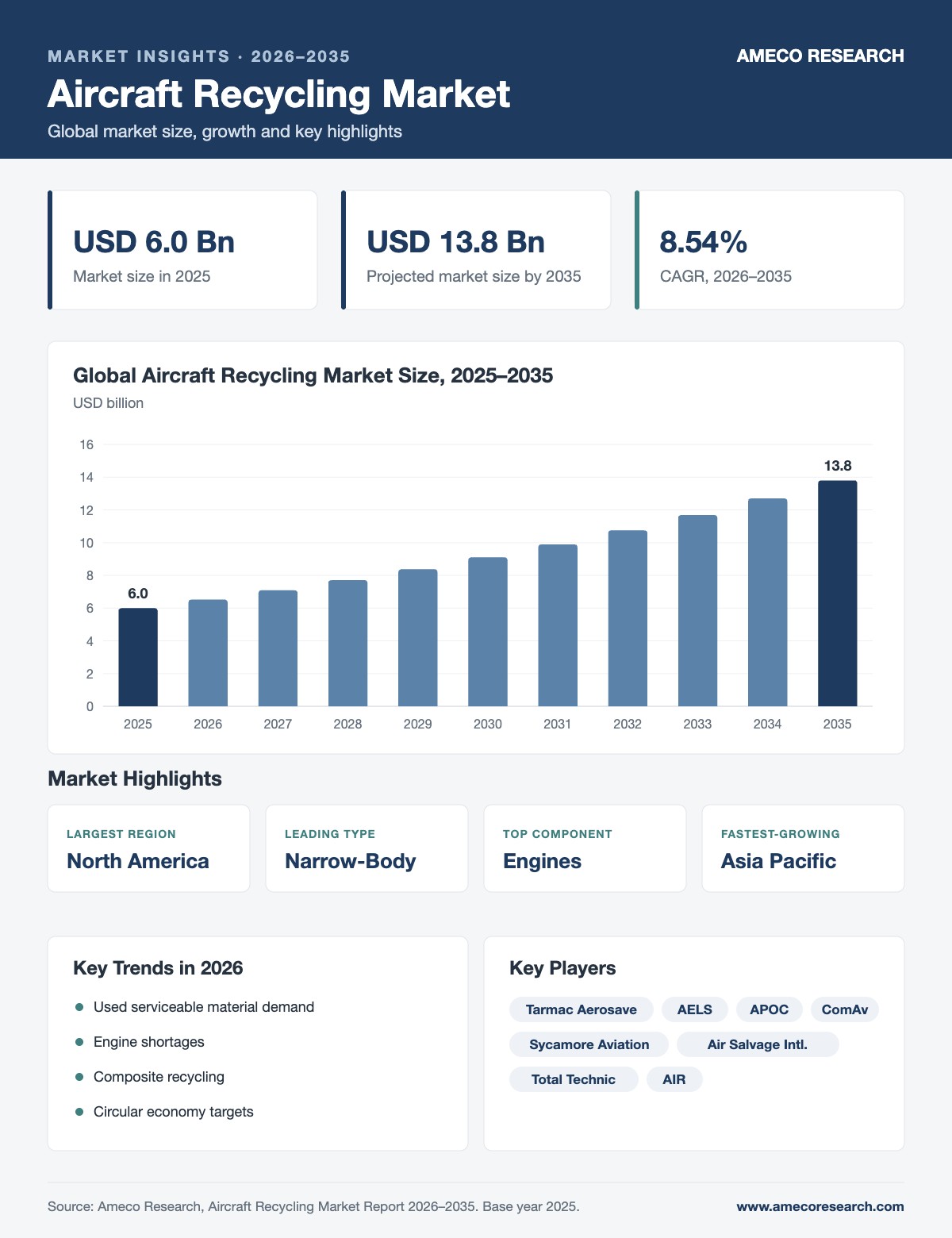 Infographic: Aircraft Recycling Market Size and Growth Opportunities and Forecast till 2026 - 2035 | Ameco Research
Aircraft Recycling Market Report Scope
| Report Attribute | Details |
| Aircraft Recycling Market Size in 2025 | USD 6.0 Billion |
| Aircraft Recycling Market Forecast by 2035 | USD 13.8 Billion |
| Aircraft Recycling Market CAGR (2026–2035) | 8.54% |
| Analysis Period | 2023–2035 |
| Base Year | 2025 |
| Forecast Period | 2026–2035 |
| Segments Covered | by Aircraft Type, by Product - Material, by Product - Component, and By Region |
| Regional Scope | North America, Europe, Asia Pacific, Latin America, and Middle East & Africa |
| Key Companies Profiled | Aircraft Part Out Company (APOC), Sycamore Aviation, Aircraft End-of-Life Solutions (AELS), ComAv - Commercial Aviation Services, Aviation International Recycling, Air Salvage International Ltd, Total Technic Ltd., and Tarmac Aerosave |
| Report Coverage | Market Trends, Drivers, Restraints, Opportunities, Competitive Analysis, Player Profiling, Regulation Analysis |
Aircraft Recycling Market Size Forecast, 2023–2035
The table below shows the year-by-year size of the global aircraft recycling market. Revenue is expected to grow about 2.3 times between 2025 and 2035, reaching roughly USD 9.1 billion by 2030.
| Year | Market Size (USD Billion) |
| 2023 (historical) | 5.1 |
| 2024 (historical) | 5.5 |
| 2025 (base year) | 6.0 |
| 2026 (forecast) | 6.5 |
| 2027 (forecast) | 7.1 |
| 2028 (forecast) | 7.7 |
| 2029 (forecast) | 8.4 |
| 2030 (forecast) | 9.1 |
| 2031 (forecast) | 9.9 |
| 2032 (forecast) | 10.7 |
| 2033 (forecast) | 11.7 |
| 2034 (forecast) | 12.7 |
| 2035 (forecast) | 13.8 |
Latest Aircraft Recycling Market Trends (2026)
Used serviceable material demand
Supply chain delays for new parts and engines have increased demand for certified used parts, raising the value of engines, landing gear and other components recovered from retired aircraft.
Engine shortages and retirement timing
Engine inspection programs and delays in new aircraft deliveries have led airlines to keep some older aircraft flying longer, while engines from retired aircraft are in high demand as spares.
Composite recycling
Newer aircraft such as the Boeing 787 and Airbus A350 use large amounts of carbon fiber composites, and the industry is developing methods to recover and reuse these materials at end of life.
Circular economy and sustainability
Airlines, lessors and manufacturers are setting targets to reuse or recycle a high share of aircraft weight, and designing future aircraft with end-of-life recovery in mind.
Certified and standardized dismantling
AFRA accreditation and best-practice standards help ensure parts traceability, safe handling of hazardous materials and environmental compliance.
Lessor-driven part-outs
Aircraft lessors increasingly decide when to part out older aircraft based on component values, making the market sensitive to parts prices and lease demand.
Aircraft Recycling Market Dynamics
Growth drivers
- Large number of aircraft scheduled for retirement over the next two decades
- Strong demand for used serviceable material and spare engines
- Airline goals to be more environmentally friendly while cutting costs
- Value recovery from aluminum, alloys and other materials
- Industry standards for certified dismantling
Restraints and challenges
- Delayed retirements when airlines keep older aircraft flying
- Difficulty recycling composite materials
- Handling of hazardous materials and environmental rules
- Volatile scrap metal and used parts prices
Opportunities
Key opportunities include composite recovery technologies, engine teardown and parts trading, recycling hubs in Asia Pacific and the Middle East, and partnerships between lessors, airlines and dismantlers.
Aircraft Recycling Market Segment Analysis
By aircraft type
The market is segmented into narrow-body and wide-body aircraft. Narrow-body aircraft account for the larger share because they make up most of the global fleet and retirements, while wide-body aircraft offer high-value engines and components.
By product
Products include materials (aluminum, other metals and alloys, and other materials) and components (landing gear, avionics, engines and others). Engines are the most valuable components, while aluminum is the main recycled material by weight.
Aircraft Recycling Market Regional Analysis
North America holds the largest share and is expected to keep its lead, supported by large retired fleets, aircraft storage and dismantling facilities and many parts trading companies.
Europe is a major market with certified dismantling sites in France, the U.K. and other countries. Asia Pacific is expected to grow fastest as large fleets in China, India and Southeast Asia age.
Latin America and the Middle East & Africa are smaller markets, with growing storage and teardown activity in the Middle East.
Aircraft Recycling Market Segmentation
Aircraft Recycling Market Leading Companies
The aircraft recycling market includes aircraft storage and dismantling companies, parts traders, MRO providers and material recyclers. Companies compete on certified dismantling capability, parts traceability, storage capacity, location and relationships with airlines and lessors. Key players profiled in this report include Aircraft Part Out Company (APOC), Sycamore Aviation, Aircraft End-of-Life Solutions (AELS), ComAv - Commercial Aviation Services, Aviation International Recycling, Air Salvage International Ltd, Total Technic Ltd., and Tarmac Aerosave.
Aircraft Part Out Company (APOC)Sycamore AviationAircraft End-of-Life Solutions (AELS)ComAv - Commercial Aviation ServicesAviation International RecyclingAir Salvage International LtdTotal Technic Ltd.Tarmac Aerosave
Key Questions Answered in This Report
- What is the size of the aircraft recycling market in 2025, and how large will it be by 2030 and 2035?
- What are the main growth drivers, restraints and opportunities through 2035?
- Which by aircraft type and by product - material segments will grow the fastest?
- Which regions and countries offer the largest and fastest-growing opportunities?
- How are used part demand, engine shortages and composite recycling shaping aircraft recycling in 2026?
- Who are the leading companies, and what strategies are they using to compete?
Research Methodology
This report combines primary and secondary research. Primary research includes interviews with dismantlers, parts traders, airlines, aircraft lessors and industry associations. Secondary research covers company annual reports, investor presentations, government and trade association data, patent filings and industry publications. Market size is estimated using both bottom-up (company revenue and production data) and top-down (end-use demand) methods, and results are cross-checked through data triangulation before forecasts are built for 2026–2035.
Related Reports
- Aircraft Engine Market Report
- Narrow-Body Aircraft Market Report
- Air Traffic Control Market Report
- Artificial Intelligence in Aviation Market Report
- Unmanned Ground Vehicles Market Report
Aircraft Recycling Market: Frequently Asked Questions
How big is the aircraft recycling market?
The global aircraft recycling market was valued at USD 6.0 billion in 2025 and is expected to reach USD 13.8 billion by 2035.
What is the growth rate of the aircraft recycling market?
The aircraft recycling market is projected to grow at a CAGR of 8.54% from 2026 to 2035.
What will the aircraft recycling market be worth in 2030?
The aircraft recycling market is projected to reach about USD 9.1 billion in 2030, growing at a CAGR of 8.54%.
What is driving growth in the aircraft recycling market?
Key drivers are the large number of aircraft due for retirement, demand for used serviceable parts and engines, airline sustainability goals and value recovery from materials.
What is aircraft recycling?
Aircraft recycling is the dismantling of retired aircraft to recover reusable parts, such as engines and landing gear, and recyclable materials such as aluminum and alloys.
Which region leads the aircraft recycling market?
North America holds the largest share, while Asia Pacific is expected to grow fastest.
Which segment holds the largest share of the aircraft recycling market?
Narrow-body aircraft account for the larger share, and engines are the most valuable recovered components.
What are the latest trends in the aircraft recycling market?
The main 2026 trends are used serviceable material demand, engine shortages and retirement timing, composite recycling, circular economy and sustainability, certified and standardized dismantling and lessor-driven part-outs.
What are the main challenges in the aircraft recycling market?
The main challenges are delayed retirements, composite recycling, hazardous material handling and volatile scrap and parts prices.
What is used serviceable material?
Used serviceable material (USM) is aircraft parts removed from retired aircraft, inspected and certified so they can be installed on other aircraft, often at lower cost than new parts.
Who are the key players in the aircraft recycling market?
Leading companies include Aircraft Part Out Company (APOC), Sycamore Aviation, Aircraft End-of-Life Solutions (AELS), ComAv - Commercial Aviation Services, Aviation International Recycling, Air Salvage International Ltd, Total Technic Ltd., and Tarmac Aerosave.