Automotive Operating Systems Market Size and Growth Opportunities and Forecast till 2026 - 2035
Automotive Operating Systems Market Size, Share & Trends Report, 2026–2035
LAST UPDATED: OCTOBER 2026
The global Automotive Operating Systems Market size was valued at USD 8.52 billion in 2025 and is projected to reach USD 34.87 billion by 2035, growing at a CAGR of 15% from 2026 to 2035. Growth is driven by the shift to software-defined vehicles, centralized vehicle computers, connected infotainment and ADAS, electric vehicle platforms, and over-the-air software updates that make the operating system a core part of vehicle value.
An automotive operating system is the software layer that runs on a vehicle's electronic control units (ECUs) and central computers, managing hardware resources and hosting applications for infotainment, instrument clusters, ADAS, powertrain, body control and connectivity. Examples include Linux-based platforms, Android Automotive, QNX, real-time operating systems such as VxWorks, and standards-based software such as AUTOSAR. Automakers increasingly combine these into in-house vehicle software platforms.
Automotive Operating Systems Market Key Takeaways
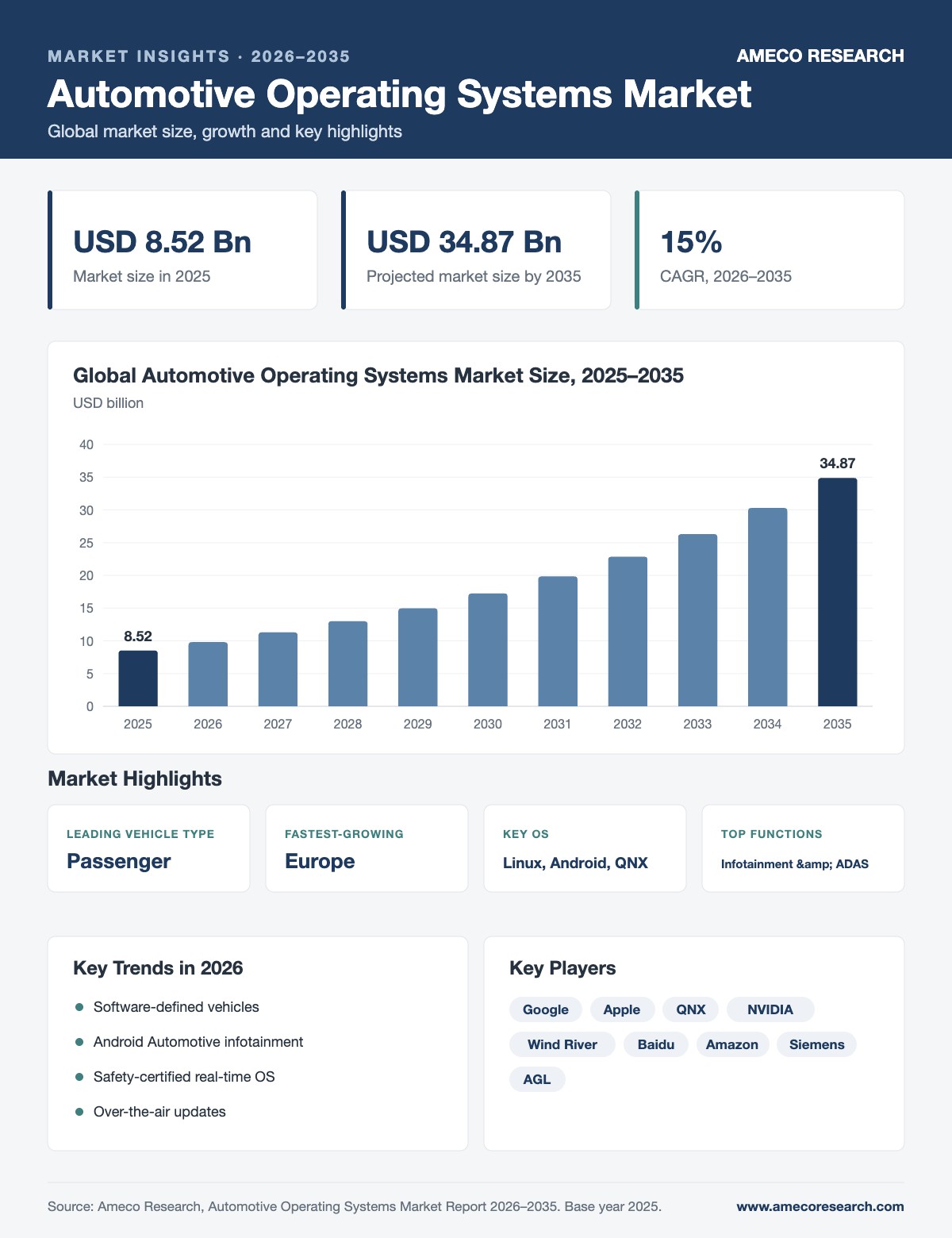 Infographic: Automotive Operating Systems Market Size and Growth Opportunities and Forecast till 2026 - 2035 | Ameco Research
Automotive Operating Systems Market Report Scope
| Report Attribute | Details |
| Automotive Operating Systems Market Size in 2025 | USD 8.52 Billion |
| Automotive Operating Systems Market Forecast by 2035 | USD 34.87 Billion |
| Automotive Operating Systems Market CAGR (2026–2035) | 15% |
| Analysis Period | 2023–2035 |
| Base Year | 2025 |
| Forecast Period | 2026–2035 |
| Segments Covered | by OS Type, by Vehicle Type, by ECU Function, and By Region |
| Regional Scope | North America, Europe, Asia Pacific, Latin America, and Middle East & Africa |
| Key Companies Profiled | AUTOSAR, Apple Inc., Google LLC, Amazon.com, Inc., Automotive Grade Linux, Baidu, Inc., ArcherMind Technology Co., Ltd, QNX (BlackBerry), NVIDIA Corporation, Wind River (VxWorks), Siemens, and COVESA (formerly GENIVI Alliance) |
| Report Coverage | Market Trends, Drivers, Restraints, Opportunities, Competitive Analysis, Player Profiling, Regulation Analysis |
Automotive Operating Systems Market Size Forecast, 2023–2035
The table below shows the year-by-year size of the global automotive operating systems market. Revenue is expected to grow about 4.1 times between 2025 and 2035, reaching roughly USD 17.24 billion by 2030.
| Year | Market Size (USD Billion) |
| 2023 (historical) | 6.43 |
| 2024 (historical) | 7.40 |
| 2025 (base year) | 8.52 |
| 2026 (forecast) | 9.81 |
| 2027 (forecast) | 11.29 |
| 2028 (forecast) | 13.00 |
| 2029 (forecast) | 14.97 |
| 2030 (forecast) | 17.24 |
| 2031 (forecast) | 19.84 |
| 2032 (forecast) | 22.85 |
| 2033 (forecast) | 26.31 |
| 2034 (forecast) | 30.29 |
| 2035 (forecast) | 34.87 |
Latest Automotive Operating Systems Market Trends (2026)
Software-defined vehicles
Automakers are moving from many separate ECUs to centralized and zonal computing architectures, with a common operating system that lets features be added and updated through software across the vehicle's life.
Android Automotive in infotainment
More automakers are using Android Automotive OS for infotainment, either with Google built-in services or with their own app ecosystems based on the open-source project, while others keep in-house platforms to retain control of data and user experience.
Real-time and safety-certified OS
ADAS, cockpit domain controllers and powertrain systems need real-time, safety-certified operating systems and hypervisors that meet ISO 26262 functional safety requirements, supporting QNX, VxWorks and certified Linux variants.
In-house automaker platforms
Several automakers are building their own vehicle operating systems and software units to control the user experience, reduce supplier dependence and create new software revenue.
Over-the-air updates and cybersecurity
Over-the-air updates are becoming standard, and regulations such as UN R155 and R156 on cybersecurity and software updates shape how operating systems are designed and maintained.
EV and connected platforms
Electric vehicles are typically built on newer electrical architectures, which makes them early adopters of centralized operating systems, connected apps and software features.
Automotive Operating Systems Market Dynamics
Growth drivers
- Growth of connected cars and smart infotainment systems
- Rising adoption of ADAS and autonomous driving features
- Shift to software-defined vehicle architectures
- Government focus on passenger safety and electric vehicles
- Demand for IoT integration and user-friendly in-vehicle apps
Restraints and challenges
- High development, validation and safety certification costs
- Cybersecurity risks in connected vehicles
- Automaker concerns over dependency and data ownership with third-party platforms
- Fragmentation across hardware and software standards
Opportunities
Key opportunities include centralized vehicle computers, Android Automotive and open-source platforms, safety-certified hypervisors, software subscription features, and growth in EVs in Europe, China and North America.
Automotive Operating Systems Market Segment Analysis
By OS type
The market is segmented into Linux, Android, QNX, Windows Embedded Automotive 7 and others. Linux and Android are widely used for infotainment, while QNX and other real-time systems are strong in safety-critical and digital cockpit applications.
By vehicle type
Vehicle types include passenger vehicles and commercial vehicles. Passenger vehicles hold more than half of the market, supported by demand for connected features in new cars.
By ECU function
ECU functions include body comfort & control, powertrain, communication, infotainment, and safety & ADAS. Infotainment and safety & ADAS are the fastest-growing functions.
Automotive Operating Systems Market Regional Analysis
Europe is expected to be the fastest-growing region, supported by strong automotive R&D in Germany, EV adoption and software-defined vehicle programs at European automakers.
Asia Pacific is a large market led by China, where fast EV growth and local software platforms drive adoption, along with Japan and South Korea. North America is a key market for connected and autonomous vehicle technology.
Latin America and the Middle East & Africa are smaller markets, with growth tied to connected vehicle adoption.
Automotive Operating Systems Market Segmentation
Automotive Operating Systems Market Leading Companies
The automotive operating systems market includes technology companies, embedded and real-time OS vendors, chipmakers, open-source alliances and automakers' own software units. Players compete on safety certification, developer ecosystems, app and service integration, performance and long-term software support. Key players profiled in this report include AUTOSAR, Apple Inc., Google LLC, Amazon.com, Inc., Automotive Grade Linux, Baidu, Inc., ArcherMind Technology Co., Ltd, QNX (BlackBerry), NVIDIA Corporation, Wind River (VxWorks), Siemens, and COVESA (formerly GENIVI Alliance).
AUTOSARApple Inc.Google LLCAmazon.com, Inc.Automotive Grade LinuxBaidu, Inc.ArcherMind Technology Co., LtdQNX (BlackBerry)NVIDIA CorporationWind River (VxWorks)SiemensCOVESA (formerly GENIVI Alliance)
Key Questions Answered in This Report
- What is the size of the automotive operating systems market in 2025, and how large will it be by 2030 and 2035?
- What are the main growth drivers, restraints and opportunities through 2035?
- Which by os type and by vehicle type segments will grow the fastest?
- Which regions and countries offer the largest and fastest-growing opportunities?
- How are software-defined vehicles, Android Automotive and over-the-air updates shaping the market in 2026?
- Who are the leading companies, and what strategies are they using to compete?
Research Methodology
Ameco Research built this forecast from a mix of primary and secondary research. Analysts spoke with automakers, Tier 1 suppliers, operating system and software vendors, and chipmakers to validate pricing, volumes and demand trends, and reviewed company filings, trade statistics, regulatory documents and industry publications. The automotive operating systems market size was estimated with bottom-up and top-down approaches and validated through data triangulation, with 2025 as the base year and forecasts for 2026–2035.
Related Reports
- Automotive Electric HVAC Compressor Market Report
- Automotive Turbocharger Market Report
- Automotive Digital Cockpit Market Report
- Automotive Collision Repair Market Report
- Automotive Switches Market Report
Automotive Operating Systems Market: Frequently Asked Questions
How big is the automotive operating systems market?
The global automotive operating systems market was valued at USD 8.52 billion in 2025 and is expected to reach USD 34.87 billion by 2035.
What is the growth rate of the automotive operating systems market?
The automotive operating systems market is projected to grow at a CAGR of 15% from 2026 to 2035.
What will the automotive operating systems market be worth in 2030?
The automotive operating systems market is projected to reach about USD 17.24 billion in 2030, growing at a CAGR of 15%.
What is driving growth in the automotive operating systems market?
Key drivers are connected cars and infotainment, ADAS and autonomous features, software-defined vehicle architectures, and government focus on safety and EVs.
What is automotive operating systems?
An automotive operating system is the software platform that runs a vehicle's ECUs and central computers and hosts applications for infotainment, ADAS, powertrain and connectivity.
Which region leads the automotive operating systems market?
Europe is expected to be the fastest-growing region, while Asia Pacific, led by China, and North America are large markets.
Which segment holds the largest share of the automotive operating systems market?
Passenger vehicles hold more than half of the market, and infotainment and safety & ADAS are the fastest-growing ECU functions.
What are the latest trends in the automotive operating systems market?
The main 2026 trends are software-defined vehicles, android Automotive in infotainment, real-time and safety-certified OS, in-house automaker platforms, over-the-air updates and cybersecurity and eV and connected platforms.
What are the main challenges in the automotive operating systems market?
The main challenges are high development and safety certification costs, cybersecurity risks, concerns over data ownership and platform dependency, and fragmented standards.
What is a software-defined vehicle?
A software-defined vehicle is one whose features and functions are mainly controlled by software running on central computers, so they can be updated or added over the air during the vehicle's life.
Who are the key players in the automotive operating systems market?
Leading companies include AUTOSAR, Apple Inc., Google LLC, Amazon.com, Inc., Automotive Grade Linux, Baidu, Inc., ArcherMind Technology Co., Ltd, QNX (BlackBerry), NVIDIA Corporation, Wind River (VxWorks), Siemens, and COVESA (formerly GENIVI Alliance).