Automotive Seat Market Size and Growth Opportunities and Forecast till 2026 - 2035
Automotive Seat Market Size, Share & Trends Report, 2026–2035
LAST UPDATED: OCTOBER 2026
The global Automotive Seat Market size was valued at USD 57.69 billion in 2025 and is projected to reach USD 84.57 billion by 2035, growing at a CAGR of 3.9% from 2026 to 2035. Growth is driven by steady global vehicle production, rising demand for comfort features such as powered, heated, ventilated and massage seats, the shift to electric vehicles with new cabin layouts, and stricter occupant-safety requirements.
An automotive seat is a safety-critical vehicle component that supports, protects and keeps occupants comfortable. A modern seat combines a metal or composite frame, foam cushions, trim covers in fabric, leather or synthetic materials, and mechanisms such as recliners, tracks and height adjusters. Many seats now also integrate electronics, including power motors, heating and ventilation, occupant sensors, side airbags and seatbelt components.
Automotive Seat Market Key Takeaways
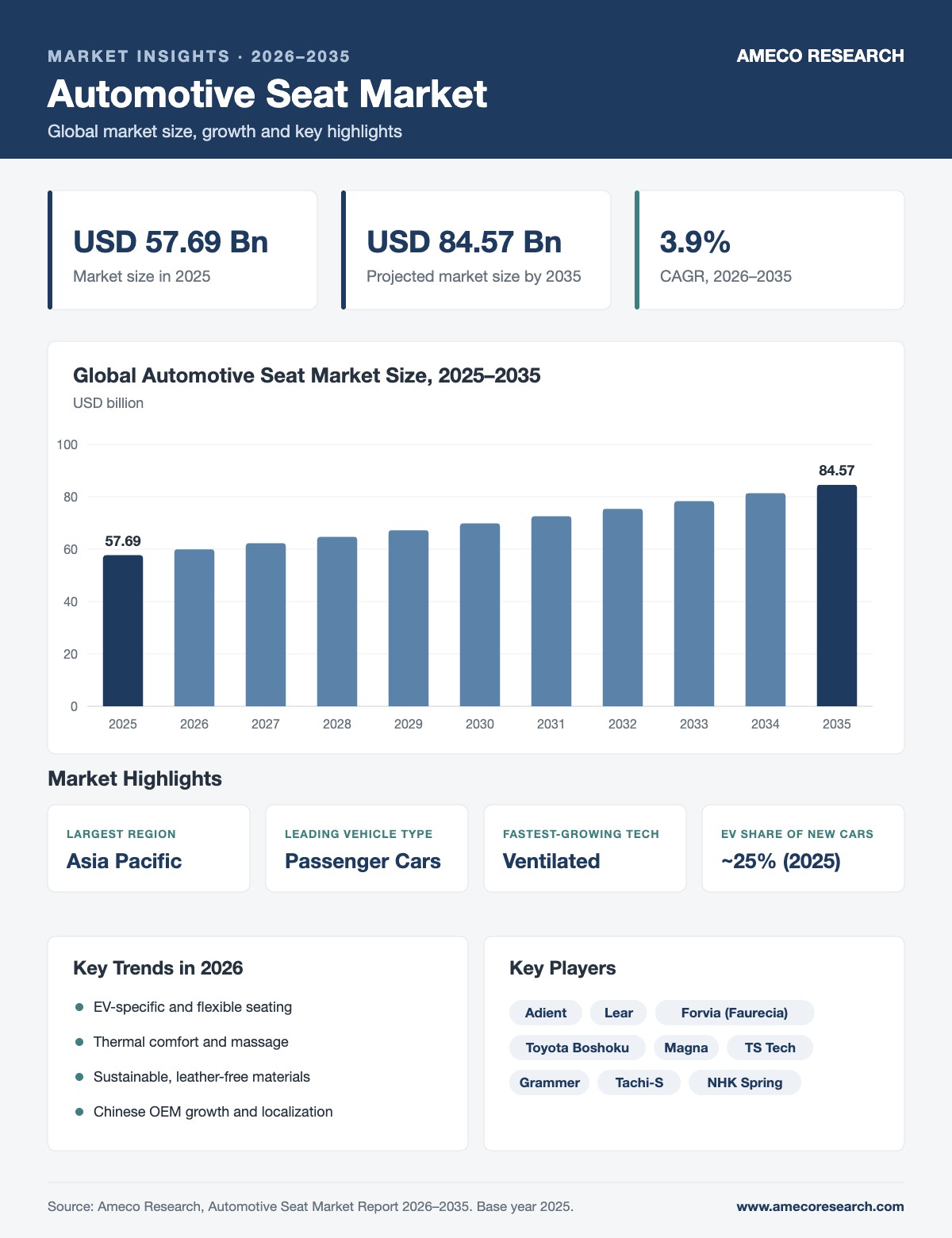 Infographic: Automotive Seat Market Size and Growth Opportunities and Forecast till 2026 - 2035 | Ameco Research
Automotive Seat Market Report Scope
| Report Attribute | Details |
| Automotive Seat Market Size in 2025 | USD 57.69 Billion |
| Automotive Seat Market Forecast by 2035 | USD 84.57 Billion |
| Automotive Seat Market CAGR (2026–2035) | 3.9% |
| Analysis Period | 2023–2035 |
| Base Year | 2025 |
| Forecast Period | 2026–2035 |
| Segments Covered | By Material, By Technology, By Vehicle Type, and By Region |
| Regional Scope | North America, Europe, Asia Pacific, Latin America, and Middle East & Africa |
| Key Companies Profiled | Adient plc, Lear Corporation, Forvia (Faurecia), Toyota Boshoku Corporation, Magna International Inc., Grupo Antolin, TS Tech Co., Ltd., Grammer AG, Tachi-S Co., Ltd., NHK Spring Co., Ltd., Gentherm, and Isringhausen GmbH & Co. KG |
| Report Coverage | Market Trends, Drivers, Restraints, Opportunities, Competitive Analysis, Player Profiling, Regulation Analysis |
Latest Automotive Seat Market Trends (2026)
EVs reshape seat design
According to the IEA, global electric car sales passed 20 million in 2025, about a quarter of all new cars. Flat EV floors and larger cabins allow thinner, lighter seats, longer seat tracks, rotating and reclining positions, and more lounge-style layouts. Lighter seats also help extend driving range.
Thermal comfort and wellness features spread
Heated, ventilated and massage seats are moving from luxury models into mainstream vehicles. Because they warm and cool the body directly, they use less energy than heating or cooling the whole cabin, which matters for EV range. Lear's ComfortMax Seat, adopted by GM from 2025, heats and cools up to 40% faster and can cut part count by up to 50%.
Sustainable and leather-free materials
Automakers are using more recycled PET fabrics, bio-based and recycled foams and synthetic leather alternatives to cut carbon footprints and meet buyer demand for animal-free interiors. Seat makers are also designing seats that are easier to take apart and recycle.
Chinese automakers and localization
Chinese automakers are winning share at home and abroad, and seat suppliers are adjusting. Adient said about 70% of its new China business wins come from local automakers, while tariffs and onshoring are moving more seat production closer to vehicle plants in North America.
Smart seats and occupant sensing
Seats increasingly include sensors that detect occupants, posture and seatbelt use, supporting airbag deployment, child-presence detection and driver-monitoring systems. Memory settings, app-controlled adjustment and haptic alerts are becoming more common.
Safety rules for new seating positions
Crash-test programs such as Euro NCAP are expanding far-side impact, whiplash and rear-occupant assessments. As seats recline and rotate further, suppliers are building more belts and airbags directly into the seat structure.
Automotive Seat Market Dynamics
Growth drivers
- Steady global vehicle production and rising car ownership in emerging markets
- Growing demand for comfort, convenience and premium seat features
- EV adoption, which opens the door to new seat layouts and lighter designs
- Stricter occupant safety standards and crash-test requirements
- Higher seat content per vehicle as electronics and sensors are added
Restraints and challenges
- Cost and complexity of meeting safety, emissions and sustainability rules
- Volatile prices for steel, foam chemicals and leather
- Pricing pressure from automakers and fast-growing Chinese competitors
- Exposure to cyclical vehicle production, tariffs and supply-chain disruptions
Opportunities
Key opportunities include lightweight seat structures for EVs, reconfigurable seats for future autonomous vehicles, sustainable materials, smart seats with health and wellness monitoring, and growth in emerging markets such as India, Southeast Asia and Latin America.
Automotive Seat Market Segment Analysis
By material
The market is segmented into leather, fabric and other materials. Fabric accounts for the largest volume because it is affordable, breathable and widely used in mass-market cars. Leather and synthetic leather lead in premium trims, and recycled and bio-based fabrics are growing quickly.
By technology
The market covers standard seats, powered seats, ventilated seats and others. Standard seats still account for a large share in entry-level vehicles, while powered and ventilated seats are the fastest-growing segments as comfort features become standard in mid-range models, SUVs and EVs.
By vehicle type
Passenger vehicles hold the largest share thanks to high production volumes and rising demand for comfort features. Commercial vehicles, including trucks and buses, need durable seats with suspension and ergonomic designs for drivers who spend long hours on the road.
Automotive Seat Market Regional Analysis
Asia Pacific is the largest automotive seat market, driven by high vehicle production in China, Japan, India and South Korea, a growing middle class and rapid EV adoption in China. Local suppliers and joint ventures play a large role in the region.
North America is driven by strong demand for SUVs and pickup trucks with large, feature-rich seats and by onshoring of seat production. Europe leads in premium vehicles, sustainable materials and strict safety standards.
Latin America and the Middle East & Africa offer growth from rising vehicle ownership, with demand for durable, easy-to-maintain seats and heat-resistant, ventilated designs in hot climates.
Automotive Seat Market Segmentation
Automotive Seat Market Leading Companies
The automotive seat market is concentrated among a few large global tier-1 suppliers, led by Adient and Lear, alongside Japanese suppliers tied to major automakers and fast-growing Chinese seat makers. Companies compete on cost, comfort features, safety performance, weight, sustainability and long-term automaker contracts. Key players profiled in this report include Adient plc, Lear Corporation, Forvia (Faurecia), Toyota Boshoku Corporation, Magna International Inc., Grupo Antolin, TS Tech Co., Ltd., Grammer AG, Tachi-S Co., Ltd., NHK Spring Co., Ltd., Gentherm, and Isringhausen GmbH & Co. KG.
AdientLearForvia (Faurecia)Toyota BoshokuMagnaGrupo AntolinTS TechGrammerTachi-SNHK SpringGenthermIsringhausen
Recent developments
Automotive Seat Market: Frequently Asked Questions
How big is the automotive seat market?
The global automotive seat market was valued at USD 57.69 billion in 2025 and is expected to reach USD 84.57 billion by 2035.
What is the growth rate of the automotive seat market?
The automotive seat market is projected to grow at a CAGR of 3.9% from 2026 to 2035.
What is driving growth in the automotive seat market?
Key drivers are steady vehicle production, demand for comfort features such as powered, heated and ventilated seats, the shift to EVs and stricter occupant-safety rules.
Which region leads the automotive seat market?
Asia Pacific is the largest market, led by vehicle production in China, Japan, India and South Korea.
How are electric vehicles changing car seats?
EVs favor lighter, thinner seats, flexible layouts and energy-efficient heated and ventilated seats that help preserve driving range.
What are the latest trends in automotive seats?
The main 2026 trends are EV-specific and flexible seating, thermal comfort and massage features, sustainable and leather-free materials, smart occupant sensing and the rise of Chinese automakers.
Who are the key players in the automotive seat market?
Leading companies include Adient, Lear, Forvia (Faurecia), Toyota Boshoku, Magna, TS Tech, Grammer, Tachi-S, NHK Spring and Grupo Antolin.
Related Automobile & Transportation Market Reports
- Autonomous Forklift Market Growth Opportunities and Forecast till 2030
- Automotive Aluminum Alloy Market Growth Opportunities and Forecast till 2030
- Tire Pressure Monitoring System Market Growth Opportunities and Forecast till 2030
- Automotive Cooling Fan Market Growth Opportunities and Forecast till 2030
- Anti-Lock Braking System Market Growth Opportunities and Forecast till 2030