Battery Technology Market Size and Growth Opportunities and Forecast till 2026 - 2035
Battery Technology Market Size, Share & Trends Report, 2026–2035
LAST UPDATED: OCTOBER 2026
The global Battery Technology Market size was valued at USD 140.0 billion in 2025 and is projected to reach USD 316.5 billion by 2035, growing at a CAGR of 8.5% from 2026 to 2035. Growth is driven by electric vehicles, grid-scale and home energy storage paired with solar and wind, falling lithium-ion and LFP cell prices, consumer electronics and power tools, data center backup power, and new chemistries such as sodium-ion and solid-state batteries.
Battery technology covers rechargeable and primary batteries and the systems that charge, condition and manage them. Main chemistries include lithium-ion (such as LFP and NMC), lead acid, nickel-metal hydride, nickel cadmium and emerging lithium-metal, solid-state and sodium-ion batteries. Control technologies include battery chargers, battery conditioners and smart battery management systems. Batteries power electric vehicles, energy storage systems for utilities, homes and businesses, consumer electronics, industrial equipment and backup power.
Battery Technology Market Key Takeaways
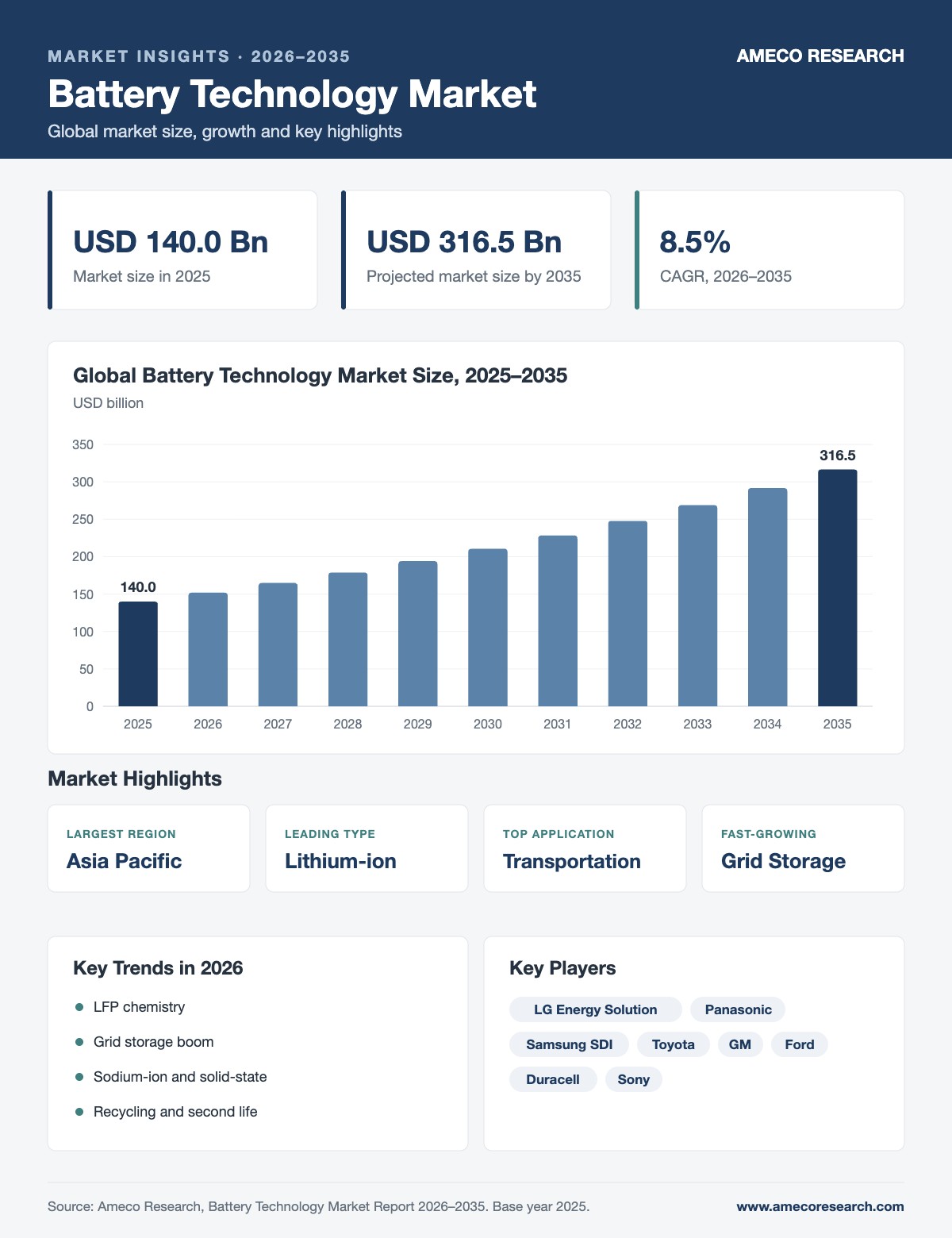 Infographic: Battery Technology Market Size and Growth Opportunities and Forecast till 2026 - 2035 | Ameco Research
Battery Technology Market Report Scope
| Report Attribute | Details |
| Battery Technology Market Size in 2025 | USD 140.0 Billion |
| Battery Technology Market Forecast by 2035 | USD 316.5 Billion |
| Battery Technology Market CAGR (2026–2035) | 8.5% |
| Analysis Period | 2023–2035 |
| Base Year | 2025 |
| Forecast Period | 2026–2035 |
| Segments Covered | by Battery Type, by Control Technology, by Application, and By Region |
| Regional Scope | North America, Europe, Asia Pacific, Latin America, and Middle East & Africa |
| Key Companies Profiled | LG Energy Solution (LG Chem), Panasonic Corporation, Samsung SDI Co. Ltd., Toyota Motor Corp., Honda Motor Co. Ltd., General Motors, Ford Motor Co., Duracell, Ever Ready, GE Vernova (GE Energy), and Sony Electronics Inc. |
| Report Coverage | Market Trends, Drivers, Restraints, Opportunities, Competitive Analysis, Player Profiling, Regulation Analysis |
Battery Technology Market Size Forecast, 2023–2035
The table below shows the year-by-year size of the global battery technology market. Revenue is expected to grow about 2.3 times between 2025 and 2035, reaching roughly USD 210.5 billion by 2030.
| Year | Market Size (USD Billion) |
| 2023 (historical) | 118.9 |
| 2024 (historical) | 129.0 |
| 2025 (base year) | 140.0 |
| 2026 (forecast) | 151.9 |
| 2027 (forecast) | 164.8 |
| 2028 (forecast) | 178.8 |
| 2029 (forecast) | 194.0 |
| 2030 (forecast) | 210.5 |
| 2031 (forecast) | 228.4 |
| 2032 (forecast) | 247.8 |
| 2033 (forecast) | 268.9 |
| 2034 (forecast) | 291.7 |
| 2035 (forecast) | 316.5 |
Latest Battery Technology Market Trends (2026)
LFP chemistry gains share
Lithium iron phosphate (LFP) batteries, which avoid cobalt and nickel and offer long life and safety, are widely used in EVs and dominate new energy storage projects.
Grid-scale and home storage boom
Utilities, businesses and households are installing battery storage to balance solar and wind power, shift peak demand and provide backup, making storage a fast-growing battery application.
Falling cell prices
Large-scale manufacturing, especially in China, has pushed lithium-ion cell prices down, improving the economics of EVs and storage.
Sodium-ion and solid-state batteries
Sodium-ion batteries are entering production as a lower-cost option for storage and small vehicles, while solid-state batteries are moving through pilot production for future EVs.
Supply chain localization
Incentives and trade policies in the U.S., Europe and India are driving new gigafactories and local sourcing of cells, materials and components.
Recycling and second life
Battery recycling and reuse of EV batteries in stationary storage are growing to recover lithium, nickel and cobalt and meet sustainability rules.
Battery Technology Market Dynamics
Growth drivers
- Rapid growth of electric vehicles
- Grid integration of renewable energy and storage needs
- Demand for portable electronics, power tools and wearables
- Falling battery costs and better performance
- Government policies and incentives for EVs and clean energy
Restraints and challenges
- Raw material price volatility for lithium, nickel and cobalt
- Safety risks such as thermal runaway
- Supply chain concentration and trade restrictions
- Recycling and end-of-life challenges
Opportunities
Key opportunities include grid-scale storage, sodium-ion and solid-state batteries, battery management systems, recycling, and new manufacturing in North America, Europe and India.
Battery Technology Market Segment Analysis
By battery type
The market is segmented into lead acid, lithium-ion, lithium-metal, nickel cadmium and nickel metal hydride batteries. Lithium-ion holds the largest share and is growing fastest, while lead acid remains important for vehicle starter and backup applications.
By control technology
Control technologies include battery chargers, battery conditioners and smart battery systems. Smart battery management systems are growing quickly as EVs and storage systems need precise monitoring and safety control.
By application
Applications include power & utilities, transportation, industrial, commercial & residential, consumer electronics and others. Transportation is the largest application, while power & utilities grows fastest with grid storage.
Battery Technology Market Regional Analysis
Asia Pacific holds the largest share, led by China, which dominates cell, material and component manufacturing and is the world's largest EV market, along with South Korea and Japan.
North America is a major and fast-growing market, supported by EV makers, new gigafactories and energy storage incentives. Europe is growing with EV adoption, emissions standards and new battery plants in Germany, France, Hungary and the Nordic countries.
Latin America and the Middle East & Africa are smaller markets, with lithium supply in South America and growing storage projects in the Gulf.
Battery Technology Market Segmentation
Battery Technology Market Leading Companies
The battery technology market includes cell manufacturers, automakers investing in battery production, consumer battery brands and energy companies. Companies compete on energy density, cost, safety, cycle life, manufacturing scale and long-term supply agreements. Key players profiled in this report include LG Energy Solution (LG Chem), Panasonic Corporation, Samsung SDI Co. Ltd., Toyota Motor Corp., Honda Motor Co. Ltd., General Motors, Ford Motor Co., Duracell, Ever Ready, GE Vernova (GE Energy), and Sony Electronics Inc..
LG Energy Solution (LG Chem)Panasonic CorporationSamsung SDI Co. Ltd.Toyota Motor Corp.Honda Motor Co. Ltd.General MotorsFord Motor Co.DuracellEver ReadyGE Vernova (GE Energy)Sony Electronics Inc.
Key Questions Answered in This Report
- What is the size of the battery technology market in 2025, and how large will it be by 2030 and 2035?
- What are the main growth drivers, restraints and opportunities through 2035?
- Which by battery type and by control technology segments will grow the fastest?
- Which regions and countries offer the largest and fastest-growing opportunities?
- How are LFP batteries, grid storage and new chemistries shaping battery technology in 2026?
- Who are the leading companies, and what strategies are they using to compete?
Research Methodology
This report combines primary and secondary research. Primary research includes interviews with battery makers, automakers, energy storage developers, material suppliers and energy agencies. Secondary research covers company annual reports, investor presentations, government and trade association data, patent filings and industry publications. Market size is estimated using both bottom-up (company revenue and production data) and top-down (end-use demand) methods, and results are cross-checked through data triangulation before forecasts are built for 2026–2035.
Related Reports
- Graphene Battery Market Report
- Portable Lithium Power Station Market Report
- Energy Storage as a Service Market Report
- Hydrogen Energy Storage Market Report
- Wireless EV Charging Market Report
Battery Technology Market: Frequently Asked Questions
How big is the battery technology market?
The global battery technology market was valued at USD 140.0 billion in 2025 and is expected to reach USD 316.5 billion by 2035.
What is the growth rate of the battery technology market?
The battery technology market is projected to grow at a CAGR of 8.5% from 2026 to 2035.
What will the battery technology market be worth in 2030?
The battery technology market is projected to reach about USD 210.5 billion in 2030, growing at a CAGR of 8.5%.
What is driving growth in the battery technology market?
Key drivers are electric vehicle growth, renewable energy storage, demand for portable electronics, falling battery costs and supportive government policies.
What is battery technology?
Battery technology covers rechargeable and primary batteries, such as lithium-ion and lead acid, and the systems that charge and manage them.
Which region leads the battery technology market?
Asia Pacific holds the largest share, led by China, while North America and Europe are growing quickly.
Which segment holds the largest share of the battery technology market?
Lithium-ion is the leading battery type, and transportation is the largest application, with grid storage growing fastest.
What are the latest trends in the battery technology market?
The main 2026 trends are lFP chemistry gains share, grid-scale and home storage boom, falling cell prices, sodium-ion and solid-state batteries, supply chain localization and recycling and second life.
What are the main challenges in the battery technology market?
The main challenges are raw material price swings, safety risks, concentrated supply chains and recycling.
What is an LFP battery?
An LFP battery is a lithium-ion battery that uses lithium iron phosphate as the cathode, offering long life, good safety and lower cost without cobalt or nickel.
Who are the key players in the battery technology market?
Leading companies include LG Energy Solution (LG Chem), Panasonic Corporation, Samsung SDI Co. Ltd., Toyota Motor Corp., Honda Motor Co. Ltd., General Motors, Ford Motor Co., Duracell, Ever Ready, GE Vernova (GE Energy), and Sony Electronics Inc..
Related Energy and Power Market Reports
- Steam Boiler Market Growth Opportunities and Forecast till 2030
- Flue Gas Desulfurization Systems Market Growth Opportunities and Forecast till 2035
- Hydrogen Generation Market Size and Growth Opportunities and Forecast till 2026 - 2035
- Gas Engines Market Growth Opportunities and Forecast till 2030
- Alternator Market Growth Opportunities and Forecast till 2030