Cell and Tissue Preservation Market Size and Growth Opportunities and Forecast till 2026 - 2035
Cell and Tissue Preservation Market Size, Share & Trends Report, 2026–2035
LAST UPDATED: OCTOBER 2026
The global Cell and Tissue Preservation Market size was valued at USD 5.85 billion in 2025 and is projected to reach USD 17.37 billion by 2035, growing at a CAGR of 11.4% from 2026 to 2035. Growth is driven by the expansion of cell and gene therapies that depend on cryopreserved starting materials and final products, growth of biobanks, regenerative medicine and transplantation research, demand for GMP-grade and serum-free preservation media, and automated, monitored cold storage.
Cell and tissue preservation covers the media, equipment and services used to keep cells, tissues and other biological samples viable for later use. Main methods are cryopreservation at very low temperatures, often in liquid nitrogen vapor, and hypothermic storage at 2 to 8°C. Products include biopreservation media with cryoprotectants such as DMSO and glycerol, controlled-rate freezers, ultra-low temperature freezers, thawing systems, storage systems and monitoring software. They are used in cell therapy manufacturing, biobanking, transplantation, drug discovery and research.
Cell and Tissue Preservation Market Key Takeaways
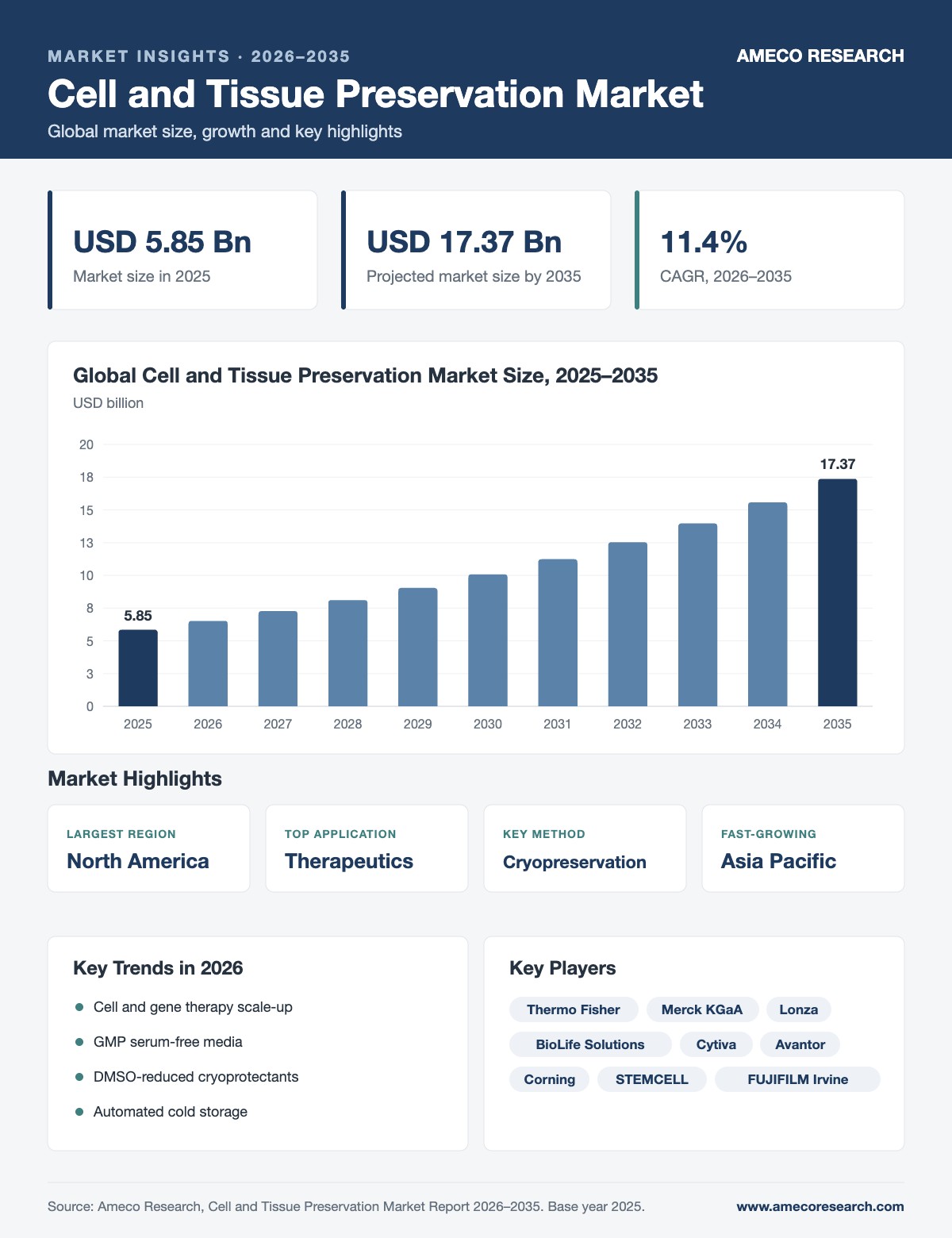 Infographic: Cell and Tissue Preservation Market Size and Growth Opportunities and Forecast till 2026 - 2035 | Ameco Research
Cell and Tissue Preservation Market Report Scope
| Report Attribute | Details |
| Cell and Tissue Preservation Market Size in 2025 | USD 5.85 Billion |
| Cell and Tissue Preservation Market Forecast by 2035 | USD 17.37 Billion |
| Cell and Tissue Preservation Market CAGR (2026–2035) | 11.4% |
| Analysis Period | 2023–2035 |
| Base Year | 2025 |
| Forecast Period | 2026–2035 |
| Segments Covered | by Type, by Product, by Application, by End-User, and By Region |
| Regional Scope | North America, Europe, Asia Pacific, Latin America, and Middle East & Africa |
| Key Companies Profiled | Thermo Fisher Scientific, Inc., Merck KGaA, Lonza, Avantor, Inc., Cytiva, BioLifeSolutions Inc., FUJIFILM Irvine Scientific, Corning Incorporated, STEMCELL Technologies Inc., BD, Agilent Technologies, Inc., AMSBIO, LGC SeraCare, Princeton CryoTech, and CellGenix GmbH |
| Report Coverage | Market Trends, Drivers, Restraints, Opportunities, Competitive Analysis, Player Profiling, Regulation Analysis |
Cell and Tissue Preservation Market Size Forecast, 2023–2035
The table below shows the year-by-year size of the global cell and tissue preservation market. Revenue is expected to grow about 3.0 times between 2025 and 2035, reaching roughly USD 10.08 billion by 2030.
| Year | Market Size (USD Billion) |
| 2023 (historical) | 4.71 |
| 2024 (historical) | 5.25 |
| 2025 (base year) | 5.85 |
| 2026 (forecast) | 6.52 |
| 2027 (forecast) | 7.27 |
| 2028 (forecast) | 8.11 |
| 2029 (forecast) | 9.04 |
| 2030 (forecast) | 10.08 |
| 2031 (forecast) | 11.24 |
| 2032 (forecast) | 12.53 |
| 2033 (forecast) | 13.97 |
| 2034 (forecast) | 15.58 |
| 2035 (forecast) | 17.37 |
Latest Cell and Tissue Preservation Market Trends (2026)
Cell and gene therapy scale-up
Approved CAR-T and other cell and gene therapies rely on cryopreserved patient cells and final products, driving demand for GMP-grade media, controlled-rate freezing and validated cold chain logistics.
GMP-grade and serum-free media
Developers are moving from home-brew to pre-formulated, animal-component-free media with documented quality, which simplifies regulatory filings and improves consistency.
Reducing DMSO toxicity
Researchers and suppliers are developing low-DMSO and DMSO-free cryoprotectant formulations to reduce side effects in patients and improve post-thaw cell function.
Automated and monitored storage
Automated liquid nitrogen and ultra-low freezers with sample tracking, remote alarms and chain-of-custody software reduce human error and protect high-value samples.
Biobank expansion
National and hospital biobanks are growing to support genomics, precision medicine and population health studies, increasing storage system and consumable demand.
Better viability assessment
Because cell death after thawing can be delayed, labs are adopting longer post-thaw assessments and functional assays rather than relying only on immediate membrane-integrity tests.
Cell and Tissue Preservation Market Dynamics
Growth drivers
- Growth of cell and gene therapies and regenerative medicine
- Rising R&D in cell and tissue research
- Expansion of biobanks and precision medicine programs
- Unmet needs in organ and tissue preservation for transplantation
- Wider use of cryopreservation in drug discovery
Restraints and challenges
- High cost of GMP media and cryogenic equipment
- Limitations of current cryopreservation and hypothermic methods
- Toxicity concerns with cryoprotectants such as DMSO
- Complex regulatory and quality requirements
Opportunities
Key opportunities include DMSO-free and serum-free media, automated cryogenic storage, cold chain services for cell therapies, organ preservation technologies, and biobank growth in Asia Pacific and the Middle East.
Cell and Tissue Preservation Market Segment Analysis
By type
The market is segmented into cells (mammalian cells and others such as plant cells and microorganisms) and tissues (bone, blood, skin, soft tissues and others). Mammalian cells hold a large share due to their use in cell therapy and research.
By product
Products include biopreservation media (pre-formulated and home-brew) and equipment (refrigerators, freezers, thawing equipment, storage systems and others). Pre-formulated media are growing faster as developers shift to GMP-grade products.
By application and end-user
Applications include therapeutics, drug discovery, research & development and others such as clinical trials and cosmetics. End-users include hospitals, biobanks and others, with biobanks a key and growing user group.
Cell and Tissue Preservation Market Regional Analysis
North America holds the largest share, supported by higher healthcare investment, advances in biomedical research, growing R&D activity and many cell and gene therapy developers.
Europe is a major market with strong biobanking networks and advanced therapy research. Asia Pacific is expected to gain significant momentum as pharmaceutical and biotech companies acquire and use more preservation equipment.
Latin America and the Middle East & Africa are smaller but growing markets, supported by new biobanks and transplant programs.
Cell and Tissue Preservation Market Segmentation
Cell and Tissue Preservation Market Leading Companies
The cell and tissue preservation market includes life science tools companies, specialist biopreservation media suppliers and cryogenic equipment makers. Companies compete on post-thaw viability, GMP quality, regulatory support, equipment reliability and cold chain services. Key players profiled in this report include Thermo Fisher Scientific, Inc., Merck KGaA, Lonza, Avantor, Inc., Cytiva, BioLifeSolutions Inc., FUJIFILM Irvine Scientific, Corning Incorporated, STEMCELL Technologies Inc., BD, Agilent Technologies, Inc., AMSBIO, LGC SeraCare, Princeton CryoTech, and CellGenix GmbH.
Thermo Fisher Scientific, Inc.Merck KGaALonzaAvantor, Inc.CytivaBioLifeSolutions Inc.FUJIFILM Irvine ScientificCorning IncorporatedSTEMCELL Technologies Inc.BDAgilent Technologies, Inc.AMSBIOLGC SeraCarePrinceton CryoTechCellGenix GmbH
Key Questions Answered in This Report
- What is the size of the cell and tissue preservation market in 2025, and how large will it be by 2030 and 2035?
- What are the main growth drivers, restraints and opportunities through 2035?
- Which by type and by product segments will grow the fastest?
- Which regions and countries offer the largest and fastest-growing opportunities?
- How are cell and gene therapy scale-up, GMP media and automated cold storage shaping the market in 2026?
- Who are the leading companies, and what strategies are they using to compete?
Research Methodology
Ameco Research built this forecast from a mix of primary and secondary research. Analysts spoke with biopreservation media and equipment suppliers, cell therapy developers, biobanks and research institutes to validate pricing, volumes and demand trends, and reviewed company filings, trade statistics, regulatory documents and industry publications. The cell and tissue preservation market size was estimated with bottom-up and top-down approaches and validated through data triangulation, with 2025 as the base year and forecasts for 2026–2035.
Related Reports
- Cell Therapy Technologies Market Report
- Tissue Processing Systems Market Report
- Sickle Cell Anemia Testing & Screening Market Report
- High Pressure Contrast Media Injectors (HPCMI) Market Report
- Anti-Biofilm Wound Dressing Market Report
Cell and Tissue Preservation Market: Frequently Asked Questions
How big is the cell and tissue preservation market?
The global cell and tissue preservation market was valued at USD 5.85 billion in 2025 and is expected to reach USD 17.37 billion by 2035.
What is the growth rate of the cell and tissue preservation market?
The cell and tissue preservation market is projected to grow at a CAGR of 11.4% from 2026 to 2035.
What will the cell and tissue preservation market be worth in 2030?
The cell and tissue preservation market is projected to reach about USD 10.08 billion in 2030, growing at a CAGR of 11.4%.
What is driving growth in the cell and tissue preservation market?
Key drivers are the growth of cell and gene therapies, rising cell and tissue research, biobank expansion, transplantation needs and wider use of cryopreservation.
What is cell and tissue preservation?
Cell and tissue preservation covers the media, equipment and methods, such as cryopreservation and hypothermic storage, used to keep biological samples viable for later use.
Which region leads the cell and tissue preservation market?
North America holds the largest share, while Asia Pacific is expected to gain significant momentum.
Which segment holds the largest share of the cell and tissue preservation market?
Therapeutics is the leading application, and pre-formulated biopreservation media and storage equipment are key product groups.
What are the latest trends in the cell and tissue preservation market?
The main 2026 trends are cell and gene therapy scale-up, gMP-grade and serum-free media, reducing DMSO toxicity, automated and monitored storage, biobank expansion and better viability assessment.
What are the main challenges in the cell and tissue preservation market?
The main challenges are high costs, limitations of current preservation methods, cryoprotectant toxicity and complex regulatory requirements.
What is cryopreservation?
Cryopreservation is the storage of cells or tissues at very low temperatures, usually in liquid nitrogen vapor, with cryoprotectants that prevent damage from ice crystals.
Who are the key players in the cell and tissue preservation market?
Leading companies include Thermo Fisher Scientific, Inc., Merck KGaA, Lonza, Avantor, Inc., Cytiva, BioLifeSolutions Inc., FUJIFILM Irvine Scientific, Corning Incorporated, STEMCELL Technologies Inc., BD, Agilent Technologies, Inc., AMSBIO, LGC SeraCare, Princeton CryoTech, and CellGenix GmbH.
Related Healthcare Market Reports
- High-Pressure Contrast Media Injectors (HPCMI) Market Size and Growth Opportunities and Forecast till 2026 - 2035
- Anti-Biofilm Wound Dressing Market Size and Growth Opportunities and Forecast till 2026 - 2035
- Sodium Citrate Blood Specimen Collection Tubes Market Size and Growth Opportunities and Forecast till 2026 - 2035
- Mobile Surgical Unit Market Size and Growth Opportunities and Forecast till 2026 - 2035
- High Potent Active Pharmaceutical Ingredient (HPAPI) Market Size and Growth Opportunities and Forecast till 2026 - 2035