Cryogenic Insulation Market Size and Growth Opportunities and Forecast till 2026 - 2035
Cryogenic Insulation Market Size, Share & Trends Report, 2026–2035
LAST UPDATED: OCTOBER 2026
The global Cryogenic Insulation Market size was valued at USD 4.45 billion in 2025 and is projected to reach USD 9.78 billion by 2035, growing at a CAGR of 8.2% from 2026 to 2035. Growth is driven by a record wave of new LNG export and import capacity, early build-out of liquid hydrogen infrastructure, rising use of liquid nitrogen, oxygen and argon in healthcare, food and electronics, and the fast-growing space launch industry.
Cryogenic insulation is a class of high-performance thermal insulation used to keep liquefied gases at extremely low temperatures, typically below -150°C (-238°F). It limits heat gain into tanks, pipelines, valves, pumps and vaporizers that store or move LNG, liquid hydrogen, liquid nitrogen, liquid oxygen and other cryogens. Common materials include polyurethane and polyisocyanurate (PU & PIR) foams, cellular glass, expanded perlite, fiberglass, polystyrene, aerogels and multilayer insulation (MLI).
Cryogenic Insulation Market Key Takeaways
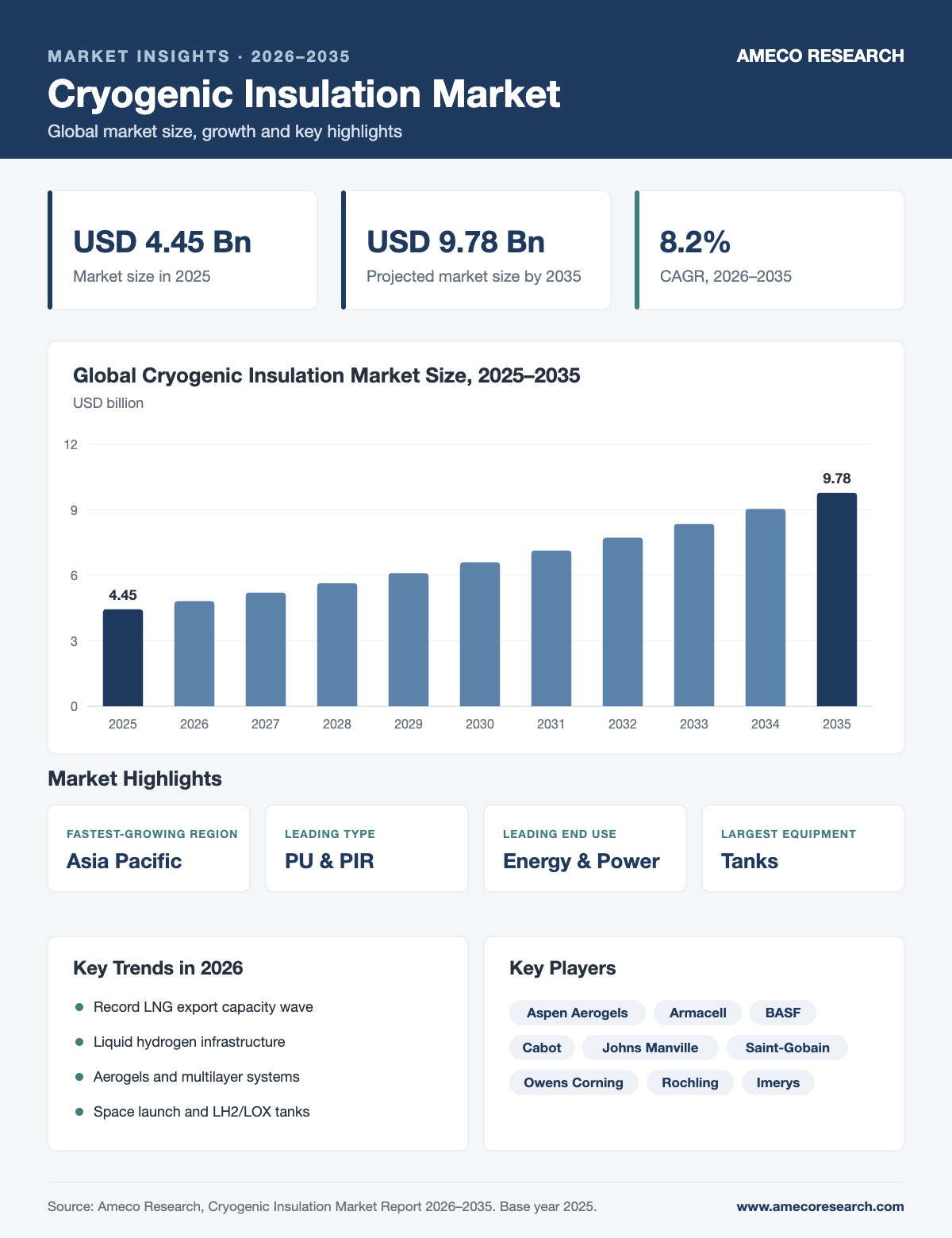 Infographic: Cryogenic Insulation Market Size and Growth Opportunities and Forecast till 2026 - 2035 | Ameco Research
Cryogenic Insulation Market Report Scope
| Report Attribute | Details |
| Cryogenic Insulation Market Size in 2025 | USD 4.45 Billion |
| Cryogenic Insulation Market Forecast by 2035 | USD 9.78 Billion |
| Cryogenic Insulation Market CAGR (2026–2035) | 8.2% |
| Analysis Period | 2023–2035 |
| Base Year | 2025 |
| Forecast Period | 2026–2035 |
| Segments Covered | By Type, By Form, By Cryogenic Equipment, By End-Use, and By Region |
| Regional Scope | North America, Europe, Asia Pacific, Latin America, and Middle East & Africa |
| Key Companies Profiled | Aspen Aerogels, Amol Dicalite, Armacell International Holding GmbH, Saint-Gobain (Isover), BASF SE, Cabot Corporation, Dunmore Corporation, G+H Group, Hertel, Imerys Minerals, Johns Manville Inc., Lydall Inc., Owens Corning (Pittsburgh Corning), and Rochling Group |
| Report Coverage | Market Trends, Drivers, Restraints, Opportunities, Competitive Analysis, Player Profiling, Regulation Analysis |
Latest Cryogenic Insulation Market Trends (2026)
A record LNG supply wave lifts insulation demand
The IEA expects global LNG supply to grow by more than 7% in 2026, the fastest pace since 2019, led by North America. More than 90 bcm per year of new liquefaction capacity reached a final investment decision in 2025, the second-highest total on record, and the IEA tracks nearly 290 bcm per year of export capacity due online between 2025 and 2030. Every new train, storage tank, jetty line and LNG carrier needs large volumes of PIR, cellular glass and perlite insulation.
Liquid hydrogen opens a new, demanding niche
Liquid hydrogen is stored at about -253°C, far colder than LNG, so it needs vacuum-jacketed and multilayer insulation systems. The IEA's Global Hydrogen Review 2025 counts more than 4 million tonnes per year of low-emissions hydrogen production that is operating, under construction or at FID by 2030, over five times the 2024 level. Even with project delays, this is creating demand for high-end insulation in hydrogen storage, transport and refueling.
Aerogels and multilayer insulation gain share
Owners want thinner, lighter systems that cut boil-off and installation time. Aerogel blankets and multilayer insulation are winning share in pipelines, subsea lines and compact equipment. Aspen Aerogels is targeting about 20% growth in its Energy Industrial segment in 2026, supported by multiyear LNG and subsea project activity.
Record space launch cadence
Global orbital launches reached a record 324 in 2025, up about 25% from 2024, with SpaceX alone flying 165 missions. Launch vehicles and ground systems that store liquid oxygen, liquid hydrogen and liquid methane need advanced foam, MLI and vacuum insulation, making aerospace a fast-growing high-value end use.
Industrial and medical gases keep growing
Liquid nitrogen, oxygen and argon are used in hospitals, biobanking, food freezing, steelmaking and semiconductor fabs. Expanding chip manufacturing and healthcare capacity drives steady demand for insulated bulk tanks, transfer lines and vaporizers.
Sustainability and safety requirements rise
Buyers increasingly ask for low-GWP blowing agents, non-combustible materials such as cellular glass and perlite, and longer-life systems that reduce boil-off losses. Tighter fire-safety rules at LNG terminals and on ships favor inorganic and aerogel-based solutions.
Cryogenic Insulation Market Dynamics
Growth drivers
- Large-scale expansion of LNG liquefaction, storage, shipping and regasification capacity
- Early build-out of liquid hydrogen production, storage and transport
- Rising demand for liquid nitrogen, oxygen and argon in healthcare, food processing, metals and electronics
- Growth in space launches and LOX/LH2 propellant infrastructure
- Focus on energy efficiency and cutting boil-off losses
Restraints and challenges
- High cost and installation complexity of advanced systems such as aerogels, vacuum and multilayer insulation
- Environmental rules on blowing agents used in PU & PIR foams
- Project delays and cancellations in hydrogen, and timing risk in large LNG projects
- Volatile raw-material prices and limited supply of specialty materials
Opportunities
New opportunities include insulation for liquid hydrogen carriers and refueling stations, LNG bunkering for ships, small-scale LNG, carbon capture and CO2 shipping, and prefabricated, pre-insulated pipe systems that cut site labor.
Cryogenic Insulation Market Segment Analysis
By type
PU & PIR insulation held the largest share in 2025. Its high thermal efficiency, low k-value, water resistance, low cost and simple installation make it the standard choice for LNG storage tanks, pipelines and ships. Cellular glass and perlite are widely used where non-combustibility and compressive strength are critical, such as tank bases and walls, while aerogels are the fastest-growing type.
By form
Foam dominates the market thanks to low thermal conductivity, light weight and high compressive strength, and it suits tanks, pipelines and equipment at large scale. Bulk-fill perlite is common in double-wall storage tanks, and multilayer insulation is the fastest-growing form, used in liquid hydrogen, aerospace and vacuum-jacketed systems.
By cryogenic equipment
Tanks are the largest segment because storing LNG, liquid nitrogen, oxygen and hydrogen requires the best possible insulation to prevent heat gain, boil-off and safety risks. Valves, vaporizers and pumps add steady demand as LNG terminals and industrial gas plants expand.
By end-use
Energy & power is the largest end-use segment, driven by LNG and emerging hydrogen infrastructure. Shipping is growing quickly with LNG carriers and LNG-fueled vessels, while chemicals, metallurgy and electronics rely on industrial gases for production processes.
Cryogenic Insulation Market Regional Analysis
Asia Pacific is expected to grow the fastest, supported by rising LNG imports in China, Japan, South Korea and India, a move away from coal, the region's dominant shipbuilding industry, and growing electronics, chemical and metals production.
North America is a major market, led by the United States, which accounts for most of the new LNG export capacity reaching FID. Strong investment in healthcare, research and space launch also supports demand for cryogenic insulation.
Europe is driven by new LNG import terminals and floating storage and regasification units, hydrogen projects and strict safety and efficiency standards. The Middle East & Africa gains from large LNG expansions in Qatar and new projects in Africa, while Latin America grows with LNG import terminals and industrial gas demand.
Cryogenic Insulation Market Segmentation
Cryogenic Insulation Market Leading Companies
The cryogenic insulation market is moderately fragmented, with material producers and specialist insulation contractors competing on thermal performance, fire safety, durability, project references and installation capability. Key players profiled in this report include Aspen Aerogels, Amol Dicalite, Armacell International Holding GmbH, Saint-Gobain (Isover), BASF SE, Cabot Corporation, Dunmore Corporation, G+H Group, Hertel, Imerys Minerals, Johns Manville Inc., Lydall Inc., Owens Corning (Pittsburgh Corning), and Rochling Group.
Aspen AerogelsAmol DicaliteArmacellSaint-Gobain (Isover)BASFCabotDunmoreG+H GroupHertelImerysJohns ManvilleLydallOwens CorningRochling
Recent developments
Cryogenic Insulation Market: Frequently Asked Questions
How big is the cryogenic insulation market?
The global cryogenic insulation market was valued at USD 4.45 billion in 2025 and is expected to reach USD 9.78 billion by 2035.
What is the growth rate of the cryogenic insulation market?
The cryogenic insulation market is projected to grow at a CAGR of 8.2% from 2026 to 2035.
What is driving growth in the cryogenic insulation market?
Key drivers are new LNG export and import capacity, liquid hydrogen infrastructure, growing use of industrial and medical gases, and record space launch activity.
Which type of cryogenic insulation is most used?
PU & PIR foam holds the largest share because of its low thermal conductivity, moisture resistance and low installed cost, while aerogels and multilayer insulation are growing fastest.
Which region leads the cryogenic insulation market?
Asia Pacific is the fastest-growing region, driven by LNG imports and shipbuilding, while North America leads new LNG export capacity.
What are the latest trends in cryogenic insulation?
The main 2026 trends are the LNG supply wave, liquid hydrogen storage and transport, aerogel and multilayer insulation, record space launches and lower-carbon, non-combustible materials.
Who are the key players in the cryogenic insulation market?
Leading companies include Aspen Aerogels, Armacell, BASF, Cabot, Johns Manville, Saint-Gobain (Isover), Owens Corning (Pittsburgh Corning), G+H Group, Imerys and Rochling Group.
Related Chemical & Material Market Reports
- Additive Manufacturing with Metal Powders Market Growth Opportunities and Forecast till 2032
- Iron Ore Pellets Market Growth Opportunities and Forecast till 2032
- Polyester Fiber Market Growth Opportunities and Forecast till 2032
- Steel Rebar Market Growth Opportunities and Forecast till 2032
- Super Absorbent Polymer Market Growth Opportunities and Forecast till 2032