Digestive Health Products Market Growth Opportunities and Forecast till 2026 - 2035
Digestive Health Products Market Size, Share & Trends Report, 2026–2035
LAST UPDATED: OCTOBER 2026
The global Digestive Health Products Market size was valued at USD 56.1 billion in 2025 and is projected to reach USD 115.9 billion by 2035, growing at a CAGR of 7.5% from 2026 to 2035. Growth is driven by rising awareness of the gut's role in overall health, booming demand for fiber and "gut-friendly" foods and drinks, the spread of GLP-1 weight-loss drugs, and new science on prebiotics, probiotics and postbiotics.
Digestive health products are foods, beverages and supplements formulated to support a healthy digestive system. They typically contain probiotics (beneficial live bacteria or yeasts), prebiotics (fibers that feed good gut bacteria), digestive enzymes and dietary fiber. They help with occasional bloating, irregularity, mild constipation and diarrhea, support nutrient absorption, and are increasingly linked to immunity, mood and metabolic health.
Digestive Health Products Market Key Takeaways
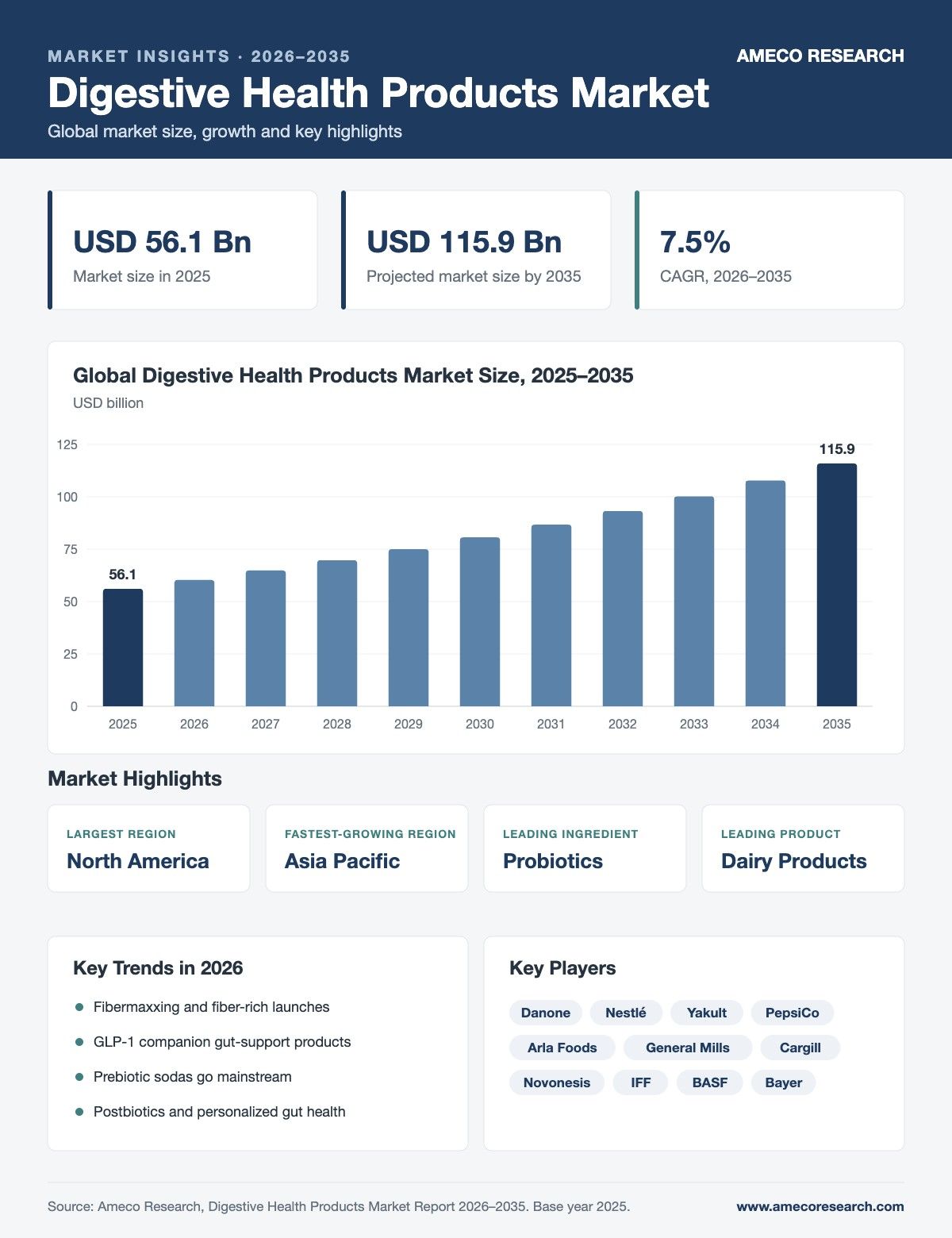 Infographic: Digestive Health Products Market Growth Opportunities and Forecast till 2026 - 2035 | Ameco Research
Digestive Health Products Market Report Scope
| Report Attribute | Details |
| Digestive Health Products Market Size in 2025 | USD 56.1 Billion |
| Digestive Health Products Market Forecast by 2035 | USD 115.9 Billion |
| Digestive Health Products Market CAGR (2026–2035) | 7.5% |
| Analysis Period | 2023–2035 |
| Base Year | 2025 |
| Forecast Period | 2026–2035 |
| Segments Covered | By Ingredient, By Product, By Distribution Channel, and By Region |
| Regional Scope | North America, Europe, Asia Pacific, Latin America, and Middle East & Africa |
| Key Companies Profiled | Arla Foods Inc., BASF SE, Bayer AG, Cargill Inc., Danone SA, DuPont de Nemours (nutrition business now part of IFF), General Mills, Chr. Hansen Holding (now part of Novonesis), Nestlé SA, PepsiCo Inc., and Yakult Honsha Co. Ltd. |
| Report Coverage | Market Trends, Drivers, Restraints, Opportunities, Competitive Analysis, Player Profiling, Regulation Analysis |
Latest Digestive Health Products Market Trends (2026)
Fiber becomes the new protein
"Fibermaxxing", deliberately adding more fiber to every meal, has become one of the biggest food trends of 2025–2026. ADM reports that nearly 70% of consumers worldwide want to increase their fiber intake, and major food and beverage companies have launched high-fiber snacks, cereals and drinks. Ingredient makers are expanding prebiotic fiber portfolios; in June 2026 Ingredion acquired NutriLeads' Benicaros prebiotic carrot fiber.
GLP-1 drugs create a new gut-support category
The rapid uptake of GLP-1 weight-loss medicines, which commonly cause nausea, constipation and other digestive side effects, is fueling "GLP-1 companion" products. Brands are launching fiber, probiotic and enzyme formats designed to support digestive comfort and nutrient intake for people taking these drugs.
Prebiotic sodas go mainstream
Gut-friendly soft drinks have moved from niche to big business. PepsiCo completed its acquisition of prebiotic soda brand poppi in May 2025 for USD 1.95 billion, and other large beverage companies have launched competing prebiotic sodas. Non-alcoholic functional drinks are now one of the fastest-growing formats for digestive health ingredients.
Postbiotics and synbiotics widen the toolkit
Beyond live probiotics, suppliers are commercializing heat-treated postbiotics that survive baking and long shelf life without refrigeration, allowing gut-health claims in gummies, snacks and chocolate. Synbiotics, which pair probiotics with prebiotics such as HMOs, are positioned for stronger, targeted benefits.
Personalized and multi-benefit gut health
The category is shifting from general "digestive wellness" claims to targeted needs such as lactose intolerance, IBS-type bloating and the gut-brain axis. Consumers increasingly connect gut health with immunity, mood, sleep and skin, and at-home microbiome tests and app-based nutrition advice are helping brands personalize recommendations.
Deal activity concentrates on gut-health brands
Investors and food companies continue to buy into the category. In Q2 2026 alone, Hero Group acquired UK brand The Gut Stuff, Kirin's Blackmores invested in microbiome company BiomeBank, and several fiber and probiotic start-ups raised new funding.
Digestive Health Products Market Dynamics
Growth drivers
- Growing awareness of the gut microbiome and the gut-brain connection
- Rising digestive complaints linked to diet, stress, sedentary lifestyles and aging populations
- Fortification of everyday dairy, snacks and beverages with probiotics, prebiotics and fiber
- GLP-1 drug adoption creating demand for digestive-support products
- Expansion of e-commerce and direct-to-consumer supplement brands
Restraints and challenges
- Strict health-claim rules, such as DSHEA in the U.S. and the lack of authorized probiotic claims in the EU
- Strain-specific clinical evidence that is costly and slow to generate
- Product stability and shelf-life challenges for live probiotic cultures
- Consumer confusion caused by unclear or exaggerated gut-health marketing
Opportunities in digital health
Mobile apps, wearables, telehealth and at-home microbiome tests are being used to track symptoms, give personalized diet advice and recommend products. As healthcare becomes more digital, these tools are opening new direct-to-consumer and subscription models for digestive health brands.
Digestive Health Products Market Segment Analysis
By ingredient
The market is segmented into probiotics, prebiotics and food enzymes (animal-based, plant-based and microbial-based). Probiotics account for more than 85% of the market, as they are widely recognized for supporting gut flora balance, digestion and immunity, particularly among older consumers. Prebiotic fibers are the fastest-rising ingredient group in 2026, helped by the fiber trend and prebiotic beverages.
By product
Segments include dairy products, non-alcoholic beverages, supplements and others. Dairy products hold almost 74% of the market, because yogurts, kefir and fermented milks are natural carriers for probiotics. Non-alcoholic beverages such as kombucha, prebiotic sodas and functional waters are expanding quickly, and supplements are gaining from GLP-1 companion and targeted-need formulations.
By distribution channel
Channels include supermarkets and hypermarkets, pharmacy stores, e-commerce and others. Pharmacies are a preferred channel for digestive supplements because of pharmacist advice and credibility, while supermarkets and hypermarkets lead for everyday foods and drinks. E-commerce is the fastest-growing channel, driven by wider product choice, subscriptions and home delivery.
Digestive Health Products Market Regional Analysis
North America leads the digestive health products market with about 33% of revenue, supported by strong consumer awareness, the presence of major manufacturers, wide product availability, fast-growing prebiotic beverage and fiber launches, and high GLP-1 drug adoption in the United States.
Asia Pacific is expected to grow fastest during 2026–2035. Rising incomes, urbanization, a growing health-conscious middle class and long traditions of fermented foods in Japan, China, South Korea and India are boosting demand for probiotic drinks, supplements and functional foods.
Europe is a mature market led by fermented dairy and fiber-rich foods, although strict EU health-claim rules limit probiotic marketing, while Latin America and the Middle East & Africa grow with expanding modern retail, urban lifestyles and rising awareness of preventive health.
Digestive Health Products Market Segmentation
Digestive Health Products Market Leading Companies
The digestive health products market combines global food and beverage majors, dairy cooperatives, probiotic specialists and ingredient suppliers, which compete on clinically studied strains, brand trust, product innovation and retail reach. Key players profiled in this report include Arla Foods Inc., BASF SE, Bayer AG, Cargill Inc., Danone SA, DuPont de Nemours (nutrition business now part of IFF), General Mills, Chr. Hansen Holding (now part of Novonesis), Nestlé SA, PepsiCo Inc., and Yakult Honsha Co. Ltd.
Arla FoodsBASFBayerCargillDanoneGeneral MillsIFF (DuPont Nutrition)NestléNovonesis (Chr. Hansen)PepsiCoYakult
Recent developments
Digestive Health Products Market: Frequently Asked Questions
How big is the digestive health products market?
The global digestive health products market was valued at USD 56.1 billion in 2025 and is expected to reach USD 115.9 billion by 2035.
What is the growth rate of the digestive health products market?
The digestive health products market is projected to grow at a CAGR of 7.5% from 2026 to 2035.
What is driving growth in the digestive health products market?
Key drivers are rising gut-health awareness, demand for fiber-rich and probiotic foods and drinks, GLP-1 drug use, aging populations and the growth of e-commerce.
Which region leads the digestive health products market?
North America leads with about 33% of revenue, while Asia Pacific is the fastest-growing region.
Which ingredient holds the largest share of digestive health products?
Probiotics hold the largest share, accounting for more than 85% of the digestive health products market.
What are the latest trends in digestive health products?
The main 2026 trends are fibermaxxing, GLP-1 companion products, prebiotic sodas, postbiotics and synbiotics, and personalized, multi-benefit gut health.
Who are the key players in the digestive health products market?
Leading companies include Arla Foods, BASF, Bayer, Cargill, Danone, General Mills, IFF, Nestlé, Novonesis (Chr. Hansen), PepsiCo and Yakult.
Related Food & Beverages Market Reports
- In-Flight Catering Services Market Growth Opportunities and Forecast till 2032
- Coenzyme Q10 Market Growth Opportunities and Forecast till 2032
- Dough Conditioner Market Growth Opportunities and Forecast till 2032
- Fish Protein Hydrolysate Market Growth Opportunities and Forecast till 2032
- Botanical Supplements Market Growth Opportunities and Forecast till 2030