Energy Storage as a Service (ESaaS) Market Size and Growth Opportunities and Forecast till 2026 - 2035
Energy Storage as a Service (ESaaS) Market Size, Share & Trends Report, 2026–2035
LAST UPDATED: OCTOBER 2026
The global Energy Storage as a Service (ESaaS) Market size was valued at USD 1.95 billion in 2025 and is projected to reach USD 4.96 billion by 2035, growing at a CAGR of 9.8% from 2026 to 2035. Growth is driven by falling battery costs, businesses seeking to cut peak demand charges and gain backup power without upfront investment, grid operators needing flexibility for renewables, rising electricity prices and data center and EV charging loads.
Energy storage as a service (ESaaS) is a business model in which a provider designs, finances, installs, owns, operates and maintains battery or other energy storage systems at a customer site or on the grid, and the customer pays a subscription, shared-savings or service fee instead of buying the system. Services include bulk energy services, ancillary services such as frequency regulation, transmission and distribution infrastructure support, and customer energy management such as peak shaving, demand charge reduction and backup power. Customers include utilities and industrial, commercial and residential users.
Energy Storage as a Service (ESaaS) Market Key Takeaways
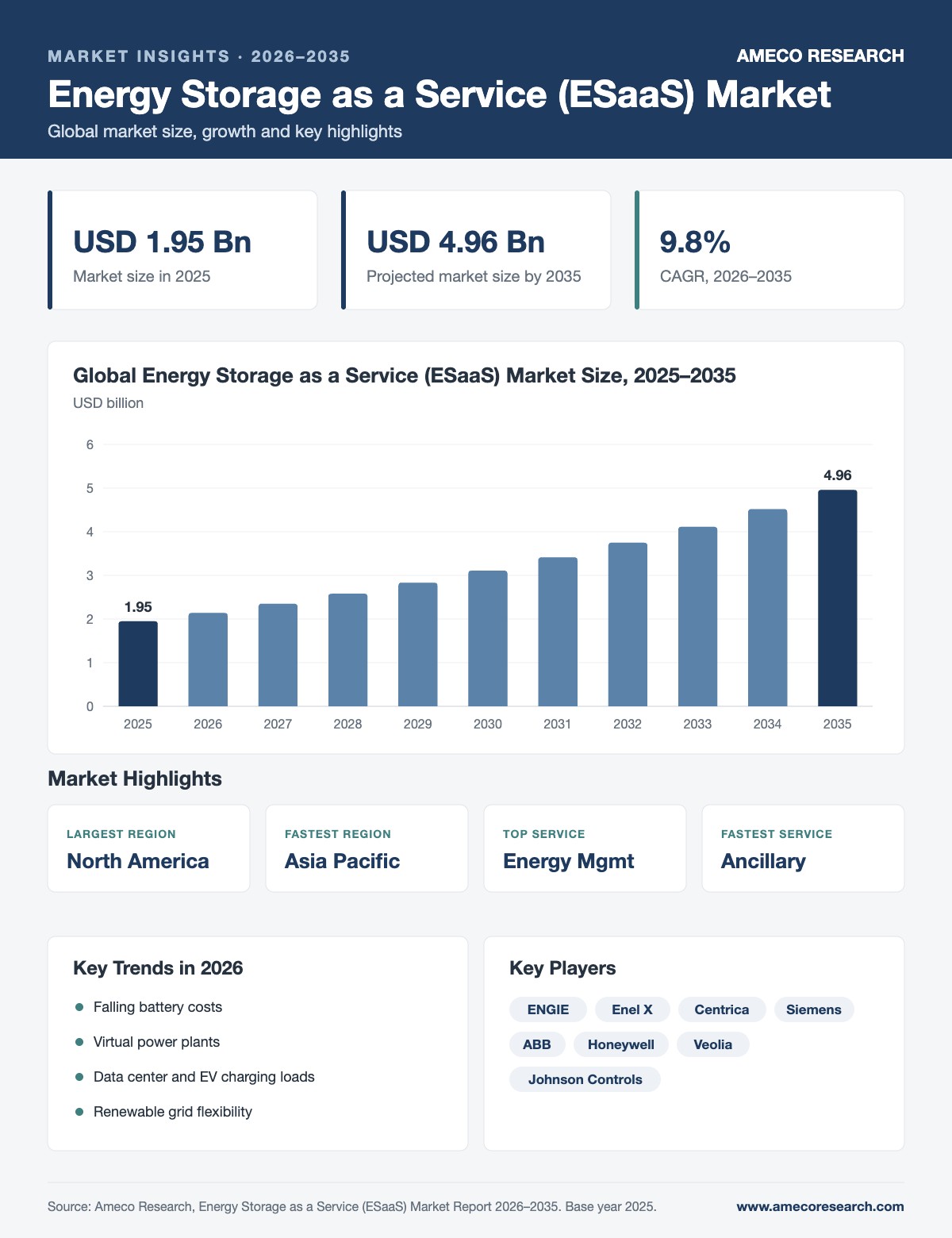 Infographic: Energy Storage as a Service (ESaaS) Market Size and Growth Opportunities and Forecast till 2026 - 2035 | Ameco Research
Energy Storage as a Service (ESaaS) Market Report Scope
| Report Attribute | Details |
| Energy Storage as a Service (ESaaS) Market Size in 2025 | USD 1.95 Billion |
| Energy Storage as a Service (ESaaS) Market Forecast by 2035 | USD 4.96 Billion |
| Energy Storage as a Service (ESaaS) Market CAGR (2026–2035) | 9.8% |
| Analysis Period | 2023–2035 |
| Base Year | 2025 |
| Forecast Period | 2026–2035 |
| Segments Covered | by Service, by End-User, and By Region |
| Regional Scope | North America, Europe, Asia Pacific, Latin America, and Middle East & Africa |
| Key Companies Profiled | ABB, Centrica, Customized Energy Solutions Ltd., Enel X, ENGIE Storage Services NA LLC, Honeywell International Inc., Johnson Controls, NRStor Inc., Orsted, Siemens, Suntuity Solar LLC, Veolia, and WGL Holdings, Inc. |
| Report Coverage | Market Trends, Drivers, Restraints, Opportunities, Competitive Analysis, Player Profiling, Regulation Analysis |
Energy Storage as a Service (ESaaS) Market Size Forecast, 2023–2035
The table below shows the year-by-year size of the global energy storage as a service (esaas) market. Revenue is expected to grow about 2.5 times between 2025 and 2035, reaching roughly USD 3.11 billion by 2030.
| Year | Market Size (USD Billion) |
| 2023 (historical) | 1.62 |
| 2024 (historical) | 1.78 |
| 2025 (base year) | 1.95 |
| 2026 (forecast) | 2.14 |
| 2027 (forecast) | 2.35 |
| 2028 (forecast) | 2.58 |
| 2029 (forecast) | 2.83 |
| 2030 (forecast) | 3.11 |
| 2031 (forecast) | 3.41 |
| 2032 (forecast) | 3.75 |
| 2033 (forecast) | 4.12 |
| 2034 (forecast) | 4.52 |
| 2035 (forecast) | 4.96 |
Latest Energy Storage as a Service (ESaaS) Market Trends (2026)
Falling battery costs
Prices for lithium-ion and especially LFP battery systems have fallen sharply, improving the economics of storage-as-a-service contracts for businesses and utilities.
Virtual power plants
Providers aggregate many behind-the-meter batteries into virtual power plants that sell grid services, sharing revenue with customers and lowering their costs.
Data centers, EV charging and electrification
Data centers, fleet EV charging depots and electrified industrial sites use storage to manage peak demand, avoid costly grid upgrades and ensure backup power.
Incentives and policy changes
Investment tax credits for standalone storage, capacity markets and resilience programs support ESaaS, though changes in tariffs on imported batteries and incentive rules affect project costs.
Renewable integration and grid flexibility
Grid operators need fast-responding storage for frequency regulation, ramping and renewable firming, driving growth in ancillary services.
Long-duration and hybrid storage
Flow batteries, thermal storage and hybrid solar-plus-storage offerings are expanding the range of services providers can offer.
Energy Storage as a Service (ESaaS) Market Dynamics
Growth drivers
- No upfront capital needed for customers
- Rising electricity and demand charges
- Need for backup power and resilience
- Renewable integration and grid services
- Falling battery costs
Restraints and challenges
- Long-term contract and performance risk
- Regulatory and market design uncertainty
- Battery safety and degradation concerns
- Supply chain and tariff risks for batteries
Opportunities
Key opportunities include storage for data centers and EV charging hubs, virtual power plants, microgrids for critical facilities, solar-plus-storage for commercial users and utility partnerships in Asia Pacific, Europe and Latin America.
Energy Storage as a Service (ESaaS) Market Segment Analysis
By service
The market is segmented into bulk energy services, ancillary services, transmission infrastructure services, customer energy management services, distribution infrastructure services and others. Customer energy management services gained a considerable share, while ancillary services are projected to register the fastest growth.
By end user
End users include utilities and industrial, residential and commercial customers. Industrial, commercial and residential customers contribute more than two-thirds of the market, while the utility segment is expected to gain significant momentum.
Energy Storage as a Service (ESaaS) Market Regional Analysis
The North American region dominates the market with over one third of the total share, supported by demand charges, storage incentives and access to wholesale and capacity markets in the United States and Canada.
The quickest growth is expected in the Asia-Pacific region, led by Australia, Japan, China and India. Europe is a major market with strong grid services and renewable integration needs.
Latin America and the Middle East & Africa are emerging markets for commercial and microgrid storage.
Energy Storage as a Service (ESaaS) Market Segmentation
Energy Storage as a Service (ESaaS) Market Leading Companies
The energy storage as a service market includes energy service companies, utilities and their subsidiaries, battery integrators and building technology firms. Companies compete on financing capability, software and optimization, project execution, performance guarantees and access to grid service revenues. Key players profiled in this report include ABB, Centrica, Customized Energy Solutions Ltd., Enel X, ENGIE Storage Services NA LLC, Honeywell International Inc., Johnson Controls, NRStor Inc., Orsted, Siemens, Suntuity Solar LLC, Veolia, and WGL Holdings, Inc..
ABBCentricaCustomized Energy Solutions Ltd.Enel XENGIE Storage Services NA LLCHoneywell International Inc.Johnson ControlsNRStor Inc.OrstedSiemensSuntuity Solar LLCVeoliaWGL Holdings, Inc.
Key Questions Answered in This Report
- What is the size of the energy storage as a service (esaas) market in 2025, and how large will it be by 2030 and 2035?
- What are the main growth drivers, restraints and opportunities through 2035?
- Which by service and by end-user segments will grow the fastest?
- Which regions and countries offer the largest and fastest-growing opportunities?
- How are battery costs, virtual power plants and data center loads shaping ESaaS demand in 2026?
- Who are the leading companies, and what strategies are they using to compete?
Research Methodology
Our estimates draw on interviews with energy service companies, utilities, battery integrators, commercial and industrial customers and grid operators, supported by secondary data from annual reports, investor materials, trade and customs data, standards bodies and industry journals. Bottom-up estimates of company revenues and top-down estimates of application demand are reconciled through data triangulation, and the model is updated with 2026 developments to forecast the market through 2035.
Related Reports
- Hydrogen Energy Storage Market Report
- Renewable Energy Certificate Market Report
- Offshore Wind Energy Market Report
- Subsea Power Grid Systems Market Report
- Wind Energy Foundation Market Report
Energy Storage as a Service (ESaaS) Market: Frequently Asked Questions
How big is the energy storage as a service (esaas) market?
The global energy storage as a service (esaas) market was valued at USD 1.95 billion in 2025 and is expected to reach USD 4.96 billion by 2035.
What is the growth rate of the energy storage as a service (esaas) market?
The energy storage as a service (esaas) market is projected to grow at a CAGR of 9.8% from 2026 to 2035.
What will the energy storage as a service (esaas) market be worth in 2030?
The energy storage as a service (esaas) market is projected to reach about USD 3.11 billion in 2030, growing at a CAGR of 9.8%.
What is driving growth in the energy storage as a service (esaas) market?
Key drivers are no upfront cost for customers, rising electricity and demand charges, resilience needs, renewable integration and falling battery costs.
What is energy storage as a service?
Energy storage as a service is a model in which a provider finances, installs, owns and operates a battery system and the customer pays a service fee to use it for savings, backup or grid services.
Which region leads the energy storage as a service (esaas) market?
North America dominates with over one third of the market, while Asia-Pacific is expected to grow fastest.
Which segment holds the largest share of the energy storage as a service (esaas) market?
Customer energy management services hold a considerable share, ancillary services grow fastest and industrial, commercial and residential users account for more than two-thirds of demand.
What are the latest trends in the energy storage as a service (esaas) market?
The main 2026 trends are falling battery costs, virtual power plants, data centers, EV charging and electrification, incentives and policy changes, renewable integration and grid flexibility and long-duration and hybrid storage.
What are the main challenges in the energy storage as a service (esaas) market?
The main challenges are long-term contract risk, regulatory uncertainty, battery safety and degradation and supply chain and tariff risks.
How does energy storage reduce demand charges?
A battery discharges during short periods of peak power use, lowering the highest demand the utility measures each month and therefore the demand charges on the bill.
Who are the key players in the energy storage as a service (esaas) market?
Leading companies include ABB, Centrica, Customized Energy Solutions Ltd., Enel X, ENGIE Storage Services NA LLC, Honeywell International Inc., Johnson Controls, NRStor Inc., Orsted, Siemens, Suntuity Solar LLC, Veolia, and WGL Holdings, Inc..
Related Energy and Power Market Reports
- Coal Power Generation Market Size and Growth Opportunities and Forecast till 2026 - 2035
- Hydrogen Energy Storage Market Size and Growth Opportunities and Forecast till 2026 - 2035
- Substation Market Size and Growth Opportunities and Forecast till 2026 - 2035
- Plastic to Fuel Market Size and Growth Opportunities and Forecast till 2026 - 2035