Esports Market Size and Growth Opportunities and Forecast till 2026 - 2035
Esports Market Size, Share & Trends Report, 2026–2035
LAST UPDATED: OCTOBER 2026
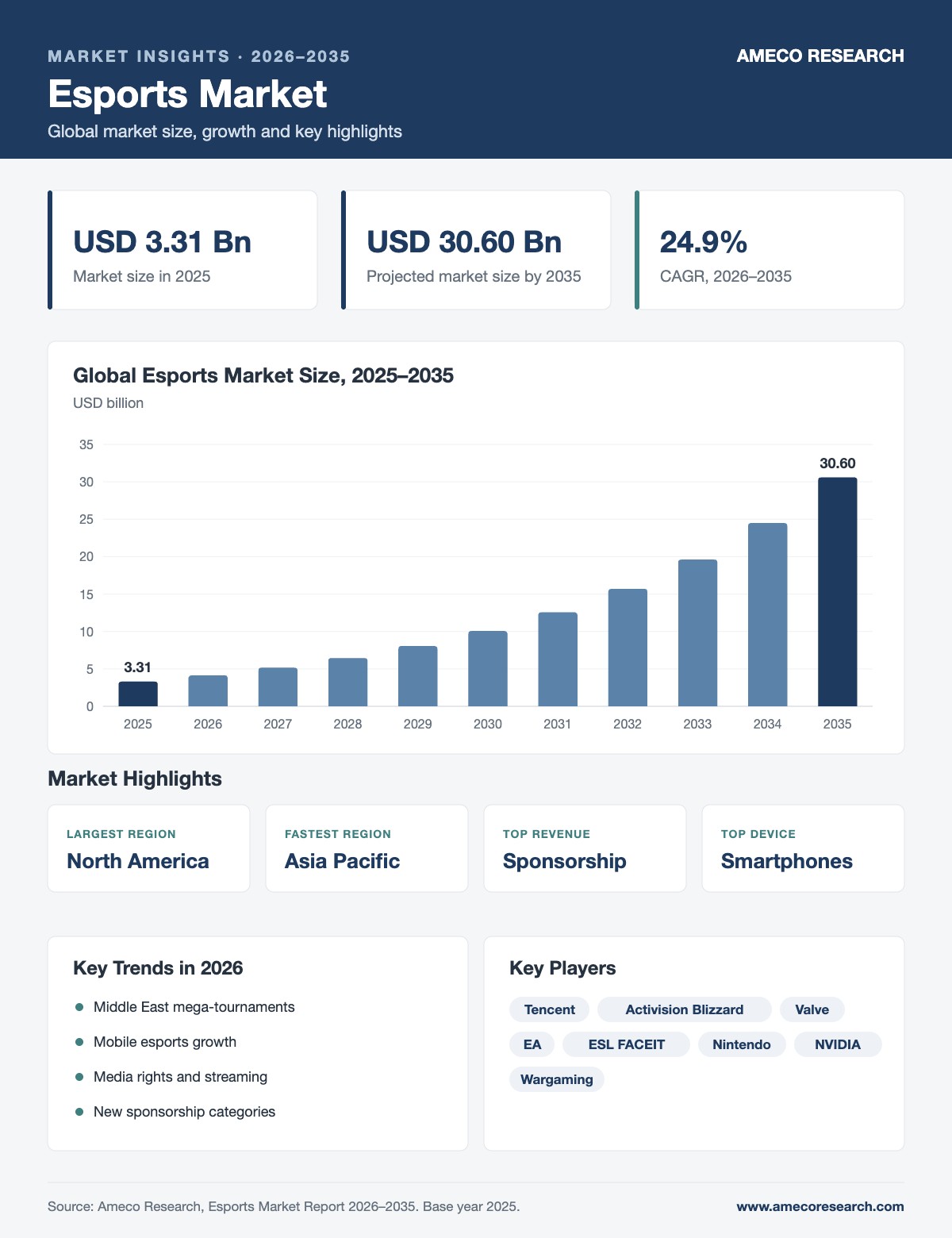
The global Esports Market size was valued at USD 3.31 billion in 2025 and is projected to reach USD 30.60 billion by 2035, growing at a CAGR of 24.9% from 2026 to 2035. Growth is driven by sponsorship and media rights deals, mobile esports in Asia and emerging markets, large international tournaments, streaming on platforms such as Twitch and YouTube, and government and investor support in the Middle East and Asia.
Esports is organized, competitive video gaming in which professional players and teams compete in leagues and tournaments that are watched live and on demand by large online and in-person audiences. Popular titles include multiplayer battle arena, shooter, battle royale, sports and fighting games. The esports market covers revenue from sponsorship, media rights, advertising, publisher fees, merchandise and tickets, and spans platforms and services across smartphones, PCs, consoles and smart TVs.
Esports Market Key Takeaways
Esports Market Report Scope
| Report Attribute | Details |
| Esports Market Size in 2025 | USD 3.31 Billion |
| Esports Market Forecast by 2035 | USD 30.60 Billion |
| Esports Market CAGR (2026–2035) | 24.9% |
| Analysis Period | 2023–2035 |
| Base Year | 2025 |
| Forecast Period | 2026–2035 |
| Segments Covered | by Streaming Type, by Device Type, by Revenue, by Application, and By Region |
| Regional Scope | North America, Europe, Asia Pacific, Latin America, and Middle East & Africa |
| Key Companies Profiled | Activision Blizzard, Inc. (Microsoft), Electronic Arts Inc., Faceit (ESL FACEIT Group), Gameloft SE, Modern Times Group, Nintendo of America Inc., NVIDIA Corporation, Tencent Holding Limited, Valve Corporation, and Wargaming |
| Report Coverage | Market Trends, Drivers, Restraints, Opportunities, Competitive Analysis, Player Profiling, Regulation Analysis |
Esports Market Size Forecast, 2023–2035
The table below shows the year-by-year size of the global esports market, with figures rolled forward from the 2022 base at the report's 24.9% CAGR.
| Year | Market Size (USD Billion) |
| 2023 (historical) | 2.12 |
| 2024 (historical) | 2.65 |
| 2025 (base year) | 3.31 |
| 2026 (forecast) | 4.13 |
| 2027 (forecast) | 5.16 |
| 2028 (forecast) | 6.45 |
| 2029 (forecast) | 8.06 |
| 2030 (forecast) | 10.06 |
| 2031 (forecast) | 12.57 |
| 2032 (forecast) | 15.70 |
| 2033 (forecast) | 19.61 |
| 2034 (forecast) | 24.50 |
| 2035 (forecast) | 30.60 |
Latest Esports Market Trends (2026)
Middle East mega-events
Saudi Arabia hosts the annual Esports World Cup in Riyadh, featuring a prize pool of more than USD 70 million in 2025, and Saudi-backed Savvy Games Group owns ESL FACEIT Group. The region has become a major hub for esports investment.
Mobile esports growth
Mobile titles dominate esports viewership and participation in Asia, Latin America and the Middle East, making smartphones the most important device for competitive gaming.
Media rights and streaming
Streaming platforms, broadcasters and publishers are signing media rights deals, and on-demand content such as highlights and creator co-streams is expanding reach.
Publisher-led ecosystems
Game publishers run franchised leagues and partner programs, sharing revenue with teams and controlling competitive calendars. Microsoft's ownership of Activision Blizzard has reshaped several leagues.
New sponsorship categories
Beyond gaming hardware and energy drinks, brands in automotive, finance, fashion and telecom are sponsoring teams and events to reach younger audiences.
Team profitability focus
Esports organizations are cutting costs and diversifying into content, merchandise and creator businesses to build sustainable revenue.
Esports Market Dynamics
Growth drivers
- Growing global audience of gamers and viewers
- Rising sponsorship and advertising spending
- Media rights and streaming platform deals
- Growth of mobile gaming and internet access
- Government and investor support for esports hubs
Restraints and challenges
- Dependence on sponsorship and investor funding
- Profitability challenges for teams and leagues
- Game publisher control over competitions
- Regulatory issues around betting and youth audiences
Opportunities
Key opportunities include mobile esports leagues, media rights in emerging markets, branded content and creator partnerships, esports tourism and live events, and education and collegiate esports programs.
Esports Market Segment Analysis
By streaming type
The market is segmented into on-demand and live streaming. Live streaming drives tournament viewership, while on-demand is predicted to expand the fastest as fans watch highlights and creator content.
By device type
Device types include smartphones, smart TVs, desktops, laptops and tablets, and gaming consoles. Smartphones are expected to be the most popular device.
By revenue
Revenue streams include sponsorship, merchandise and tickets, advertising, publisher fees and media rights. Sponsorship held the majority of the share.
By application
Applications include platform and service. The platform sector is the dominant category in the esports market.
Esports Market Regional Analysis
North America is the largest area, with a mature and well-established esports ecosystem of franchised leagues, teams, sponsors and streaming platforms.
Asia-Pacific is the fastest-growing area in the esports business, driven by its large population, growing middle class and mobile gaming in China, South Korea, Japan, India and Southeast Asia. Europe is a major market with strong PC esports.
The Middle East is a fast-rising hub led by Saudi Arabia, and Latin America is growing quickly with mobile esports.
Esports Market Segmentation
Esports Market Leading Companies
The esports market includes game publishers, tournament organizers, streaming platforms, hardware companies and teams. Companies compete on popular game titles, event quality, audience reach, media and sponsorship partnerships, and fan engagement. Key players profiled in this report include Activision Blizzard, Inc. (Microsoft), Electronic Arts Inc., Faceit (ESL FACEIT Group), Gameloft SE, Modern Times Group, Nintendo of America Inc., NVIDIA Corporation, Tencent Holding Limited, Valve Corporation, and Wargaming.
Activision Blizzard, Inc. (Microsoft)Electronic Arts Inc.Faceit (ESL FACEIT Group)Gameloft SEModern Times GroupNintendo of America Inc.NVIDIA CorporationTencent Holding LimitedValve CorporationWargaming
Recent developments
Key Questions Answered in This Report
- What is the size of the esports market in 2025, and how large will it be by 2030 and 2035?
- What are the main growth drivers, restraints and opportunities through 2035?
- Which by streaming type and by device type segments will grow the fastest?
- Which regions and countries offer the largest and fastest-growing opportunities?
- How are Middle East tournaments, mobile esports and media rights shaping the esports market in 2026?
- Who are the leading companies, and what strategies are they using to compete?
Research Methodology
This report combines primary and secondary research. Primary research includes interviews with game publishers, tournament organizers, teams, streaming platforms, sponsors and industry experts. Secondary research covers company annual reports, investor presentations, government and trade association data, patent filings and industry publications. Market size is estimated using both bottom-up (company revenue and production data) and top-down (end-use demand) methods, and results are cross-checked through data triangulation before forecasts are built for 2026–2035.
Related Reports
- Video Streaming Market Report
- Social Media Management Market Report
- Precious Metal Plating Chemicals Market Report
- Data Preparation Tools Market Report
- Commercial Telematics Market Report
Esports Market: Frequently Asked Questions
How big is the esports market?
The global esports market was valued at USD 3.31 billion in 2025 and is expected to reach USD 30.60 billion by 2035.
What is the growth rate of the esports market?
The esports market is projected to grow at a CAGR of 24.9% from 2026 to 2035.
What will the esports market be worth in 2030?
The esports market is projected to reach about USD 10.06 billion in 2030, growing at a CAGR of 24.9%.
What is driving growth in the esports market?
Key drivers are a growing gaming audience, rising sponsorship and advertising, media rights and streaming deals, mobile gaming growth and government and investor support.
What is esports?
Esports is organized competitive video gaming in which professional players and teams compete in leagues and tournaments watched live and online.
Which region leads the esports market?
North America is the largest area, while Asia-Pacific is the fastest-growing region.
Which segment holds the largest share of the esports market?
Sponsorship holds the majority of revenue, the platform segment is dominant and smartphones are expected to be the most popular device.
What are the latest trends in the esports market?
The main 2026 trends are middle East mega-events, mobile esports growth, media rights and streaming, publisher-led ecosystems, new sponsorship categories and team profitability focus.
What are the main challenges in the esports market?
The main challenges are dependence on sponsorship and investors, profitability of teams and leagues, publisher control and regulation of betting and youth audiences.
How do esports make money?
Esports earns revenue mainly from sponsorship, media rights, advertising, publisher fees, merchandise and ticket sales, along with streaming and digital content.
Who are the key players in the esports market?
Leading companies include Activision Blizzard, Inc. (Microsoft), Electronic Arts Inc., Faceit (ESL FACEIT Group), Gameloft SE, Modern Times Group, Nintendo of America Inc., NVIDIA Corporation, Tencent Holding Limited, Valve Corporation, and Wargaming.