Home Fitness Market Size and Growth Opportunities and Forecast till 2026 - 2035
Home Fitness Market Size, Share & Trends Report, 2026–2035
LAST UPDATED: OCTOBER 2026
The global Home Fitness Market size was valued at USD 13.2 billion in 2025 and is projected to reach USD 20.9 billion by 2035, growing at a CAGR of 4.7% from 2026 to 2035. Growth is driven by lasting interest in exercising at home, hybrid routines that mix gym and home workouts, connected equipment with streaming classes and AI coaching, compact and multi-use strength equipment, rising health awareness and online sales of fitness products.
The home fitness market covers exercise equipment used outside commercial gyms, mainly in homes but also in offices, hotels and small health clubs. It includes cardiovascular equipment such as treadmills, exercise bikes, elliptical machines, stair climbers and rowers, and strength training equipment such as dumbbells, barbells, weight plates, power racks, benches and multi-gyms. Many products now connect to apps and screens for streamed classes, performance tracking and personalized training, and are sold through online and offline channels.
Home Fitness Market Key Takeaways
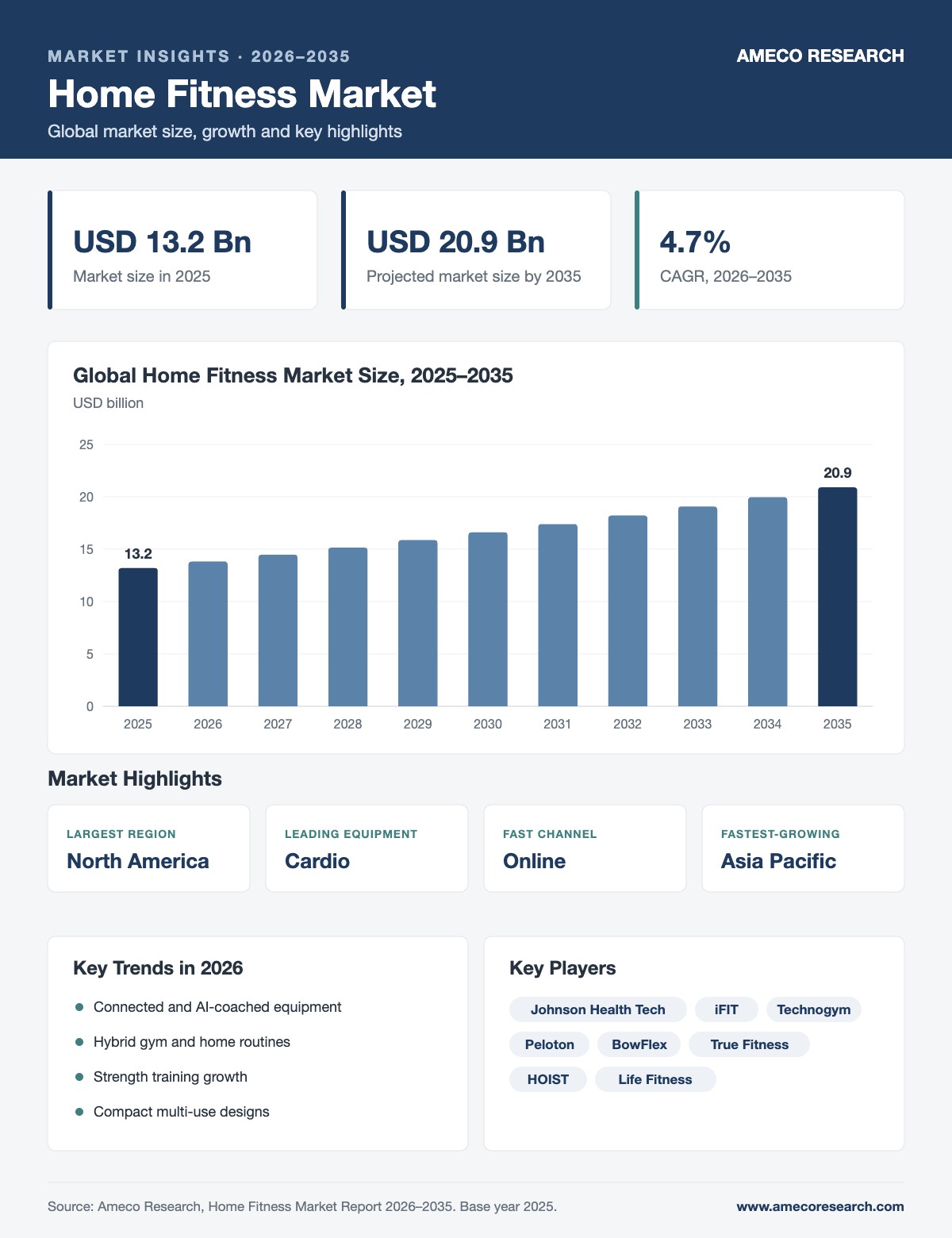 Infographic: Home Fitness Market Size and Growth Opportunities and Forecast till 2026 - 2035 | Ameco Research
Home Fitness Market Report Scope
| Report Attribute | Details |
| Home Fitness Market Size in 2025 | USD 13.2 Billion |
| Home Fitness Market Forecast by 2035 | USD 20.9 Billion |
| Home Fitness Market CAGR (2026–2035) | 4.7% |
| Analysis Period | 2023–2035 |
| Base Year | 2025 |
| Forecast Period | 2026–2035 |
| Segments Covered | by Equipment, by Sales Channel, by End-Use, and By Region |
| Regional Scope | North America, Europe, Asia Pacific, Latin America, and Middle East & Africa |
| Key Companies Profiled | Johnson Health Tech. Co., Ltd., iFIT Health & Fitness (formerly ICON Health & Fitness), Technogym, Peloton Interactive (incl. Precor), Nautilus / BowFlex, True Fitness, HOIST Fitness Systems, and Life Fitness |
| Report Coverage | Market Trends, Drivers, Restraints, Opportunities, Competitive Analysis, Player Profiling, Regulation Analysis |
Home Fitness Market Size Forecast, 2023–2035
Figures for 2025–2035 extend the earlier 2021 baseline of USD 11 billion at the report's 4.7% CAGR.
| Year | Market Size (USD Billion) |
| 2023 (historical) | 12.0 |
| 2024 (historical) | 12.6 |
| 2025 (base year) | 13.2 |
| 2026 (forecast) | 13.8 |
| 2027 (forecast) | 14.5 |
| 2028 (forecast) | 15.2 |
| 2029 (forecast) | 15.9 |
| 2030 (forecast) | 16.6 |
| 2031 (forecast) | 17.4 |
| 2032 (forecast) | 18.2 |
| 2033 (forecast) | 19.1 |
| 2034 (forecast) | 20.0 |
| 2035 (forecast) | 20.9 |
Latest Home Fitness Market Trends (2026)
Connected and AI-coached equipment
Treadmills, bikes, rowers and strength machines with screens and apps offer streamed classes, AI form feedback and personalized programs, often sold with subscriptions.
Hybrid fitness routines
After the pandemic boom and correction, many consumers now combine gym visits with home workouts, supporting steady demand for compact, quality home equipment.
Strength training growth
Interest in strength training for health and healthy aging is lifting sales of adjustable dumbbells, racks, benches and smart cable machines.
Compact and multi-use designs
Foldable treadmills, under-desk walking pads and space-saving multi-gyms suit apartments and small homes.
Resale and rental
Used equipment marketplaces, refurbishment and rental programs make home fitness more affordable and extend product life.
Industry consolidation
Some connected fitness brands have restructured or been acquired after the post-pandemic slowdown, while established equipment makers expand their connected ranges.
Home Fitness Market Dynamics
Growth drivers
- Growing health and fitness awareness
- Convenience and time savings of home workouts
- Rising gym membership costs
- Connected equipment and streamed classes
- Growth of internet penetration and e-commerce
Restraints and challenges
- High prices of premium connected equipment
- Limited space in urban homes
- Low long-term use after initial purchase
- Competition from gyms and outdoor activities
Opportunities
Key opportunities include AI coaching, smart strength equipment, rental and subscription models, office and hotel fitness rooms, and growing middle-class demand in Asia Pacific and Latin America.
Home Fitness Market Segment Analysis
By equipment
The market is segmented into cardiovascular equipment (climbers, elliptical machines, exercise bikes, treadmills and others) and strength training equipment (barbells and racks, extension machines, weightlifting equipment, power racks, weights and others). Cardiovascular equipment is expected to dominate, while strength training equipment grows quickly.
By sales channel
Sales channels include online and offline. Offline stores remain important for large equipment that buyers want to try, while online sales grow significantly with e-commerce and direct-to-consumer brands.
By end-use
End-uses include home, health clubs, office and hotel. Home use holds the largest share, while offices and hotels add demand for compact, durable equipment.
Home Fitness Market Regional Analysis
North America holds the largest share, supported by high-value homes with home gyms, health awareness, strong online retail and many fitness equipment brands.
Asia Pacific is expected to grow fastest, driven by rising incomes, urban fitness trends and e-commerce in China, India, Japan and Southeast Asia. Europe is a major market with strong demand for compact equipment.
Latin America and the Middle East & Africa are growing markets, supported by rising health awareness.
Home Fitness Market Segmentation
Home Fitness Market Leading Companies
The home fitness market includes established fitness equipment makers, connected fitness brands and sports and consumer goods companies. Companies compete on product quality, connected features and content, design, price, financing and online and retail distribution. Key players profiled in this report include Johnson Health Tech. Co., Ltd., iFIT Health & Fitness (formerly ICON Health & Fitness), Technogym, Peloton Interactive (incl. Precor), Nautilus / BowFlex, True Fitness, HOIST Fitness Systems, and Life Fitness.
Johnson Health Tech. Co., Ltd.iFIT Health & Fitness (formerly ICON Health & Fitness)TechnogymPeloton Interactive (incl. Precor)Nautilus / BowFlexTrue FitnessHOIST Fitness SystemsLife Fitness
Key Questions Answered in This Report
- What is the size of the home fitness market in 2025, and how large will it be by 2030 and 2035?
- What are the main growth drivers, restraints and opportunities through 2035?
- Which by equipment and by sales channel segments will grow the fastest?
- Which regions and countries offer the largest and fastest-growing opportunities?
- How are connected equipment, AI coaching and hybrid fitness routines shaping home fitness in 2026?
- Who are the leading companies, and what strategies are they using to compete?
Research Methodology
Ameco Research built this forecast from a mix of primary and secondary research. Analysts spoke with fitness equipment makers, connected fitness brands, retailers and e-commerce platforms to validate pricing, volumes and demand trends, and reviewed company filings, trade statistics, regulatory documents and industry publications. The home fitness market size was estimated with bottom-up and top-down approaches and validated through data triangulation, with 2025 as the base year and forecasts for 2026–2035.
Related Reports
- Nutrition & Weight Management Market Report
- Liver Health Supplements Market Report
- Vegan Supplements Market Report
- Complete Nutrition Products Market Report
- Artificial Intelligence in Sports Market Report
Home Fitness Market: Frequently Asked Questions
How big is the home fitness market?
The global home fitness market was valued at USD 13.2 billion in 2025 and is expected to reach USD 20.9 billion by 2035.
What is the growth rate of the home fitness market?
The home fitness market is projected to grow at a CAGR of 4.7% from 2026 to 2035.
What will the home fitness market be worth in 2030?
The home fitness market is projected to reach about USD 16.6 billion in 2030, growing at a CAGR of 4.7%.
What is driving growth in the home fitness market?
Key drivers are health and fitness awareness, the convenience of home workouts, rising gym costs, connected equipment and e-commerce growth.
What is home fitness?
The home fitness market covers cardio and strength training equipment used for exercise at home and in offices, hotels and small health clubs.
Which region leads the home fitness market?
North America holds the largest share, while Asia Pacific is expected to grow fastest.
Which segment holds the largest share of the home fitness market?
Cardiovascular equipment is expected to dominate, home use holds the largest share, and online sales are growing significantly.
What are the latest trends in the home fitness market?
The main 2026 trends are connected and AI-coached equipment, hybrid fitness routines, strength training growth, compact and multi-use designs, resale and rental and industry consolidation.
What are the main challenges in the home fitness market?
The main challenges are high prices of premium equipment, limited home space, low long-term usage and competition from gyms.
What is connected home fitness equipment?
Connected equipment includes treadmills, bikes, rowers and strength machines with screens or apps that stream classes, track performance and offer personalized coaching.
Who are the key players in the home fitness market?
Leading companies include Johnson Health Tech. Co., Ltd., iFIT Health & Fitness (formerly ICON Health & Fitness), Technogym, Peloton Interactive (incl. Precor), Nautilus / BowFlex, True Fitness, HOIST Fitness Systems, and Life Fitness.