HVAC Filters Market Size and Growth Opportunities and Forecast till 2026 - 2035
HVAC Filters Market Size, Share & Trends Report, 2026–2035
LAST UPDATED: OCTOBER 2026
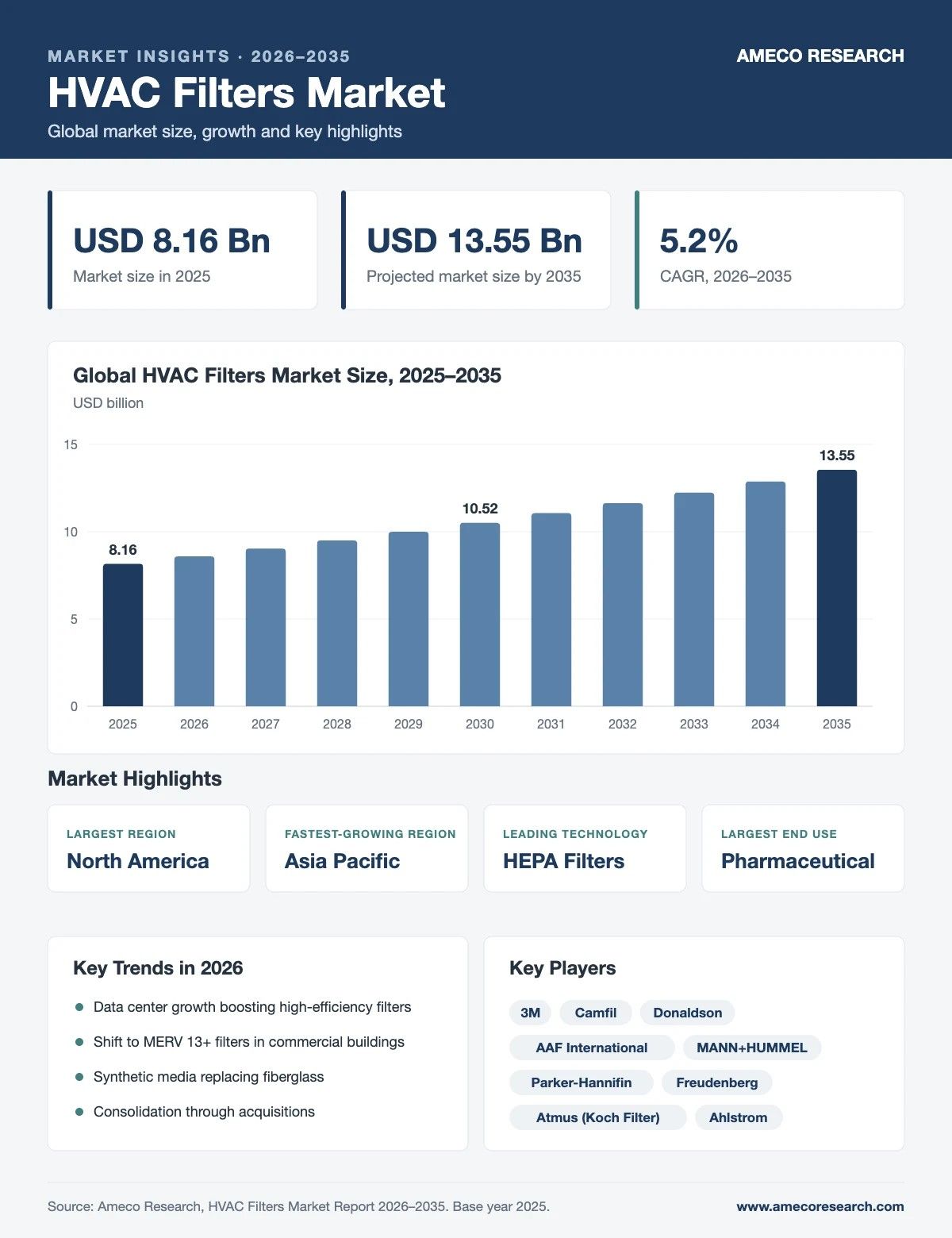
The global HVAC Filters Market size was valued at USD 8,161 million in 2025 and is projected to reach USD 13,548 million by 2035, growing at a CAGR of 5.2% from 2026 to 2035. Demand is driven by rising concern over indoor air quality (IAQ), stricter ventilation and filtration standards, steady construction activity, and fast-growing filtration needs in pharmaceuticals, healthcare and AI-driven data centers.
HVAC filters are replaceable filtration media installed in heating, ventilation and air-conditioning systems to capture dust, pollen, smoke, microbes and gaseous pollutants before air is recirculated. They protect occupants' health, keep HVAC equipment clean and efficient, and extend system life. Filter efficiency is rated mainly on the MERV scale (Minimum Efficiency Reporting Value, typically 1–16), while HEPA filters capture at least 99.97% of airborne particles at 0.3 microns.
HVAC Filters Market Key Takeaways
HVAC Filters Market Report Scope
| Report Attribute | Details |
| HVAC Filters Market Size in 2025 | USD 8,161 Million |
| HVAC Filters Market Forecast by 2035 | USD 13,548 Million |
| HVAC Filters Market CAGR (2026–2035) | 5.2% |
| Analysis Period | 2021–2035 |
| Base Year | 2025 |
| Forecast Period | 2026–2035 |
| Segments Covered | By Material, By Technology, By End-Use Industry, and By Region |
| Regional Scope | North America, Europe, Asia Pacific, Latin America, and Middle East & Africa |
| Key Companies Profiled | 3M, Ahlstrom, American Air Filter Company, Inc. (AAF International), Atmus Filtration Technologies (Koch Filter), Camfil, Donaldson Company, Inc., Filtration Group, Freudenberg Filtration Technologies, MANN+HUMMEL, and Parker-Hannifin Corporation |
| Report Coverage | Market Trends, Drivers, Restraints, Opportunities, Competitive Analysis, Player Profiling, Regulation Analysis |
Latest HVAC Filters Market Trends (2026)
Data centers become a core demand driver
AI and cloud workloads are pushing data center construction to record levels, with JLL projecting global data center capacity to nearly double between 2025 and 2030. These facilities run continuous airflow around densely packed servers, so operators specify high-efficiency particulate filters with low pressure drop, along with gas-phase (molecular) filtration to prevent corrosion of electronics. Filter makers now treat data centers as a priority vertical rather than a niche.
Consolidation reshapes the competitive landscape
In January 2026, Atmus Filtration Technologies completed its acquisition of Koch Filter Corporation for about USD 450 million, creating a new Industrial Solutions segment focused on commercial and industrial HVAC, data centers and power generation. Rensa Filtration completed its tenth add-on acquisition in April 2026 by buying Air Filters Northwest, and AAF International continues to buy regional filter-service firms. Larger players are acquiring distribution and on-site service capacity to secure recurring filter-replacement revenue.
MERV 13 and higher move into the mainstream
Repeated wildfire-smoke seasons, post-pandemic health awareness and guidance such as ASHRAE Standard 241, which links required clean-air delivery to building occupancy to control infectious aerosols, are pushing offices, schools and commercial buildings toward MERV 13 and above. Manufacturers are responding with deeper-pleat and synthetic media designs that raise efficiency without a large energy penalty.
Synthetic media replaces fiberglass
Polyester and polypropylene media offer higher dust-holding capacity, lower pressure drop and longer service life than fiberglass. That combination reduces fan energy use and replacement frequency, making synthetic polymer one of the fastest-growing material segments in the HVAC filters market.
Smart, IoT-enabled filter monitoring
Pressure sensors and connected building-management systems now track filter loading in real time, replacing calendar-based change-outs. Facility managers use this data to optimize replacement intervals and energy use, while suppliers bundle monitoring with subscription replacement programs.
Sustainability and lifecycle cost
Green building certifications and decarbonization targets are increasing demand for energy-efficient, low-pressure-drop filters, recyclable frames and used-filter recycling services. Total lifecycle cost (energy plus replacement) is replacing purchase price as the main buying criterion in commercial projects.
Tariffs and raw-material costs
Tariffs have raised the cost of imported synthetic polymers, metals, activated carbon and filtration media. Manufacturers are localizing media production and passing through price increases, accelerating regional supply-chain investment, particularly in North America.
HVAC Filters Market Dynamics
Growth drivers
- Rising awareness of the health effects of indoor air pollution, allergens and airborne pathogens
- Stricter air quality and ventilation standards for commercial, healthcare and public buildings
- Expansion of residential, commercial and industrial construction, especially in Asia Pacific
- Growth of pharmaceutical manufacturing, cleanrooms, food processing and data centers
- Recurring replacement demand from a large installed base of HVAC systems
Restraints and challenges
- Higher pressure drop from high-efficiency filters can reduce airflow and raise fan energy use if systems are not designed for it
- Raw-material price volatility and tariff-related cost increases
- Low awareness of correct replacement intervals in the residential segment
- Price competition from low-cost unbranded filters sold online
Understanding MERV ratings
The MERV scale runs from 1 at the low end to 16 at the high end; the higher the rating, the better the filter captures fine airborne particles. MERV 13–16 filters are standard in hospitals and surgical centers, and ASHRAE recommends MERV 13 or higher for commercial buildings where the system can support it. If a system cannot handle a top-rated filter, the highest MERV filter it can accommodate is the best choice.
HVAC Filters Market Segment Analysis
By material
The market is segmented into synthetic polymer, carbon, fiberglass and others. Synthetic polymer holds a significant share of the HVAC filters market. These media are produced as pleats or expanded films using spun-bond or melt-blown processes; pleating increases surface area so the filter captures more airborne particles.
By technology
Segments include HEPA, activated carbon, electrostatic precipitators and others (UV filtration and ionic filtration). HEPA filters generate the largest market share because they remove at least 99.97% of dust, mold, pollen, bacteria, viruses and other fine particles, making them the standard for healthcare, pharmaceutical, cleanroom and critical data center applications.
By end-use industry
The end-use segment covers automotive, building & construction, food & beverage, pharmaceutical and others (electronics & semiconductors, data centers and livestock). Pharmaceuticals account for the largest share, as drug manufacturing relies on HEPA filtration and high MERV ratings to keep fine particulates out of production areas. Building & construction is a major volume segment, while data centers and food & beverage are among the fastest-growing applications.
HVAC Filters Market Regional Analysis
North America dominates the global HVAC filters market, supported by a mature pharmaceutical and healthcare sector, widespread adoption of high-MERV filters, ASHRAE guidance, wildfire-smoke events and the concentration of hyperscale data center construction in the United States.
Asia Pacific is expected to record the fastest CAGR during 2026–2035. Large-scale construction and infrastructure projects, rapid urbanization, severe urban air pollution and growing manufacturing and data center investment in China, India, Japan and Southeast Asia are propelling demand.
Europe growth is shaped by energy-efficiency regulation, ISO 16890 filter classification and building renovation programs that favor low-energy, high-efficiency filters. Latin America and the Middle East & Africa are smaller but growing markets, with demand tied to commercial construction, healthcare and, in the Gulf states, dusty climates and new data center hubs.
HVAC Filters Market Segmentation
HVAC Filters Market Leading Companies
The HVAC filters market is moderately fragmented, with global leaders competing alongside regional manufacturers and private-label suppliers on media technology, energy efficiency, certification and service-network reach. Key players profiled in this report include 3M, Ahlstrom, American Air Filter Company, Inc. (AAF International, a Daikin company), Atmus Filtration Technologies (Koch Filter), Camfil, Donaldson Company, Inc., Filtration Group, Freudenberg Filtration Technologies, MANN+HUMMEL, and Parker-Hannifin Corporation.
3MAhlstromAAF International (Daikin)Atmus Filtration (Koch Filter)CamfilDonaldsonFiltration GroupFreudenbergMANN+HUMMELParker-Hannifin
Recent developments
HVAC Filters Market: Frequently Asked Questions
How big is the HVAC filters market?
The global HVAC filters market was valued at USD 8,161 million in 2025 and is expected to reach USD 13,548 million by 2035.
What is the growth rate of the HVAC filters market?
The HVAC filters market is projected to grow at a CAGR of 5.2% from 2026 to 2035.
What is driving growth in the HVAC filters market?
Key drivers are rising indoor air quality awareness, stricter ventilation and filtration standards, construction growth, and rising demand from pharmaceuticals, healthcare and data centers.
Which region dominates the HVAC filters market?
North America holds the largest share of the HVAC filters market, while Asia Pacific is the fastest-growing region.
Which HVAC filter technology holds the largest share?
HEPA filters account for the largest technology share of the HVAC filters market.
What are the latest trends in the HVAC filters market?
The main 2026 trends are data center demand, industry consolidation, wider adoption of MERV 13+ filters, synthetic filter media, IoT-based filter monitoring, sustainable filter lifecycles and tariff-driven supply-chain localization.
Who are the key players in the HVAC filters market?
Leading companies include 3M, Ahlstrom, AAF International, Atmus Filtration (Koch Filter), Camfil, Donaldson, Filtration Group, Freudenberg, MANN+HUMMEL and Parker-Hannifin.