Hybrid Drive Train Market Size and Growth Opportunities and Forecast till 2026 - 2035
Hybrid Drive Train Market Size, Share & Trends Report, 2026–2035
LAST UPDATED: OCTOBER 2026
The global Hybrid Drive Train Market size was valued at USD 165.0 billion in 2025 and is projected to reach USD 490.0 billion by 2035, growing at a CAGR of 11.5% from 2026 to 2035. Growth is driven by strong hybrid vehicle sales as buyers seek fuel savings without range or charging concerns, stricter CO2 and fuel economy rules, automakers adding hybrid versions across their lineups, fast growth of plug-in and range-extended hybrids in China, and 48V mild hybrid systems in Europe.
A hybrid drive train combines an internal combustion engine with one or more electric motors, a battery and power electronics to move a vehicle. Depending on the design, the electric motor assists the engine, drives the wheels alone at low speeds, or acts as a generator. Main levels include mild hybrids (MHEV, usually 48V), full hybrids (HEV) and plug-in hybrids (PHEV), arranged in parallel, series or series-parallel (power-split) configurations. Key components include engines, electric motors, hybrid transmissions, inverters, batteries and control units.
Hybrid Drive Train Market Key Takeaways
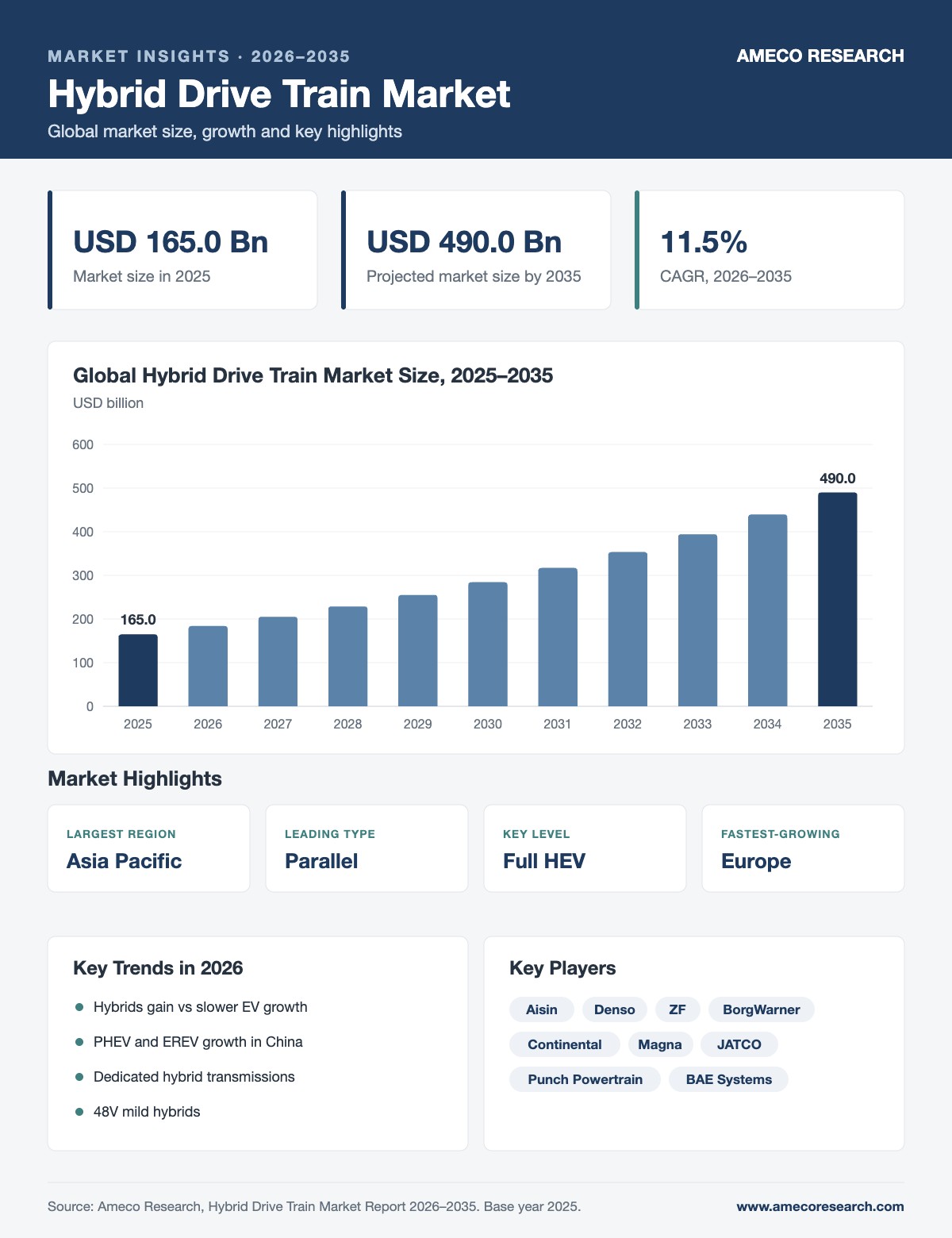 Infographic: Hybrid Drive Train Market Size and Growth Opportunities and Forecast till 2026 - 2035 | Ameco Research
Hybrid Drive Train Market Report Scope
| Report Attribute | Details |
| Hybrid Drive Train Market Size in 2025 | USD 165.0 Billion |
| Hybrid Drive Train Market Forecast by 2035 | USD 490.0 Billion |
| Hybrid Drive Train Market CAGR (2026–2035) | 11.5% |
| Analysis Period | 2023–2035 |
| Base Year | 2025 |
| Forecast Period | 2026–2035 |
| Segments Covered | by Level, by Type, by Component, and By Region |
| Regional Scope | North America, Europe, Asia Pacific, Latin America, and Middle East & Africa |
| Key Companies Profiled | Aisin Corporation, Denso Corporation, ZF Friedrichshafen AG (ZF Group), BorgWarner Inc. (incl. former Delphi Technologies), Continental AG, Magna International Inc., JATCO Ltd, Punch Powertrain NV, Hofer Powertrain, OBRIST Group, and BAE Systems plc |
| Report Coverage | Market Trends, Drivers, Restraints, Opportunities, Competitive Analysis, Player Profiling, Regulation Analysis |
Hybrid Drive Train Market Size Forecast, 2023–2035
The table below shows the year-by-year size of the global hybrid drive train market. Revenue is expected to grow about 3.0 times between 2025 and 2035, reaching roughly USD 284.3 billion by 2030.
| Year | Market Size (USD Billion) |
| 2023 (historical) | 132.7 |
| 2024 (historical) | 148.0 |
| 2025 (base year) | 165.0 |
| 2026 (forecast) | 184.0 |
| 2027 (forecast) | 205.1 |
| 2028 (forecast) | 228.7 |
| 2029 (forecast) | 255.0 |
| 2030 (forecast) | 284.3 |
| 2031 (forecast) | 317.0 |
| 2032 (forecast) | 353.5 |
| 2033 (forecast) | 394.1 |
| 2034 (forecast) | 439.5 |
| 2035 (forecast) | 490.0 |
Latest Hybrid Drive Train Market Trends (2026)
Hybrids gain as EV adoption slows in some markets
With slower battery electric vehicle growth in North America and parts of Europe, automakers are expanding hybrid lineups to meet emissions rules and customer demand for fuel savings without charging.
Plug-in and range-extended hybrids in China
China has seen strong growth in plug-in and range-extended electric vehicles, which combine large batteries with small engines that act mainly as generators.
Dedicated hybrid transmissions
Suppliers and automakers are developing dedicated hybrid transmissions that integrate motors and gears, reducing cost, size and weight compared with adapted conventional gearboxes.
48V mild hybrids
Mild hybrid systems using 48V batteries and starter-generators are widely used in Europe to cut fuel consumption at relatively low cost.
Cost reduction and localization
Suppliers are lowering hybrid system costs through higher-volume production, shared electric drive components and local supply chains in Asia, Europe and North America.
Commercial vehicle hybrids
Hybrid drivetrains are also used in buses, delivery trucks and work vehicles to cut fuel use in stop-and-go operation.
Hybrid Drive Train Market Dynamics
Growth drivers
- Demand for fuel-efficient vehicles without charging concerns
- Stricter CO2 and fuel economy regulations
- Government incentives and tax benefits for hybrid and electric vehicles
- Automakers expanding hybrid lineups
- Rising consumer spending power in developing nations
Restraints and challenges
- Higher cost than conventional powertrains
- Complexity of combining engines and electric systems
- Competition from battery electric vehicles in the long term
- Policy changes reducing hybrid incentives in some markets
Opportunities
Key opportunities include dedicated hybrid transmissions, range-extended EVs, hybrid pickups and SUVs, commercial vehicle hybrids, and growing hybrid markets in India and Southeast Asia.
Hybrid Drive Train Market Segment Analysis
By level
The market is segmented into full HEV, mild HEV and PHEV. Full hybrids hold a large share, plug-in hybrids are growing strongly with range-extended designs in China, and mild hybrids are widely used in Europe.
By type
Types include parallel, series-parallel and series. Parallel hybrids hold the largest share because they are common in mild and full hybrid passenger cars, while series hybrids are growing with range-extended EVs.
By component
Components are grouped by HEV and PHEV systems, including engines, electric motors, hybrid transmissions, power electronics and batteries. Batteries and electric drive components account for a growing share of system value.
Hybrid Drive Train Market Regional Analysis
Asia Pacific holds the largest share, led by China's financial and non-financial incentives for new energy vehicles and Japan's long-established hybrid market.
Europe is expected to grow fastest, as automakers use mild and plug-in hybrids to meet strict CO2 targets. North America is a major market where hybrid sales have grown strongly in recent years.
Latin America and the Middle East & Africa are smaller markets, with flex-fuel hybrids emerging in Brazil.
Hybrid Drive Train Market Segmentation
Hybrid Drive Train Market Leading Companies
The hybrid drive train market includes automotive transmission and electric drive suppliers, Tier 1 component makers, engineering firms and automakers with in-house hybrid systems. Companies compete on efficiency, cost, packaging, integration of motors and transmissions, and supply relationships with automakers. Key players profiled in this report include Aisin Corporation, Denso Corporation, ZF Friedrichshafen AG (ZF Group), BorgWarner Inc. (incl. former Delphi Technologies), Continental AG, Magna International Inc., JATCO Ltd, Punch Powertrain NV, Hofer Powertrain, OBRIST Group, and BAE Systems plc.
Aisin CorporationDenso CorporationZF Friedrichshafen AG (ZF Group)BorgWarner Inc. (incl. former Delphi Technologies)Continental AGMagna International Inc.JATCO LtdPunch Powertrain NVHofer PowertrainOBRIST GroupBAE Systems plc
Key Questions Answered in This Report
- What is the size of the hybrid drive train market in 2025, and how large will it be by 2030 and 2035?
- What are the main growth drivers, restraints and opportunities through 2035?
- Which by level and by type segments will grow the fastest?
- Which regions and countries offer the largest and fastest-growing opportunities?
- How are slower EV growth, range-extended hybrids and dedicated hybrid transmissions shaping the market in 2026?
- Who are the leading companies, and what strategies are they using to compete?
Research Methodology
This report combines primary and secondary research. Primary research includes interviews with automakers, drivetrain and component suppliers, industry associations and vehicle sales data. Secondary research covers company annual reports, investor presentations, government and trade association data, patent filings and industry publications. Market size is estimated using both bottom-up (company revenue and production data) and top-down (end-use demand) methods, and results are cross-checked through data triangulation before forecasts are built for 2026–2035.
Related Reports
- Hybrid Electric Powertrain Market Report
- Variable Frequency Drive Market Report
- Hybrid Valve Market Report
- Utility Terrain Vehicles Market Report
- Ride Hailing Services Market Report
Hybrid Drive Train Market: Frequently Asked Questions
How big is the hybrid drive train market?
The global hybrid drive train market was valued at USD 165.0 billion in 2025 and is expected to reach USD 490.0 billion by 2035.
What is the growth rate of the hybrid drive train market?
The hybrid drive train market is projected to grow at a CAGR of 11.5% from 2026 to 2035.
What will the hybrid drive train market be worth in 2030?
The hybrid drive train market is projected to reach about USD 284.3 billion in 2030, growing at a CAGR of 11.5%.
What is driving growth in the hybrid drive train market?
Key drivers are demand for fuel-efficient vehicles, CO2 and fuel economy rules, incentives for hybrid and electric vehicles, and automakers expanding hybrid lineups.
What is hybrid drive train?
A hybrid drive train combines an engine with electric motors, a battery and power electronics to drive a vehicle more efficiently.
Which region leads the hybrid drive train market?
Asia Pacific holds the largest share, while Europe is expected to grow fastest.
Which segment holds the largest share of the hybrid drive train market?
Parallel hybrids hold the largest type share, full hybrids hold a large level share, and plug-in hybrids are growing strongly.
What are the latest trends in the hybrid drive train market?
The main 2026 trends are hybrids gain as EV adoption slows in some markets, plug-in and range-extended hybrids in China, dedicated hybrid transmissions, 48V mild hybrids, cost reduction and localization and commercial vehicle hybrids.
What are the main challenges in the hybrid drive train market?
The main challenges are higher cost, system complexity, long-term competition from battery EVs and changes to incentives.
What is the difference between a mild hybrid and a full hybrid?
A mild hybrid uses a small electric motor to assist the engine and cannot drive on electric power alone, while a full hybrid can drive short distances using only its electric motor.
Who are the key players in the hybrid drive train market?
Leading companies include Aisin Corporation, Denso Corporation, ZF Friedrichshafen AG (ZF Group), BorgWarner Inc. (incl. former Delphi Technologies), Continental AG, Magna International Inc., JATCO Ltd, Punch Powertrain NV, Hofer Powertrain, OBRIST Group, and BAE Systems plc.
Related Automobile & Transportation Market Reports
- Utility Terrain Vehicles (UTV) Market Size and Growth Opportunities and Forecast till 2026 - 2035
- Automotive Operating Systems Market Size and Growth Opportunities and Forecast till 2026 - 2035
- E-Commerce Logistics Market Size and Growth Opportunities and Forecast till 2026 - 2035
- Engine Fastener Market Size and Growth Opportunities and Forecast till 2026 - 2035