Lignans Market Size and Growth Opportunities and Forecast till 2026 - 2035
Lignans Market Size, Share & Trends Report, 2026–2035
LAST UPDATED: OCTOBER 2026
The global Lignans Market size was valued at USD 504.7 million in 2025 and is projected to reach USD 1,002.1 million by 2035, growing at a CAGR of 7.1% from 2026 to 2035. Growth is driven by functional foods and dietary supplements for heart, hormonal and women's health, flaxseed and sesame ingredients, plant-based and clean-label nutrition, cosmetics and personal care, and research on lignans in healthy aging.
Lignans are polyphenolic plant compounds found in oilseeds such as flaxseed and sesame, whole grains, plant resins, vegetables and berries. Common lignans include secoisolariciresinol diglucoside (SDG) from flaxseed, sesamin from sesame and hydroxymatairesinol (HMR) from Norway spruce. They act as antioxidants and phytoestrogens and are converted by gut bacteria into enterolignans. Lignans are used in dietary supplements, functional foods and beverages, cosmetics and toiletries, pharmaceuticals and animal nutrition.
Lignans Market Key Takeaways
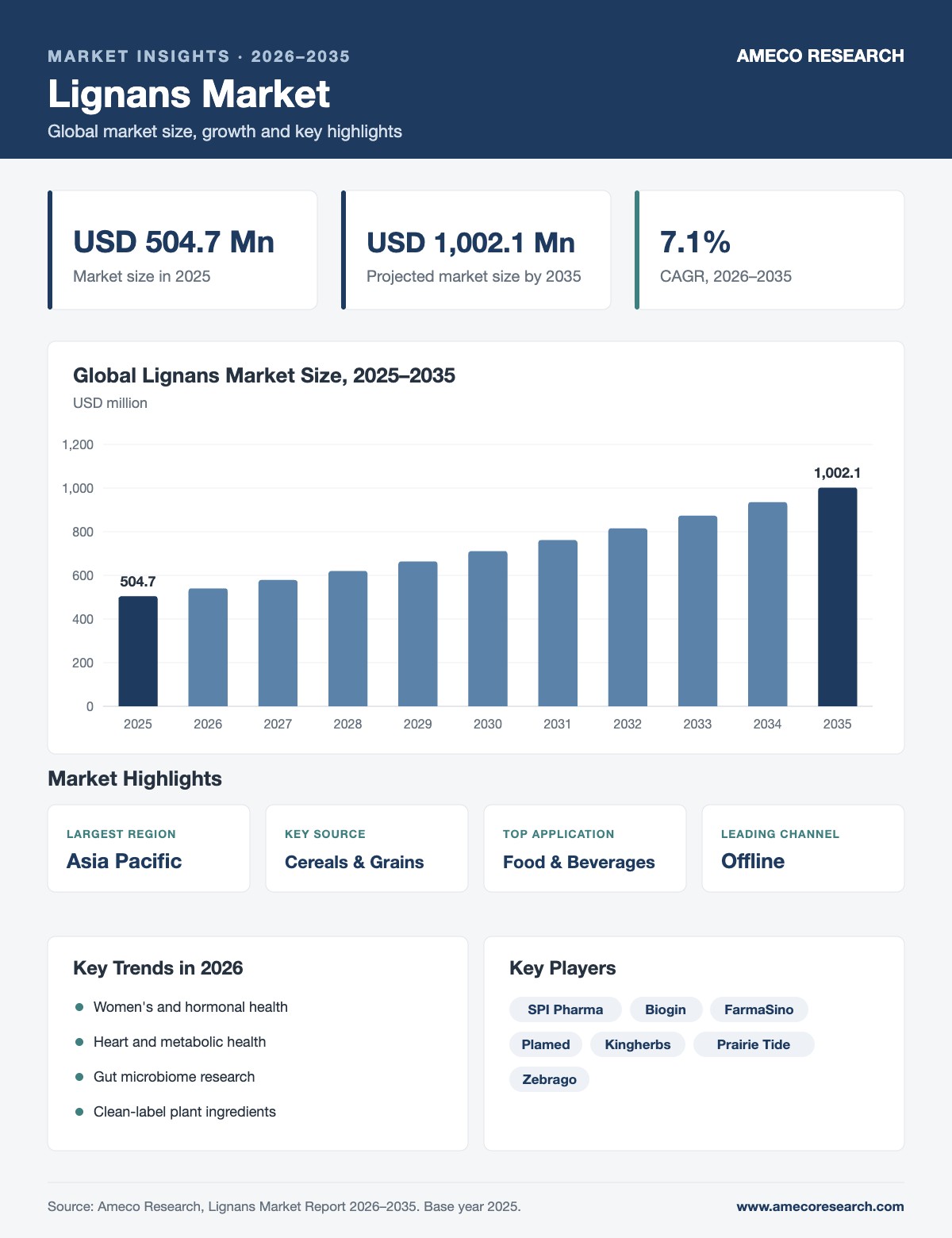 Infographic: Lignans Market Size and Growth Opportunities and Forecast till 2026 - 2035 | Ameco Research
Lignans Market Report Scope
| Report Attribute | Details |
| Lignans Market Size in 2025 | USD 504.7 Million |
| Lignans Market Forecast by 2035 | USD 1,002.1 Million |
| Lignans Market CAGR (2026–2035) | 7.1% |
| Analysis Period | 2023–2035 |
| Base Year | 2025 |
| Forecast Period | 2026–2035 |
| Segments Covered | by Source, by Application, by Distribution Channel, and By Region |
| Regional Scope | North America, Europe, Asia Pacific, Latin America, and Middle East & Africa |
| Key Companies Profiled | SPI Pharma, Biogin Biochemicals Co. Ltd., FarmaSino Pharmaceuticals (Jiangsu) Co. Ltd., Plamed Green Science Group, Kingherbs Naturalin Bio-resources Co. Ltd., Hebei Xinqidian Biotechnology Co. Ltd., TSKG Products, LLC, Xi'an Sinuote Bio-Tech Co. Ltd., Prairie Tide Diversified Inc., and Shaanxi Zebrago Industrial Co. Ltd. |
| Report Coverage | Market Trends, Drivers, Restraints, Opportunities, Competitive Analysis, Player Profiling, Regulation Analysis |
Lignans Market Size Forecast, 2023–2035
The table below shows the year-by-year size of the global lignans market, with figures rolled forward from the 2022 base at the report's 7.1% CAGR.
| Year | Market Size (USD Million) |
| 2023 (historical) | 440.0 |
| 2024 (historical) | 471.2 |
| 2025 (base year) | 504.7 |
| 2026 (forecast) | 540.5 |
| 2027 (forecast) | 578.9 |
| 2028 (forecast) | 620.0 |
| 2029 (forecast) | 664.0 |
| 2030 (forecast) | 711.2 |
| 2031 (forecast) | 761.7 |
| 2032 (forecast) | 815.7 |
| 2033 (forecast) | 873.6 |
| 2034 (forecast) | 935.7 |
| 2035 (forecast) | 1,002.1 |
Latest Lignans Market Trends (2026)
Women's and hormonal health
Lignans, especially flaxseed SDG, are marketed in supplements for menopause support and hormonal balance as women's health becomes a fast-growing supplement category.
Heart and metabolic health
Consumers looking for natural support for cholesterol, blood pressure and blood sugar are driving demand for flaxseed and sesame lignan products.
Gut microbiome research
Research on how gut bacteria convert lignans into active enterolignans is supporting interest in combining lignans with probiotics and fiber.
Clean-label plant-based ingredients
Food and beverage makers are adding whole grains, flaxseed and sesame to bakery, cereals and plant-based foods to boost natural lignan and fiber content.
Online sales of supplements
Although offline channels still dominate, e-commerce and direct-to-consumer brands are expanding the reach of lignan supplements.
Cosmetic antioxidants
Lignans such as sesamin and spruce-derived HMR are used as antioxidant and anti-aging actives in skin and hair care.
Lignans Market Dynamics
Growth drivers
- Rising demand for functional foods and supplements
- Interest in natural antioxidants and phytoestrogens
- Plant-based and clean-label food trends
- Aging populations and preventive health
- Use in cosmetics and animal nutrition
Restraints and challenges
- Limited clinical evidence for some health claims
- Strict rules on health claims in food and supplements
- Variable lignan content in raw materials
- Competition from other polyphenols and phytoestrogens
Opportunities
Key opportunities include standardized flaxseed and sesame extracts, women's health formulations, synbiotic products combining lignans and probiotics, cosmetic actives, pet and animal nutrition, and online supplement sales.
Lignans Market Segment Analysis
By source
The market is segmented into oilseed, plant resins, cereals and grains, and others. Cereals and grains gathered a significant share, while oilseeds such as flaxseed and sesame provide the most concentrated lignan extracts.
By application
Applications include cosmetics and toiletries (haircare, skincare, toiletries and others), food and beverages (functional food, functional beverages, dietary supplements and others), pharmaceuticals and animal nutrition. Food and beverages generated the largest market share.
By distribution channel
Channels include offline and online. The offline channel remains dominant, while the online channel is likely to grow over the forecast period.
Lignans Market Regional Analysis
Asia-Pacific leads the worldwide lignans market, supported by sesame and grain production, traditional plant medicine and a large food and supplement industry in China, Japan and India.
North America accounted for the second-largest share, with the United States as the leading country, driven by dietary supplements and functional foods. Europe is a significant market for flaxseed and spruce lignan ingredients.
Latin America and the Middle East & Africa are smaller but growing markets.
Lignans Market Segmentation
Lignans Market Leading Companies
The lignans market includes plant extract manufacturers, nutraceutical ingredient suppliers and oilseed processors, many based in China and North America. Companies compete on extract purity and standardization, raw material sourcing, regulatory documentation and supply to supplement, food and cosmetic brands. Key players profiled in this report include SPI Pharma, Biogin Biochemicals Co. Ltd., FarmaSino Pharmaceuticals (Jiangsu) Co. Ltd., Plamed Green Science Group, Kingherbs Naturalin Bio-resources Co. Ltd., Hebei Xinqidian Biotechnology Co. Ltd., TSKG Products, LLC, Xi'an Sinuote Bio-Tech Co. Ltd., Prairie Tide Diversified Inc., and Shaanxi Zebrago Industrial Co. Ltd..
SPI PharmaBiogin Biochemicals Co. Ltd.FarmaSino Pharmaceuticals (Jiangsu) Co. Ltd.Plamed Green Science GroupKingherbs Naturalin Bio-resources Co. Ltd.Hebei Xinqidian Biotechnology Co. Ltd.TSKG Products, LLCXi'an Sinuote Bio-Tech Co. Ltd.Prairie Tide Diversified Inc.Shaanxi Zebrago Industrial Co. Ltd.
Key Questions Answered in This Report
- What is the size of the lignans market in 2025, and how large will it be by 2030 and 2035?
- What are the main growth drivers, restraints and opportunities through 2035?
- Which by source and by application segments will grow the fastest?
- Which regions and countries offer the largest and fastest-growing opportunities?
- How are women's health, gut microbiome research and clean-label trends shaping lignan demand in 2026?
- Who are the leading companies, and what strategies are they using to compete?
Research Methodology
Our estimates draw on interviews with plant extract manufacturers, nutraceutical brands, food and cosmetic companies, and distributors, supported by secondary data from annual reports, investor materials, trade and customs data, standards bodies and industry journals. Bottom-up estimates of company revenues and top-down estimates of application demand are reconciled through data triangulation, and the model is updated with 2026 developments to forecast the market through 2035.
Related Reports
- Vegan Supplements Market Report
- Botanical Supplements Market Report
- Mobile Power Plant Market Report
- Functional Apparel Market Report
- Food Service Packaging Market Report
Lignans Market: Frequently Asked Questions
How big is the lignans market?
The global lignans market was valued at USD 504.7 million in 2025 and is expected to reach USD 1,002.1 million by 2035.
What is the growth rate of the lignans market?
The lignans market is projected to grow at a CAGR of 7.1% from 2026 to 2035.
What will the lignans market be worth in 2030?
The lignans market is projected to reach about USD 711.2 million in 2030, growing at a CAGR of 7.1%.
What is driving growth in the lignans market?
Key drivers are demand for functional foods and supplements, natural antioxidants and phytoestrogens, plant-based trends and preventive health for aging populations.
What are lignans?
Lignans are polyphenol compounds found in flaxseed, sesame, whole grains and other plants that act as antioxidants and phytoestrogens and are used in supplements, foods and cosmetics.
Which region leads the lignans market?
Asia-Pacific leads the market, while North America, led by the United States, holds the second-largest share.
Which segment holds the largest share of the lignans market?
Food and beverages is the largest application, cereals and grains hold a significant share by source and offline is the dominant channel.
What are the latest trends in the lignans market?
The main 2026 trends are women's and hormonal health, heart and metabolic health, gut microbiome research, clean-label plant-based ingredients, online sales of supplements and cosmetic antioxidants.
What are the main challenges in the lignans market?
The main challenges are limited clinical evidence for some claims, strict health claim rules, variable raw material content and competition from other polyphenols.
Which foods are richest in lignans?
Flaxseed is by far the richest dietary source of lignans, followed by sesame seeds, whole grains such as rye and wheat bran, and some fruits and vegetables.
Who are the key players in the lignans market?
Leading companies include SPI Pharma, Biogin Biochemicals Co. Ltd., FarmaSino Pharmaceuticals (Jiangsu) Co. Ltd., Plamed Green Science Group, Kingherbs Naturalin Bio-resources Co. Ltd., Hebei Xinqidian Biotechnology Co. Ltd., TSKG Products, LLC, Xi'an Sinuote Bio-Tech Co. Ltd., Prairie Tide Diversified Inc., and Shaanxi Zebrago Industrial Co. Ltd..