Micro-Mobility Charging Infrastructure Market Size and Growth Opportunities and Forecast till 2026 - 2035
Micro-Mobility Charging Infrastructure Market Size, Share & Trends Report, 2026–2035
LAST UPDATED: OCTOBER 2026
The global Micro-Mobility Charging Infrastructure Market size was valued at USD 8.8 billion in 2025 and is projected to reach USD 64.3 billion by 2035, growing at a CAGR of 22% from 2026 to 2035. Growth is driven by the spread of shared e-scooter and e-bike fleets, rising personal e-bike ownership, city rules that require docked or hub-based parking and charging, battery-swapping networks for delivery riders, fire safety requirements for lithium-ion charging, and solar-powered and wireless charging stations.
Micro-mobility charging infrastructure includes the docks, charging stations, lockers, battery-swapping cabinets and wireless pads used to charge small electric vehicles such as e-bikes, e-scooters, e-unicycles and e-skateboards. It is installed on streets and sidewalks, at transit stations, workplaces, campuses, apartment buildings and homes, and is used by shared fleet operators, delivery riders and private owners. Systems can be wired or wireless and grid-connected, battery-buffered or solar powered.
Micro-Mobility Charging Infrastructure Market Key Takeaways
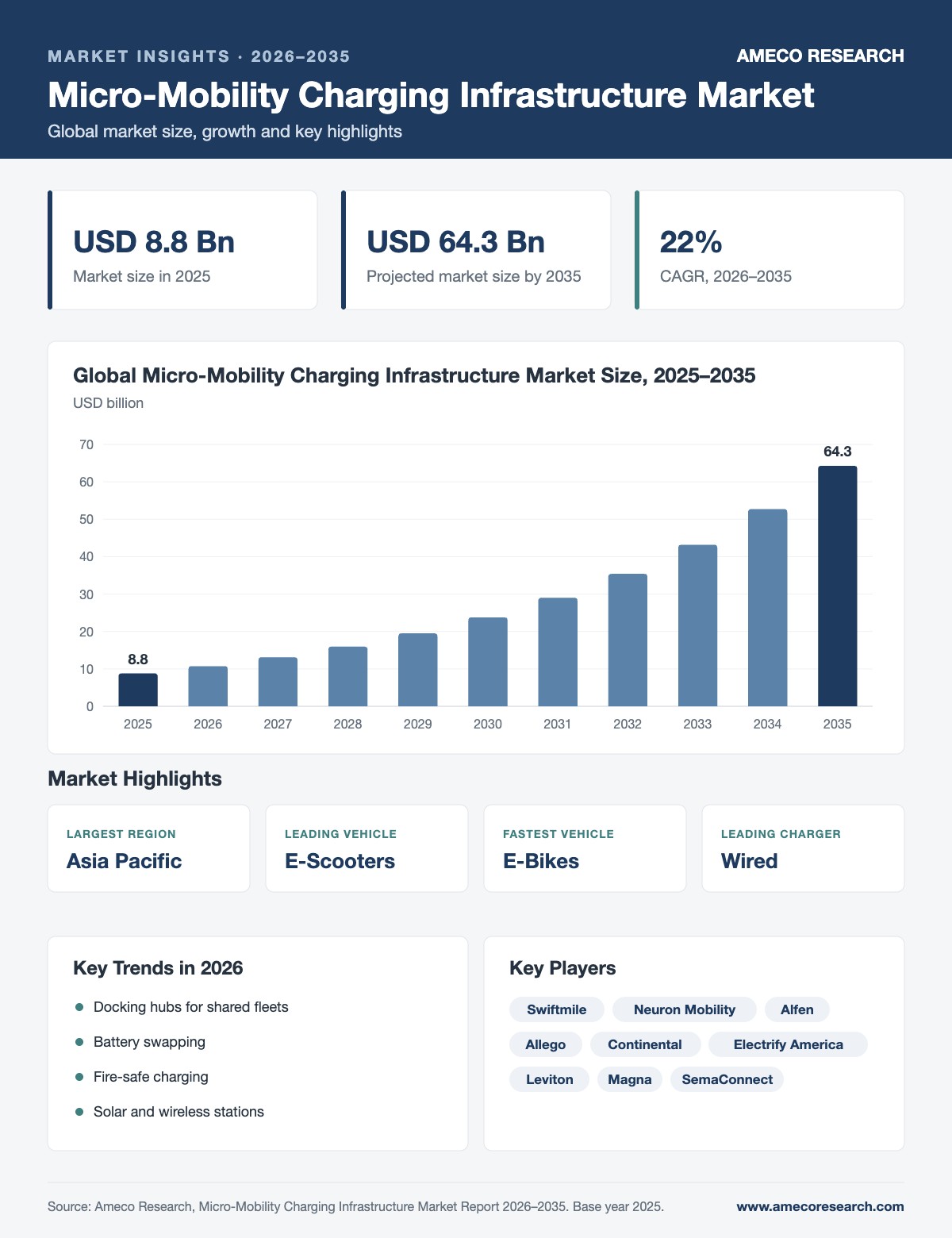 Infographic: Micro-Mobility Charging Infrastructure Market Size and Growth Opportunities and Forecast till 2026 - 2035 | Ameco Research
Micro-Mobility Charging Infrastructure Market Report Scope
| Report Attribute | Details |
| Micro-Mobility Charging Infrastructure Market Size in 2025 | USD 8.8 Billion |
| Micro-Mobility Charging Infrastructure Market Forecast by 2035 | USD 64.3 Billion |
| Micro-Mobility Charging Infrastructure Market CAGR (2026–2035) | 22% |
| Analysis Period | 2023–2035 |
| Base Year | 2025 |
| Forecast Period | 2026–2035 |
| Segments Covered | by Vehicle Type, by Charger Type, by Power Source, by End-Use, and By Region |
| Regional Scope | North America, Europe, Asia Pacific, Latin America, and Middle East & Africa |
| Key Companies Profiled | Swiftmile, Neuron Mobility, Alfen N.V., Allego B.V., Continental AG, Electrify America, Leviton Manufacturing Co., Inc., Magna International Inc., SemaConnect (Blink Charging), and Stable Auto Corporation |
| Report Coverage | Market Trends, Drivers, Restraints, Opportunities, Competitive Analysis, Player Profiling, Regulation Analysis |
Micro-Mobility Charging Infrastructure Market Size Forecast, 2023–2035
The table below shows the year-by-year size of the global micro-mobility charging infrastructure market. Revenue is expected to grow about 7.3 times between 2025 and 2035, reaching roughly USD 23.8 billion by 2030.
| Year | Market Size (USD Billion) |
| 2023 (historical) | 5.9 |
| 2024 (historical) | 7.2 |
| 2025 (base year) | 8.8 |
| 2026 (forecast) | 10.7 |
| 2027 (forecast) | 13.1 |
| 2028 (forecast) | 16.0 |
| 2029 (forecast) | 19.5 |
| 2030 (forecast) | 23.8 |
| 2031 (forecast) | 29.0 |
| 2032 (forecast) | 35.4 |
| 2033 (forecast) | 43.2 |
| 2034 (forecast) | 52.7 |
| 2035 (forecast) | 64.3 |
Latest Micro-Mobility Charging Infrastructure Market Trends (2026)
Docking hubs for shared fleets
Cities are asking shared e-scooter and e-bike operators to use designated parking and charging hubs to reduce sidewalk clutter, which lowers operating costs by cutting the need to collect vehicles for charging.
Battery swapping
Battery-swapping cabinets let delivery riders and shared fleets exchange depleted batteries in seconds, a model already common in Asian cities and spreading to Europe and North America.
Fire safety and certified charging
Lithium-ion battery fires in homes and apartment buildings have led to stricter safety standards, certified chargers and outdoor or fire-rated charging lockers.
Solar and off-grid stations
Solar-powered charging stations reduce installation costs where grid connections are expensive and support sustainability goals.
Wireless and universal charging
Wireless charging pads and universal docks that work across vehicle brands are being tested to simplify charging and reduce wear on connectors.
Integration with transit and buildings
Charging is being added at train stations, workplaces, campuses and residential buildings to support first- and last-mile trips.
Micro-Mobility Charging Infrastructure Market Dynamics
Growth drivers
- Growth of shared e-scooter and e-bike services
- Rising personal e-bike ownership and delivery rider demand
- City policies supporting low-emission urban transport
- Advances in charging technology, including wireless charging
- Improvements in battery technology and lower costs
Restraints and challenges
- Low awareness of shared mobility in some emerging economies
- Lack of regulations and standards for micro-mobility
- Battery fire risks and safety requirements
- Limited space and permitting challenges in dense cities
Opportunities
Key opportunities include battery-swapping networks, charging lockers for apartment buildings, solar-powered hubs, integration with public transit, and partnerships between cities, operators and property owners.
Micro-Mobility Charging Infrastructure Market Segment Analysis
By vehicle type
The market is segmented into e-bikes, e-scooters, e-unicycles and e-skateboards. E-scooters hold the largest share due to wide use in shared programs, while e-bikes are expected to grow fastest with rising ownership and charging station development.
By charger type and power source
Charger types include wired and wireless, with wired chargers holding the larger share. Power sources include solar powered and battery powered, with solar-powered stations gaining interest for off-grid sites.
By end-use
End-uses include commercial and residential. Residential charging holds a large share as owners charge at home, while commercial charging for shared fleets, workplaces and transit hubs is growing quickly.
Micro-Mobility Charging Infrastructure Market Regional Analysis
Asia Pacific holds the largest share, supported by major players and startups in micro-mobility projects, very large two-wheeler fleets and battery-swapping networks in China, India and Southeast Asia.
North America is expected to be a fast-growing market, driven by city programs, e-bike incentives and charging at transit and buildings. Europe is a major market with strong shared mobility and cycling infrastructure.
Latin America and the Middle East & Africa are emerging markets, with growth in delivery and shared fleets in major cities.
Micro-Mobility Charging Infrastructure Market Segmentation
Micro-Mobility Charging Infrastructure Market Leading Companies
The micro-mobility charging infrastructure market includes specialist dock and hub makers, shared mobility operators, EV charging companies and electrical equipment manufacturers. Companies compete on reliability, safety certification, compatibility across vehicle brands, installation cost and partnerships with cities and operators. Key players profiled in this report include Swiftmile, Neuron Mobility, Alfen N.V., Allego B.V., Continental AG, Electrify America, Leviton Manufacturing Co., Inc., Magna International Inc., SemaConnect (Blink Charging), and Stable Auto Corporation.
SwiftmileNeuron MobilityAlfen N.V.Allego B.V.Continental AGElectrify AmericaLeviton Manufacturing Co., Inc.Magna International Inc.SemaConnect (Blink Charging)Stable Auto Corporation
Key Questions Answered in This Report
- What is the size of the micro-mobility charging infrastructure market in 2025, and how large will it be by 2030 and 2035?
- What are the main growth drivers, restraints and opportunities through 2035?
- Which by vehicle type and by charger type segments will grow the fastest?
- Which regions and countries offer the largest and fastest-growing opportunities?
- How are docking hubs, battery swapping and fire safety rules shaping micro-mobility charging in 2026?
- Who are the leading companies, and what strategies are they using to compete?
Research Methodology
Our estimates draw on interviews with charging hardware makers, shared mobility operators, city transport agencies and property owners, supported by secondary data from annual reports, investor materials, trade and customs data, standards bodies and industry journals. Bottom-up estimates of company revenues and top-down estimates of application demand are reconciled through data triangulation, and the model is updated with 2026 developments to forecast the market through 2035.
Related Reports
- Electric Vehicle Charging Station Infrastructure Market Growth & Forecast to 2035 Report
- Smart Mobility Market Report
- Mobility as a Service Market Report
- Wireless EV Charging Market Report
- Electric Vehicle Charging Station Market Report
Micro-Mobility Charging Infrastructure Market: Frequently Asked Questions
How big is the micro-mobility charging infrastructure market?
The global micro-mobility charging infrastructure market was valued at USD 8.8 billion in 2025 and is expected to reach USD 64.3 billion by 2035.
What is the growth rate of the micro-mobility charging infrastructure market?
The micro-mobility charging infrastructure market is projected to grow at a CAGR of 22% from 2026 to 2035.
What will the micro-mobility charging infrastructure market be worth in 2030?
The micro-mobility charging infrastructure market is projected to reach about USD 23.8 billion in 2030, growing at a CAGR of 22%.
What is driving growth in the micro-mobility charging infrastructure market?
Key drivers are the growth of shared e-scooters and e-bikes, rising e-bike ownership, city policies for low-emission transport and advances in charging and battery technology.
What is micro-mobility charging infrastructure?
Micro-mobility charging infrastructure is the docks, stations, lockers and battery-swapping cabinets used to charge e-bikes, e-scooters and other small electric vehicles.
Which region leads the micro-mobility charging infrastructure market?
Asia Pacific holds the largest share, while North America is expected to be a fast-growing market.
Which segment holds the largest share of the micro-mobility charging infrastructure market?
E-scooters hold the largest vehicle share, e-bikes are growing fastest, and wired chargers lead by charger type.
What are the latest trends in the micro-mobility charging infrastructure market?
The main 2026 trends are docking hubs for shared fleets, battery swapping, fire safety and certified charging, solar and off-grid stations, wireless and universal charging and integration with transit and buildings.
What are the main challenges in the micro-mobility charging infrastructure market?
The main challenges are low awareness in some markets, limited regulations and standards, battery fire risks and space and permitting limits in cities.
What is micro-mobility battery swapping?
Battery swapping lets riders replace a depleted e-bike or e-scooter battery with a charged one at a cabinet in seconds, instead of waiting for the vehicle to charge.
Who are the key players in the micro-mobility charging infrastructure market?
Leading companies include Swiftmile, Neuron Mobility, Alfen N.V., Allego B.V., Continental AG, Electrify America, Leviton Manufacturing Co., Inc., Magna International Inc., SemaConnect (Blink Charging), and Stable Auto Corporation.
Related Automobile & Transportation Market Reports
- Automotive Electric HVAC Compressor Market Size and Growth Opportunities and Forecast till 2026 - 2035
- Ride-Hailing Services Market Size and Growth Opportunities and Forecast till 2026 - 2035
- Hybrid Drive Train Market Size and Growth Opportunities and Forecast till 2026 - 2035
- Utility Terrain Vehicles (UTV) Market Size and Growth Opportunities and Forecast till 2026 - 2035
- Automotive Operating Systems Market Size and Growth Opportunities and Forecast till 2026 - 2035