Offshore Wind Energy Market Size and Growth Opportunities and Forecast till 2026 - 2035
Offshore Wind Energy Market Size, Share & Trends Report, 2026–2035
LAST UPDATED: OCTOBER 2026
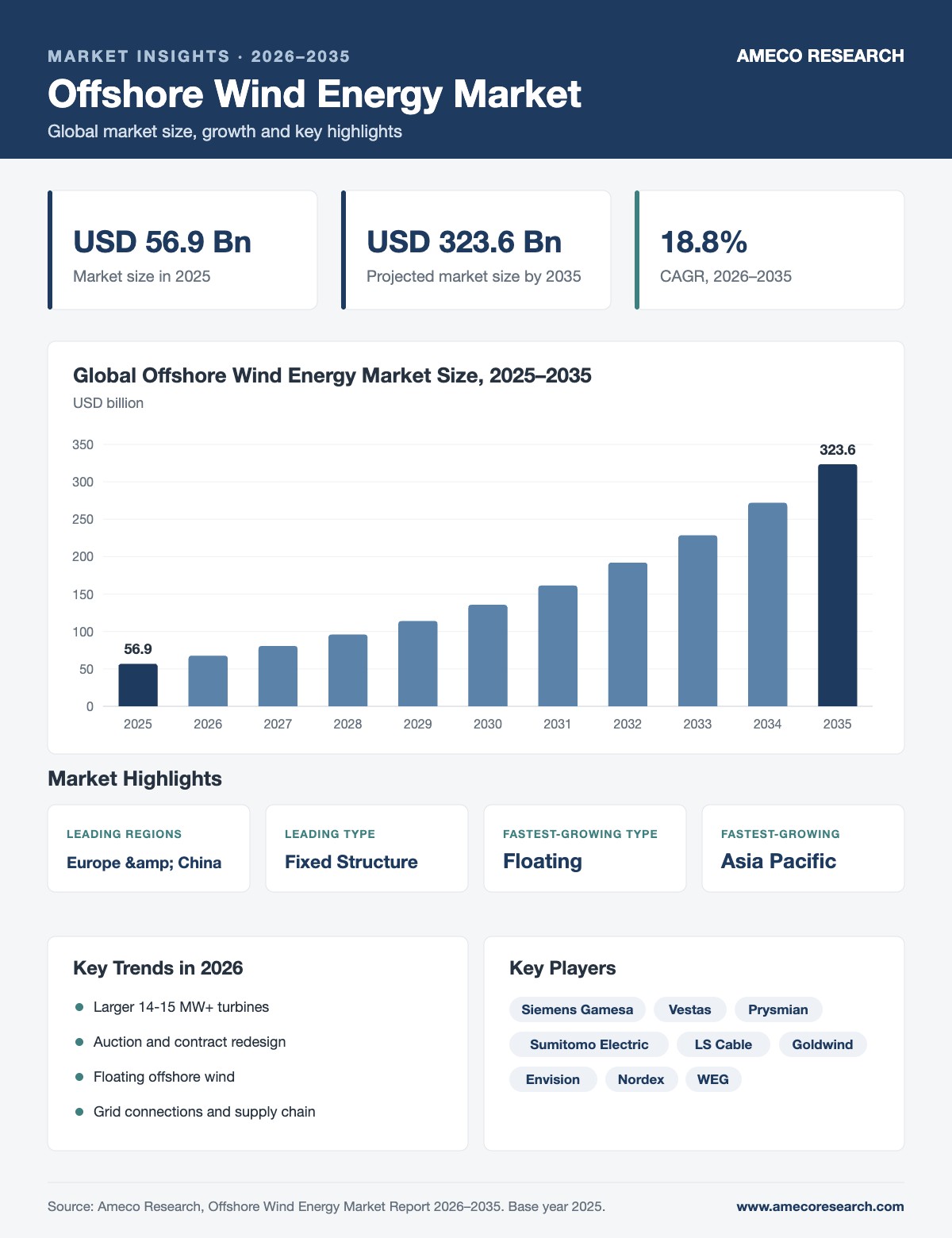
The global Offshore Wind Energy Market size was valued at USD 56.9 billion in 2025 and is projected to reach USD 323.6 billion by 2035, growing at a CAGR of 18.8% from 2026 to 2035. Growth is driven by national clean energy and net-zero targets, stronger and steadier winds at sea, larger turbines that cut the cost per megawatt-hour, new auctions in Europe and Asia Pacific, and the first commercial floating wind projects in deeper waters.
Offshore wind energy is electricity generated by wind turbines installed in seas, lakes and coastal waters. Turbines are mounted on fixed foundations such as monopiles and jackets in shallower water, or on floating platforms anchored to the seabed in deeper water. Power is carried to shore by subsea export cables and offshore substations. Offshore sites offer stronger and more consistent winds than most onshore sites, allowing large projects of several hundred megawatts to more than a gigawatt.
Offshore Wind Energy Market Key Takeaways
Offshore Wind Energy Market Report Scope
| Report Attribute | Details |
| Offshore Wind Energy Market Size in 2025 | USD 56.9 Billion |
| Offshore Wind Energy Market Forecast by 2035 | USD 323.6 Billion |
| Offshore Wind Energy Market CAGR (2026–2035) | 18.8% |
| Analysis Period | 2023–2035 |
| Base Year | 2025 |
| Forecast Period | 2026–2035 |
| Segments Covered | by Installation, by Water Depth, and By Region |
| Regional Scope | North America, Europe, Asia Pacific, Latin America, and Middle East & Africa |
| Key Companies Profiled | Siemens Gamesa Renewable Energy, S.A., Vestas Wind Systems A/S, Prysmian Group, Sumitomo Electric Industries, Ltd., LS Cable & System Ltd., Southwire Company, LLC, Goldwind, Envision Group, Nordex SE, Suzlon Energy Limited, WEG, Enessere, RTS Wind AG, and Smart Dolphin GmbH |
| Report Coverage | Market Trends, Drivers, Restraints, Opportunities, Competitive Analysis, Player Profiling, Regulation Analysis |
Offshore Wind Energy Market Size Forecast, 2023–2035
The table below shows the year-by-year size of the global offshore wind energy market. Revenue is expected to grow about 5.7 times between 2025 and 2035, reaching roughly USD 135.7 billion by 2030.
| Year | Market Size (USD Billion) |
| 2023 (historical) | 40.2 |
| 2024 (historical) | 47.8 |
| 2025 (base year) | 56.9 |
| 2026 (forecast) | 67.7 |
| 2027 (forecast) | 80.6 |
| 2028 (forecast) | 95.8 |
| 2029 (forecast) | 114.0 |
| 2030 (forecast) | 135.7 |
| 2031 (forecast) | 161.5 |
| 2032 (forecast) | 192.1 |
| 2033 (forecast) | 228.6 |
| 2034 (forecast) | 272.0 |
| 2035 (forecast) | 323.6 |
Latest Offshore Wind Energy Market Trends (2026)
Larger turbines
Turbine ratings keep rising, with 14 to 15 MW models now common in new European projects and even larger prototypes in China. Bigger turbines reduce the number of foundations and cables needed per gigawatt.
Auction and contract redesign
After cost inflation and higher interest rates made some projects unviable, governments have revised auctions with indexation, contracts for difference and higher price ceilings to keep projects moving.
Floating offshore wind
Floating platforms allow turbines in water deeper than about 60 meters. Pilot and pre-commercial projects in Europe and Asia are paving the way for larger floating wind farms later in the decade.
Grid connections and transmission
Offshore substations, HVDC export cables and coordinated offshore grids are becoming critical, and cable and transformer supply is a key bottleneck for project timelines.
Supply chain localization
Countries are investing in ports, installation vessels, cable factories and turbine plants to secure supply and local jobs, while turbine makers focus on profitability over volume.
Policy uncertainty in the United States
U.S. offshore wind faced federal policy changes and project delays in 2025, which has slowed the North American pipeline while Europe and Asia continue to expand.
Offshore Wind Energy Market Dynamics
Growth drivers
- National renewable energy and net-zero targets
- Stronger and more consistent offshore wind resources
- Larger turbines lowering the cost of energy
- Growing pipeline of offshore turbine installation projects
- Rising R&D investment and government support
Restraints and challenges
- High capital costs and installation difficulties
- Cost inflation and higher financing costs
- Grid connection, port and vessel bottlenecks
- Permitting delays and policy uncertainty in some markets
Opportunities
Key opportunities include floating wind in deep waters, offshore grids and HVDC transmission, repowering early wind farms, green hydrogen production from offshore wind, and new markets in Asia Pacific, Latin America and the Middle East.
Offshore Wind Energy Market Segment Analysis
By installation
The market is segmented into fixed structure and floating structure. Fixed structures hold most of the market because most current projects are in relatively shallow water with monopile and jacket foundations. Floating structures are expected to grow fastest as they reach commercial scale.
By water depth
Water depth segments include up to 30 m and above 30 m. The up-to-30 m segment holds a considerable share, while the above-30 m segment is growing as projects move farther from shore into deeper water.
Offshore Wind Energy Market Regional Analysis
Europe is a leading region, with large installed fleets in the U.K., Germany, the Netherlands and Denmark, and new capacity planned in the North Sea, Baltic Sea and Atlantic.
Asia Pacific is the fastest-growing region, led by China, which has the largest installed offshore wind capacity, along with growing programs in Taiwan, South Korea, Japan, Vietnam and Australia. North America has a project pipeline on the U.S. East Coast but faces policy uncertainty.
Latin America and the Middle East & Africa are early-stage markets, with Brazil studying large offshore wind areas.
Offshore Wind Energy Market Segmentation
Offshore Wind Energy Market Leading Companies
The offshore wind energy market includes turbine makers, subsea cable suppliers, foundation and installation contractors, and developers. Companies compete on turbine size and reliability, cable capacity, delivery schedules, cost and long-term service contracts. Key players profiled in this report include Siemens Gamesa Renewable Energy, S.A., Vestas Wind Systems A/S, Prysmian Group, Sumitomo Electric Industries, Ltd., LS Cable & System Ltd., Southwire Company, LLC, Goldwind, Envision Group, Nordex SE, Suzlon Energy Limited, WEG, Enessere, RTS Wind AG, and Smart Dolphin GmbH.
Siemens Gamesa Renewable Energy, S.A.Vestas Wind Systems A/SPrysmian GroupSumitomo Electric Industries, Ltd.LS Cable & System Ltd.Southwire Company, LLCGoldwindEnvision GroupNordex SESuzlon Energy LimitedWEGEnessereRTS Wind AGSmart Dolphin GmbH
Key Questions Answered in This Report
- What is the size of the offshore wind energy market in 2025, and how large will it be by 2030 and 2035?
- What are the main growth drivers, restraints and opportunities through 2035?
- Which by installation and by water depth segments will grow the fastest?
- Which regions and countries offer the largest and fastest-growing opportunities?
- How are larger turbines, auction redesigns and floating wind shaping offshore wind in 2026?
- Who are the leading companies, and what strategies are they using to compete?
Research Methodology
Our estimates draw on interviews with turbine makers, cable suppliers, developers, installation contractors and energy agencies, supported by secondary data from annual reports, investor materials, trade and customs data, standards bodies and industry journals. Bottom-up estimates of company revenues and top-down estimates of application demand are reconciled through data triangulation, and the model is updated with 2026 developments to forecast the market through 2035.
Related Reports
- Wind Energy Foundation Market Report
- Renewable Energy Certificate Market Report
- Energy Storage as a Service Market Report
- Hydrogen Energy Storage Market Report
- Offshore Crane Market Report
Offshore Wind Energy Market: Frequently Asked Questions
How big is the offshore wind energy market?
The global offshore wind energy market was valued at USD 56.9 billion in 2025 and is expected to reach USD 323.6 billion by 2035.
What is the growth rate of the offshore wind energy market?
The offshore wind energy market is projected to grow at a CAGR of 18.8% from 2026 to 2035.
What will the offshore wind energy market be worth in 2030?
The offshore wind energy market is projected to reach about USD 135.7 billion in 2030, growing at a CAGR of 18.8%.
What is driving growth in the offshore wind energy market?
Key drivers are net-zero and renewable energy targets, strong offshore wind resources, larger turbines that lower costs, and government support for new projects.
What is offshore wind energy?
Offshore wind energy is electricity produced by wind turbines installed at sea on fixed or floating foundations and connected to shore by subsea cables.
Which region leads the offshore wind energy market?
Europe and China lead installed capacity, and Asia Pacific is the fastest-growing region.
Which segment holds the largest share of the offshore wind energy market?
Fixed structures hold most of the market, while floating structures are expected to grow fastest as deep-water projects scale up.
What are the latest trends in the offshore wind energy market?
The main 2026 trends are larger turbines, auction and contract redesign, floating offshore wind, grid connections and transmission, supply chain localization and policy uncertainty in the United States.
What are the main challenges in the offshore wind energy market?
The main challenges are high capital costs, cost inflation, grid and supply chain bottlenecks, permitting delays and policy uncertainty in some markets.
What is floating offshore wind?
Floating offshore wind places turbines on buoyant platforms moored to the seabed, allowing projects in water too deep for fixed foundations.
Who are the key players in the offshore wind energy market?
Leading companies include Siemens Gamesa Renewable Energy, S.A., Vestas Wind Systems A/S, Prysmian Group, Sumitomo Electric Industries, Ltd., LS Cable & System Ltd., Southwire Company, LLC, Goldwind, Envision Group, Nordex SE, Suzlon Energy Limited, WEG, Enessere, RTS Wind AG, and Smart Dolphin GmbH.
Related Energy and Power Market Reports
- Renewable Energy Certificate Market Size and Growth Opportunities and Forecast till 2026 - 2035
- Energy Storage as a Service (ESaaS) Market Size and Growth Opportunities and Forecast till 2026 - 2035
- Coal Power Generation Market Size and Growth Opportunities and Forecast till 2026 - 2035
- Hydrogen Energy Storage Market Size and Growth Opportunities and Forecast till 2026 - 2035
- Substation Market Size and Growth Opportunities and Forecast till 2026 - 2035