Pharmacy Management System Market Size, Share, Trends & Growth Opportunities Forecast to 2026 - 2035
Pharmacy Management System Market Size, Share & Trends Report, 2026–2035
LAST UPDATED: OCTOBER 2026
The global pharmacy management system market size was valued at USD 32.38 billion in 2025 and is projected to reach USD 97.91 billion by 2035, growing at a CAGR of 11.7% from 2026 to 2035. The market is estimated at USD 36.17 billion in 2026, with North America holding the largest share and Asia Pacific registering the fastest growth.
A pharmacy management system (PMS) is the software platform that runs a pharmacy’s day-to-day operations, from receiving electronic prescriptions and checking them for drug interactions and dosage errors to dispensing, labeling, insurance claims, billing, inventory control and regulatory reporting. Modern systems connect with e-prescribing networks, electronic health records, wholesaler ordering portals, point-of-sale and dispensing robots.
Pharmacies are under pressure from rising prescription volumes, staff shortages, tight reimbursement and stricter compliance rules. Pharmacy management systems help them work faster and more safely by automating routine tasks, preventing medication errors and cutting stock-outs and waste. The market is now shifting toward cloud platforms, AI-driven inventory and workflow automation, and omnichannel tools that support home delivery, telepharmacy and online ordering.
Pharmacy Management System Market Key Takeaways
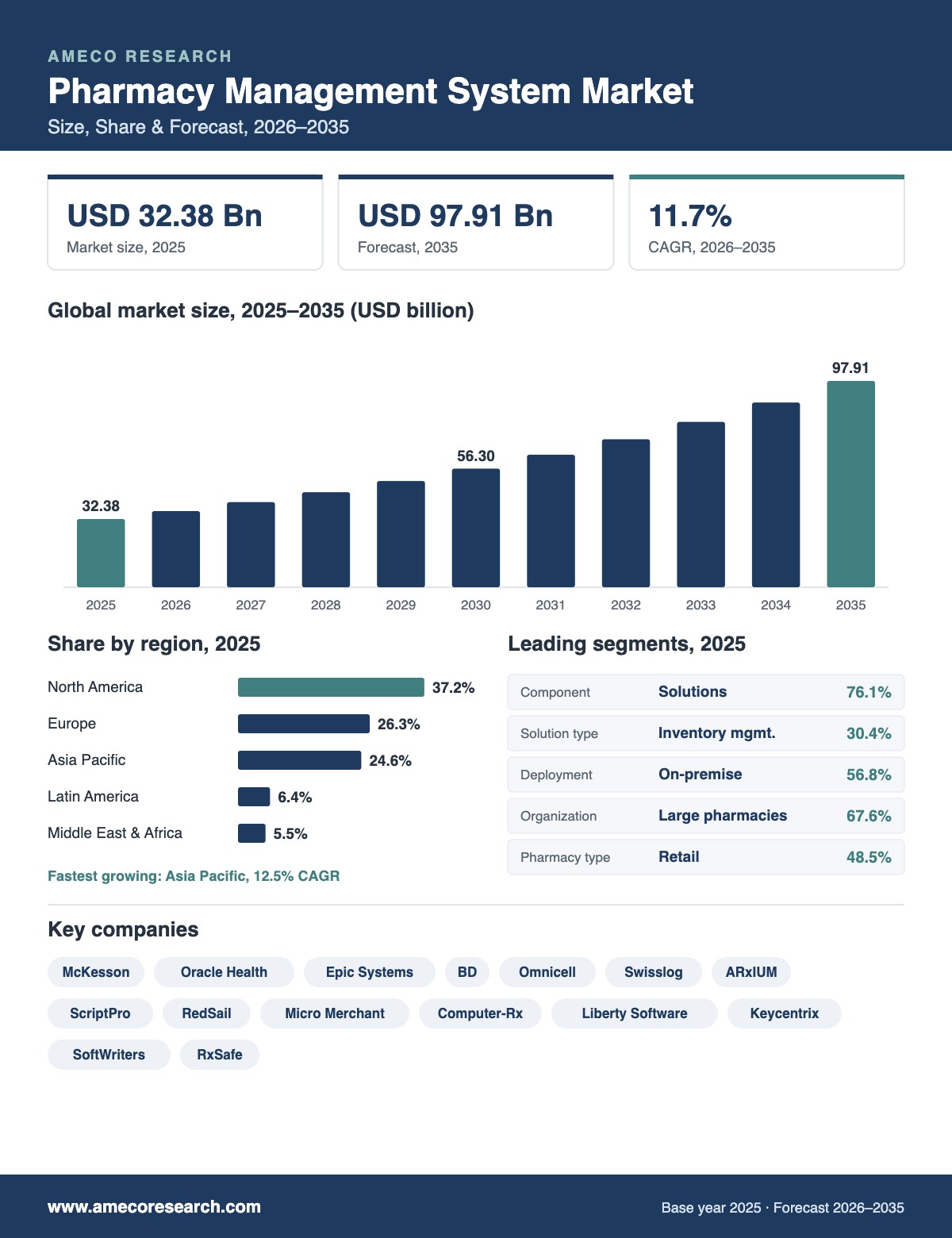 Infographic: Pharmacy Management System Market Size, Share, Trends & Growth Opportunities Forecast to 2026 - 2035 | Ameco Research
Pharmacy Management System Market Report Scope
| Report Attribute | Details |
| Pharmacy Management System Market Size in 2025 | USD 32.38 Billion |
| Pharmacy Management System Market Size in 2026 | USD 36.17 Billion |
| Pharmacy Management System Market Forecast by 2035 | USD 97.91 Billion |
| Pharmacy Management System Market CAGR (2026–2035) | 11.7% |
| Historical Data | 2021–2024 |
| Base Year | 2025 |
| Forecast Period | 2026–2035 |
| Largest Region | North America (37.2% share in 2025) |
| Fastest-Growing Region | Asia Pacific (12.5% CAGR) |
| Segments Covered | Component, Solution Type, Deployment, Organization Size, Pharmacy Type and Region |
| Regional Scope | North America, Europe, Asia Pacific, Latin America, and Middle East & Africa |
| Key Companies Profiled | McKesson Corporation, Oracle Health, Epic Systems, Becton, Dickinson and Company (BD), Omnicell, Swisslog Healthcare, ARxIUM, ScriptPro, RedSail Technologies, Micro Merchant Systems, Computer-Rx, Liberty Software, Keycentrix, SoftWriters and RxSafe |
| Report Coverage | Market size and forecast, trends, drivers, restraints, opportunities, segment and regional analysis, regulatory landscape, competitive landscape, recent developments |
How Big Is the Pharmacy Management System Market in 2026?
Ameco Research estimates the pharmacy management system market at USD 36.17 billion in 2026, up about 12% from USD 32.38 billion in 2025. The market is expected to reach about USD 56.30 billion by 2030 and USD 97.91 billion by 2035, as pharmacies replace legacy software with cloud platforms, add AI-powered automation and connect more closely with EHRs, payers and patients.
| Year | Pharmacy Management System Market Size (USD Billion) |
| 2025 | 32.38 |
| 2026 | 36.17 |
| 2028 | 45.13 |
| 2030 | 56.30 |
| 2032 | 70.25 |
| 2035 | 97.91 |
Latest Pharmacy Management System Market Trends 2026
Consolidation of pharmacy software vendors
Vendors are combining to gain scale and broader product suites. In February 2026, RedSail Technologies added PrimeRx as an affiliate, expanding its network to about 16,000 pharmacies, and in January 2026 Uniphar agreed to acquire Irish dispensing and retail software provider TouchStore.
AI-driven automation of pharmacy workflows
AI is being applied to prescription data entry, insurance verification, prior authorizations, demand forecasting and refill management. AI-enabled inventory tools can cut excess stock and waste, while start-ups focused on AI pharmacy automation are raising significant funding and acquiring workflow specialists.
Shift to cloud-based platforms
Independent and small chain pharmacies are moving to cloud systems that need no local servers, update automatically and support multi-store management, remote access and faster rollout of new features such as telepharmacy and delivery tracking.
Integration with dispensing robots and cabinets
Hospital and high-volume retail pharmacies are linking their PMS directly to robots, automated dispensing cabinets, vial fillers and pouch packagers to reduce manual counting, speed up fulfillment and improve medication traceability.
Updated e-prescribing and interoperability rules
Regulators are tightening digital standards. In the U.S., the HTI-4 final rule requires the updated NCPDP SCRIPT standard for certified e-prescribing systems and Medicare Part D transactions from January 1, 2028, pushing vendors to upgrade their platforms.
Digital care homes and specialty pharmacy
Electronic medication administration records (eMAR) for care homes and specialty pharmacy platforms for complex therapies are growing quickly. In July 2026, MedPal AI acquired UK care home medication software provider eMARx to expand its platform.
Pharmacy Management System Market Dynamics
Growth drivers
- Rising prescription volumes: ageing populations and chronic disease are increasing the number of prescriptions pharmacies must process every day.
- Medication safety: built-in checks for drug interactions, allergies and dosage help reduce dispensing errors, a major patient safety and liability concern.
- Staff shortages and cost pressure: automation of data entry, claims, inventory and refills lets pharmacists spend more time on patient care.
- E-prescribing and digital health: widespread e-prescriptions, EHRs and telehealth require pharmacy software that connects securely with doctors, payers and patients.
- Regulatory compliance: controlled substance tracking, drug supply chain traceability and reporting requirements make compliant software essential.
Restraints and challenges
- High implementation and maintenance costs: licensing, hardware, training and integration costs can be a burden for independent pharmacies.
- Data security and privacy: pharmacy systems hold sensitive patient and payment data and are frequent targets of cyberattacks.
- Legacy system integration: connecting new software with older hospital systems, EHRs and automation equipment can be complex.
- Multi-jurisdiction compliance: differing prescription, privacy and reporting rules across countries and states add complexity for vendors.
- Change management: staff training and workflow disruption during system migration can slow adoption.
Opportunities
- Cloud and SaaS models that make advanced pharmacy software affordable for independent and rural pharmacies.
- AI-enabled inventory and prescription management for demand forecasting, automated reordering and error detection.
- E-pharmacy and omnichannel services, including online ordering, home delivery, click-and-collect and telepharmacy.
- Emerging markets such as India under the Ayushman Bharat Digital Mission, Southeast Asia, the Middle East and Latin America.
- Clinical services support for vaccinations, medication therapy management and point-of-care testing in community pharmacies.
Pharmacy Management System Market Segment Analysis
By component: Why do solutions dominate?
Solutions accounted for 76.1% of revenue in 2025, as software licenses and subscriptions form the core of pharmacy management spending. Services held 23.9%, covering implementation, integration, data migration, training, maintenance and technical support, and are growing as pharmacies move to new cloud platforms.
| Component | Share (2025) | Key Highlights |
| Solutions | 76.1% | Dispensing, inventory, billing, compliance and analytics software |
| Services | 23.9% | Implementation, integration, migration, training and support |
By solution type: Which features drive spending?
Inventory management was the largest solution type, at about 30.4% of solutions revenue in 2025, because accurate stock control directly affects pharmacy profits, drug availability and expiry waste. Clinical and administrative performance tools, purchase order management and supply chain management followed.
| Solution Type | Share (2025) | Key Highlights |
| Inventory Management | 30.4% | Stock control, automatic reordering and expiry tracking |
| Clinical & Administrative Performance | 16.3% | Workflow, safety checks, reporting and analytics |
| Purchase Orders Management | 15.8% | Supplier ordering, invoicing and price management |
| Supply Chain Management | 14.6% | Wholesaler integration and drug traceability |
| Regulatory & Compliance Information | 13.2% | Controlled substances, audits and reporting |
| Others (E-Prescription, SMS/Notifications) | 9.7% | Patient messaging, refill reminders and e-prescribing |
By deployment: Is cloud overtaking on-premise?
On-premise systems accounted for 56.8% of revenue in 2025, as many hospitals and large chains still run installed software integrated with their internal IT. Cloud-based deployment held 43.2% and is the faster-growing segment, favored by independent pharmacies and multi-site operators for lower upfront costs and easier updates.
| Deployment | Share (2025) | Key Highlights |
| On-Premise | 56.8% | Installed systems in hospitals and large chains |
| Cloud-Based | 43.2% | Faster-growing; subscription pricing and remote access |
By organization size
Large pharmacies and chains accounted for 67.6% of revenue in 2025, as they operate many stores and need enterprise-grade systems with central management. Small and medium-sized pharmacies held 32.4% and are adopting affordable cloud systems quickly to compete on service and efficiency.
| Organization Size | Share (2025) | Key Highlights |
| Large Pharmacies & Chains | 67.6% | Enterprise systems with central control across stores |
| Small & Medium-Sized Pharmacies | 32.4% | Independents adopting affordable cloud platforms |
By pharmacy type
Retail pharmacies accounted for about 48.5% of revenue in 2025, reflecting the large number of community and chain pharmacies. Hospital pharmacies held 27.3%, with high demand for systems integrated with EHRs and dispensing automation, while specialty and long-term care pharmacies are growing fastest.
| Pharmacy Type | Share (2025) | Key Highlights |
| Retail Pharmacies | 48.5% | Chain and independent community pharmacies |
| Hospital Pharmacies | 27.3% | EHR integration and automated dispensing |
| Specialty Pharmacies | 11.6% | Complex therapies, prior authorization and patient support |
| Long-Term Care Pharmacies | 7.9% | Care homes, eMAR and multi-dose packaging |
| Others | 4.7% | Online, mail-order and clinic pharmacies |
Pharmacy Management System Market Regional Analysis
| Region | Share (2025) | Outlook |
| North America | 37.2% | Largest market; growing at an 11.3% CAGR; strong e-prescribing adoption |
| Europe | 26.3% | NHS digital integration, EU e-prescription and falsified medicines rules |
| Asia Pacific | 24.6% | Fastest-growing at a 12.5% CAGR; India, China, Japan and Australia |
| Latin America | 6.4% | Pharmacy chain expansion in Brazil and Mexico |
| Middle East & Africa | 5.5% | Healthcare digitization in the GCC and South Africa |
Why does North America dominate the pharmacy management system market?
North America accounted for about 37.2% of global revenue in 2025 and is expected to grow at around an 11.3% CAGR. The U.S. has very high prescription volumes, near-universal e-prescribing, complex insurance claims processing and strict controlled substance rules, all of which require advanced pharmacy software. Most leading vendors, including McKesson, Oracle Health, Epic, BD, Omnicell and RedSail, are based in the region.
What makes Asia Pacific the fastest-growing region?
Asia Pacific held about 24.6% of the market in 2025 and is forecast to grow at a 12.5% CAGR through 2035. India’s Ayushman Bharat Digital Mission, Australia’s electronic prescribing and interoperability plans, rapid growth of pharmacy chains and e-pharmacies in India and China, and rising hospital investment across Southeast Asia are driving adoption.
How is Europe developing?
Europe represented about 26.3% of revenue in 2025. In the U.K., NHS community pharmacy digital integration is linking pharmacy systems with GP records and national services, while EU e-prescription programs and falsified medicines verification requirements are pushing pharmacies to upgrade software across Germany, France, Ireland and the Nordics.
Pharmacy Management System Market Segmentation
Pharmacy Management System Market Leading Companies
The pharmacy management system market includes large healthcare IT and EHR vendors, pharmacy automation companies and specialist software providers focused on independent, chain, specialty and long-term care pharmacies. Competition centers on workflow efficiency, clinical safety features, integration with automation and EHRs, cloud capabilities, AI tools, compliance support and customer service.
McKesson Corporation · Oracle Health · Epic Systems · Becton, Dickinson and Company (BD) · Omnicell · Swisslog Healthcare · ARxIUM · ScriptPro · RedSail Technologies · Micro Merchant Systems · Computer-Rx · Liberty Software · Keycentrix · SoftWriters · RxSafe
Recent developments
- July 2026: MedPal AI acquired eMARx, a U.K. provider of electronic medication administration record software for care homes, to expand its care home medication platform.
- February 2026: RedSail Technologies added PrimeRx as an affiliate, expanding the RedSail network to about 16,000 pharmacies.
- January 2026: Uniphar announced the acquisition of TouchStore, an Irish provider of pharmacy dispensing and retail management software.
Pharmacy Management System Market: Frequently Asked Questions
How big is the pharmacy management system market?
The global pharmacy management system market was valued at USD 32.38 billion in 2025 and is estimated at USD 36.17 billion in 2026. Ameco Research projects it to reach USD 97.91 billion by 2035, growing at a CAGR of 11.7% from 2026 to 2035.
What is the growth rate of the pharmacy management system market?
The pharmacy management system market is expected to grow at a CAGR of 11.7% between 2026 and 2035, about three times its 2025 size, driven by pharmacy automation, e-prescribing, cloud adoption and AI-enabled inventory and workflow tools.
What is a pharmacy management system?
A pharmacy management system (PMS) is software that runs the daily operations of a pharmacy. It handles prescription processing and dispensing, drug interaction and dosage checks, inventory and purchasing, insurance claims and billing, patient records, regulatory reporting and point-of-sale, and connects with e-prescribing networks, EHRs and dispensing automation.
What are the main features of pharmacy management software?
Core features include e-prescription intake, dispensing workflow and label printing, clinical safety alerts, inventory and reorder management, supplier purchase orders, insurance adjudication and billing, controlled substance tracking, refill reminders and patient messaging, reporting and analytics, and integration with robots and automated dispensing cabinets.
Is cloud or on-premise pharmacy software more common?
On-premise systems still held the larger share at about 56.8% in 2025 because many hospitals and established pharmacy chains run installed software. Cloud-based systems held about 43.2% and are growing faster, as independent and small pharmacies prefer lower upfront costs, automatic updates and remote access.
Who uses pharmacy management systems?
Pharmacy management systems are used by retail and chain pharmacies, independent community pharmacies, hospital and health-system pharmacies, specialty pharmacies, long-term care and care home pharmacies, and online and mail-order pharmacies.
Which region leads the pharmacy management system market?
North America leads with about 37.2% of global revenue in 2025, driven by high prescription volumes, widespread e-prescribing and the presence of major vendors in the U.S. Asia Pacific is the fastest-growing region at about a 12.5% CAGR, supported by digital health programs in India, China and Australia.
Who are the key players in the pharmacy management system market?
Leading companies include McKesson Corporation, Oracle Health, Epic Systems, Becton, Dickinson and Company (BD), Omnicell, Swisslog Healthcare, ARxIUM, ScriptPro, RedSail Technologies, Micro Merchant Systems, Computer-Rx, Liberty Software, Keycentrix, SoftWriters and RxSafe.
Related Pharma & Healthcare Market Reports
- Precision Medicine Market Growth Opportunities and Forecast till 2026 - 2035
- Healthcare Staffing Market Growth Opportunities and Forecast till 2032
- Telehealth Market Growth Opportunities and Forecast till 2032
- Insulin Delivery Devices Market Growth Opportunities and Forecast till 2032
- eClinical Solutions Market Growth Opportunities and Forecast till 2032