Substation Market Size and Growth Opportunities and Forecast till 2026 - 2035
Substation Market Size, Share & Trends Report, 2026–2035
LAST UPDATED: OCTOBER 2026
The global Substation Market size was valued at USD 132.22 billion in 2025 and is projected to reach USD 199.90 billion by 2035, growing at a CAGR of 4.19% from 2026 to 2035. Growth is driven by power grid expansion and modernization, renewable energy and battery storage connections, surging electricity demand from data centers and electrification, replacement of aging equipment, and the shift to digital substations.
A substation is a part of the electricity grid that transforms voltage levels and switches, protects and controls power flows between generation, transmission and distribution networks. Substations include transformers, busbars, circuit breakers, protective relays, switchgear, substation automation, communication networks and monitoring and control systems such as human machine interfaces and programmable logic controllers. They range from low and medium voltage distribution substations to high and extra-high voltage transmission substations, serving utilities and industrial users, and can be conventional or digital (IEC 61850-based).
Substation Market Key Takeaways
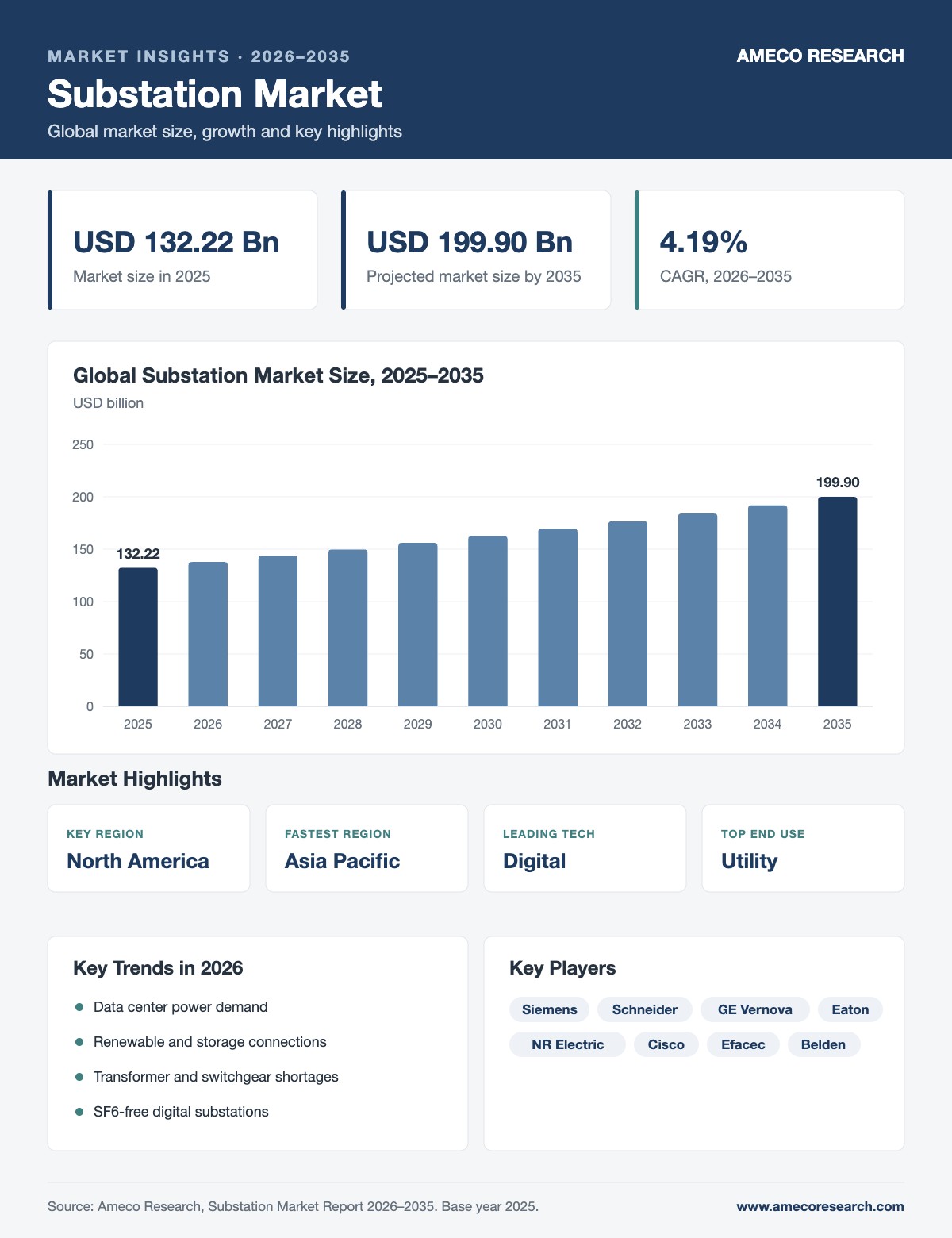 Infographic: Substation Market Size and Growth Opportunities and Forecast till 2026 - 2035 | Ameco Research
Substation Market Report Scope
| Report Attribute | Details |
| Substation Market Size in 2025 | USD 132.22 Billion |
| Substation Market Forecast by 2035 | USD 199.90 Billion |
| Substation Market CAGR (2026–2035) | 4.19% |
| Analysis Period | 2023–2035 |
| Base Year | 2025 |
| Forecast Period | 2026–2035 |
| Segments Covered | by Technology, by Component, by Connectivity, by Application, by End-Use, and By Region |
| Regional Scope | North America, Europe, Asia Pacific, Latin America, and Middle East & Africa |
| Key Companies Profiled | Alphapower Electrical Technology PLC, Belden, Cisco Systems, Eaton, Efacec, Emerson Electric, General Electric (GE Vernova), NetControl Group, NR Electric, Rockwell Automation, Schneider Electric, Siemens, Tesco Automation, and Texas Instruments |
| Report Coverage | Market Trends, Drivers, Restraints, Opportunities, Competitive Analysis, Player Profiling, Regulation Analysis |
Substation Market Size Forecast, 2023–2035
The table below shows the year-by-year size of the global substation market. Revenue is expected to grow about 1.5 times between 2025 and 2035, reaching roughly USD 162.58 billion by 2030.
| Year | Market Size (USD Billion) |
| 2023 (historical) | 121.73 |
| 2024 (historical) | 126.87 |
| 2025 (base year) | 132.22 |
| 2026 (forecast) | 137.80 |
| 2027 (forecast) | 143.62 |
| 2028 (forecast) | 149.68 |
| 2029 (forecast) | 155.99 |
| 2030 (forecast) | 162.58 |
| 2031 (forecast) | 169.44 |
| 2032 (forecast) | 176.59 |
| 2033 (forecast) | 184.04 |
| 2034 (forecast) | 191.81 |
| 2035 (forecast) | 199.90 |
Latest Substation Market Trends (2026)
Data centers and electrification
AI data centers, EV charging, heat pumps and industrial electrification are driving fast growth in electricity demand, requiring new high-voltage substations and grid connections.
Renewable and storage interconnection
Solar, wind and battery storage projects need collector and grid substations, and interconnection queues in many countries are pushing utilities to expand transmission capacity.
Transformer and switchgear shortages
Lead times for large power transformers and high-voltage switchgear have stretched to years, prompting manufacturers such as Hitachi Energy, Siemens Energy and GE Vernova to expand factories.
Digital substations
Utilities are adopting IEC 61850-based digital substations with fiber-optic communication, intelligent electronic devices and remote monitoring to cut costs and improve reliability.
SF6-free switchgear
Regulations such as the revised EU F-gas Regulation are phasing out SF6 in new medium- and high-voltage switchgear, driving adoption of clean-air and vacuum alternatives.
Grid resilience and cybersecurity
Extreme weather and cyber threats are leading utilities to invest in hardened substations, mobile substations and stronger cybersecurity for automation systems.
Substation Market Dynamics
Growth drivers
- Rising electricity demand from data centers and electrification
- Renewable energy and storage integration
- Replacement of aging grid infrastructure
- Government grid modernization programs
- Adoption of digital and automated substations
Restraints and challenges
- Long lead times and supply shortages for key equipment
- High capital costs and permitting delays
- Cybersecurity risks in digital systems
- Shortage of skilled engineers and technicians
Opportunities
Key opportunities include substations for data centers and industrial parks, offshore wind and HVDC converter stations, digital retrofits of existing substations, SF6-free equipment, mobile and modular substations, and grid expansion in India, Southeast Asia, Africa and the Middle East.
Substation Market Segment Analysis
By technology
The market is segmented into conventional and digital substations. Digital substations accounted for the bulk of the market, and their share is rising as utilities modernize.
By component
Components include the electrical system (transformers, busbars and protection devices such as circuit breakers, protective relays and switchgear), substation automation systems, communication networks, monitoring and control systems (HMI, PLC and others) and others. Substation automation systems held the largest share.
By connectivity and voltage
Connectivity classes range from ≤33 kV to >550 kV, and voltage levels include low, medium and high. The ≤33 kV segment holds the biggest share thanks to distribution substations, while high-voltage transmission substations are growing with grid expansion.
By application and end use
Applications include transmission and distribution, and end uses include utility and industrial. Transmission is a major force in the market, and utilities are the dominant end users.
Substation Market Regional Analysis
North America maintained a significant market share, supported by grid modernization, data center connections, renewable interconnection and replacement of aging equipment.
The Asia-Pacific region is predicted to have the highest CAGR during the forecast period, led by grid investment in China, India, Japan, South Korea and Southeast Asia. Europe is investing heavily in grid expansion and offshore wind connections.
The Middle East & Africa and Latin America are growing markets with new transmission and renewable projects.
Substation Market Segmentation
Substation Market Leading Companies
The substation market includes global electrical equipment makers, automation and protection specialists, networking companies and engineering contractors. Companies compete on equipment portfolio, digital and automation capabilities, delivery lead times, project execution and service. Key players profiled in this report include Alphapower Electrical Technology PLC, Belden, Cisco Systems, Eaton, Efacec, Emerson Electric, General Electric (GE Vernova), NetControl Group, NR Electric, Rockwell Automation, Schneider Electric, Siemens, Tesco Automation, and Texas Instruments.
Alphapower Electrical Technology PLCBeldenCisco SystemsEatonEfacecEmerson ElectricGeneral Electric (GE Vernova)NetControl GroupNR ElectricRockwell AutomationSchneider ElectricSiemensTesco AutomationTexas Instruments
Key Questions Answered in This Report
- What is the size of the substation market in 2025, and how large will it be by 2030 and 2035?
- What are the main growth drivers, restraints and opportunities through 2035?
- Which by technology and by component segments will grow the fastest?
- Which regions and countries offer the largest and fastest-growing opportunities?
- How are data centers, renewables and equipment shortages shaping substation investment in 2026?
- Who are the leading companies, and what strategies are they using to compete?
Research Methodology
This report combines primary and secondary research. Primary research includes interviews with electrical equipment manufacturers, utilities, EPC contractors, grid operators and industry associations. Secondary research covers company annual reports, investor presentations, government and trade association data, patent filings and industry publications. Market size is estimated using both bottom-up (company revenue and production data) and top-down (end-use demand) methods, and results are cross-checked through data triangulation before forecasts are built for 2026–2035.
Related Reports
- Subsea Power Grid Systems Market Report
- Coal Power Generation Market Report
- Portable Lithium Power Station Market Report
- Mobile Power Plant Market Report
- Concentrated Solar Power Market Report
Substation Market: Frequently Asked Questions
How big is the substation market?
The global substation market was valued at USD 132.22 billion in 2025 and is expected to reach USD 199.90 billion by 2035.
What is the growth rate of the substation market?
The substation market is projected to grow at a CAGR of 4.19% from 2026 to 2035.
What will the substation market be worth in 2030?
The substation market is projected to reach about USD 162.58 billion in 2030, growing at a CAGR of 4.19%.
What is driving growth in the substation market?
Key drivers are rising electricity demand from data centers and electrification, renewable integration, replacement of aging assets, grid programs and digital substation adoption.
What is an electrical substation?
An electrical substation is a facility in the power grid that changes voltage levels and switches, protects and controls the flow of electricity between generation, transmission and distribution.
Which region leads the substation market?
North America maintains a significant share, while Asia-Pacific is predicted to have the highest CAGR.
Which segment holds the largest share of the substation market?
Digital substations account for the bulk of the market, substation automation systems are the largest component, ≤33 kV is the largest connectivity class and utilities are the dominant end users.
What are the latest trends in the substation market?
The main 2026 trends are data centers and electrification, renewable and storage interconnection, transformer and switchgear shortages, digital substations, sF6-free switchgear and grid resilience and cybersecurity.
What are the main challenges in the substation market?
The main challenges are equipment shortages and long lead times, high costs and permitting delays, cybersecurity risks and a shortage of skilled workers.
What is a digital substation?
A digital substation replaces copper wiring between equipment with fiber-optic communication and intelligent electronic devices based on the IEC 61850 standard, enabling remote monitoring, automation and lower lifetime costs.
Who are the key players in the substation market?
Leading companies include Alphapower Electrical Technology PLC, Belden, Cisco Systems, Eaton, Efacec, Emerson Electric, General Electric (GE Vernova), NetControl Group, NR Electric, Rockwell Automation, Schneider Electric, Siemens, Tesco Automation, and Texas Instruments.