Transcatheter Devices Market Size and Growth Opportunities and Forecast till 2026 - 2035
Transcatheter Devices Market Size, Share & Trends Report, 2026–2035
LAST UPDATED: OCTOBER 2026
The global Transcatheter Devices Market size was valued at USD 17.63 billion in 2025 and is projected to reach USD 69.48 billion by 2035, growing at a CAGR of 14.7% from 2026 to 2035. Growth is driven by the rising number of older patients with aortic stenosis and other valve disease, the expansion of transcatheter aortic valve replacement (TAVR) to earlier and lower-risk patients, new mitral and tricuspid therapies, and the broader shift from open-heart surgery to minimally invasive, catheter-based treatment.
Transcatheter devices are implants and tools delivered through a thin, flexible catheter inserted into a blood vessel, usually in the groin, and guided to the treatment site without opening the chest. They are used to replace or repair heart valves, close holes and blood vessels, and block the left atrial appendage to lower stroke risk. Compared with open surgery, transcatheter procedures typically mean shorter hospital stays, faster recovery and fewer complications, especially for older and high-risk patients.
Transcatheter Devices Market Key Takeaways
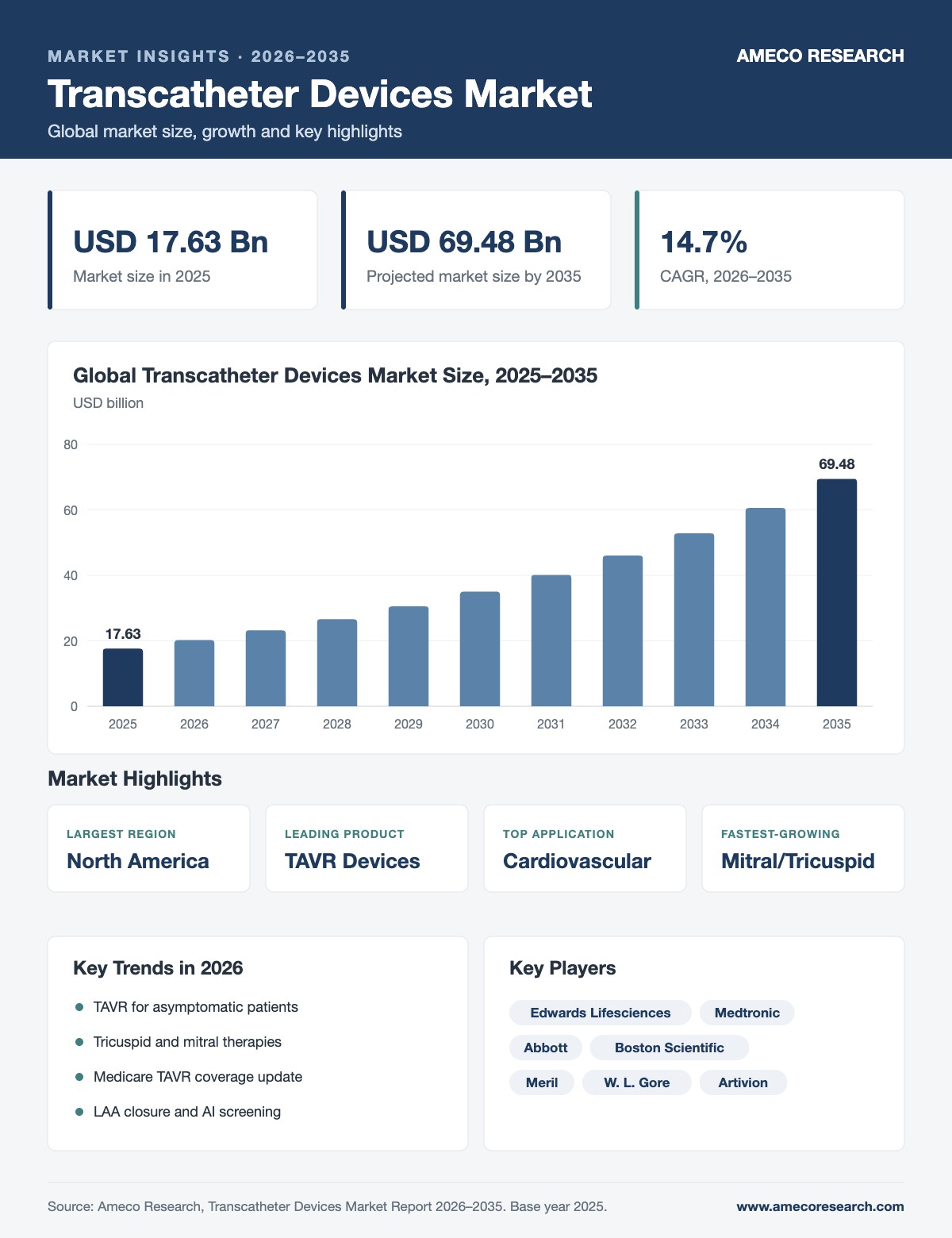 Infographic: Transcatheter Devices Market Size and Growth Opportunities and Forecast till 2026 - 2035 | Ameco Research
Transcatheter Devices Market Report Scope
| Report Attribute | Details |
| Transcatheter Devices Market Size in 2025 | USD 17.63 Billion |
| Transcatheter Devices Market Forecast by 2035 | USD 69.48 Billion |
| Transcatheter Devices Market CAGR (2026–2035) | 14.7% |
| Analysis Period | 2023–2035 |
| Base Year | 2025 |
| Forecast Period | 2026–2035 |
| Segments Covered | By Product, By Application, and By Region |
| Regional Scope | North America, Europe, Asia Pacific, Latin America, and Middle East & Africa |
| Key Companies Profiled | Abbott, Boston Scientific Corporation, Artivion, Inc. (formerly CryoLife), Edwards Lifesciences Corporation, JenaValve Technology, Inc., Medtronic plc, Meril Life Sciences Pvt. Ltd., Neovasc Inc., Symetis SA, Terumo Corporation, Venus Medtech (Hangzhou) Inc., and W. L. Gore & Associates |
| Report Coverage | Market Trends, Drivers, Restraints, Opportunities, Competitive Analysis, Player Profiling, Regulation Analysis |
Latest Transcatheter Devices Market Trends (2026)
TAVR moves to asymptomatic patients
In May 2025, the FDA approved Edwards' SAPIEN 3 valve for patients with severe aortic stenosis who have no symptoms, the first such approval. It was based on the EARLY TAVR trial, where death, stroke or unplanned cardiovascular hospitalization occurred in 26.8% of TAVR patients versus 45.3% of patients under watchful waiting. Treating patients earlier could significantly expand the number of TAVR candidates.
Medicare updates TAVR coverage
In September 2026, CMS finalized an updated national coverage determination for TAVR. It covers symptomatic severe aortic stenosis without the earlier coverage-with-evidence-development requirement, removes hospital volume thresholds and mandatory registry participation as coverage conditions, and allows more flexible heart team review. Coverage for asymptomatic patients is limited to CMS-approved studies for now.
Tricuspid and mitral therapies take off
Valves beyond the aortic position are the fastest-growing area. Edwards reported first-quarter 2026 sales of its transcatheter mitral and tricuspid therapies up about 52%, driven by its EVOQUE tricuspid valve and PASCAL repair system. Abbott's TriClip showed a significant reduction in heart failure hospitalization in the Tri.Fr study presented at ACC 2026.
Strong TAVR growth from market leaders
Edwards Lifesciences reported first-quarter 2026 TAVR sales of USD 1.20 billion, up 14.4%, and raised its full-year TAVR growth outlook to 7%–9%. Medtronic, Abbott, Boston Scientific and fast-growing Asian makers such as Meril and Venus Medtech are competing on valve design, delivery systems and long-term durability.
Left atrial appendage closure expands
LAA occluders such as Boston Scientific's WATCHMAN FLX and Abbott's Amulet offer an alternative to lifelong blood thinners for patients with atrial fibrillation. New CHAMPION-AF findings presented at ACC 2026 support using WATCHMAN FLX as a first-line option against blood thinners for stroke prevention.
AI helps find untreated patients
Many patients with valve disease are never referred for treatment. Medtronic's ALERT trial showed that AI-driven alerts in electronic health records significantly improved timely evaluation and treatment of aortic stenosis and mitral regurgitation, a trend that could widen the pool of patients treated with transcatheter devices.
Transcatheter Devices Market Dynamics
Growth drivers
- Aging populations and a rising number of patients with aortic stenosis and other valve disease
- Expansion of TAVR to low-risk and asymptomatic patients
- Strong clinical data and new approvals for mitral, tricuspid and LAA closure devices
- Patient and physician preference for minimally invasive procedures with faster recovery
- Growth of catheterization labs and structural heart programs worldwide
Restraints and challenges
- High cost of transcatheter valves and procedures, especially in emerging markets
- Need for specialized heart teams, imaging and trained operators
- Questions about long-term valve durability in younger patients
- Reimbursement differences between countries and complex regulatory pathways
Opportunities
Key opportunities include earlier treatment of asymptomatic aortic stenosis, new transcatheter mitral and tricuspid replacement valves, LAA closure as a first-line stroke prevention option, AI-based patient identification, and rapid growth in structural heart programs across Asia Pacific.
Transcatheter Devices Market Segment Analysis
By product
The market includes transcatheter embolization and occlusion devices (coil and non-coil), transcatheter replacement devices (aortic, pulmonary and mitral valves) and transcatheter repair devices (mitral and tricuspid valve repair). TAVR devices hold the largest share, driven by the high number of elderly patients with severe aortic stenosis and strong clinical results. Mitral and tricuspid repair and replacement devices are the fastest-growing segment as new devices win approvals and reimbursement.
By application
Applications include cardiovascular, oncology, neurology, urology and others. Cardiovascular is the largest segment, covering valve replacement and repair, structural heart defect closure and LAA closure. Oncology and neurology use transcatheter embolization to block blood supply to tumors and treat aneurysms and vascular malformations.
Transcatheter Devices Market Regional Analysis
North America is the largest market, led by the United States, thanks to high procedure volumes, early adoption of new devices, broad Medicare coverage and the presence of leading manufacturers.
Europe is a major market with widespread TAVR use and early CE Mark approvals for new valves and repair devices. Asia Pacific is expected to grow the fastest, supported by aging populations in China and Japan, more catheterization labs and growing local manufacturers in China and India.
Latin America and the Middle East & Africa are smaller but growing markets, as more hospitals build structural heart programs and train interventional teams.
Transcatheter Devices Market Segmentation
Transcatheter Devices Market Leading Companies
The transcatheter devices market is led by a few large medical device companies, with Edwards Lifesciences and Medtronic dominating TAVR and Abbott and Boston Scientific strong in mitral, tricuspid and LAA closure devices. Competition centers on clinical evidence, valve durability, delivery system size and ease of use, and new indications. Key players profiled in this report include Abbott, Boston Scientific Corporation, Artivion, Inc. (formerly CryoLife), Edwards Lifesciences Corporation, JenaValve Technology, Inc., Medtronic plc, Meril Life Sciences Pvt. Ltd., Neovasc Inc., Symetis SA, Terumo Corporation, Venus Medtech (Hangzhou) Inc., and W. L. Gore & Associates.
Edwards LifesciencesMedtronicAbbottBoston ScientificMeril Life SciencesVenus MedtechW. L. GoreTerumoArtivionJenaValveNeovascSymetis
Recent developments
Transcatheter Devices Market: Frequently Asked Questions
How big is the transcatheter devices market?
The global transcatheter devices market was valued at USD 17.63 billion in 2025 and is expected to reach USD 69.48 billion by 2035.
What is the growth rate of the transcatheter devices market?
The transcatheter devices market is projected to grow at a CAGR of 14.7% from 2026 to 2035.
What is driving growth in the transcatheter devices market?
Key drivers are aging populations, the expansion of TAVR to earlier and lower-risk patients, new mitral, tricuspid and LAA closure devices, and the shift to minimally invasive heart procedures.
What is TAVR?
Transcatheter aortic valve replacement (TAVR) replaces a narrowed aortic valve with a new valve delivered by catheter, usually through the groin, without open-heart surgery.
Which region leads the transcatheter devices market?
North America is the largest market, while Asia Pacific is expected to grow the fastest.
What are the latest trends in transcatheter devices?
The main 2026 trends are TAVR for asymptomatic patients, updated Medicare TAVR coverage, fast-growing tricuspid and mitral therapies, wider LAA closure use and AI-based patient screening.
Who are the key players in the transcatheter devices market?
Leading companies include Edwards Lifesciences, Medtronic, Abbott, Boston Scientific, Meril Life Sciences, Venus Medtech, W. L. Gore & Associates, Terumo, Artivion and JenaValve.
Sources
- MassDevice – FDA approves Edwards SAPIEN 3 TAVR for asymptomatic aortic stenosis (May 2025)
- American College of Cardiology – CMS finalizes updated TAVR national coverage determination (September 2026)
- Edwards Lifesciences – First quarter 2026 results (April 2026)
- MassDevice – The biggest cardiology tech stories out of ACC 2026
Related Pharma & Healthcare Market Reports
- Vaginal Rejuvenation Market Growth Opportunities and Forecast till 2032
- Hepatitis B Vaccine Market Growth Opportunities and Forecast till 2032
- Gamma-Polyglutamic Acid Market Growth Opportunities and Forecast till 2032
- Inhalable Drugs Market Growth Opportunities and Forecast till 2032
- Animal Feed Enzymes Market Growth Opportunities and Forecast till 2032