Press Release
Physical AI Market Size to Reach USD 82.79 Billion by 2035 | Humanoid Robots and Autonomous Systems Drive 32.8% CAGR
Date : Jul 20, 2026
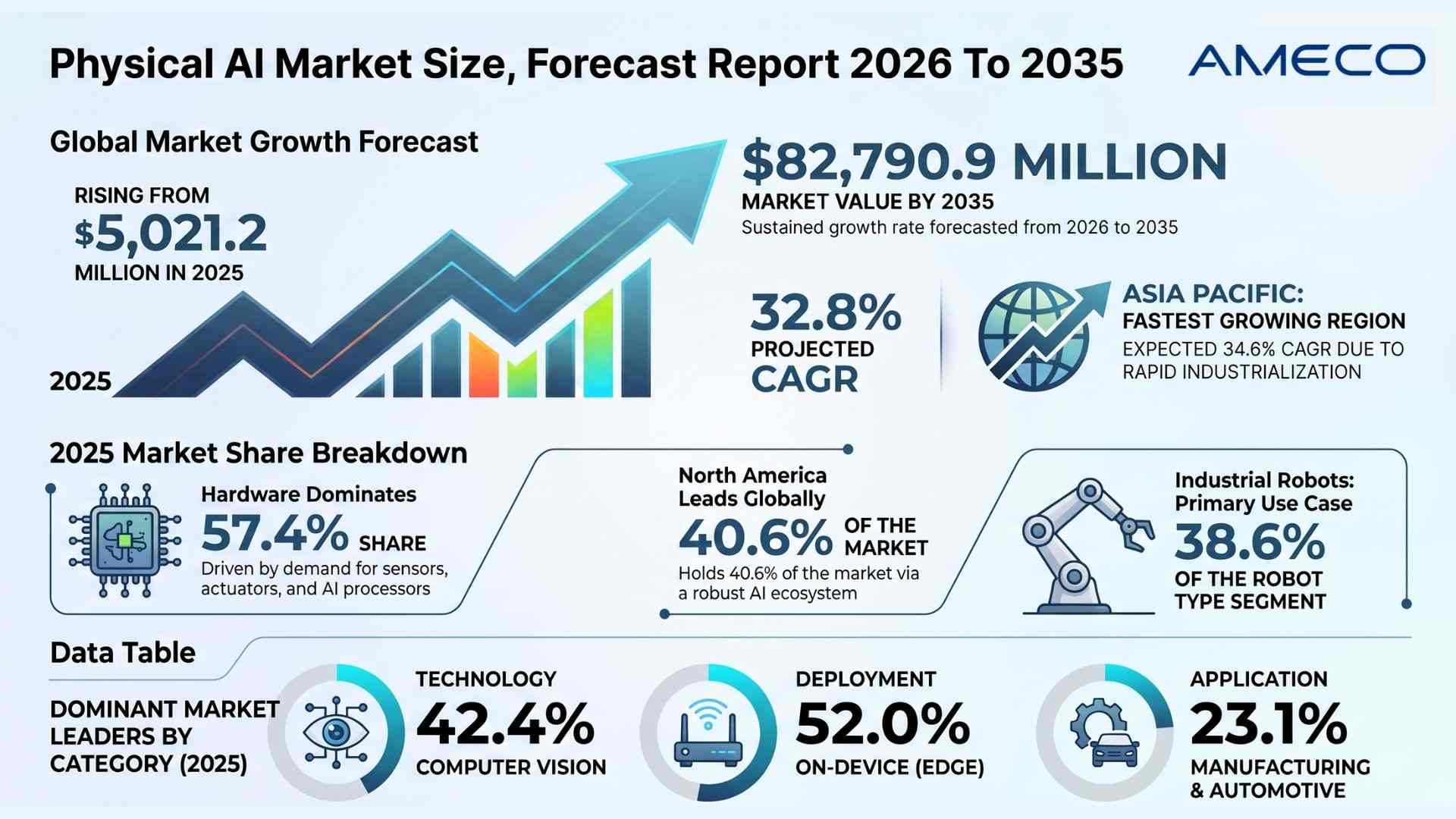
The global Physical AI Market size accounted for USD 5,021.2 million in 2025 and is estimated to achieve a market size of USD 82,790.9 million by 2035 growing at a CAGR of 32.8% from 2026 to 2035.
The physical AI market is defined as artificial intelligence technologies embedded within the physical world, encompassing systems like industrial robots, autonomous mobile robots (AMRs), humanoid robots, drones, autonomous vehicles, robots in healthcare, and intelligent machines with sensing, learning, reasoning, and physical interactions. The physical AI market consists of hardware, software and services to empower real-world decision making powered by advanced AI technologies such as computer vision, machine learning, NLP, edge AI, and sensor fusion used across diverse sectors including manufacturing, healthcare, logistics, automotive, retail, agriculture and defense.
Physical AI Market Statistics:
· By region: In 2025, the physical AI market in North America held approximately 40.6% share. It witnessed massive growth due to accelerated commercialization of AI-powered robotics, autonomous vehicles and sophisticated semiconductor technologies. The growing R&D activities and established leading AI & robotics firms ensure sustained progress in the segment.
· By region: Asia Pacific stood with an approximately 30.6% market share in 2025 and is expected to witness a CAGR of 34.6% during 2026–2035 due to extensive investments in the manufacturing industry, various government initiatives to support technology adoption, and increasing utilization of intelligent automation technologies.
· By component: In 2025, the hardware segment accounted for the largest share of 57.4%. Increased demand for smart sensors, advanced robotic systems, high-processing AI processors, cameras and actuators has been fueling the market for advanced hardware components needed to perform physical tasks intelligently. The large-scale deployment of intelligent industrial and service robots across manufacturing and other industries is the prime reason behind this.
· By component: The software segment accounted for a significant market share of 30.6% in 2025, driven by widespread deployment of advanced AI algorithms, machine learning models, digital twins and autonomous control systems.
· By deployment: In 2025, the on-device deployment segment held 52.0% market share, driven by the use of edge computing to offer real-time data processing, rapid response times, and high reliability without dependence on cloud infrastructure. In autonomous robots and industrial automation, the adoption of low-latency and secure AI applications is spurring segment growth.
· By deployment: Cloud-based deployments occupied 48.0% of the market share in 2025, facilitating efficient AI model training, centralized data analytics and the management of robotic fleets. The increased reliance on cloud technology ensures continuous updates and scaling of cloud-based AI systems, leading to higher adoption.
· By technology: In 2025, computer vision commanded a dominant share of 42.4% in the market, owing to its significance in navigation, object detection, environment understanding, and quality inspection.
· By technology: In 2025, the speech/NLP technology accounted for 21.9% of the market share, driven by greater demand for natural user-machine interactions in robots used in service, hospitality and healthcare sectors. The evolution of sophisticated conversational AI and multilingual capabilities will expand its use.
· By robot type: In 2025, industrial robots generated the largest share of 38.6% of the market. Increased automation in the manufacturing, electronics and automotive sectors is fueling the adoption of industrial robots powered by AI for assembly, welding, quality assurance, and predictive maintenance tasks.
· By robot type: The service robot type segment contributed 14.3% share in 2025, fueled by its adoption in various sectors like healthcare, retail, hospitality, logistics and domestic support. Need to mitigate labor shortages and enhance operational efficiency is creating substantial opportunities for this segment.
· By application: In 2025, the manufacturing and automotive sectors accounted for 23.1% of the market, thanks to the rising use of AI-powered robots in manufacturing, including welding, assembly, inspection, and predictive maintenance, driving overall productivity, reducing costs and improving flexibility.
· By application: The healthcare sector represented 18.0% market share in 2025, driven by increased use of robotic-assisted surgery, rehabilitative devices and AI diagnostic tools to improve healthcare outcomes and enhance operational efficiencies. Growing interest in automation for precision surgical procedures has accelerated the trend.
How Will Humanoid Robots and Autonomous Systems Unlock the Next Phase of Growth in the Physical AI Market?
One of the biggest opportunities for physical AI comes from the expanding commercialization of humanoid robots and other autonomous systems. Labor shortages are growing, the population is aging and demand for better productivity continues to rise, spurring investment in intelligent robots able to perform a range of complex physical actions in applications ranging from manufacturing, warehousing, hospitals, retail and construction to homes.
Combined with ongoing advancements in generative AI, multimodal foundation models, edge AI and powerful AI chip technologies, robots are getting better at understanding natural language, reacting in unpredictable environments and working alongside human beings. With lower costs for development and more sophisticated capabilities, physical AI is poised to move beyond just industrial automation into common commercial and consumer spaces, representing a vast market for technology vendors, robotics manufacturers, software engineers and chip makers globally.
Physical AI Market Regional Outlook:
In 2025, North America accounted for a significant market share of 40.6% in the global physical AI market, propelled by a robust artificial intelligence ecosystem, sophisticated semiconductor manufacturing and substantial investments in robotics, autonomous vehicles, and defense industries. North America is experiencing substantial growth in terms of artificial intelligence development, driven by leading technology companies and the increased spending on artificial intelligence research coupled with faster commercialization of smart robotics in the healthcare, automotive, and manufacturing sectors.
In 2025, Asia Pacific occupied 30.6% of the global physical AI market, and is expected to experience the quickest CAGR of 34.6% in the forecast period due to the accelerated industrialization and expansion of smart manufacturing technologies, supported by governments’ efforts to enhance the uptake of AI in their respective countries. With the deployment of industrial robots, autonomous mobile robots, and other artificial intelligence powered production technologies on the rise, the physical AI market in Asia Pacific is poised for remarkable growth during the forecast period.
Top Companies in the Physical AI Market
The physical AI market is dominated by a constellation of tech and robotics firms across autonomous systems, industrial automation, and intelligence machines. Among key technology enablers is NVIDIA Corporation, whose AI computing platforms, GPUs and robotics software are widely adopted to develop and implement models for physical AI.
Boston Dynamics is a leader in sophisticated mobile robots that enable inspection and maintenance, logistics, and warehouse automation. Two of the most exciting new startups commercializing humanoids are Agility Robotics and Figure AI.
Segments Covered in the Report
By Component
- Hardware
- Software
- Services
By Deployment
- Cloud-based AI
- On-device
By Technology
- Computer Vision
- Speech / NLP
- Gesture / Movement Recognition
- Reinforcement Learning & Control Systems
- Others (multi-modal AI, biomimetic robotics)
By Robot Type
- Industrial Robots
- Service Robots
- Humanoids/Social Robots
- Cobots
- Exoskeletons/Prosthetics
- Mobile Robots/Drones
By Application
- Healthcare
- Manufacturing & Automotive
- Logistics & Warehousing
- Retail & Hospitality
- Defense & Security
- Agriculture
- Education & Research
- Others
By Region
- North America
- U.S.
- Canada
- Europe
- U.K.
- Germany
- France
- Spain
- Rest of Europe
- Asia-Pacific
- India
- Japan
- China
- Australia
- South Korea
- Rest of Asia-Pacific
- Latin America
- Brazil
- Mexico
- Rest of LATAM
- The Middle East & Africa
- South Africa
- GCC Countries
- Rest of the Middle East & Africa (ME&A)
Did not find what you were looking for?
Contact Us:
Mr. Richard Johnson
Ameco Research
India: +91 8983225533
E-mail: [email protected]