Automotive Interior Materials Market Size and Growth Opportunities and Forecast till 2026 - 2035
Automotive Interior Materials Market Size, Share & Trends Report, 2026–2035
LAST UPDATED: OCTOBER 2026
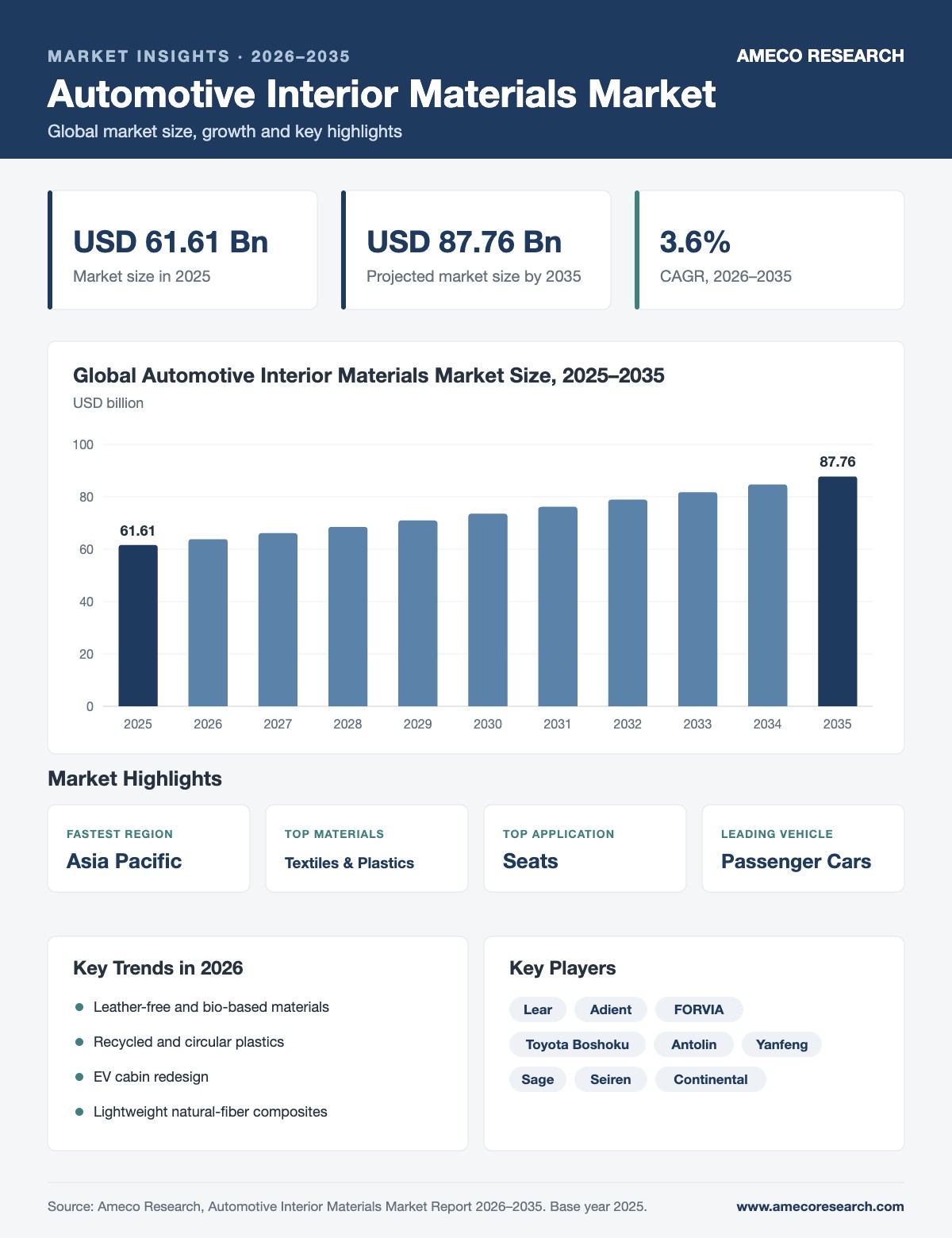
The global Automotive Interior Materials Market size was valued at USD 61.61 billion in 2025 and is projected to reach USD 87.76 billion by 2035, growing at a CAGR of 3.6% from 2026 to 2035. Growth is driven by rising vehicle production in Asia, premium and comfort-focused cabins, the shift to electric vehicles with redesigned interiors, and strong demand for lightweight, recycled and leather-free materials.
Automotive interior materials are the leathers, synthetic leathers, fabrics, thermoplastic polymers, foams and composites used to make seats, dashboards, door panels, headliners, consoles and carpets inside vehicles. They must meet strict requirements for durability, safety, low emissions, comfort and appearance. The market covers both passenger cars and commercial vehicles and is shifting toward lightweight, recyclable and bio-based materials as automakers cut weight and carbon emissions.
Automotive Interior Materials Market Key Takeaways
Automotive Interior Materials Market Report Scope
| Report Attribute | Details |
| Automotive Interior Materials Market Size in 2025 | USD 61.61 Billion |
| Automotive Interior Materials Market Forecast by 2035 | USD 87.76 Billion |
| Automotive Interior Materials Market CAGR (2026–2035) | 3.6% |
| Analysis Period | 2023–2035 |
| Base Year | 2025 |
| Forecast Period | 2026–2035 |
| Segments Covered | by Material Type, by Vehicle Type, by Application, and By Region |
| Regional Scope | North America, Europe, Asia Pacific, Latin America, and Middle East & Africa |
| Key Companies Profiled | Lear Corporation, Adient PLC, Faurecia SA (FORVIA), Toyota Boshoku Corporation, Grupo Antolin, Yanfeng Automotive Interiors, Sage Automotive Interiors, Seiren Co., Ltd., DK Leather Corporation, and Continental AG |
| Report Coverage | Market Trends, Drivers, Restraints, Opportunities, Competitive Analysis, Player Profiling, Regulation Analysis |
Automotive Interior Materials Market Size Forecast, 2023–2035
The table below shows the year-by-year size of the global automotive interior materials market. Revenue is expected to grow about 1.4 times between 2025 and 2035, reaching roughly USD 73.53 billion by 2030.
| Year | Market Size (USD Billion) |
| 2023 (historical) | 57.40 |
| 2024 (historical) | 59.47 |
| 2025 (base year) | 61.61 |
| 2026 (forecast) | 63.83 |
| 2027 (forecast) | 66.13 |
| 2028 (forecast) | 68.51 |
| 2029 (forecast) | 70.98 |
| 2030 (forecast) | 73.53 |
| 2031 (forecast) | 76.18 |
| 2032 (forecast) | 78.92 |
| 2033 (forecast) | 81.77 |
| 2034 (forecast) | 84.71 |
| 2035 (forecast) | 87.76 |
Latest Automotive Interior Materials Market Trends (2026)
Leather-free and vegan interiors
Automakers are replacing animal leather with synthetic and bio-based alternatives, led by EV brands such as Volvo, which committed to leather-free interiors for its fully electric models. Suppliers are scaling plant-based and recycled leather alternatives for seats and trim.
Recycled and circular materials
Recycled PET fabrics, recycled polypropylene panels and mono-material designs are spreading as automakers set recycled-content targets and Europe moves toward minimum recycled plastic content in new vehicles. Circular next-generation materials were a key theme at the June 2026 Automotive Interiors Expo in Stuttgart.
EV cabins redesigned as living spaces
Flat floors, larger screens and reconfigurable seating in electric vehicles are changing material needs toward premium soft-touch surfaces, acoustic materials and lightweight structures.
Lightweighting
Natural-fiber composites, foamed plastics and thinner laminates are used to cut interior weight, which helps extend EV range and improve fuel economy.
Smart and functional surfaces
Heated and ventilated fabrics, integrated lighting, capacitive controls under decorative surfaces and antimicrobial coatings are adding value to interior materials.
Low-emission and healthy cabins
Stricter rules on vehicle interior air quality, especially in China, are pushing suppliers toward low-VOC adhesives, foams and coatings.
Automotive Interior Materials Market Dynamics
Growth drivers
- Rising vehicle production, especially in Asia Pacific
- Consumer demand for comfort, premium feel and personalization
- Electric vehicles with redesigned, tech-rich cabins
- Automaker targets for recycled and sustainable materials
- Need to reduce vehicle weight
Restraints and challenges
- Volatile raw material prices for leather, polymers and fibers
- Higher cost of bio-based and recycled materials
- Cyclical vehicle production and trade tariffs
- Strict durability, flammability and emission standards
Opportunities
Key opportunities include plant-based and recycled leather alternatives, natural-fiber composites, smart and heated surfaces, low-VOC materials for the Chinese market, and premium interiors for electric vehicles in Asia Pacific, Europe and North America.
Automotive Interior Materials Market Segment Analysis
By material type
The market is segmented into leather, thermoplastic polymers, fabric, synthetic leather and others. Textiles and plastics are the most widely used materials, while synthetic leather is one of the fastest-growing segments as automakers move away from animal leather.
By vehicle type
Vehicle types include passenger cars and commercial vehicles. Passenger cars dominate the market because of higher production volumes and richer interior content.
By application
Applications include seats, dashboards, door panels and others. Seats are the largest application, using fabric, leather, synthetic leather and foam, followed by dashboards and door panels.
Automotive Interior Materials Market Regional Analysis
Asia Pacific is the fastest-growing market for automotive interior materials, led by China, India, Japan and South Korea, where vehicle production and EV adoption are rising quickly.
In North America, the United States is the largest market, supported by strong sales of SUVs and pickups with premium interiors. Europe leads in sustainable and recycled interior materials, driven by premium automakers and strict regulations.
Latin America and the Middle East & Africa are smaller but growing markets, supported by vehicle assembly in Mexico, Brazil, South Africa and Morocco.
Automotive Interior Materials Market Segmentation
Automotive Interior Materials Market Leading Companies
The automotive interior materials market includes global seating and interior system suppliers, textile and leather specialists and polymer surface makers. Companies compete on material innovation, sustainability, cost, global production footprint and long-term programs with automakers. Key players profiled in this report include Lear Corporation, Adient PLC, Faurecia SA (FORVIA), Toyota Boshoku Corporation, Grupo Antolin, Yanfeng Automotive Interiors, Sage Automotive Interiors, Seiren Co., Ltd., DK Leather Corporation, and Continental AG.
Lear CorporationAdient PLCFaurecia SA (FORVIA)Toyota Boshoku CorporationGrupo AntolinYanfeng Automotive InteriorsSage Automotive InteriorsSeiren Co., Ltd.DK Leather CorporationContinental AG
Recent developments
Key Questions Answered in This Report
- What is the size of the automotive interior materials market in 2025, and how large will it be by 2030 and 2035?
- What are the main growth drivers, restraints and opportunities through 2035?
- Which by material type and by vehicle type segments will grow the fastest?
- Which regions and countries offer the largest and fastest-growing opportunities?
- How are leather-free, recycled and EV-focused interior designs shaping demand in 2026?
- Who are the leading companies, and what strategies are they using to compete?
Research Methodology
Our estimates draw on interviews with interior system suppliers, leather, textile and polymer producers, automakers, and distributors, supported by secondary data from annual reports, investor materials, trade and customs data, standards bodies and industry journals. Bottom-up estimates of company revenues and top-down estimates of application demand are reconciled through data triangulation, and the model is updated with 2026 developments to forecast the market through 2035.
Related Reports
- Automotive Interior Market Report
- Automotive Lightweight Materials Market Report
- Glass Fiber Reinforcement Materials Market Report
- Water Treatment Materials Market Report
- High Thermal Conductivity Graphite Materials Market Report
Automotive Interior Materials Market: Frequently Asked Questions
How big is the automotive interior materials market?
The global automotive interior materials market was valued at USD 61.61 billion in 2025 and is expected to reach USD 87.76 billion by 2035.
What is the growth rate of the automotive interior materials market?
The automotive interior materials market is projected to grow at a CAGR of 3.6% from 2026 to 2035.
What will the automotive interior materials market be worth in 2030?
The automotive interior materials market is projected to reach about USD 73.53 billion in 2030, growing at a CAGR of 3.6%.
What is driving growth in the automotive interior materials market?
Key drivers are rising vehicle production in Asia, demand for premium and comfortable cabins, electric vehicle interior redesign and automaker targets for sustainable, lightweight materials.
What is automotive interior materials?
Automotive interior materials are the leathers, synthetic leathers, fabrics, plastics and foams used to make seats, dashboards, door panels and other parts inside a vehicle.
Which region leads the automotive interior materials market?
Asia Pacific is the fastest-growing region, led by China and India, while the United States is the largest market in North America.
Which segment holds the largest share of the automotive interior materials market?
Textiles and plastics are the most widely used materials, passenger cars dominate by vehicle type, and seats are the largest application.
What are the latest trends in the automotive interior materials market?
The main 2026 trends are leather-free and vegan interiors, recycled and circular materials, eV cabins redesigned as living spaces, lightweighting, smart and functional surfaces and low-emission and healthy cabins.
What are the main challenges in the automotive interior materials market?
The main challenges are volatile raw material prices, higher costs of sustainable materials, cyclical vehicle production and strict durability and emission standards.
What materials are used in car interiors?
Car interiors use fabrics such as polyester, genuine and synthetic leather, thermoplastic polymers such as polypropylene and ABS, polyurethane foams and natural-fiber composites.
Who are the key players in the automotive interior materials market?
Leading companies include Lear Corporation, Adient PLC, Faurecia SA (FORVIA), Toyota Boshoku Corporation, Grupo Antolin, Yanfeng Automotive Interiors, Sage Automotive Interiors, Seiren Co., Ltd., DK Leather Corporation, and Continental AG.