Agriculture Adjuvant Market Size and Growth Opportunities and Forecast till 2026 - 2035
Agriculture Adjuvant Market Size, Share & Trends Report, 2026–2035
LAST UPDATED: OCTOBER 2026
The global Agriculture Adjuvant Market size was valued at USD 4.5 billion in 2025 and is projected to reach USD 7.7 billion by 2035, growing at a CAGR of 5.45% from 2026 to 2035. Growth is driven by the need to get more performance from each pesticide application, shrinking arable land and rising food demand, precision and drone spraying, drift and resistance management, and fast growth of biological crop protection products that need compatible adjuvants.
Agricultural adjuvants are substances added to pesticides, herbicides, fungicides, insecticides and foliar nutrients to improve how they mix, spray, stick, spread and penetrate plant surfaces. Activator adjuvants, such as surfactants and crop oils, increase biological activity, while utility adjuvants, such as drift control agents, water conditioners, buffers, antifoams and compatibility agents, improve handling and application. Adjuvants are added in the spray tank (tank mix) or built into the product formulation (in-formulation).
Agriculture Adjuvant Market Key Takeaways
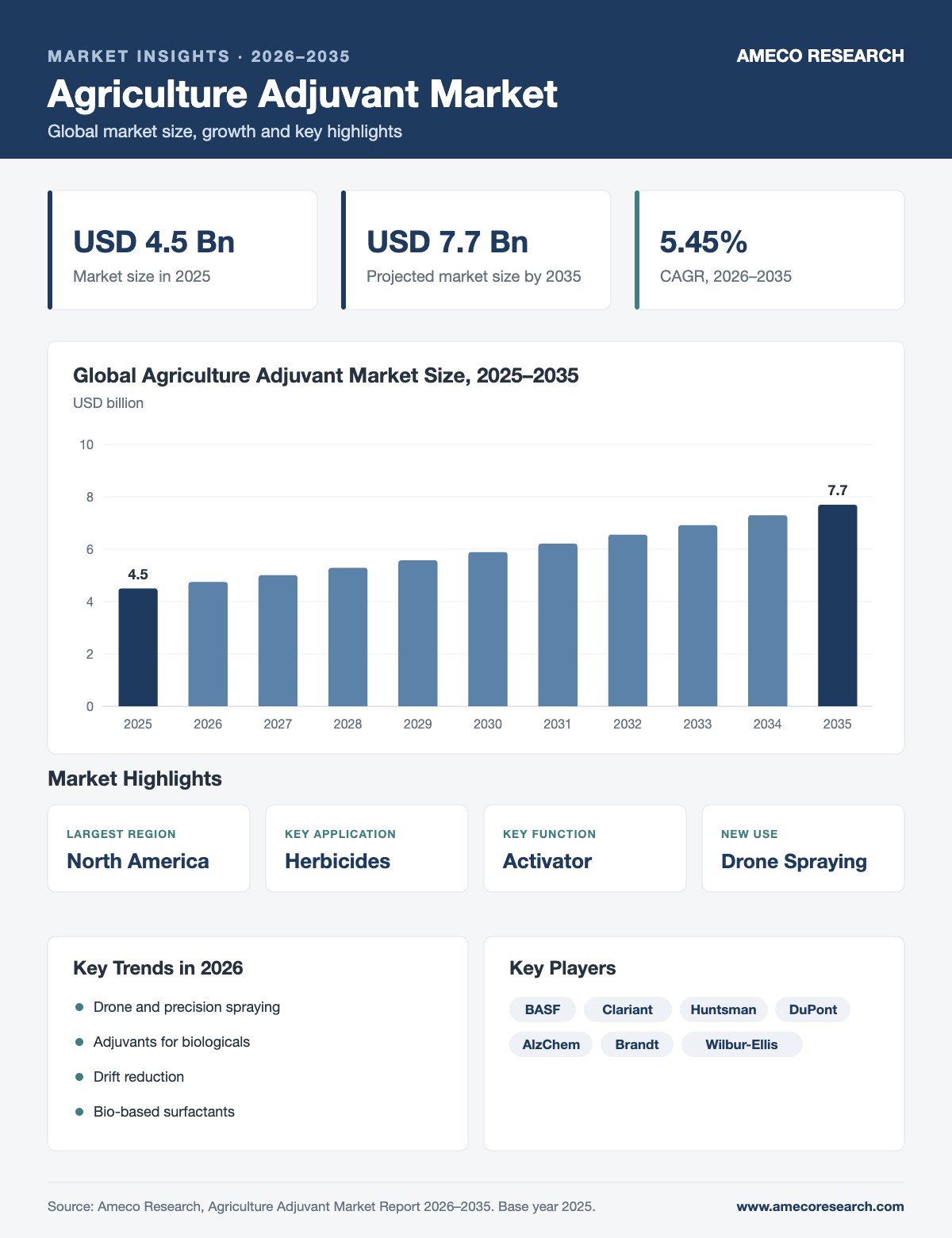 Infographic: Agriculture Adjuvant Market Size and Growth Opportunities and Forecast till 2026 - 2035 | Ameco Research
Agriculture Adjuvant Market Report Scope
| Report Attribute | Details |
| Agriculture Adjuvant Market Size in 2025 | USD 4.5 Billion |
| Agriculture Adjuvant Market Forecast by 2035 | USD 7.7 Billion |
| Agriculture Adjuvant Market CAGR (2026–2035) | 5.45% |
| Analysis Period | 2023–2035 |
| Base Year | 2025 |
| Forecast Period | 2026–2035 |
| Segments Covered | by Function, by Application, by Formulation, by Crop Type, by Adoption Stage, and By Region |
| Regional Scope | North America, Europe, Asia Pacific, Latin America, and Middle East & Africa |
| Key Companies Profiled | BASF SE, Clariant AG, Huntsman Corporation, DuPont de Nemours, Inc., AlzChem Group AG, Brandt Consolidated, Inc., and Wilbur-Ellis Company Inc. |
| Report Coverage | Market Trends, Drivers, Restraints, Opportunities, Competitive Analysis, Player Profiling, Regulation Analysis |
Agriculture Adjuvant Market Size Forecast, 2023–2035
The table below shows the year-by-year size of the global agriculture adjuvant market. Revenue is expected to grow about 1.7 times between 2025 and 2035, reaching roughly USD 5.9 billion by 2030.
| Year | Market Size (USD Billion) |
| 2023 (historical) | 4.0 |
| 2024 (historical) | 4.3 |
| 2025 (base year) | 4.5 |
| 2026 (forecast) | 4.7 |
| 2027 (forecast) | 5.0 |
| 2028 (forecast) | 5.3 |
| 2029 (forecast) | 5.6 |
| 2030 (forecast) | 5.9 |
| 2031 (forecast) | 6.2 |
| 2032 (forecast) | 6.6 |
| 2033 (forecast) | 6.9 |
| 2034 (forecast) | 7.3 |
| 2035 (forecast) | 7.7 |
Latest Agriculture Adjuvant Market Trends (2026)
Drone and precision spraying
Spray drones and precision sprayers use lower water volumes and finer droplets, creating demand for adjuvants that control drift, evaporation and droplet size and keep coverage consistent.
Adjuvants for biologicals
The growth of biopesticides and biostimulants is driving development of adjuvants that protect living organisms and natural compounds while improving coverage and uptake.
Drift reduction and stewardship
Rules and product labels for some herbicides require drift-reducing agents and specific nozzles, supporting demand for certified drift control adjuvants.
Bio-based and eco-friendly surfactants
Concern about residues and environmental impact is pushing suppliers toward seed oil, sugar-based and other biodegradable adjuvant chemistries.
Herbicide resistance management
As weeds become resistant to common herbicides, farmers use tank mixes of several modes of action and rely on adjuvants to improve performance and compatibility.
Built-in formulations
Crop protection companies are adding more adjuvants directly into formulations, while tank-mix adjuvants remain popular for flexibility.
Agriculture Adjuvant Market Dynamics
Growth drivers
- Shrinking arable land and rising food demand
- Growing use of agrochemicals and need to reduce pesticide waste
- Adoption of precision farming and drone spraying
- Commercial, contract and protected agriculture
- Herbicide resistance and complex tank mixes
Restraints and challenges
- Regulatory scrutiny of agrochemicals and their co-formulants
- Limited product differentiation among many adjuvants
- Lack of awareness among smaller farmers
- Volatile raw material prices for oils and surfactants
Opportunities
Key opportunities include adjuvants for biological products, eco-conscious and bio-based adjuvants, drone and UAV application, and growing crop protection markets in Latin America and Asia Pacific.
Agriculture Adjuvant Market Segment Analysis
By function
The market is segmented into activator adjuvants, such as surfactants and oil adjuvants, and utility adjuvants, including antifoam agents, compatibility agents, buffers/acidifiers, drift control agents, water conditioning agents and others. Activator adjuvants account for a large share because they directly improve pesticide performance.
By application and crop type
Applications include insecticides, herbicides, fungicides and others, with herbicides the largest. Crop types include cereals and grains, oilseeds and pulses, fruits and vegetables, and other crops, with cereals, grains and oilseeds accounting for most use.
By formulation and adoption stage
Formulations include emulsifiable concentrates and suspension concentrates, with suspension concentrates gaining attention. Adoption stages include tank mix and in-formulation, with tank mix giving farmers flexibility and in-formulation growing with ready-to-use products.
Agriculture Adjuvant Market Regional Analysis
North America holds the largest share and is expected to keep it, supported by a strong agrochemical customer base and large-scale farming. Canada is the fastest-growing country in the region.
Latin America, led by Brazil, is a major and growing market with large soybean, corn and sugarcane areas. Asia Pacific is growing with rising pesticide use and drone spraying in China and India.
Europe is a mature market shaped by strict pesticide regulation, and the Middle East & Africa is a smaller, developing market.
Agriculture Adjuvant Market Segmentation
Agriculture Adjuvant Market Leading Companies
The agriculture adjuvant market includes specialty chemical companies, surfactant producers and agricultural input distributors. Companies compete on performance data, product registrations, compatibility with pesticides and biologicals, sustainability and relationships with farmers and retailers. Key players profiled in this report include BASF SE, Clariant AG, Huntsman Corporation, DuPont de Nemours, Inc., AlzChem Group AG, Brandt Consolidated, Inc., and Wilbur-Ellis Company Inc..
BASF SEClariant AGHuntsman CorporationDuPont de Nemours, Inc.AlzChem Group AGBrandt Consolidated, Inc.Wilbur-Ellis Company Inc.
Key Questions Answered in This Report
- What is the size of the agriculture adjuvant market in 2025, and how large will it be by 2030 and 2035?
- What are the main growth drivers, restraints and opportunities through 2035?
- Which by function and by application segments will grow the fastest?
- Which regions and countries offer the largest and fastest-growing opportunities?
- How are drone spraying, biologicals and drift reduction shaping adjuvant demand in 2026?
- Who are the leading companies, and what strategies are they using to compete?
Research Methodology
Ameco Research built this forecast from a mix of primary and secondary research. Analysts spoke with adjuvant and surfactant manufacturers, crop protection companies, distributors and growers to validate pricing, volumes and demand trends, and reviewed company filings, trade statistics, regulatory documents and industry publications. The agriculture adjuvant market size was estimated with bottom-up and top-down approaches and validated through data triangulation, with 2025 as the base year and forecasts for 2026–2035.
Related Reports
- Farm Equipment Rental Market Report
- Nitrogenous Fertilizers Market Report
- Vertical Farming Market Growth Opportunities and Global Forecast to 2035 Report
- Hybrid Drive Train Market Report
- Mandelic Acid Market Report
Agriculture Adjuvant Market: Frequently Asked Questions
How big is the agriculture adjuvant market?
The global agriculture adjuvant market was valued at USD 4.5 billion in 2025 and is expected to reach USD 7.7 billion by 2035.
What is the growth rate of the agriculture adjuvant market?
The agriculture adjuvant market is projected to grow at a CAGR of 5.45% from 2026 to 2035.
What will the agriculture adjuvant market be worth in 2030?
The agriculture adjuvant market is projected to reach about USD 5.9 billion in 2030, growing at a CAGR of 5.45%.
What is driving growth in the agriculture adjuvant market?
Key drivers are shrinking arable land and rising food demand, growing agrochemical use, precision and drone spraying, and the need to reduce pesticide waste.
What is agriculture adjuvant?
Agricultural adjuvants are additives mixed with pesticides and other sprays to improve mixing, spreading, sticking, penetration and drift control.
Which region leads the agriculture adjuvant market?
North America holds the largest share, with Canada the fastest-growing country in the region, while Latin America and Asia Pacific are growing markets.
Which segment holds the largest share of the agriculture adjuvant market?
Activator adjuvants such as surfactants and oils hold a large share, and herbicides are the largest application.
What are the latest trends in the agriculture adjuvant market?
The main 2026 trends are drone and precision spraying, adjuvants for biologicals, drift reduction and stewardship, bio-based and eco-friendly surfactants, herbicide resistance management and built-in formulations.
What are the main challenges in the agriculture adjuvant market?
The main challenges are regulatory scrutiny, limited product differentiation, low awareness among small farmers and volatile raw material prices.
What is the difference between activator and utility adjuvants?
Activator adjuvants, such as surfactants and crop oils, increase a pesticide's activity, while utility adjuvants, such as drift control agents and water conditioners, improve mixing and application.
Who are the key players in the agriculture adjuvant market?
Leading companies include BASF SE, Clariant AG, Huntsman Corporation, DuPont de Nemours, Inc., AlzChem Group AG, Brandt Consolidated, Inc., and Wilbur-Ellis Company Inc..