Bepirovirsen (Hibsago) Market Size, Share, Trends & Growth Opportunities Forecast to 2026 - 2035
Bepirovirsen Market (Hibsago) Size, Share & Forecast Report, 2026–2035
LAST UPDATED: NOVEMBER 2026
The global bepirovirsen market size is estimated at USD 35.2 million in 2026 and is projected to reach USD 1,986.5 million by 2035, growing at a CAGR of 29.0% from 2027 to 2035. Bepirovirsen, sold by GSK as Hibsago, was approved in Japan in August 2026 and in the U.S. in October 2026. Sales are expected to reach USD 258.4 million in 2027, its first full year on the market, with North America holding the largest share and Europe growing fastest.
Bepirovirsen (brand name Hibsago; also known as GSK3228836) is an antisense oligonucleotide for chronic hepatitis B (CHB). It was discovered by Ionis Pharmaceuticals and is developed and sold by GSK. The drug targets all hepatitis B virus RNAs, which lowers levels of viral proteins, including hepatitis B surface antigen (HBsAg), and helps the immune system regain control of the virus. It is the first antisense therapy approved for CHB in the U.S.
Current nucleos(t)ide analogue (NA) drugs suppress the virus but rarely clear HBsAg, so most patients stay on them for life. Bepirovirsen is added to NA therapy for a fixed, six-month course with the goal of functional cure: a lasting loss of HBsAg and undetectable HBV DNA after all treatment stops. This makes the Hibsago market the first commercial market for a finite, cure-oriented hepatitis B treatment.
Bepirovirsen Market Key Takeaways
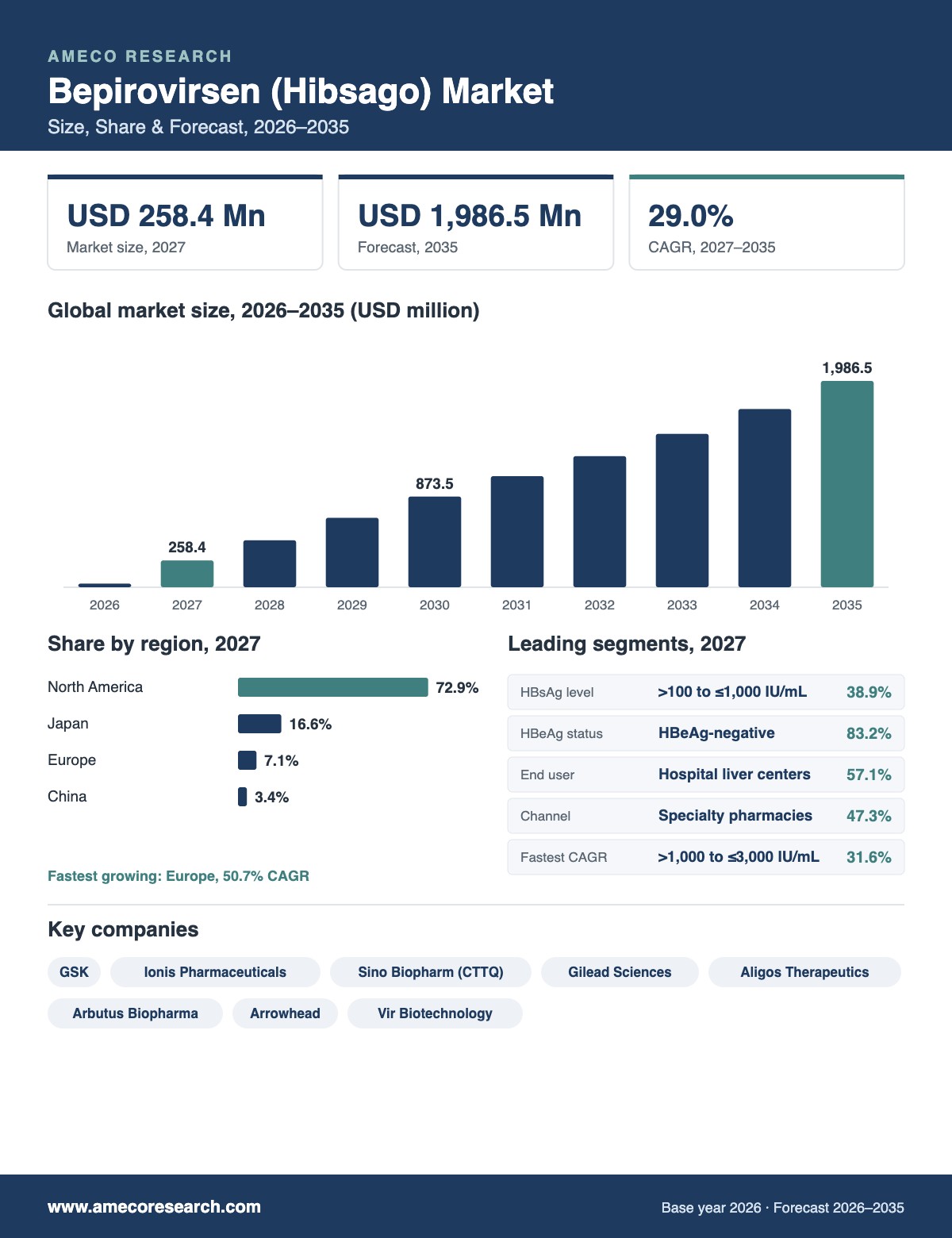 Infographic: Bepirovirsen (Hibsago) Market Size, Share, Trends & Growth Opportunities Forecast to 2026 - 2035 | Ameco Research
Bepirovirsen Market Report Scope
| Report Attribute | Details |
| Bepirovirsen Market Size in 2026 | USD 35.2 Million |
| Bepirovirsen Market Size in 2027 | USD 258.4 Million |
| Bepirovirsen Market Forecast by 2035 | USD 1,986.5 Million |
| Bepirovirsen Market CAGR (2027–2035) | 29.0% |
| Brand Name | Hibsago (GSK) |
| Base Year | 2026 (launch year) |
| Forecast Period | 2026–2035 |
| Largest Region | North America (72.9% share in 2027) |
| Fastest-Growing Region | Europe (50.7% CAGR, 2027–2035) |
| Segments Covered | Baseline HBsAg Level, HBeAg Status, End User, Distribution Channel and Region |
| Regional Scope | North America, Europe, Japan, China, Rest of Asia Pacific, Latin America, and Middle East & Africa |
| Key Companies Profiled | GSK plc, Ionis Pharmaceuticals, Sino Biopharmaceutical (Chia Tai Tianqing), Gilead Sciences, Aligos Therapeutics, Arbutus Biopharma, Arrowhead Pharmaceuticals and Vir Biotechnology |
| Report Coverage | Market size and forecast, epidemiology, clinical evidence, regulatory status, pricing and access, drivers, restraints, opportunities, segment and regional analysis, competitive landscape |
How Big Is the Bepirovirsen (Hibsago) Market in 2026?
Ameco Research estimates the bepirovirsen market at USD 35.2 million in 2026, reflecting only a few months of sales after the Japanese launch and the U.S. approval in October 2026. Revenue is expected to jump to USD 258.4 million in 2027, the first full year of U.S. sales, reach about USD 873.5 million by 2030 and climb to USD 1,986.5 million by 2035 as approvals expand to the European Union, China and other markets and more patients are tested for HBsAg eligibility.
| Year | Bepirovirsen Market Size (USD Million) |
| 2026 | 35.2 |
| 2027 | 258.4 |
| 2028 | 452.6 |
| 2030 | 873.5 |
| 2032 | 1,262.4 |
| 2035 | 1,986.5 |
Hibsago Market Outlook: Clinical Evidence
The approvals are based on the global Phase III B-Well 1 and B-Well 2 trials in patients on stable NA therapy. Both trials met their primary endpoint. GSK notes that functional cure rates with standard NA therapy are typically below 1% after one year.
| Outcome (pooled B-Well 1 and 2) | Result |
| Functional cure, overall (baseline HBsAg ≤3,000 IU/mL) | 19% (233 of 1,220) vs. 0% on placebo |
| Functional cure, baseline HBsAg ≤1,000 IU/mL | 26% (200 of 768) vs. 0% on placebo |
| HBsAg ≤100 IU/mL at week 72, overall (exploratory) | 49% |
| HBsAg ≤100 IU/mL at week 72, ≤1,000 IU/mL subgroup (exploratory) | 62% |
| Most common side effects | Injection-site redness, injection-site pain and a temporary rise in liver enzymes (ALT) |
| Treatment course | Fixed six months (24 weeks) of subcutaneous injections; 300 mg once weekly in Phase III |
Bepirovirsen Regulatory Status by Country
| Market | Status |
| Japan | Approved, August 2026 (first global approval; SENKU designation) |
| United States | Approved as Hibsago by the FDA, October 20, 2026 |
| European Union | Under review by the European Medicines Agency |
| China | Under review by the NMPA with Breakthrough Therapy (2021) and Priority Review (April 2026) status |
| Other markets | Further submissions planned; GSK expects more decisions in the coming months |
The U.S. label covers adults with CHB without cirrhosis who have been on NA therapy for at least six months, have suppressed HBV DNA and have an HBsAg level of 3,000 IU/mL or lower, measured with an FDA-authorized quantitative test. This links Hibsago uptake directly to quantitative HBsAg testing.
Chronic Hepatitis B Patient Pool
- More than 240 million people live with chronic hepatitis B worldwide, and hepatitis B causes about 1.1 million deaths a year.
- About 1.7 million people live with CHB in the U.S.
- Patients with HBsAg of 1,000 IU/mL or lower, who respond best to bepirovirsen, make up about 45% of diagnosed CHB cases globally.
- CHB accounts for more than half of liver cancer cases worldwide, which gives health systems a strong reason to fund curative treatment.
- China has the largest CHB population in the world, making it the largest long-term opportunity once the drug is approved and reimbursed.
Latest Bepirovirsen Market Trends 2026
From lifelong suppression to finite therapy
Bepirovirsen is the first approved CHB drug designed for a fixed course that aims at functional cure. This shifts treatment goals from lifelong viral control to stopping therapy, a change that guidelines, payers and specialists are now adapting to.
HBsAg testing becomes the gateway to treatment
Because eligibility and response depend on baseline HBsAg, quantitative HBsAg testing is set to become routine in CHB care. Wider testing in primary care and community settings will expand the treatable pool.
Launches roll out country by country
After Japan and the U.S., decisions in the European Union and China will shape growth. In May 2026, GSK partnered with Sino Biopharmaceutical’s Chia Tai Tianqing, which covers more than 5,000 medical centers, to prepare the China launch.
Self-administration supports outpatient care
After the first dose, patients may self-inject at home. This moves much of the six-month course out of the hospital and supports growth in specialty and retail pharmacy channels.
Combination and sequential regimens
Developers are testing bepirovirsen with other agents, such as siRNAs and immune modulators, to raise functional cure rates and reach patients with higher HBsAg levels.
Competition for functional cure builds
siRNAs, capsid assembly modulators, therapeutic vaccines and TLR agonists, including Gilead’s selgantolimod, are in development. Bepirovirsen’s head start gives GSK a lead of several years.
Bepirovirsen Market Dynamics
Growth drivers
- Large unmet need: current NA drugs rarely achieve HBsAg loss, leaving hundreds of millions of people on lifelong therapy.
- First-in-class functional cure: bepirovirsen is the only approved therapy with Phase III proof of functional cure in CHB.
- Finite treatment: a six-month course is attractive to patients and could reduce long-term drug, monitoring and liver cancer costs.
- Regulatory momentum: Breakthrough Therapy, Priority Review and SENKU designations speed access in China and Japan.
- Strong commercial partners: GSK’s global reach and CTTQ’s footprint in China support rapid uptake.
Restraints and challenges
- Response varies: most treated patients do not achieve functional cure, and response falls as baseline HBsAg rises.
- Narrow label: approval excludes patients with cirrhosis, those not on NA therapy and those with HBsAg above 3,000 IU/mL.
- Patient identification: many people with CHB are undiagnosed, and quantitative HBsAg testing is not yet routine.
- Safety monitoring: liver enzyme flares and other laboratory changes require regular blood tests during treatment.
- Pricing and reimbursement: a premium price must be justified to payers, especially in high-prevalence, cost-sensitive markets.
Opportunities
- Approvals in the European Union and China, which would greatly expand the eligible population.
- Broader HBsAg screening programs that identify more suitable patients earlier.
- Combination regimens that could extend benefit to HBeAg-positive and higher-HBsAg patients.
- Functional cure care pathways with biomarker monitoring after treatment ends.
- Emerging markets in Asia Pacific, Latin America and Africa, where CHB burden is highest.
Bepirovirsen Market Segment Analysis
By baseline HBsAg level: Which patients drive demand?
Patients with baseline HBsAg above 100 to 1,000 IU/mL formed the largest segment at 38.9% in 2027 (about USD 100.5 million) and are expected to hold 39.6% by 2035. The above 1,000 to 3,000 IU/mL group, at 29.7% in 2027, is the fastest-growing segment at about a 31.6% CAGR as label use widens, while the ≤100 IU/mL group’s share eases from 31.4% to 25.7%.
| Baseline HBsAg Level | Share (2027) | Key Highlights |
| ≤100 IU/mL | 31.4% | Highest response rates; share falls to 25.7% by 2035 (25.8% CAGR) |
| >100 to ≤1,000 IU/mL | 38.9% | Largest segment; USD 786.7 million by 2035 (29.3% CAGR) |
| >1,000 to ≤3,000 IU/mL | 29.7% | Fastest-growing at 31.6% CAGR; 34.7% share by 2035 |
By HBeAg status
HBeAg-negative patients, who make up most of the treated CHB population, accounted for 83.2% of revenue in 2027 and are expected to grow at about a 28.7% CAGR. HBeAg-positive patients held 16.8% and are growing faster, at about a 30.7% CAGR, reaching about USD 369.5 million by 2035.
| HBeAg Status | Share (2027) | Key Highlights |
| HBeAg-Negative | 83.2% | Largest segment; 81.4% share by 2035 (28.7% CAGR) |
| HBeAg-Positive | 16.8% | Faster-growing at 30.7% CAGR; 18.6% share by 2035 |
By end user
Hospital hepatology and gastroenterology centers held the largest share at 57.1% in 2027, as specialists start treatment and manage monitoring. Specialty clinics accounted for 30.2%, while community health centers and others, at 12.7%, are the fastest-growing end users at about a 35.1% CAGR, reaching 18.3% by 2035 as HBsAg testing and treatment move closer to patients.
| End User | Share (2027) | Key Highlights |
| Hospital Hepatology & Gastroenterology Centers | 57.1% | Largest; treatment start and laboratory monitoring |
| Specialty Clinics | 30.2% | Liver and infectious disease clinics; 28.6% CAGR |
| Community Health Centers & Others | 12.7% | Fastest-growing at 35.1% CAGR; 18.3% share by 2035 |
By distribution channel
Specialty pharmacies accounted for 47.3% of revenue in 2027 and are expected to reach 51.6% by 2035, about USD 1,025.0 million, given the drug’s specialty handling and patient support needs. Hospital pharmacies held 38.4%, while retail and online pharmacies, at 14.3%, are the fastest-growing channel at about a 32.1% CAGR as self-administration spreads.
| Distribution Channel | Share (2027) | Key Highlights |
| Specialty Pharmacies | 47.3% | Largest; 51.6% share by 2035 (30.5% CAGR) |
| Hospital Pharmacies | 38.4% | First doses and inpatient settings; 25.7% CAGR |
| Retail & Online Pharmacies | 14.3% | Fastest-growing at 32.1% CAGR; home self-injection |
Bepirovirsen Market Regional Analysis
| Region | Share (2027) | Outlook |
| North America | 72.9% | Largest; U.S. launch in late 2026; 46.9% share by 2035 (22.1% CAGR) |
| Japan | 16.6% | First approval in August 2026; 8.8% share by 2035 (19.2% CAGR) |
| Europe | 7.1% | Fastest-growing at 50.7% CAGR after EU approval; 24.6% share by 2035 |
| China | 3.4% | Launch with CTTQ after NMPA approval; 48.0% CAGR; 10.2% share by 2035 |
| Rest of Asia Pacific | – | Later launches; 6.3% share by 2035 |
| Latin America | – | Later launches; 1.7% share by 2035 |
| Middle East & Africa | – | Later launches; 1.5% share by 2035 |
Why does North America dominate the bepirovirsen market?
North America is expected to account for about 72.9% of revenue in 2027, or roughly USD 188.4 million. The FDA approval of Hibsago in October 2026, about 1.7 million people living with CHB in the U.S., high specialty drug prices and established specialty pharmacy networks support early uptake. The region’s share is expected to fall to about 46.9% by 2035 as launches outside the U.S. ramp up.
What makes Europe the fastest-growing region?
Europe is forecast to grow at about a 50.7% CAGR from 2027 to 2035, raising its share from 7.1% to about 24.6%. Growth depends on approval by the European Commission after the EMA review, followed by country-by-country pricing and reimbursement in Germany, France, Italy, Spain, the U.K. and other markets.
How important are China and Japan?
Japan granted bepirovirsen its first global approval in August 2026 and is expected to hold about 16.6% of revenue in 2027. China, home to the world’s largest CHB population, is under Priority Review, and GSK has partnered with Chia Tai Tianqing for importation, distribution and hospital access. China’s share is forecast to rise from 3.4% in 2027 to about 10.2% by 2035, at about a 48.0% CAGR.
Bepirovirsen Market Segmentation
Bepirovirsen Market Competitive Landscape
GSK holds global rights to bepirovirsen and is its only marketer, with Ionis Pharmaceuticals, which discovered the drug, eligible for milestones and royalties. In China, Chia Tai Tianqing will buy bepirovirsen from GSK under an initial 5.5-year supply agreement and handle distribution and hospital access. Future competition will come from other functional cure approaches in development.
GSK plc · Ionis Pharmaceuticals · Sino Biopharmaceutical (Chia Tai Tianqing) · Gilead Sciences · Aligos Therapeutics · Arbutus Biopharma · Arrowhead Pharmaceuticals · Vir Biotechnology
| Company | Role in CHB Functional Cure |
| GSK plc | Developer and marketer of bepirovirsen (Hibsago); combination studies |
| Ionis Pharmaceuticals | Discovered bepirovirsen; licensed to GSK |
| Sino Biopharmaceutical (CTTQ) | Commercialization partner for mainland China |
| Gilead Sciences | Selgantolimod (TLR8 agonist) in late-stage development |
| Aligos Therapeutics | Pevifoscorvir sodium (ALG-000184) capsid assembly modulator |
| Arbutus Biopharma | Imdusiran (AB-729) siRNA |
| Arrowhead Pharmaceuticals | JNJ-3989 (ARO-HBV) siRNA |
| Vir Biotechnology | siRNA and antibody-based hepatitis B programs |
Recent developments
- October 2026: The U.S. FDA approved Hibsago (bepirovirsen) for adults with chronic hepatitis B on NA therapy with HBsAg of 3,000 IU/mL or lower, the first antisense therapy for CHB in the U.S.
- August 2026: Japan granted bepirovirsen its first global approval for chronic hepatitis B.
- May 2026: GSK entered an exclusive collaboration with Sino Biopharmaceutical’s Chia Tai Tianqing to commercialize bepirovirsen in mainland China.
- April 2026: China’s NMPA accepted bepirovirsen for Priority Review.
- 2026: The European Medicines Agency accepted bepirovirsen for review, and full B-Well 1 and B-Well 2 results showed a 19% functional cure rate.
Bepirovirsen Market: Frequently Asked Questions
How big is the bepirovirsen market?
The global bepirovirsen market is estimated at USD 35.2 million in 2026, its launch year, and is expected to reach USD 258.4 million in 2027, its first full year on the market. Ameco Research projects it to reach USD 1,986.5 million by 2035, growing at a CAGR of 29.0% from 2027 to 2035.
How big is the Hibsago market?
Hibsago is the brand name of bepirovirsen, so the Hibsago market is the same as the bepirovirsen market. Ameco Research expects Hibsago sales to rise from USD 258.4 million in 2027 to about USD 1,986.5 million by 2035 as the drug launches in the U.S., Japan, China and Europe.
What is bepirovirsen (Hibsago) used for?
Bepirovirsen, sold as Hibsago, is an antisense oligonucleotide from GSK for adults with chronic hepatitis B. In the U.S. it is approved for use with nucleos(t)ide analogue therapy in adults without cirrhosis who have been on that therapy for at least six months, have suppressed HBV DNA and have an HBsAg level of 3,000 IU/mL or lower.
When was Hibsago approved?
Bepirovirsen received its first approval in Japan in August 2026. The U.S. FDA approved it as Hibsago on October 20, 2026, making it the first antisense therapy for chronic hepatitis B in the U.S. It is under regulatory review in the European Union and in China, where it has Breakthrough Therapy and Priority Review status.
How effective is bepirovirsen?
In the Phase III B-Well 1 and B-Well 2 trials, 19% of patients treated with bepirovirsen (233 of 1,220) achieved functional cure, compared with none on placebo. Among patients with a baseline HBsAg level of 1,000 IU/mL or lower, the functional cure rate rose to 26% (200 of 768).
How is bepirovirsen given?
Bepirovirsen is given as a subcutaneous injection over a fixed, six-month (24-week) course, added to ongoing nucleos(t)ide analogue therapy. In the Phase III program, patients received 300 mg once a week. After the first dose, patients may self-administer.
Which region leads the bepirovirsen market?
North America leads the bepirovirsen market with about 72.9% of revenue in 2027, driven by the early U.S. launch. Europe is the fastest-growing region, at about a 50.7% CAGR from 2027 to 2035, followed by China at about 48.0% as approvals and reimbursement expand.
Who are the key players in the bepirovirsen market?
GSK plc develops and sells bepirovirsen, which was discovered by Ionis Pharmaceuticals. Sino Biopharmaceutical’s Chia Tai Tianqing will commercialize it in mainland China. Companies developing rival chronic hepatitis B functional cure therapies include Gilead Sciences, Aligos Therapeutics, Arbutus Biopharma, Arrowhead Pharmaceuticals and Vir Biotechnology.
Related Pharma & Healthcare Market Reports
- Pharmacy Management System Market Size, Share, Trends & Growth Opportunities Forecast to 2026 - 2035
- Precision Medicine Market Growth Opportunities and Forecast till 2026 - 2035
- Healthcare Staffing Market Growth Opportunities and Forecast till 2032
- Telehealth Market Growth Opportunities and Forecast till 2032
- Insulin Delivery Devices Market Growth Opportunities and Forecast till 2032