Data Center Cooling Market Size, Share, Trends & Growth Opportunities Forecast to 2026 - 2035
Data Center Cooling Market Size, Share & Trends Report, 2026–2035
LAST UPDATED: OCTOBER 2026
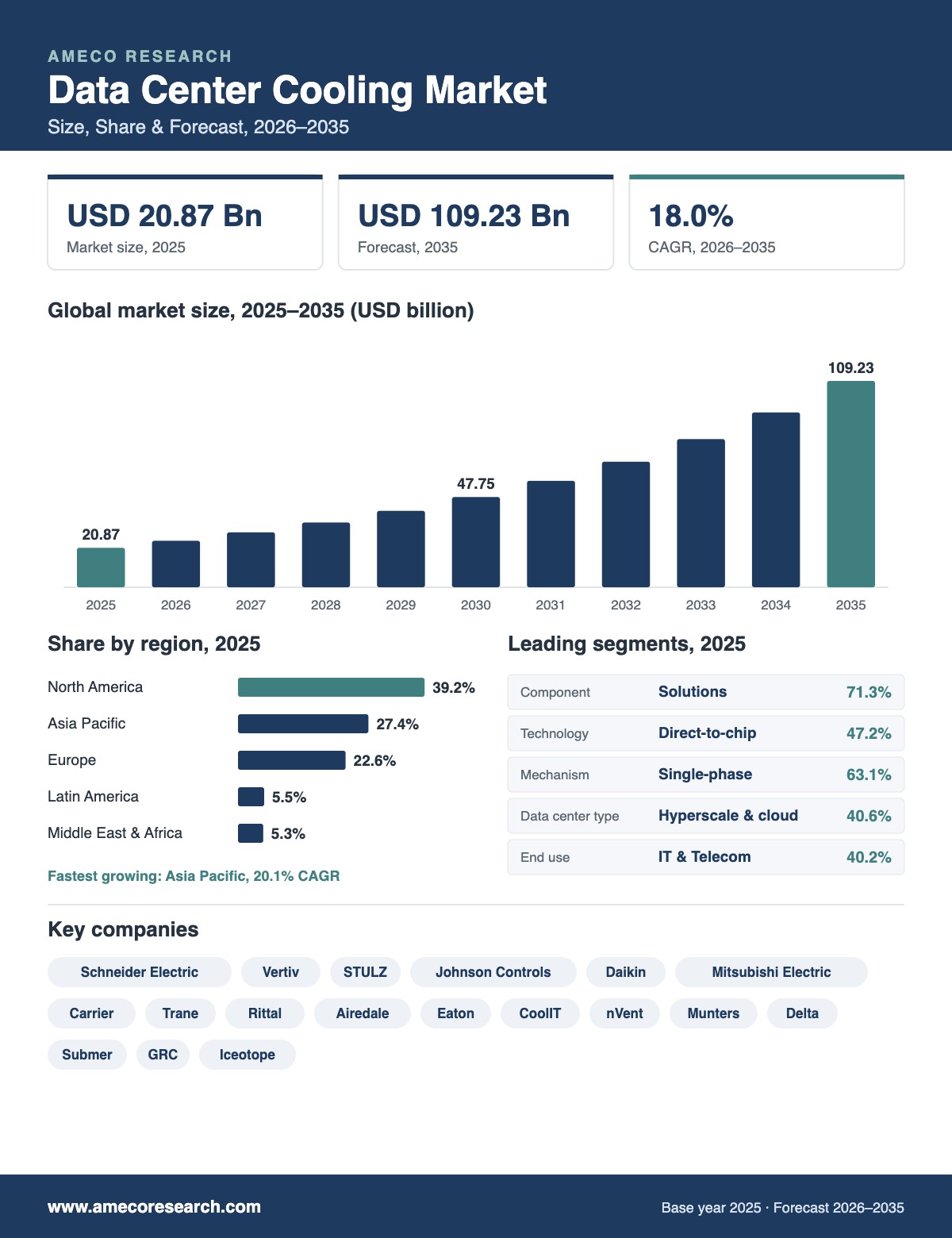
The global data center cooling market size was valued at USD 20.87 billion in 2025 and is projected to reach USD 109.23 billion by 2035, growing at a CAGR of 18.0% from 2026 to 2035. The market is estimated at USD 24.63 billion in 2026, with North America holding the largest share and Asia Pacific registering the fastest growth.
Data center cooling refers to the equipment, fluids, controls and services used to remove heat from servers, storage and network equipment and keep IT hardware within safe operating temperatures. Solutions range from traditional computer room air conditioners (CRAC), air handlers (CRAH), chillers and containment systems to liquid technologies such as direct-to-chip cold plates, rear-door heat exchangers (RDHx) and single-phase or two-phase immersion cooling.
Demand is being reshaped by artificial intelligence. GPU and accelerator racks now draw 50–200 kW and more, far beyond what air alone can handle, so operators are shifting new capacity to liquid cooling, retrofitting existing halls, and investing in water-efficient, heat-reuse-ready designs to meet sustainability targets.
Data Center Cooling Market Key Takeaways
Data Center Cooling Market Report Scope
| Report Attribute | Details |
| Data Center Cooling Market Size in 2025 | USD 20.87 Billion |
| Data Center Cooling Market Size in 2026 | USD 24.63 Billion |
| Data Center Cooling Market Forecast by 2035 | USD 109.23 Billion |
| Data Center Cooling Market CAGR (2026–2035) | 18.0% |
| Historical Data | 2021–2024 |
| Base Year | 2025 |
| Forecast Period | 2026–2035 |
| Largest Region | North America (39.2% share in 2025) |
| Fastest-Growing Region | Asia Pacific (20.1% CAGR) |
| Segments Covered | Component, Cooling Technology, Cooling Mechanism, Data Center Type, Rack Power Density, Deployment Type, End-Use Industry and Region |
| Regional Scope | North America, Europe, Asia Pacific, Latin America, and Middle East & Africa |
| Key Companies Profiled | Schneider Electric, Vertiv, STULZ, Johnson Controls, Daikin Industries, Mitsubishi Electric, Carrier Global, Trane Technologies, Rittal, Airedale International, Eaton, CoolIT Systems (Ecolab), nVent, Munters, Delta Electronics, Submer, Green Revolution Cooling and Iceotope |
| Report Coverage | Market size and forecast, trends, drivers, restraints, opportunities, segment and regional analysis, competitive landscape, recent developments |
How Big Is the Data Center Cooling Market in 2026?
Ameco Research estimates the data center cooling market at USD 24.63 billion in 2026, up 18% from USD 20.87 billion in 2025. The market is expected to approach USD 48 billion by 2030 and reach USD 109.23 billion by 2035, as liquid cooling moves from niche high-performance computing deployments into mainstream hyperscale, colocation and enterprise facilities.
| Year | Data Center Cooling Market Size (USD Billion) |
| 2025 | 20.87 |
| 2026 | 24.63 |
| 2028 | 34.29 |
| 2030 | 47.75 |
| 2032 | 66.48 |
| 2035 | 109.23 |
Latest Data Center Cooling Market Trends 2026
Liquid cooling becomes mainstream
Around one in five data center operators had deployed liquid cooling by early 2026, and roughly a third more plan to adopt it within the next two years. Direct-to-chip cold plates are the preferred first step because they fit standard racks and existing white space.
AI racks redefine thermal design
NVIDIA’s Vera Rubin platform, in full production since early 2026, is 100% liquid-cooled with 45°C coolant supply, removing the need for mechanical chillers in most climates. Rack power is rising to around 200 kW in 2026 and toward 600 kW with Kyber-class racks expected in 2027.
Efficiency gains depend on liquid
The Uptime Institute 2026 survey put the industry-average PUE at 1.52 and the capacity-weighted average at 1.36. Direct-to-chip designs typically achieve PUE of 1.10–1.20 and two-phase immersion as low as 1.02–1.07, compared with 1.55–1.67 for many legacy air-cooled sites.
Thermal management consolidation accelerates
Electrical and HVAC majors are buying liquid cooling specialists: Schneider Electric acquired a controlling stake in Motivair, Eaton agreed to buy Boyd Thermal for USD 9.5 billion, Trane Technologies announced the acquisition of LiquidStack in February 2026, and Ecolab completed its USD 4.75 billion purchase of CoolIT Systems in July 2026.
Water-free and closed-loop designs gain priority
Water scarcity and community scrutiny are pushing operators toward closed-loop, dry and warm-water cooling that minimizes evaporative water use, especially in water-stressed regions of the U.S., Southern Europe, the Middle East and India.
Waste heat reuse and AI-driven controls
Warm-water liquid loops make it practical to export data center heat to district heating networks, while AI-based control software continuously tunes fans, pumps and setpoints to cut cooling energy without risking hardware reliability.
Data Center Cooling Market Dynamics
Growth drivers
- AI and high-performance computing: GPU and accelerator clusters generate heat loads that exceed the practical limits of air cooling, making liquid cooling essential for new AI capacity.
- Hyperscale and colocation expansion: record data center construction by cloud providers and colocation operators requires cooling infrastructure in every new hall.
- Operational reliability: precise thermal control prevents throttling, hardware failures and downtime that can cost operators millions of dollars per incident.
- Energy and water efficiency targets: regulations, ESG commitments and rising power prices favor low-PUE and low-WUE cooling architectures.
- Edge computing growth: compact, self-contained cooling systems are needed for distributed edge sites supporting 5G, IoT and real-time AI inference.
Restraints and challenges
- High installation costs: liquid cooling requires coolant distribution units, manifolds, facility water loops and compatible servers, raising upfront investment.
- Retrofitting limitations: floor loading, ceiling height, piping routes and electrical capacity can make it difficult to convert legacy air-cooled halls.
- Reliability concerns: leak prevention, coolant quality management and new maintenance skills remain barriers for risk-averse operators.
- Lack of standardization: differing server designs, coolant chemistries and connector types complicate multi-vendor deployments.
- Extreme weather: hotter summers reduce free-cooling hours and stress heat rejection systems in many regions.
Opportunities
- Waste heat recovery for district heating, greenhouses and industrial processes, turning cooling into a revenue or sustainability asset.
- AI-driven cooling optimization using sensors, digital twins and machine learning to cut energy use and predict failures.
- Modular and prefabricated cooling skids and CDUs that shorten deployment timelines for fast-moving AI projects.
- Retrofit services that add rear-door heat exchangers or direct-to-chip loops to existing facilities without full rebuilds.
Data Center Cooling Market Segment Analysis
By component: Why do solutions dominate the data center cooling market?
Solutions accounted for 71.3% of revenue in 2025, covering chillers, CRAC and CRAH units, in-row coolers, coolant distribution units, cold plates, immersion tanks and heat rejection equipment. Services are the fastest-growing component as operators outsource design, installation, coolant management and maintenance of increasingly complex liquid systems.
| Component | Share (2025) | Key Highlights |
| Solutions | 71.3% | Chillers, CRAC/CRAH, CDUs, cold plates, immersion tanks and heat rejection systems |
| Services | 28.7% | Fastest-growing; design, installation, commissioning, coolant management and maintenance |
By cooling technology: Why does direct-to-chip lead liquid cooling?
Direct-to-chip liquid cooling held 47.2% of liquid cooling technology revenue in 2025 because cold plates fit standard rack form factors and are now specified by leading GPU and server makers. Immersion cooling is gaining ground in the highest-density AI and edge deployments.
| Cooling Technology | Share (2025) | Key Highlights |
| Direct-to-Chip Liquid Cooling | 47.2% | Cold plates on CPUs and GPUs; preferred for AI servers and standard racks |
| Immersion Cooling | 26.4% | Servers submerged in dielectric fluid; supports the highest rack densities |
| Rear-Door Heat Exchangers (RDHx) | 18.7% | Popular retrofit option for existing air-cooled halls |
| Others (In-Row, In-Rack, Spray) | 7.7% | Targeted cooling for mixed-density environments |
By cooling mechanism
Single-phase liquid cooling held 63.1% share in 2025 thanks to simpler fluid handling and broad vendor support, while two-phase systems are expanding in ultra-dense AI racks where boiling heat transfer delivers the highest efficiency.
| Cooling Mechanism | Share (2025) | Key Highlights |
| Single-Phase Liquid Cooling | 63.1% | Mature, easier to maintain, widely supported by server OEMs |
| Two-Phase Liquid Cooling | 36.9% | Highest heat removal capacity for next-generation AI racks |
By data center type: Why do hyperscale and cloud facilities lead?
Hyperscale and cloud data centers accounted for 40.6% of revenue in 2025 as the largest operators standardize liquid cooling for AI clusters. Colocation follows at 30.8% as providers build AI-ready, high-density suites for tenants, while edge facilities are the fastest-growing type.
| Data Center Type | Share (2025) | Key Highlights |
| Hyperscale & Cloud | 40.6% | Largest buyers of liquid cooling for AI training and inference clusters |
| Colocation | 30.8% | AI-ready, high-density suites built for multiple tenants |
| Enterprise | 18.4% | On-premises upgrades for private AI and regulated workloads |
| Edge | 10.2% | Fastest-growing; compact, self-contained cooling for distributed sites |
By rack power density
Racks of 50 to under 100 kW represented the largest share at 30.4% in 2025. The 100–200 kW and above-200 kW bands are growing fastest as GPU platforms scale, making liquid cooling mandatory rather than optional.
| Rack Power Density | Share (2025) | Key Highlights |
| Below 20 kW | 11.2% | Traditional enterprise and storage workloads, mainly air-cooled |
| 20 to <50 kW | 27.6% | High-density air with containment, RDHx and early liquid adoption |
| 50 to <100 kW | 30.4% | Largest band; mainstream direct-to-chip AI deployments |
| 100 to <200 kW | 23.5% | Rack-scale GPU systems requiring full liquid cooling |
| 200 kW and Above | 7.3% | Next-generation AI racks; two-phase and immersion solutions |
By deployment type
New-build facilities accounted for 57.3% of revenue in 2025 because liquid cooling is easiest to design in from day one. Retrofits held 42.7% as operators upgrade existing halls with rear-door heat exchangers and direct-to-chip loops to host AI workloads.
| Deployment Type | Share (2025) | Key Highlights |
| New-Build | 57.3% | Liquid-ready designs for AI campuses and new colocation halls |
| Retrofit / Existing | 42.7% | Upgrades of air-cooled facilities to support higher densities |
By end-use industry: Which industries spend most on data center cooling?
IT and telecommunications led with 40.2% share in 2025, followed by BFSI at 16.4% and healthcare and life sciences at 11.3%, where AI-driven imaging, genomics and drug discovery are adding compute-intensive workloads.
| End-Use Industry | Share (2025) | Key Highlights |
| IT & Telecommunications | 40.2% | Cloud, AI services, 5G core and network infrastructure |
| BFSI | 16.4% | Trading, fraud detection and risk analytics with strict uptime needs |
| Healthcare & Life Sciences | 11.3% | Medical imaging, genomics and AI drug discovery |
| Government & Public Sector | 9.6% | Sovereign cloud, defense and research computing |
| Manufacturing | 8.1% | Industrial automation, digital twins and edge analytics |
| Energy & Utilities | 6.2% | Grid analytics, seismic processing and smart metering |
| Others | 8.2% | Retail, media, education and other sectors |
Data Center Cooling Market Regional Analysis
| Region | Share (2025) | Outlook |
| North America | 39.2% | Largest market; AI campus construction across Texas, Virginia, Georgia, Ohio and the Midwest |
| Asia Pacific | 27.4% | Fastest-growing at a 20.1% CAGR; China, India, Japan, Singapore, Malaysia and Australia |
| Europe | 22.6% | Driven by energy-efficiency rules, heat reuse mandates and sovereign AI |
| Latin America | 5.5% | Emerging hubs in Brazil, Mexico and Chile |
| Middle East & Africa | 5.3% | Hot-climate cooling demand in Gulf AI campuses and South Africa |
Why does North America dominate the data center cooling market?
North America accounted for about 39.2% of global revenue in 2025. The United States hosts the world’s largest hyperscale and AI training campuses, early adoption of direct-to-chip and immersion cooling, and the headquarters of many leading thermal management vendors. Grid and water constraints are also accelerating demand for closed-loop, high-efficiency cooling.
What makes Asia Pacific the fastest-growing region?
Asia Pacific held 27.4% share in 2025 and is forecast to grow at a 20.1% CAGR through 2035. Rapid data center construction in China, India, Japan, Singapore, Malaysia and Australia, combined with hot and humid climates that limit free cooling, is driving strong demand for liquid and high-efficiency cooling. India’s gigawatt-scale AI campuses in Visakhapatnam and Jamnagar are adding significant new demand.
How are Europe and the Middle East developing?
Europe represented about 22.6% of the market in 2025, shaped by the EU Energy Efficiency Directive, reporting requirements on PUE and water use, and growing interest in exporting waste heat to district heating networks, particularly in the Nordics and Germany. In the Middle East, extreme ambient temperatures make advanced liquid cooling central to new Gulf AI campuses.
Data Center Cooling Market Segmentation
Data Center Cooling Market Leading Companies
The data center cooling market combines long-established HVAC and power companies with fast-growing liquid cooling specialists. Competition is shifting from individual products toward integrated thermal platforms that combine CDUs, cold plates, heat rejection, controls and lifecycle services, and the past two years have seen a wave of acquisitions as major vendors secure liquid cooling technology and capacity.
Schneider Electric · Vertiv · STULZ · Johnson Controls · Daikin Industries · Mitsubishi Electric · Carrier Global · Trane Technologies · Rittal · Airedale International · Eaton · CoolIT Systems (Ecolab) · nVent · Munters · Delta Electronics · Submer · Green Revolution Cooling · Iceotope
Recent developments
- July 2026: Ecolab completed its USD 4.75 billion acquisition of CoolIT Systems, a leading direct-to-chip liquid cooling provider.
- February 2026: Trane Technologies announced a definitive agreement to acquire LiquidStack, adding direct-to-chip CDUs and immersion cooling to its data center thermal portfolio.
- January 2026: NVIDIA confirmed its fully liquid-cooled Vera Rubin platform had entered full production, with 45°C warm-water cooling that removes the need for chillers in most climates.
- November 2025: Eaton agreed to acquire Boyd Thermal for USD 9.5 billion to expand its liquid cooling offering for AI data centers.
- February 2025: Schneider Electric completed the acquisition of a controlling stake in Motivair, strengthening its liquid cooling and CDU portfolio.
Data Center Cooling Market: Frequently Asked Questions
How big is the data center cooling market?
The global data center cooling market was valued at USD 20.87 billion in 2025 and is estimated at USD 24.63 billion in 2026. Ameco Research projects it to reach USD 109.23 billion by 2035, growing at a CAGR of 18.0% from 2026 to 2035.
What is the growth rate of the data center cooling market?
The market is expected to expand at a CAGR of 18.0% between 2026 and 2035, more than five times its 2025 value, as AI and high-performance computing push rack densities beyond the limits of traditional air cooling.
What is data center cooling?
Data center cooling is the set of systems that remove heat produced by servers, storage and networking equipment to keep them within safe operating temperatures. It includes air-based systems such as CRAC and CRAH units, chillers and in-row coolers, and liquid-based systems such as direct-to-chip cold plates, rear-door heat exchangers and immersion tanks.
What are the main types of data center cooling?
The main types are air cooling (CRAC/CRAH units, hot and cold aisle containment, in-row cooling), direct-to-chip liquid cooling using cold plates, immersion cooling in single-phase or two-phase dielectric fluids, and rear-door heat exchangers. Direct-to-chip liquid cooling held the largest share of liquid cooling technology revenue in 2025 at about 47.2%.
Why is liquid cooling growing in data centers?
AI accelerators and GPU servers have pushed rack power from 5–10 kW to 50–200 kW and beyond. Liquid removes heat far more efficiently than air, enabling these densities while lowering PUE to roughly 1.1–1.2 for direct-to-chip designs, compared with about 1.5–1.7 for many legacy air-cooled sites.
Which region leads the data center cooling market?
North America leads with about 39.2% of global revenue in 2025, driven by hyperscale and AI campus construction in the United States. Asia Pacific is the fastest-growing region, expected to expand at a 20.1% CAGR through 2035.
How much energy does data center cooling use?
Cooling can account for roughly 30% to 55% of a data center’s total energy use, depending on design and climate. The industry-wide average PUE was 1.52 in the Uptime Institute 2026 survey, while large modern facilities routinely report 1.3 or lower.
Who are the key players in the data center cooling market?
Leading companies include Schneider Electric, Vertiv, STULZ, Johnson Controls, Daikin Industries, Mitsubishi Electric, Carrier Global, Trane Technologies, Rittal, Airedale International, Eaton, CoolIT Systems (Ecolab), nVent, Munters, Delta Electronics, Submer, Green Revolution Cooling and Iceotope.
Related ICT and Media Market Reports
- AI Data Center Market Size, Share, Trends & Growth Opportunities Forecast to 2026 - 2035
- Physical AI Market Size and Growth Opportunities and Forecast till 2026 - 2035
- Corporate eLearning Market Size, Share, Trends & Growth Opportunities Forecast to 2026 - 2035
- Over the Top (OTT) Services Market Growth Opportunities and Forecast till 2032
- Predictive Analytics Market Size and Growth Opportunities and Forecast till 2026 - 2035