E-Waste Management Market Size and Growth Opportunities and Forecast till 2026 - 2035
E-Waste Management Market Size, Share & Trends Report, 2026–2035
LAST UPDATED: OCTOBER 2026
The global E-Waste Management Market size was valued at USD 80.0 billion in 2025 and is projected to reach USD 207.5 billion by 2035, growing at a CAGR of 10% from 2026 to 2035. Growth is driven by fast-rising volumes of discarded electronics, extended producer responsibility (EPR) laws, recovery of gold, copper, rare earths and battery metals, data center and IT asset disposal, EV and lithium-ion battery recycling, and corporate circular economy goals.
E-waste management covers the collection, transport, sorting, dismantling, refurbishment, recycling and safe disposal of discarded electrical and electronic equipment. This includes phones, computers, televisions, household appliances, IT and telecom equipment, data center hardware, industrial electronics and batteries. Processing recovers valuable materials such as gold, silver, copper, palladium and rare earth elements, along with plastics and glass, while hazardous substances such as lead, mercury and flame retardants are handled safely.
E-Waste Management Market Key Takeaways
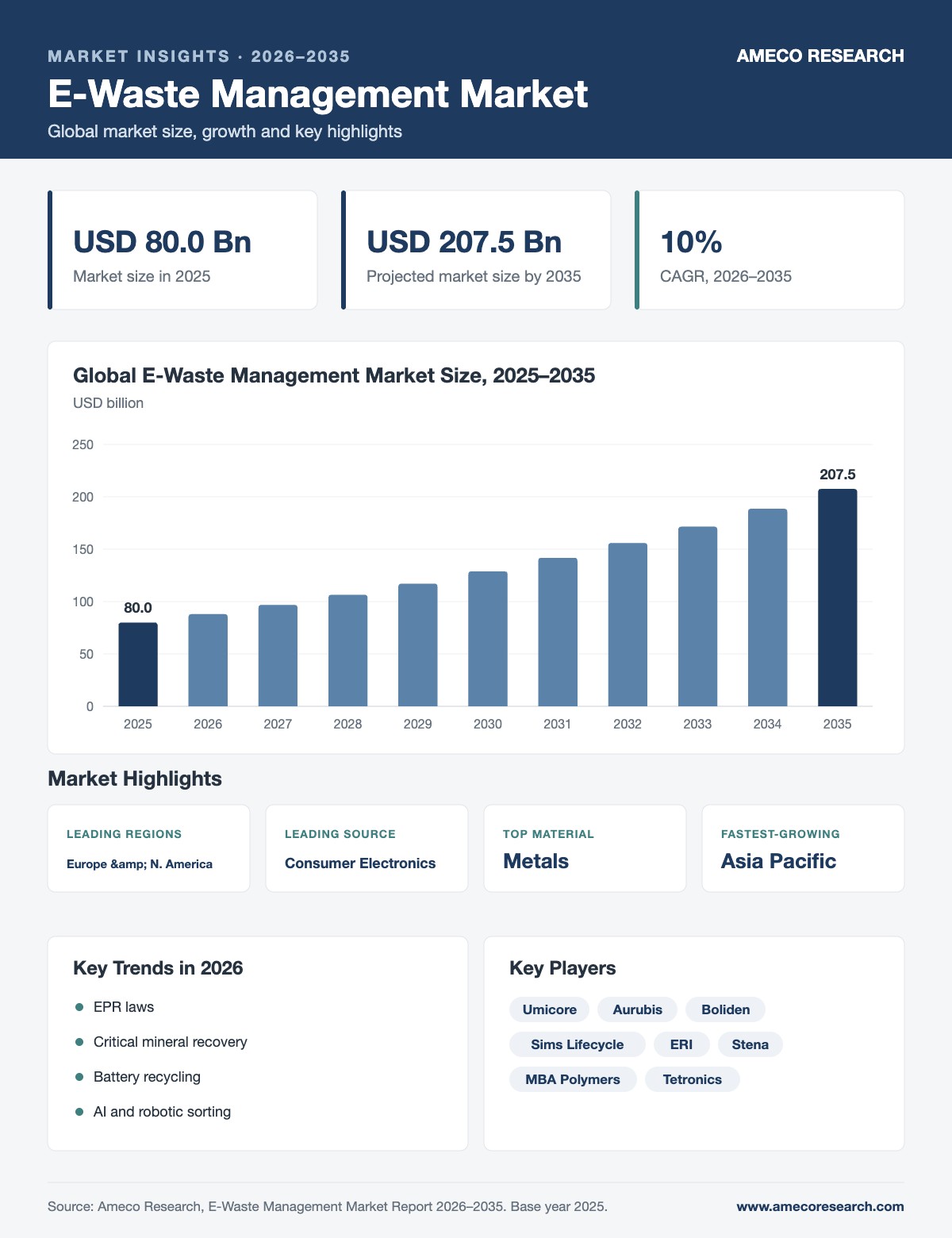 Infographic: E-Waste Management Market Size and Growth Opportunities and Forecast till 2026 - 2035 | Ameco Research
E-Waste Management Market Report Scope
| Report Attribute | Details |
| E-Waste Management Market Size in 2025 | USD 80.0 Billion |
| E-Waste Management Market Forecast by 2035 | USD 207.5 Billion |
| E-Waste Management Market CAGR (2026–2035) | 10% |
| Analysis Period | 2023–2035 |
| Base Year | 2025 |
| Forecast Period | 2026–2035 |
| Segments Covered | by Source, by Processed Material, by Application, and By Region |
| Regional Scope | North America, Europe, Asia Pacific, Latin America, and Middle East & Africa |
| Key Companies Profiled | Umicore N.V., Aurubis AG, Boliden AB, Sims Lifecycle Services, Electronic Recyclers International, Inc. (ERI), Stena Technoworld AB, MBA Polymers, Tetronics, Enviro-Hub Holdings Ltd., and Global Electric Electronic Processing Inc. |
| Report Coverage | Market Trends, Drivers, Restraints, Opportunities, Competitive Analysis, Player Profiling, Regulation Analysis |
E-Waste Management Market Size Forecast, 2023–2035
The table below shows the year-by-year size of the global e-waste management market. Revenue is expected to grow about 2.6 times between 2025 and 2035, reaching roughly USD 128.8 billion by 2030.
| Year | Market Size (USD Billion) |
| 2023 (historical) | 66.1 |
| 2024 (historical) | 72.7 |
| 2025 (base year) | 80.0 |
| 2026 (forecast) | 88.0 |
| 2027 (forecast) | 96.8 |
| 2028 (forecast) | 106.5 |
| 2029 (forecast) | 117.1 |
| 2030 (forecast) | 128.8 |
| 2031 (forecast) | 141.7 |
| 2032 (forecast) | 155.9 |
| 2033 (forecast) | 171.5 |
| 2034 (forecast) | 188.6 |
| 2035 (forecast) | 207.5 |
Latest E-Waste Management Market Trends (2026)
Fast-rising e-waste volumes
The world generated about 62 million tonnes of e-waste in 2022, and only about one-fifth was formally collected and recycled, leaving large room for growth in formal management.
Extended producer responsibility
More countries are adopting or tightening EPR rules that require producers to fund collection and recycling and meet recycling targets, including updated rules in India and the EU.
Critical mineral recovery
Recovery of copper, gold, cobalt, lithium and rare earth elements from e-waste is gaining importance as countries seek secure supplies of critical minerals.
Battery recycling
Growing volumes of lithium-ion batteries from phones, laptops, e-bikes and electric vehicles are driving investment in battery collection and hydrometallurgical recycling.
AI and robotic sorting
Recyclers use machine vision, AI and robotics to identify, sort and dismantle devices faster and more safely, improving recovery rates.
IT asset disposition and refurbishment
Data center growth and corporate device refresh cycles increase demand for secure data destruction, refurbishment and resale of IT equipment.
E-Waste Management Market Dynamics
Growth drivers
- Growth of the global electronics industry and shorter device lifecycles
- Government regulations and extended producer responsibility laws
- Scarcity and value of precious and critical metals
- Rising consumer and corporate environmental awareness
- Health and environmental risks from improper disposal
Restraints and challenges
- Large share of e-waste handled by the informal sector
- High cost of collection and logistics
- Complex product designs that make dismantling difficult
- Weak enforcement of rules in some countries
Opportunities
Key opportunities include battery and critical mineral recycling, refurbishment and resale, IT asset disposition for data centers, AI-based sorting, and formal recycling capacity in Asia Pacific, Africa and Latin America.
E-Waste Management Market Segment Analysis
By source
The market is segmented into industrial electronics, consumer electronics and others. Consumer electronics is the leading source, driven by short replacement cycles for phones, laptops, TVs and household appliances.
By processed material
Processed materials include metal, plastic, glass and others. Metals provide most of the recovered value, while plastic recycling is growing gradually as recyclers improve sorting and markets for recycled plastics.
By application
Applications include disposal and recycling. Recycling is the larger and faster-growing application as regulations and metal prices make material recovery more attractive than disposal.
E-Waste Management Market Regional Analysis
Europe and North America are the leading markets, supported by strict e-waste rules, producer responsibility schemes and formal recycling infrastructure.
Asia Pacific generates the largest volume of e-waste and is expected to grow fastest as China, India, Japan and Southeast Asian countries expand formal collection and recycling.
Latin America and the Middle East & Africa are emerging markets, where informal recycling is common and formal systems are developing.
E-Waste Management Market Segmentation
E-Waste Management Market Leading Companies
The e-waste management market includes metal smelters and refiners, specialist electronics recyclers, IT asset disposition companies and waste management firms. Companies compete on recovery rates, compliance, data security, collection networks, processing capacity and pricing. Key players profiled in this report include Umicore N.V., Aurubis AG, Boliden AB, Sims Lifecycle Services, Electronic Recyclers International, Inc. (ERI), Stena Technoworld AB, MBA Polymers, Tetronics, Enviro-Hub Holdings Ltd., and Global Electric Electronic Processing Inc..
Umicore N.V.Aurubis AGBoliden ABSims Lifecycle ServicesElectronic Recyclers International, Inc. (ERI)Stena Technoworld ABMBA PolymersTetronicsEnviro-Hub Holdings Ltd.Global Electric Electronic Processing Inc.
Key Questions Answered in This Report
- What is the size of the e-waste management market in 2025, and how large will it be by 2030 and 2035?
- What are the main growth drivers, restraints and opportunities through 2035?
- Which by source and by processed material segments will grow the fastest?
- Which regions and countries offer the largest and fastest-growing opportunities?
- How are EPR laws, critical mineral recovery and battery recycling shaping e-waste management in 2026?
- Who are the leading companies, and what strategies are they using to compete?
Research Methodology
Our estimates draw on interviews with recyclers, smelters, electronics producers, environmental agencies and published e-waste statistics, supported by secondary data from annual reports, investor materials, trade and customs data, standards bodies and industry journals. Bottom-up estimates of company revenues and top-down estimates of application demand are reconciled through data triangulation, and the model is updated with 2026 developments to forecast the market through 2035.
Related Reports
- Aircraft Recycling Market Report
- Ionic Exchange Based Liquid Nuclear Waste Treatment Market Report
- Industrial Waste Management Market Report
- Plastic Waste Management Market Report
- Recycled Glass Market Report
E-Waste Management Market: Frequently Asked Questions
How big is the e-waste management market?
The global e-waste management market was valued at USD 80.0 billion in 2025 and is expected to reach USD 207.5 billion by 2035.
What is the growth rate of the e-waste management market?
The e-waste management market is projected to grow at a CAGR of 10% from 2026 to 2035.
What will the e-waste management market be worth in 2030?
The e-waste management market is projected to reach about USD 128.8 billion in 2030, growing at a CAGR of 10%.
What is driving growth in the e-waste management market?
Key drivers are growing electronics consumption, shorter device lifecycles, e-waste regulations and EPR laws, the value of recovered metals and environmental awareness.
What is e-waste management?
E-waste management is the collection, dismantling, recycling and safe disposal of discarded electronic and electrical equipment to recover materials and prevent pollution.
Which region leads the e-waste management market?
Europe and North America are the leading markets, while Asia Pacific is expected to grow fastest.
Which segment holds the largest share of the e-waste management market?
Consumer electronics is the leading source, metals provide most recovered value, and recycling is the larger application.
What are the latest trends in the e-waste management market?
The main 2026 trends are fast-rising e-waste volumes, extended producer responsibility, critical mineral recovery, battery recycling, aI and robotic sorting and iT asset disposition and refurbishment.
What are the main challenges in the e-waste management market?
The main challenges are informal recycling, high collection and logistics costs, complex product designs and weak enforcement in some countries.
What valuable materials are recovered from e-waste?
E-waste contains gold, silver, palladium, copper, aluminum, cobalt, lithium and rare earth elements, which recyclers recover and sell back to manufacturers.
Who are the key players in the e-waste management market?
Leading companies include Umicore N.V., Aurubis AG, Boliden AB, Sims Lifecycle Services, Electronic Recyclers International, Inc. (ERI), Stena Technoworld AB, MBA Polymers, Tetronics, Enviro-Hub Holdings Ltd., and Global Electric Electronic Processing Inc..