Electric Excavator Market Size and Growth Opportunities and Forecast till 2026 - 2035
Electric Excavator Market Size, Share & Trends Report, 2026–2035
LAST UPDATED: OCTOBER 2026
The global Electric Excavator Market size was valued at USD 10.62 billion in 2025 and is projected to reach USD 63.49 billion by 2035, growing at a CAGR of 19.4% from 2026 to 2035. Growth is driven by zero-emission construction site rules in cities, falling battery costs, lower fuel and maintenance costs, quieter machines for urban and indoor work, and strong adoption of electric construction equipment in China and Europe.
Electric excavators are excavators powered by batteries, a cable connection to the grid or a hybrid diesel-electric system instead of only a diesel engine. They include mini and compact, crawler and wheeled models, from small machines under 10 hp to large over 20 hp units used in mining. Electric excavators produce zero or reduced exhaust emissions, less noise and vibration, and lower energy and maintenance costs, and are used in construction, mining, forestry, utilities, demolition and material handling.
Electric Excavator Market Key Takeaways
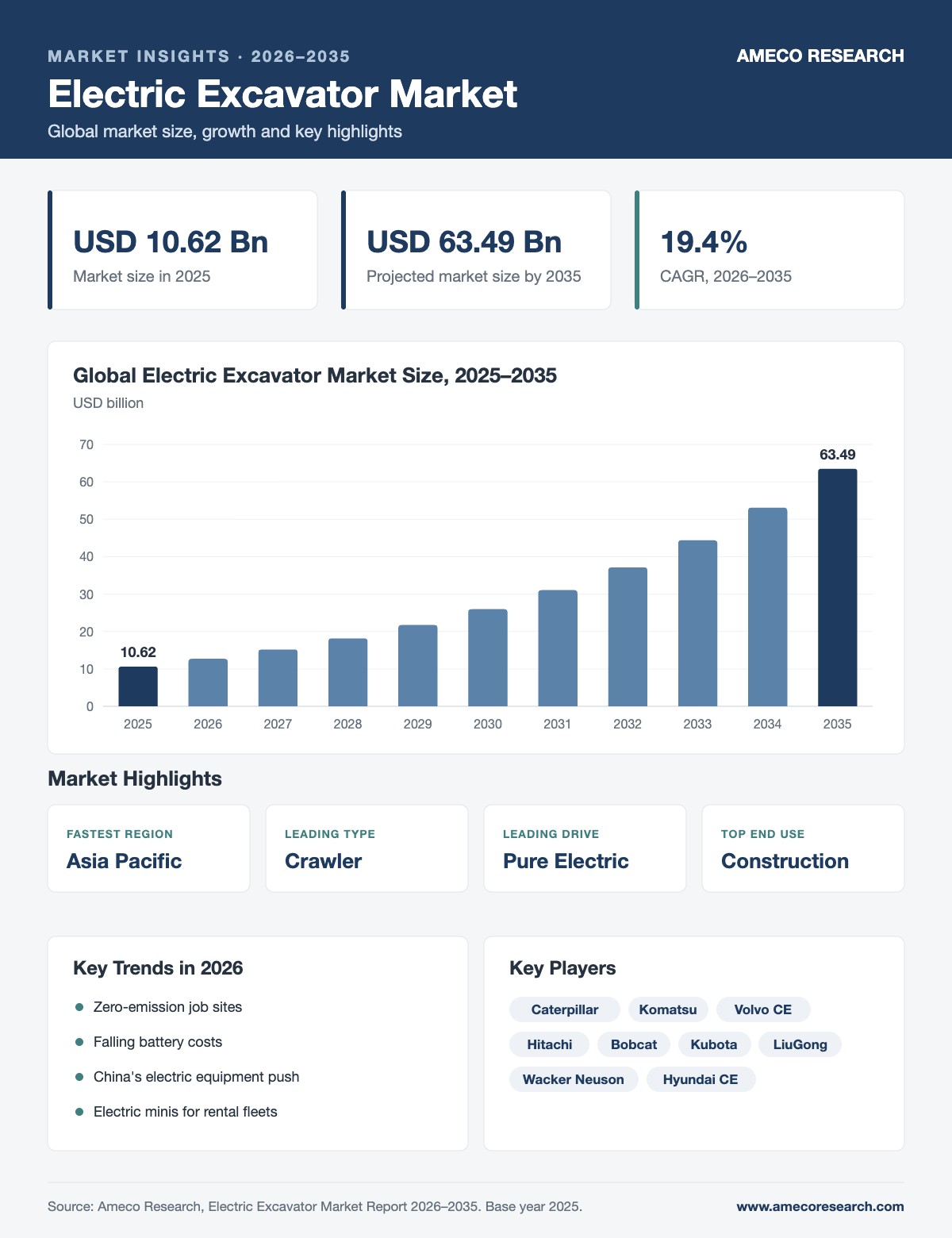 Infographic: Electric Excavator Market Size and Growth Opportunities and Forecast till 2026 - 2035 | Ameco Research
Electric Excavator Market Report Scope
| Report Attribute | Details |
| Electric Excavator Market Size in 2025 | USD 10.62 Billion |
| Electric Excavator Market Forecast by 2035 | USD 63.49 Billion |
| Electric Excavator Market CAGR (2026–2035) | 19.4% |
| Analysis Period | 2023–2035 |
| Base Year | 2025 |
| Forecast Period | 2026–2035 |
| Segments Covered | by Product Type, by Propulsion, by Power, by End-Use Industry, and By Region |
| Regional Scope | North America, Europe, Asia Pacific, Latin America, and Middle East & Africa |
| Key Companies Profiled | Bobcat (Doosan), Caterpillar, Hitachi, Hyundai Construction Equipment, Komatsu, Kubota, LiuGong, Mecalac, SENNEBOGEN, Volvo Construction Equipment, and Wacker Neuson |
| Report Coverage | Market Trends, Drivers, Restraints, Opportunities, Competitive Analysis, Player Profiling, Regulation Analysis |
Electric Excavator Market Size Forecast, 2023–2035
The table below shows the year-by-year size of the global electric excavator market. Revenue is expected to grow about 6.0 times between 2025 and 2035, reaching roughly USD 25.97 billion by 2030.
| Year | Market Size (USD Billion) |
| 2023 (historical) | 7.43 |
| 2024 (historical) | 8.88 |
| 2025 (base year) | 10.62 |
| 2026 (forecast) | 12.70 |
| 2027 (forecast) | 15.19 |
| 2028 (forecast) | 18.16 |
| 2029 (forecast) | 21.71 |
| 2030 (forecast) | 25.97 |
| 2031 (forecast) | 31.05 |
| 2032 (forecast) | 37.13 |
| 2033 (forecast) | 44.40 |
| 2034 (forecast) | 53.09 |
| 2035 (forecast) | 63.49 |
Latest Electric Excavator Market Trends (2026)
Zero-emission construction sites
Cities such as Oslo, Copenhagen and Amsterdam and many public agencies are requiring or rewarding zero-emission machinery on public projects, driving demand for electric excavators.
Battery cost declines
Lower lithium-ion and LFP battery prices are reducing the price gap with diesel machines, while lower energy and maintenance costs improve total cost of ownership.
China's electric equipment push
Chinese manufacturers are producing electric excavators at scale for domestic use and export, supported by cheap batteries and local policies.
Compact electric machines for rental
Electric mini and compact excavators are popular in rental fleets for urban, indoor and noise-sensitive work.
Charging and power solutions
Mobile battery packs, fast chargers and cable-powered designs are addressing job site charging challenges, especially for larger machines.
Larger electric and mining machines
Manufacturers are developing larger battery and cable-electric excavators for quarries and mines, where electric drives cut fuel costs and emissions.
Electric Excavator Market Dynamics
Growth drivers
- Emission regulations and zero-emission site requirements
- Lower operating and maintenance costs
- Falling battery prices
- Demand for quiet, low-vibration machines in urban areas
- Corporate sustainability goals of contractors
Restraints and challenges
- Higher purchase price than diesel machines
- Limited runtime and charging infrastructure on job sites
- Battery weight and performance limits for large machines
- Residual value and battery life uncertainty
Opportunities
Key opportunities include electric compact excavators for rental, cable-electric mining excavators, battery-swapping and mobile charging solutions, retrofits of diesel machines, and zero-emission public projects in Europe, North America and Asia.
Electric Excavator Market Segment Analysis
By product type
The market is segmented into wheeled, mini/compact, crawler and others. Crawler excavators emerged as the dominating sector, while mini and compact models are growing fastest in rental and urban work.
By propulsion
Propulsion types include pure electric and hybrid. Pure electric propulsion emerged as the dominating sector.
By power
Power classes include under 10 hp (around 2 ton), 10–20 hp (around 3.5–4 ton) and over 20 hp. Machines over 20 hp emerged as the dominating sector.
By end-use industry
End-use industries include construction, mining, forestry and others. Construction is the main end-use industry.
Electric Excavator Market Regional Analysis
North America is observed to gather a significant amount of share in the coming years, as contractors and rental companies adopt electric compact equipment.
The Asia-Pacific region is expected to witness the fastest growth rate, led by China's large-scale production and adoption of electric excavators, along with Japan and South Korea. Europe is a leading early adopter thanks to zero-emission site rules in Nordic and Western European cities.
Latin America and the Middle East & Africa are emerging markets, with interest from mining operators.
Electric Excavator Market Segmentation
Electric Excavator Market Leading Companies
The electric excavator market includes global construction equipment makers, compact equipment specialists and fast-growing Chinese manufacturers. Companies compete on battery and drive technology, runtime, charging solutions, price, dealer networks and service. Key players profiled in this report include Bobcat (Doosan), Caterpillar, Hitachi, Hyundai Construction Equipment, Komatsu, Kubota, LiuGong, Mecalac, SENNEBOGEN, Volvo Construction Equipment, and Wacker Neuson.
Bobcat (Doosan)CaterpillarHitachiHyundai Construction EquipmentKomatsuKubotaLiuGongMecalacSENNEBOGENVolvo Construction EquipmentWacker Neuson
Key Questions Answered in This Report
- What is the size of the electric excavator market in 2025, and how large will it be by 2030 and 2035?
- What are the main growth drivers, restraints and opportunities through 2035?
- Which by product type and by propulsion segments will grow the fastest?
- Which regions and countries offer the largest and fastest-growing opportunities?
- How are zero-emission site rules, battery costs and Chinese manufacturers shaping the electric excavator market in 2026?
- Who are the leading companies, and what strategies are they using to compete?
Research Methodology
Our estimates draw on interviews with construction equipment manufacturers, dealers, rental companies, contractors and battery suppliers, supported by secondary data from annual reports, investor materials, trade and customs data, standards bodies and industry journals. Bottom-up estimates of company revenues and top-down estimates of application demand are reconciled through data triangulation, and the model is updated with 2026 developments to forecast the market through 2035.
Related Reports
- Construction Equipment Aftermarket Report
- IoT in Construction Market Report
- Automotive Electric HVAC Compressor Market Report
- Pelvic Floor Electric Stimulator Market Report
- Electric Bed Market Report
Electric Excavator Market: Frequently Asked Questions
How big is the electric excavator market?
The global electric excavator market was valued at USD 10.62 billion in 2025 and is expected to reach USD 63.49 billion by 2035.
What is the growth rate of the electric excavator market?
The electric excavator market is projected to grow at a CAGR of 19.4% from 2026 to 2035.
What will the electric excavator market be worth in 2030?
The electric excavator market is projected to reach about USD 25.97 billion in 2030, growing at a CAGR of 19.4%.
What is driving growth in the electric excavator market?
Key drivers are emission regulations and zero-emission sites, lower operating costs, falling battery prices, demand for quiet machines and contractor sustainability goals.
What is an electric excavator?
An electric excavator is an excavator powered by batteries, a grid cable or a hybrid system instead of only a diesel engine, offering zero or low emissions and lower noise.
Which region leads the electric excavator market?
North America is gathering a significant share, while Asia-Pacific is expected to grow fastest.
Which segment holds the largest share of the electric excavator market?
Crawlers dominate by product type, pure electric leads propulsion, machines over 20 hp lead by power and construction is the main end use.
What are the latest trends in the electric excavator market?
The main 2026 trends are zero-emission construction sites, battery cost declines, china's electric equipment push, compact electric machines for rental, charging and power solutions and larger electric and mining machines.
What are the main challenges in the electric excavator market?
The main challenges are higher purchase prices, limited runtime and charging on sites, battery limits for large machines and residual value uncertainty.
How long does an electric excavator battery last?
Most electric mini and compact excavators can work for about a full shift on a charge under typical use, and many support fast charging or can run while plugged in.
Who are the key players in the electric excavator market?
Leading companies include Bobcat (Doosan), Caterpillar, Hitachi, Hyundai Construction Equipment, Komatsu, Kubota, LiuGong, Mecalac, SENNEBOGEN, Volvo Construction Equipment, and Wacker Neuson.