Flexible Electronics Market Size and Growth Opportunities and Forecast till 2026 - 2035
Flexible Electronics Market Size, Share & Trends Report, 2026–2035
LAST UPDATED: OCTOBER 2026
The global Flexible Electronics Market size was valued at USD 33.94 billion in 2025 and is projected to reach USD 92.13 billion by 2035, growing at a CAGR of 10.5% from 2026 to 2035. Growth is driven by the shift to flexible OLED displays in smartphones, the rise of foldable devices, fast-growing wearables and medical sensors, color e-paper and smart labels, and new uses in automotive interiors, energy and industrial IoT.
Flexible electronics are electronic circuits and devices built on bendable substrates such as plastic films, thin metal foil or paper instead of rigid silicon or glass. They can bend, fold, roll or stretch, which allows thinner, lighter and more durable products and new form factors. Key product types include flexible displays, printed and flexible sensors, thin-film and flexible batteries, flexible memory and flexible printed circuit boards (FPCs). The market is also referred to as flexible and printed electronics, bendable electronics or flexible hybrid electronics, and is closely linked to the printed electronics market and the flexible display market.
Flexible Electronics Market Key Takeaways
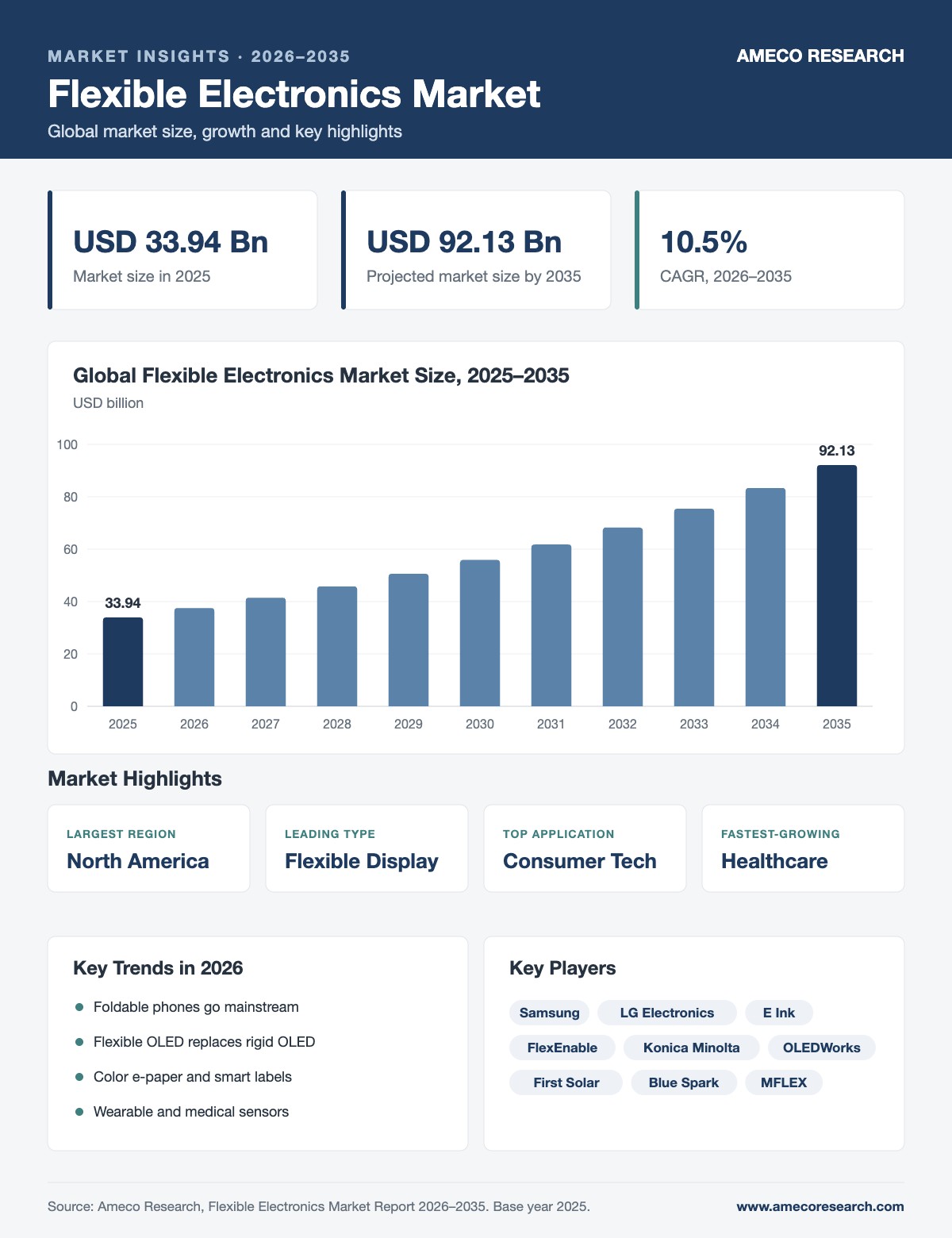 Infographic: Flexible Electronics Market Size and Growth Opportunities and Forecast till 2026 - 2035 | Ameco Research
Flexible Electronics Market Report Scope
| Report Attribute | Details |
| Flexible Electronics Market Size in 2025 | USD 33.94 Billion |
| Flexible Electronics Market Forecast by 2035 | USD 92.13 Billion |
| Flexible Electronics Market CAGR (2026–2035) | 10.5% |
| Analysis Period | 2023–2035 |
| Base Year | 2025 |
| Forecast Period | 2026–2035 |
| Segments Covered | By Type, By Application, and By Region |
| Regional Scope | North America, Europe, Asia Pacific, Latin America, and Middle East & Africa |
| Key Companies Profiled | Blue Spark Technologies, E Ink Holdings Inc., First Solar, FlexEnable, Front Edge Technologies, Konica Minolta, LG Electronics, Multi-Fineline Electronix (MFLEX), OLEDWorks, Samsung Electronics, and Solar Frontier |
| Report Coverage | Market Trends, Drivers, Restraints, Opportunities, Competitive Analysis, Player Profiling, Regulation Analysis |
Flexible Electronics Market Size Forecast, 2023–2035
The table below shows the year-by-year size of the global flexible electronics market. Revenue is expected to pass USD 50 billion in 2029 and nearly triple between 2025 and 2035.
| Year | Market Size (USD Billion) |
| 2023 (historical) | 27.80 |
| 2024 (historical) | 30.72 |
| 2025 (base year) | 33.94 |
| 2026 (forecast) | 37.51 |
| 2027 (forecast) | 41.45 |
| 2028 (forecast) | 45.80 |
| 2029 (forecast) | 50.61 |
| 2030 (forecast) | 55.92 |
| 2031 (forecast) | 61.79 |
| 2032 (forecast) | 68.28 |
| 2033 (forecast) | 75.45 |
| 2034 (forecast) | 83.37 |
| 2035 (forecast) | 92.13 |
Latest Flexible Electronics Market Trends (2026)
Foldable phones go mainstream
Foldable smartphones are expected to post strong double-digit shipment growth in 2026 as more brands enter the segment and Apple prepares its first foldable iPhone. Samsung Display holds a multi-year deal to supply its foldable OLED panels and began producing modules in June 2026. Foldables are still a small share of total smartphone shipments, leaving large room for growth in foldable OLED, ultra-thin glass, hinges and flexible printed circuits.
Flexible OLED replaces rigid displays
Flexible OLED is fast becoming the standard for smartphones. Industry data reported in August 2026 showed global flexible OLED smartphone panel shipments rising about 15.6% to roughly 350 million units in the first half of 2026, while rigid OLED shipments fell sharply as phone makers moved mid-range models to flexible panels. Samsung Display and BOE remain the largest suppliers, and Samsung Display's flexible OLED shipments jumped about 34.5% on strong iPhone demand.
Color e-paper and smart labels
Low-power, bendable e-paper is spreading in e-readers, electronic shelf labels, signage and logistics. E Ink Holdings reported record first-quarter 2026 sales and profit, with shipments of its Spectra 6 color e-paper overtaking black-and-white shipments for the first time, and is expanding into automotive, retail and healthcare.
Wearable and medical sensors
Thin, skin-like sensors are enabling continuous health monitoring through patches, smart rings, watches and smart textiles. Flexible biosensors for glucose, heart rhythm, temperature and hydration are among the fastest-growing applications as remote patient monitoring and consumer health tracking expand.
Flexible batteries and printed electronics
Thin-film and printed batteries, printed circuits and roll-to-roll manufacturing are lowering costs and enabling disposable and wearable devices, smart packaging and RFID tags. These technologies are key to powering the next generation of IoT and medical patches.
New uses in cars, energy and industry
Automakers are adding curved and flexible displays, flexible lighting and sensors to cabin designs. Flexible thin-film solar modules are used on vehicles, buildings and portable devices, and flexible sensors are spreading in industrial monitoring and robotics.
Flexible Electronics Market Dynamics
Growth drivers
- Shift to flexible OLED displays in smartphones, watches, tablets and laptops
- Growing adoption of foldable and rollable devices
- Rapid growth in wearables, remote health monitoring and medical patches
- Demand for lightweight, durable and space-saving electronics in cars and industry
- Advances in printed electronics, new materials and roll-to-roll manufacturing
Restraints and challenges
- High production costs and lower yields compared with rigid electronics
- Durability concerns such as display creases, wear and moisture sensitivity
- Complex manufacturing that requires specialized materials and equipment
- Supply chain concentration in a few Asian panel makers
Opportunities
Key opportunities include foldable and rollable laptops and tablets, medical-grade wearable sensors, flexible batteries for IoT, smart packaging and labels, automotive cabin displays and flexible solar for vehicles and buildings.
Flexible vs. Rigid Electronics: Key Differences
| Attribute | Flexible Electronics | Rigid Electronics |
| Substrate | Polyimide, PET/PEN film, thin metal foil, ultra-thin glass or paper | FR-4 board, silicon wafer or standard glass |
| Form factor | Can bend, fold, roll or stretch; thin and lightweight | Fixed, flat shape; thicker and heavier |
| Durability | High shock and vibration resistance; risk of creasing and moisture damage | Proven long-term reliability; can crack under impact |
| Manufacturing | Roll-to-roll, printing and thin-film processes; lower yields today | Mature, high-yield processes at large scale |
| Cost | Higher per unit for advanced displays; falling for printed parts | Lower per unit for most mass-market parts |
| Typical uses | Foldable phones, wearables, medical patches, smart labels, curved car displays | Computers, servers, appliances, conventional phones and controllers |
Flexible Electronics Technologies and Product Types
Flexible displays (OLED and e-paper)
Flexible OLED and color e-paper panels on plastic or ultra-thin glass power foldable phones, smartwatches, e-readers and electronic shelf labels. They are the largest product type in the market.
Flexible printed circuits (FPC) and flexible PCBs
Flexible printed circuit boards connect components inside phones, cameras, laptops, cars and medical devices where space is tight or parts must move. Rigid-flex boards combine both in one assembly.
Flexible and printed sensors
Thin pressure, temperature, strain and biosensors are printed on films or textiles for wearables, health patches, robotics and industrial monitoring. See also the chemical sensors market.
Flexible and thin-film batteries
Bendable lithium, zinc and printed batteries power smart cards, patches and IoT tags, with new chemistries covered in the graphene battery market and battery technology market reports.
Stretchable and flexible hybrid electronics
Flexible hybrid electronics combine printed circuits with thin silicon chips, while stretchable electronics use wavy or liquid-metal conductors to move with skin and fabric. Both rely on advances in the wider semiconductor market.
Flexible Electronics Market Segment Analysis
By type
The market is segmented into flexible batteries, flexible sensors, flexible displays, flexible memory and others. Flexible displays are the largest segment, led by flexible OLED panels for smartphones, foldables, smartwatches and laptops. Flexible sensors and batteries are growing fast, driven by wearables, medical devices and IoT.
By application
Applications include consumer electronics, healthcare, automotive, energy and power, industrial, defense and others. Consumer electronics holds the largest share, led by smartphones and wearables. Healthcare is among the fastest-growing applications thanks to wearable monitors and skin-like sensors, while automotive is adding flexible displays and sensors to vehicle interiors.
Flexible Electronics Market Regional Analysis
North America held the largest share of the flexible electronics market, about a third of global revenue, driven by strong demand for wearables and smart devices, major technology brands and heavy R&D investment in medical and defense applications.
Asia Pacific is the world's main manufacturing hub, with South Korea, China, Japan and Taiwan leading production of flexible OLED panels, flexible printed circuits and batteries, and is expected to grow the fastest. Europe is strong in printed electronics research, automotive and industrial applications.
Latin America and the Middle East & Africa are smaller but growing markets, supported by rising smartphone and wearable adoption.
Flexible Electronics Market Segmentation
Flexible Electronics Market Leading Companies
The flexible electronics market includes large display and consumer electronics companies, e-paper and printed electronics specialists, flexible circuit makers and thin-film solar producers. Companies compete on display quality and durability, manufacturing scale, materials innovation and partnerships with device brands. Key players profiled in this report include Blue Spark Technologies, E Ink Holdings Inc., First Solar, FlexEnable, Front Edge Technologies, Konica Minolta, LG Electronics, Multi-Fineline Electronix (MFLEX), OLEDWorks, Samsung Electronics, and Solar Frontier.
Samsung ElectronicsLG ElectronicsE Ink HoldingsFlexEnableKonica MinoltaOLEDWorksFirst SolarBlue Spark TechnologiesFront Edge TechnologiesMFLEXSolar Frontier
Recent developments
Key Questions Answered in This Report
- What is the size of the flexible electronics market in 2025, and how large will it be by 2030 and 2035?
- What are the main growth drivers, restraints and opportunities through 2035?
- Which product types and applications will grow the fastest?
- Which regions and countries offer the largest and fastest-growing opportunities?
- How are foldable phones, flexible OLED, e-paper and wearable sensors shaping demand in 2026?
- Who are the leading companies, and what strategies are they using to compete?
Research Methodology
This report combines primary and secondary research. Primary research includes interviews with manufacturers, material suppliers, distributors and industry experts. Secondary research covers company annual reports, investor presentations, government and trade association data, patent filings and industry publications. Market size is estimated using both bottom-up (company revenue and shipment data) and top-down (application demand) methods, and the results are cross-checked through data triangulation before forecasts are built for 2026–2035.
Related Reports
- Printed Electronics Market
- Flexible Display Market
- Graphene Battery Market
- Semiconductor Market
- Battery Technology Market
Flexible Electronics Market: Frequently Asked Questions
How big is the flexible electronics market?
The global flexible electronics market was valued at USD 33.94 billion in 2025 and is expected to reach USD 92.13 billion by 2035.
What is the growth rate of the flexible electronics market?
The flexible electronics market is projected to grow at a CAGR of 10.5% from 2026 to 2035.
What is driving growth in the flexible electronics market?
Key drivers are flexible OLED displays, foldable phones, wearables and medical sensors, e-paper, and new uses in automotive, energy and industry.
What are flexible electronics?
Flexible electronics are circuits and devices built on bendable materials such as plastic film, metal foil or paper, allowing them to bend, fold or stretch.
Which region leads the flexible electronics market?
North America holds the largest share of revenue, while Asia Pacific is the main manufacturing hub and the fastest-growing region.
What are the latest trends in flexible electronics?
The main 2026 trends are foldable phones, flexible OLED replacing rigid displays, color e-paper, wearable and medical sensors, flexible batteries and printed electronics.
What will the flexible electronics market be worth in 2030?
The flexible electronics market is projected to reach about USD 55.92 billion in 2030, growing at a CAGR of 10.5%.
What is the difference between flexible and rigid electronics?
Flexible electronics are built on bendable substrates such as polyimide film and can bend, fold or stretch, while rigid electronics use fixed boards or silicon. Flexible designs are thinner and lighter but currently cost more to make.
What is a flexible printed circuit (FPC)?
A flexible printed circuit is a circuit printed on a thin, bendable plastic film. FPCs connect parts inside phones, cameras, laptops, cars and medical devices where space is limited or parts must move.
Which application is growing fastest in flexible electronics?
Healthcare is among the fastest-growing applications, driven by wearable monitors, medical patches and skin-like biosensors.
What are the main challenges in the flexible electronics market?
The main challenges are high production costs, lower manufacturing yields, display creasing and durability issues, and supply chain concentration in a few Asian panel makers.
Who are the key players in the flexible electronics market?
Leading companies include Samsung Electronics, LG Electronics, E Ink Holdings, FlexEnable, Konica Minolta, OLEDWorks, First Solar, Blue Spark Technologies and Multi-Fineline Electronix (MFLEX).
Sources
Related Electronics & Semiconductor Market Reports
- Circuit Breaker Market Growth Opportunities and Forecast till 2032
- Flexible Display Market Growth Opportunities and Forecast till 2032
- Printed Electronics Market Growth Opportunities and Forecast till 2032
- Smart Refrigerator Market Growth Opportunities and Forecast till 2032
- Lighting Control System Market Growth Opportunities and Forecast till 2032