Synthetic Colored Opals Market Size and Growth Opportunities and Forecast till 2026 - 2035
Synthetic Colored Opals Market Size, Share & Trends Report, 2026–2035
LAST UPDATED: OCTOBER 2026
The global Synthetic Colored Opals Market size was valued at USD 884.4 million in 2025 and is projected to reach USD 1,683.6 million by 2035, growing at a CAGR of 6.6% from 2026 to 2035. Growth is driven by affordable, colorful and ethically produced lab-created gemstones for fashion and fine jewelry, online jewelry sales, custom and personalized designs, and new uses of opal materials in watches, accessories and decorative products.
Synthetic colored opals are laboratory-created opals that reproduce the play-of-color of natural opal. Silica-based synthetic opals, such as the Gilson process, grow ordered silica spheres that diffract light, while resin-impregnated and polymer-based opals offer lighter, lower-cost and more durable stones. They are available in many colors and patterns, consistent in quality and free from mining impacts. Synthetic opals are used in necklaces, rings, bracelets, earrings and pendants, as well as watch dials, inlays and decorative items.
Synthetic Colored Opals Market Key Takeaways
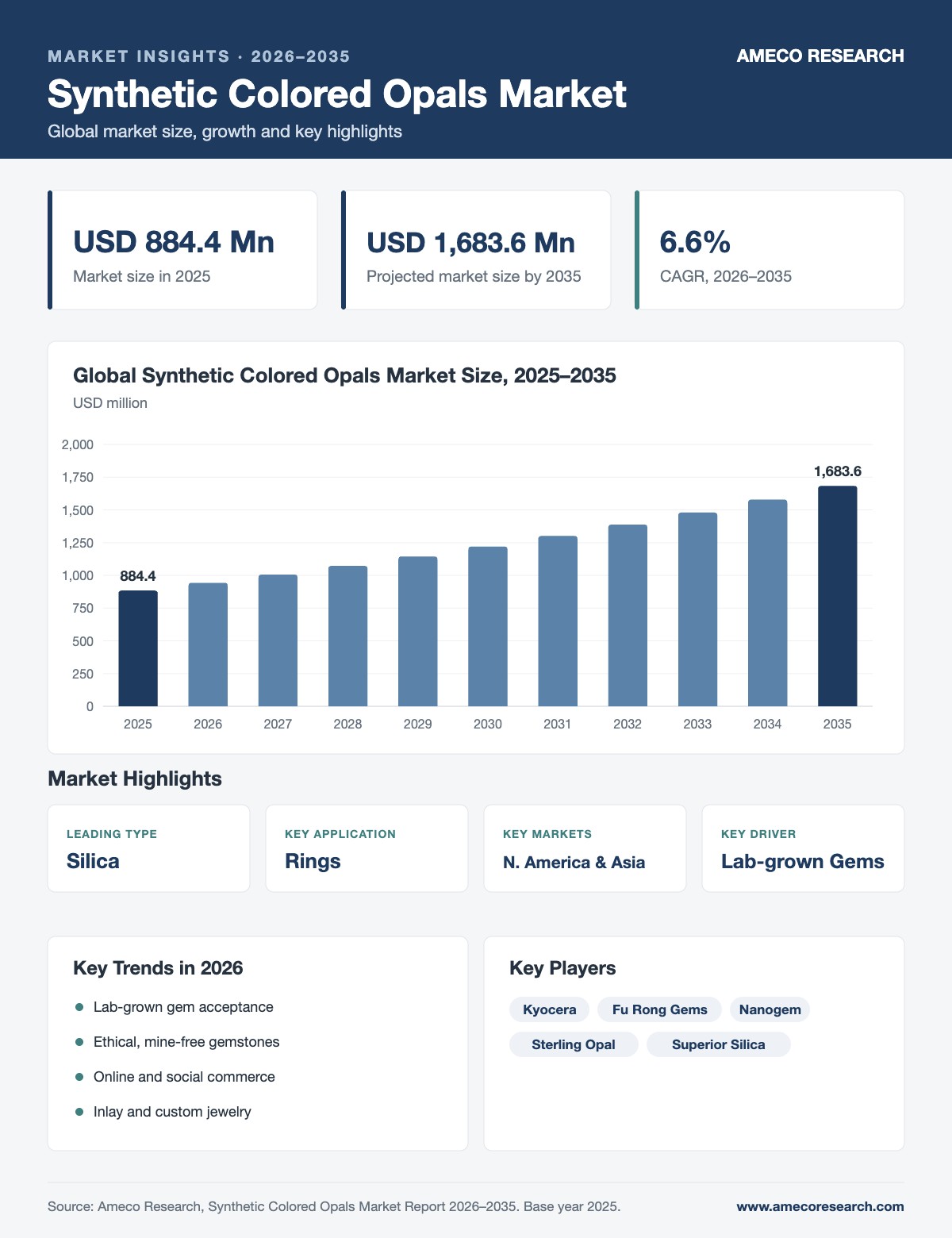 Infographic: Synthetic Colored Opals Market Size and Growth Opportunities and Forecast till 2026 - 2035 | Ameco Research
Synthetic Colored Opals Market Report Scope
| Report Attribute | Details |
| Synthetic Colored Opals Market Size in 2025 | USD 884.4 Million |
| Synthetic Colored Opals Market Forecast by 2035 | USD 1,683.6 Million |
| Synthetic Colored Opals Market CAGR (2026–2035) | 6.6% |
| Analysis Period | 2023–2035 |
| Base Year | 2025 |
| Forecast Period | 2026–2035 |
| Segments Covered | by Type, by Application, and By Region |
| Regional Scope | North America, Europe, Asia Pacific, Latin America, and Middle East & Africa |
| Key Companies Profiled | Kyocera, Fu Rong Gems Factory, Nanogem, Sterling Opal, and Superior Silica |
| Report Coverage | Market Trends, Drivers, Restraints, Opportunities, Competitive Analysis, Player Profiling, Regulation Analysis |
Synthetic Colored Opals Market Size Forecast, 2023–2035
The table below shows the year-by-year size of the global synthetic colored opals market. Revenue is expected to grow about 1.9 times between 2025 and 2035, reaching roughly USD 1,220.2 million by 2030.
| Year | Market Size (USD Million) |
| 2023 (historical) | 777.6 |
| 2024 (historical) | 829.3 |
| 2025 (base year) | 884.4 |
| 2026 (forecast) | 943.2 |
| 2027 (forecast) | 1,005.9 |
| 2028 (forecast) | 1,072.8 |
| 2029 (forecast) | 1,144.2 |
| 2030 (forecast) | 1,220.2 |
| 2031 (forecast) | 1,301.4 |
| 2032 (forecast) | 1,387.9 |
| 2033 (forecast) | 1,480.2 |
| 2034 (forecast) | 1,578.6 |
| 2035 (forecast) | 1,683.6 |
Latest Synthetic Colored Opals Market Trends (2026)
Acceptance of lab-grown gemstones
The rapid adoption of lab-grown diamonds has made consumers more comfortable with lab-created gems. Synthetic opals benefit as buyers look for colorful stones with consistent quality and lower prices.
Ethical and sustainable sourcing
Synthetic opals avoid the environmental and social concerns of mining, appealing to younger buyers and brands focused on responsible sourcing.
Online and social commerce
Independent jewelers and makers sell opal jewelry through online marketplaces and social media, increasing reach and demand for small, colorful stones.
Inlay and custom designs
Synthetic opal is easy to cut and shape, so it is popular in inlay rings, watch dials, pendants and personalized jewelry.
Disclosure and grading standards
Industry guidelines require clear disclosure of synthetic and treated gems, and better identification methods help build trust in the category.
Resin and polymer innovations
New resin-based opal materials offer brighter colors, lighter weight and better impact resistance for fashion jewelry and accessories.
Synthetic Colored Opals Market Dynamics
Growth drivers
- Growing acceptance of lab-created gemstones
- Lower cost and consistent quality compared with natural opal
- Demand for colorful, unique jewelry
- Online jewelry sales and custom design
- Ethical and sustainable sourcing preferences
Restraints and challenges
- Perception of lower value compared with natural opal
- Competition from other synthetic and imitation gems
- Need for clear disclosure to avoid misrepresentation
- Fashion and discretionary spending cycles
Opportunities
Key opportunities include opal inlay jewelry and watch dials, personalized and birthstone jewelry, branded lab-created opal lines, durable resin-based opals for fashion accessories, and growing jewelry markets in China, India and Southeast Asia.
Synthetic Colored Opals Market Segment Analysis
By type
The market is segmented into silica and resin. Silica-based synthetic opals lead because they closely match natural opal's structure and play-of-color, while resin-based opals are lighter, lower-cost and more impact resistant.
By application
Applications include necklaces, rings, bracelets and others. Rings and necklaces are the largest applications, while inlay designs, earrings and watch dials are growing.
Synthetic Colored Opals Market Regional Analysis
North America and Europe are important markets for synthetic opal jewelry, supported by independent jewelers, custom designers and online sales.
China and Japan are key production and consumer markets, with Japanese and Chinese producers among the main makers of synthetic opal. Southeast Asia and India are growing markets for jewelry manufacturing and consumption.
Other regions, including Latin America and the Middle East & Africa, are smaller but growing markets.
Synthetic Colored Opals Market Segmentation
Synthetic Colored Opals Market Leading Companies
The synthetic colored opals market includes established lab-created gemstone makers, specialist opal producers and gem cutting and jewelry manufacturers. Companies compete on color range, play-of-color quality, consistency, price and supply to jewelry brands and makers. Key players profiled in this report include Kyocera, Fu Rong Gems Factory, Nanogem, Sterling Opal, and Superior Silica.
KyoceraFu Rong Gems FactoryNanogemSterling OpalSuperior Silica
Key Questions Answered in This Report
- What is the size of the synthetic colored opals market in 2025, and how large will it be by 2030 and 2035?
- What are the main growth drivers, restraints and opportunities through 2035?
- Which by type and by application segments will grow the fastest?
- Which regions and countries offer the largest and fastest-growing opportunities?
- How are lab-grown gem acceptance, online sales and custom jewelry shaping demand in 2026?
- Who are the leading companies, and what strategies are they using to compete?
Research Methodology
This report combines primary and secondary research. Primary research includes interviews with synthetic gem producers, gem cutters, jewelry manufacturers, retailers and trade associations. Secondary research covers company annual reports, investor presentations, government and trade association data, patent filings and industry publications. Market size is estimated using both bottom-up (company revenue and production data) and top-down (end-use demand) methods, and results are cross-checked through data triangulation before forecasts are built for 2026–2035.
Related Reports
- Color Pigments Market Report
- Chlorinated Rubber Coating Market Report
- Caustic Soda Flake Market Report
- Tin Foil Market Report
- Pharmaceutical Membrane Technology Market Report
Synthetic Colored Opals Market: Frequently Asked Questions
How big is the synthetic colored opals market?
The global synthetic colored opals market was valued at USD 884.4 million in 2025 and is expected to reach USD 1,683.6 million by 2035.
What is the growth rate of the synthetic colored opals market?
The synthetic colored opals market is projected to grow at a CAGR of 6.6% from 2026 to 2035.
What will the synthetic colored opals market be worth in 2030?
The synthetic colored opals market is projected to reach about USD 1,220.2 million in 2030, growing at a CAGR of 6.6%.
What is driving growth in the synthetic colored opals market?
Key drivers are growing acceptance of lab-created gems, lower cost and consistent quality, demand for colorful jewelry, online sales and ethical sourcing.
What are synthetic opals?
Synthetic opals are lab-created opals made from silica or resin that reproduce the play-of-color of natural opal, used in rings, necklaces, bracelets and other jewelry.
Which region leads the synthetic colored opals market?
North America, Europe, China and Japan are the key markets, with Southeast Asia and India growing.
Which segment holds the largest share of the synthetic colored opals market?
Silica-based synthetic opals are the leading type, and rings and necklaces are the largest applications.
What are the latest trends in the synthetic colored opals market?
The main 2026 trends are acceptance of lab-grown gemstones, ethical and sustainable sourcing, online and social commerce, inlay and custom designs, disclosure and grading standards and resin and polymer innovations.
What are the main challenges in the synthetic colored opals market?
The main challenges are the perception of lower value than natural opal, competition from other synthetic gems, disclosure requirements and fashion spending cycles.
Are synthetic opals real opals?
Silica-based synthetic opals have a similar structure to natural opal and show real play-of-color, but they are made in a lab, so they must be sold as synthetic or lab-created.
Who are the key players in the synthetic colored opals market?
Leading companies include Kyocera, Fu Rong Gems Factory, Nanogem, Sterling Opal, and Superior Silica.
Related Chemical & Material Market Reports
- Chlorinated Rubber Coating Market Size and Growth Opportunities and Forecast till 2026 - 2035
- Tin Foil Market Size and Growth Opportunities and Forecast till 2026 - 2035
- Anti-Fingerprint Nanocoatings Market Size and Growth Opportunities and Forecast till 2026 - 2035
- Resorbable Polymers Market Size and Growth Opportunities and Forecast till 2026 - 2035
- Container Glass Market Size and Growth Opportunities and Forecast till 2026 - 2035