Resorbable Polymers Market Size and Growth Opportunities and Forecast till 2026 - 2035
Resorbable Polymers Market Size, Share & Trends Report, 2026–2035
LAST UPDATED: OCTOBER 2026
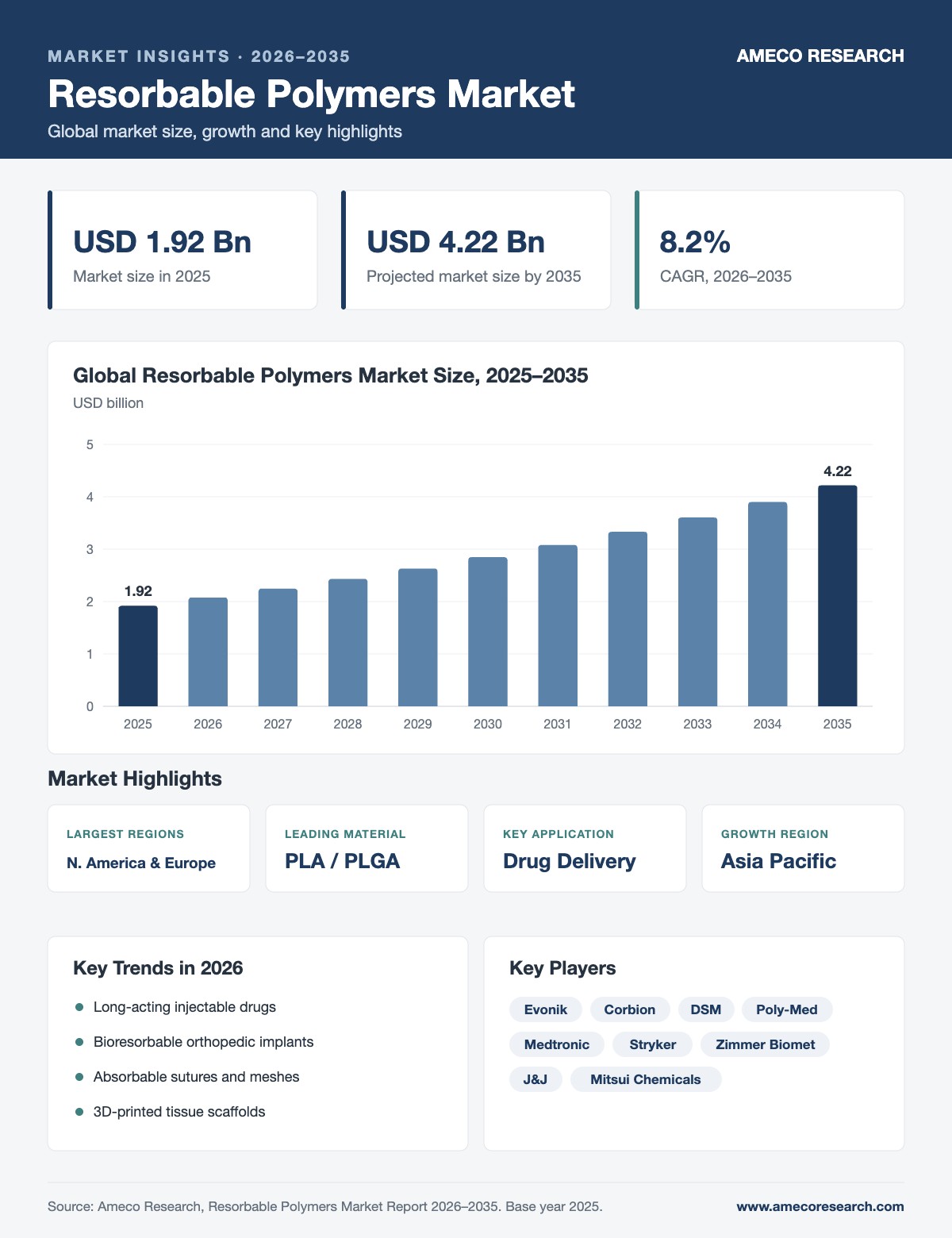
The global Resorbable Polymers Market size was valued at USD 1.92 billion in 2025 and is projected to reach USD 4.22 billion by 2035, growing at a CAGR of 8.2% from 2026 to 2035. Growth is driven by long-acting injectable and implantable drug delivery, bioresorbable orthopedic and sports medicine implants, absorbable sutures and meshes, minimally invasive surgery and an aging population.
Resorbable polymers, also called bioresorbable or bioabsorbable polymers, are medical-grade polymers that break down safely in the body over time and are absorbed or excreted, so a second surgery to remove an implant is not needed. Key materials include polylactic acid (PLA), polyglycolic acid (PGA), polycaprolactone (PCL) and PGA/PLA copolymers (PLGA). They are used in drug delivery systems such as microspheres and implants, orthopedic screws, pins and anchors, absorbable sutures, surgical meshes, stents and tissue engineering scaffolds.
Resorbable Polymers Market Key Takeaways
Resorbable Polymers Market Report Scope
| Report Attribute | Details |
| Resorbable Polymers Market Size in 2025 | USD 1.92 Billion |
| Resorbable Polymers Market Forecast by 2035 | USD 4.22 Billion |
| Resorbable Polymers Market CAGR (2026–2035) | 8.2% |
| Analysis Period | 2023–2035 |
| Base Year | 2025 |
| Forecast Period | 2026–2035 |
| Segments Covered | by Material, by Application, and By Region |
| Regional Scope | North America, Europe, Asia Pacific, Latin America, and Middle East & Africa |
| Key Companies Profiled | Evonik Industries AG, Corbion NV, DSM N.V., Poly-Med, Inc., KLS Martin Group, Johnson & Johnson, Medtronic plc, Stryker Corporation, Zimmer Biomet Holdings, Mitsui Chemicals, Inc., Foster Corporation, Galatea Surgical, Inc., Tepha, Inc., Atrium Medical Corporation, and LACTEL Absorbable Polymers (Evonik) |
| Report Coverage | Market Trends, Drivers, Restraints, Opportunities, Competitive Analysis, Player Profiling, Regulation Analysis |
Resorbable Polymers Market Size Forecast, 2023–2035
The table below shows the year-by-year size of the global resorbable polymers market. Revenue is expected to grow about 2.2 times between 2025 and 2035, reaching roughly USD 2.85 billion by 2030.
| Year | Market Size (USD Billion) |
| 2023 (historical) | 1.64 |
| 2024 (historical) | 1.77 |
| 2025 (base year) | 1.92 |
| 2026 (forecast) | 2.08 |
| 2027 (forecast) | 2.25 |
| 2028 (forecast) | 2.43 |
| 2029 (forecast) | 2.63 |
| 2030 (forecast) | 2.85 |
| 2031 (forecast) | 3.08 |
| 2032 (forecast) | 3.33 |
| 2033 (forecast) | 3.61 |
| 2034 (forecast) | 3.90 |
| 2035 (forecast) | 4.22 |
Latest Resorbable Polymers Market Trends (2026)
Long-acting injectable drug delivery
Pharmaceutical companies are developing long-acting injectables and implants that release drugs over weeks or months, many based on PLGA microspheres and implants. This is a major growth driver for medical-grade resorbable polymers.
Bioresorbable orthopedic and sports medicine implants
Resorbable screws, anchors and plates are increasingly used in sports medicine, craniomaxillofacial and pediatric surgery, where removing metal hardware would require another operation.
Absorbable sutures, meshes and wound devices
Growing surgical volumes and minimally invasive procedures support demand for absorbable sutures, meshes and hemostatic devices made from PGA, PLA and related polymers.
3D-printed scaffolds and tissue engineering
Polycaprolactone and PLA are used in 3D-printed patient-specific scaffolds and implants for bone and soft tissue repair.
Supply chain specialization
Specialist suppliers of GMP resorbable polymers have expanded through acquisitions, such as Evonik's purchase of the LACTEL absorbable polymers business from DURECT, to serve pharma and device customers.
Stricter biomaterial regulations
The EU Medical Device Regulation and FDA expectations for biocompatibility and degradation testing raise quality requirements, favoring established, fully documented polymer suppliers.
Resorbable Polymers Market Dynamics
Growth drivers
- Growth of long-acting and controlled-release drug delivery
- Demand for implants that do not need removal
- Rising surgical volumes and minimally invasive procedures
- Aging population and sports injuries
- Advances in polymer chemistry and 3D printing
Restraints and challenges
- High cost of medical-grade, GMP polymers
- Long and costly regulatory approval for devices and drugs
- Concerns about degradation rate and inflammatory response
- Competition from metal and permanent polymer implants
Opportunities
Key opportunities include polymers for long-acting injectables, bioresorbable stents and scaffolds, pediatric and craniofacial implants, 3D-printed custom implants, and growing medical device manufacturing in Asia Pacific.
Resorbable Polymers Market Segment Analysis
By material
The market is segmented into polylactic acid (PLA), polyglycolic acid (PGA), polycaprolactone (PCL) and PGA/PLA copolymers. PLA and PGA/PLA copolymers (PLGA) are the most widely used because their degradation time can be tuned for drug delivery, sutures and implants. PCL is valued for slow degradation and 3D printing.
By application
Applications include drug delivery and orthopedics. Drug delivery is growing quickly, particularly in oncology and cardiovascular therapies, while orthopedics uses resorbable screws, pins, anchors and plates.
Resorbable Polymers Market Regional Analysis
North America and Europe are the largest markets for resorbable polymers, supported by advanced healthcare systems, high surgical volumes and leading pharmaceutical and medical device companies.
Asia Pacific is expected to witness significant growth in the coming years, driven by healthcare investment, medical device manufacturing and rising surgical procedures in China, India, Japan and South Korea.
Latin America and the Middle East & Africa are expected to see moderate growth.
Resorbable Polymers Market Segmentation
Resorbable Polymers Market Leading Companies
The resorbable polymers market includes specialty polymer producers that make medical-grade PLA, PGA, PCL and copolymers, along with medical device companies that use them in implants and sutures. Companies compete on polymer purity, GMP manufacturing, regulatory documentation, custom degradation profiles and technical support for drug and device developers. Key players profiled in this report include Evonik Industries AG, Corbion NV, DSM N.V., Poly-Med, Inc., KLS Martin Group, Johnson & Johnson, Medtronic plc, Stryker Corporation, Zimmer Biomet Holdings, Mitsui Chemicals, Inc., Foster Corporation, Galatea Surgical, Inc., Tepha, Inc., Atrium Medical Corporation, and LACTEL Absorbable Polymers (Evonik).
Evonik Industries AGCorbion NVDSM N.V.Poly-Med, Inc.KLS Martin GroupJohnson & JohnsonMedtronic plcStryker CorporationZimmer Biomet HoldingsMitsui Chemicals, Inc.Foster CorporationGalatea Surgical, Inc.Tepha, Inc.Atrium Medical CorporationLACTEL Absorbable Polymers (Evonik)
Recent developments
Key Questions Answered in This Report
- What is the size of the resorbable polymers market in 2025, and how large will it be by 2030 and 2035?
- What are the main growth drivers, restraints and opportunities through 2035?
- Which by material and by application segments will grow the fastest?
- Which regions and countries offer the largest and fastest-growing opportunities?
- How are long-acting injectables, bioresorbable implants and 3D printing shaping demand in 2026?
- Who are the leading companies, and what strategies are they using to compete?
Research Methodology
Ameco Research built this forecast from a mix of primary and secondary research. Analysts spoke with polymer producers, medical device manufacturers, pharmaceutical companies, surgeons and contract manufacturers to validate pricing, volumes and demand trends, and reviewed company filings, trade statistics, regulatory documents and industry publications. The resorbable polymers market size was estimated with bottom-up and top-down approaches and validated through data triangulation, with 2025 as the base year and forecasts for 2026–2035.
Related Reports
- Intranasal Drug and Vaccine Delivery Market Report
- Nasal Drug Delivery Devices Market Report
- Metal Implants and Medical Alloys Market Report
- Electronic Drug Delivery Systems Market Report
- Implantable Medical Devices Market Report
Resorbable Polymers Market: Frequently Asked Questions
How big is the resorbable polymers market?
The global resorbable polymers market was valued at USD 1.92 billion in 2025 and is expected to reach USD 4.22 billion by 2035.
What is the growth rate of the resorbable polymers market?
The resorbable polymers market is projected to grow at a CAGR of 8.2% from 2026 to 2035.
What will the resorbable polymers market be worth in 2030?
The resorbable polymers market is projected to reach about USD 2.85 billion in 2030, growing at a CAGR of 8.2%.
What is driving growth in the resorbable polymers market?
Key drivers are long-acting drug delivery, implants that do not need removal, rising surgical volumes, an aging population and advances in polymer science.
What is resorbable polymers?
Resorbable polymers are medical-grade polymers such as PLA, PGA, PCL and PLGA that safely break down and are absorbed by the body over time.
Which region leads the resorbable polymers market?
North America and Europe are the largest markets, while Asia Pacific is expected to witness significant growth.
Which segment holds the largest share of the resorbable polymers market?
PLA and PGA/PLA copolymers are the most widely used materials, and drug delivery and orthopedics are the main applications.
What are the latest trends in the resorbable polymers market?
The main 2026 trends are long-acting injectable drug delivery, bioresorbable orthopedic and sports medicine implants, absorbable sutures, meshes and wound devices, 3D-printed scaffolds and tissue engineering, supply chain specialization and stricter biomaterial regulations.
What are the main challenges in the resorbable polymers market?
The main challenges are the high cost of medical-grade polymers, long regulatory approvals, concerns about degradation behavior and competition from permanent implants.
What is PLGA used for?
PLGA, a copolymer of lactic and glycolic acid, is used to make microspheres, implants and other systems that release drugs slowly over weeks or months, as well as absorbable sutures and devices.
Who are the key players in the resorbable polymers market?
Leading companies include Evonik Industries AG, Corbion NV, DSM N.V., Poly-Med, Inc., KLS Martin Group, Johnson & Johnson, Medtronic plc, Stryker Corporation, Zimmer Biomet Holdings, Mitsui Chemicals, Inc., Foster Corporation, Galatea Surgical, Inc., Tepha, Inc., Atrium Medical Corporation, and LACTEL Absorbable Polymers (Evonik).
Related Chemical & Material Market Reports
- Container Glass Market Size and Growth Opportunities and Forecast till 2026 - 2035
- Metal Wire Mesh Belt Market Size and Growth Opportunities and Forecast till 2026 - 2035
- White Masonry Cement Market Size and Growth Opportunities and Forecast till 2026 - 2035
- Refrigerated Display Cases Glasses Market Size and Growth Opportunities and Forecast till 2026 - 2035
- High Thermal Conductivity Graphite Materials Market Size and Growth Opportunities and Forecast till 2026 - 2035