Hydrogen Buses Market Size, Share, Trends & Growth Opportunities Forecast to 2026 - 2035
Hydrogen Buses Market Size, Share & Trends Report, 2026–2035
LAST UPDATED: OCTOBER 2026
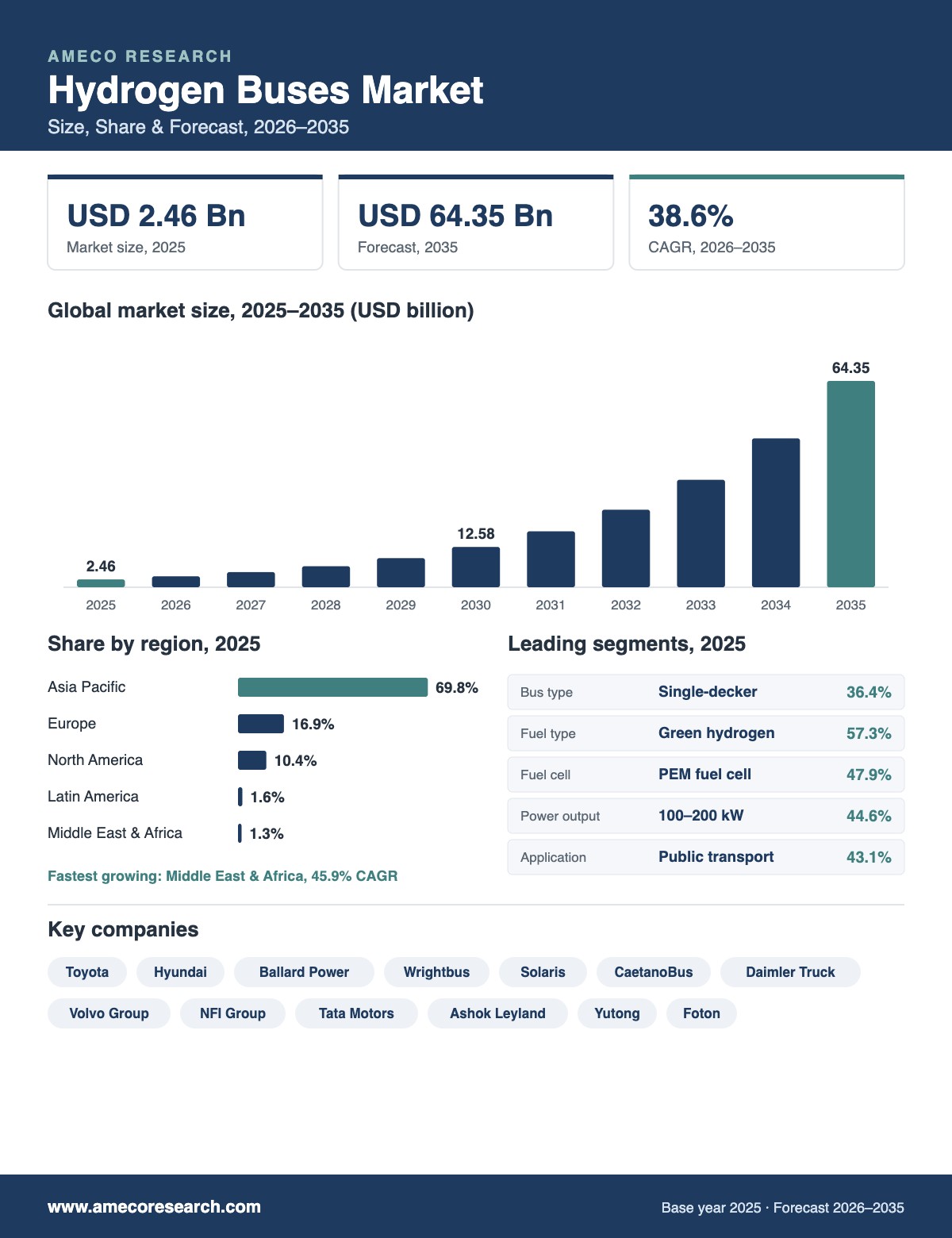
The global hydrogen buses market size was valued at USD 2.46 billion in 2025 and is projected to reach USD 64.35 billion by 2035, growing at a CAGR of 38.6% from 2026 to 2035. The market is estimated at USD 3.41 billion in 2026, with Asia Pacific holding the largest share and the Middle East & Africa registering the fastest growth.
Hydrogen buses are zero-emission passenger buses powered by hydrogen, either through a fuel cell that generates electricity for an electric drivetrain or, less commonly, through a hydrogen internal combustion engine. They are used in city transit, intercity and coach services, airport shuttles, tourism and school transport, and are sold as new vehicles or created by retrofitting existing diesel buses.
Hydrogen buses fill a gap that battery electric buses struggle with: long daily mileage, 18–20 hour shifts, hilly or cold routes and depots without the grid capacity for large-scale charging. With 300–500 km of range per fill and refueling in 10–15 minutes, they can replace diesel buses one-for-one, which is why transit agencies in Asia, Europe and North America are adding them alongside battery fleets.
Hydrogen Buses Market Key Takeaways
Hydrogen Buses Market Report Scope
| Report Attribute | Details |
| Hydrogen Buses Market Size in 2025 | USD 2.46 Billion |
| Hydrogen Buses Market Size in 2026 | USD 3.41 Billion |
| Hydrogen Buses Market Forecast by 2035 | USD 64.35 Billion |
| Hydrogen Buses Market CAGR (2026–2035) | 38.6% |
| Historical Data | 2021–2024 |
| Base Year | 2025 |
| Forecast Period | 2026–2035 |
| Largest Region | Asia Pacific (69.8% share in 2025) |
| Fastest-Growing Region | Middle East & Africa (45.9% CAGR) |
| Segments Covered | Bus Type, Fuel Type, Propulsion Type, Manufacturing, Power Output, Fuel Cell Technology, Application and Region |
| Regional Scope | North America, Europe, Asia Pacific, Latin America, and Middle East & Africa |
| Key Companies Profiled | Toyota Motor Corporation, Hyundai Motor Company, Ballard Power Systems, Wrightbus, Solaris Bus & Coach, CaetanoBus, Daimler Truck AG, Volvo Group, NFI Group (New Flyer), Tata Motors, Ashok Leyland, Yutong Bus and Beiqi Foton Motor |
| Report Coverage | Market size and forecast, trends, drivers, restraints, opportunities, segment and regional analysis, competitive landscape, recent developments |
How Big Is the Hydrogen Buses Market in 2026?
Ameco Research estimates the hydrogen buses market at USD 3.41 billion in 2026, up nearly 39% from USD 2.46 billion in 2025. The market is expected to pass USD 12.5 billion by 2030 and reach USD 64.35 billion by 2035, as fuel cell costs fall, green hydrogen supply expands and transit agencies move from pilot fleets to large orders.
| Year | Hydrogen Buses Market Size (USD Billion) |
| 2025 | 2.46 |
| 2026 | 3.41 |
| 2028 | 6.55 |
| 2030 | 12.58 |
| 2032 | 24.17 |
| 2035 | 64.35 |
Latest Hydrogen Buses Market Trends 2026
From pilots to large fleet orders
Operators are moving beyond small demonstration fleets. Bologna began running Solaris hydrogen buses in 2026 as part of a planned 127-bus fleet, Ruhrbahn in Germany is adding 52 hydrogen buses with public funding, and Porto is deploying 18-meter articulated fuel cell buses on a bus rapid transit corridor.
Fuel cell supply chains scale up
Fuel cell makers are signing volume agreements with bus builders. In 2026, Ballard Power Systems secured an order from New Flyer for 500 heavy-duty fuel cell modules totaling about 50 MW, one of the largest bus fuel cell orders to date, which should help push down stack costs.
India emerges as a new growth market
Cochin International Airport introduced India’s first hydrogen-fueled passenger buses in 2026, supplied by on-site green hydrogen, and Tata Motors announced hydrogen bus production at its Lucknow plant, supported by India’s National Green Hydrogen Mission.
Green hydrogen and on-site production
Transit agencies increasingly pair bus fleets with dedicated electrolyzers. The cost gap between green and grey hydrogen has narrowed from 3–4 times in 2020 to roughly 1.5–2 times in some regions, improving the economics of fully renewable bus operations.
Retrofits and hydrogen ICE lower the entry cost
Retrofitting existing buses with hydrogen powertrains can cut costs by around 40–50% versus new vehicles, and hydrogen combustion engine buses require roughly 20–30% lower upfront investment than fuel cell buses, giving budget-limited operators a faster route to decarbonization.
Fuel cost is now the deciding factor
Hydrogen price at the pump has become the main factor in total cost of ownership. Some early European adopters have scaled back fleets when fuel costs rose, so new projects increasingly secure long-term hydrogen supply contracts and shared refueling hubs before ordering buses.
Hydrogen Buses Market Dynamics
Growth drivers
- Zero-emission transit mandates: clean vehicle rules in the EU, China, South Korea, Japan, India and U.S. states such as California require transit agencies to phase out diesel buses.
- Range and refueling advantage: 300–500 km per fill and 10–15 minute refueling allow hydrogen buses to run long shifts and demanding routes that battery buses cannot easily cover.
- Government funding: large programs such as U.S. Regional Clean Hydrogen Hubs, EU Clean Hydrogen Partnership projects, Germany’s bus funding schemes and Chinese purchase subsidies lower the cost of buses and stations.
- Depot grid constraints: charging hundreds of battery buses overnight can require costly grid upgrades, while a hydrogen station can serve a large fleet from a single site.
- Falling fuel cell costs: higher production volumes, better stack durability and shared components with trucks are steadily reducing fuel cell system prices.
Restraints and challenges
- High vehicle cost: fuel cell stacks, carbon-fiber hydrogen tanks and low production volumes make hydrogen buses close to twice as expensive as diesel buses.
- Limited refueling infrastructure: hydrogen stations are expensive to build and maintain, and many cities still have few or none.
- Hydrogen fuel price: delivered hydrogen often costs more per kilometer than diesel or grid electricity, which can make operating costs hard to justify.
- Competition from battery electric buses: rapidly improving batteries and lower purchase prices make battery buses the default choice for many urban routes.
- Supply and service gaps: limited spare parts, technician training and supplier consolidation can affect fleet availability.
Opportunities
- Low-cost green hydrogen from large electrolyzer projects is expected to bring fuel costs closer to diesel over the next decade.
- Shared hydrogen hubs that supply buses, trucks and industry from one station improve utilization and cut fuel cost per kilogram.
- Airport, tourism and intercity coaches with long, predictable routes are well suited to hydrogen and are opening new demand.
- Retrofit programs that convert existing diesel buses give operators a cheaper, faster way to decarbonize their fleets.
- Emerging markets in India, the Middle East and Latin America are launching national hydrogen strategies that include public transport.
Hydrogen Buses Market Segment Analysis
By bus type: Why do single-decker buses lead the hydrogen buses market?
Single-decker buses accounted for 36.4% of revenue in 2025 because 12-meter city buses are the workhorse of urban transit and the first model most operators replace with zero-emission versions. Fuel cell hybrids held 26.6%, as combining a fuel cell with a larger battery can reduce hydrogen consumption by around 15–25%.
| Bus Type | Share (2025) | Key Highlights |
| Single-Decker | 36.4% | Standard 12 m and articulated city buses; the largest volume segment |
| Fuel Cell Hybrid | 26.6% | Fuel cell plus large battery; 15–25% lower hydrogen consumption |
| Battery-Electric Hydrogen (Range-Extended) | 21.9% | Battery buses with a fuel cell range extender for longer routes |
| Double-Decker | 15.1% | High-capacity urban routes in the U.K., Germany and Hong Kong |
By fuel type: Why is green hydrogen the largest fuel type?
Green hydrogen produced by renewable-powered electrolysis supplied 57.3% of market revenue in 2025, because most public funding schemes require low-carbon fuel and many agencies install on-site electrolyzers. Grey hydrogen from natural gas held 28.1%, mainly in early fleets, while blue hydrogen with carbon capture accounted for the remainder.
| Fuel Type | Share (2025) | Key Highlights |
| Green Hydrogen | 57.3% | Electrolysis using renewable power; required by many funding programs |
| Grey Hydrogen | 28.1% | Produced from natural gas; lower cost but higher emissions |
| Blue Hydrogen | 14.6% | Natural gas with carbon capture; a transition option |
By propulsion type
The market includes fuel cell electric buses (FCEB), which convert hydrogen into electricity for an electric motor, and hydrogen internal combustion engine (H2-ICE) buses, which burn hydrogen in an adapted engine. Fuel cell buses offer higher efficiency and quieter operation, while H2-ICE buses reuse proven engine technology and cost about 20–30% less upfront, making them attractive for retrofits and price-sensitive markets.
By manufacturing
Newly built hydrogen buses accounted for 71.6% of revenue in 2025 as operators buy purpose-designed vehicles with integrated tanks and fuel cells. Retrofitted buses held 28.4%, offering roughly 40–50% savings compared with new vehicles.
| Manufacturing | Share (2025) | Key Highlights |
| New Hydrogen Bus | 71.6% | Purpose-built vehicles with full OEM warranty and support |
| Retrofitted | 28.4% | Conversion of diesel buses; around 40–50% lower cost |
By power output
Buses with 100–200 kW fuel cell systems held the largest share at 44.6% in 2025, matching the power needs of standard city buses. Systems above 200 kW, used in articulated, double-decker and coach models, accounted for 32.1%.
| Power Output | Share (2025) | Key Highlights |
| Below 100 kW | 23.3% | Range extenders and smaller midi buses |
| 100–200 kW | 44.6% | Largest band; standard 12 m city buses |
| Above 200 kW | 32.1% | Articulated, double-decker and intercity coaches |
By fuel cell technology: Why do PEM fuel cells dominate?
Proton exchange membrane fuel cells (PEMFC) accounted for 47.9% of revenue in 2025 thanks to their fast start-up, compact size and high power density, which make them the standard choice for buses. Alkaline fuel cells held 29.2%, while solid oxide fuel cells are mainly used in auxiliary and range-extender roles.
| Fuel Cell Technology | Share (2025) | Key Highlights |
| PEM Fuel Cell (PEMFC) | 47.9% | Fast start-up and high power density; standard for buses |
| Alkaline Fuel Cell (AFC) | 29.2% | Lower-cost catalysts; growing in cost-focused designs |
| Solid Oxide Fuel Cell (SOFC) | 19.6% | High efficiency; used as range extenders and auxiliary power |
| Others | 3.3% | Emerging and hybrid fuel cell chemistries |
By application: Which applications use the most hydrogen buses?
Public transportation led with 43.1% share in 2025, as city transit agencies are the main buyers under zero-emission mandates. Tourism and airport transportation held 27.4%, helped by airports such as Cochin and others adopting hydrogen shuttles, while private and school transport are growing from smaller bases.
| Application | Share (2025) | Key Highlights |
| Public Transportation | 43.1% | City transit and bus rapid transit fleets |
| Tourism & Airport Transportation | 27.4% | Airport shuttles, sightseeing and intercity coaches |
| Private Transportation | 19.2% | Corporate, campus and private operator fleets |
| School Transportation | 10.3% | Zero-emission school buses supported by grant programs |
Hydrogen Buses Market Regional Analysis
| Region | Share (2025) | Outlook |
| Asia Pacific | 69.8% | Largest market; China, South Korea and Japan lead, with India emerging |
| Europe | 16.9% | Second-largest; Germany, the U.K., Italy, France, Poland and the Netherlands |
| North America | 10.4% | Strong growth at a 40.4% CAGR, led by California transit agencies |
| Latin America | 1.6% | Early projects in Brazil, Chile and Colombia |
| Middle East & Africa | 1.3% | Fastest-growing at a 45.9% CAGR; Gulf hydrogen strategies |
Why does Asia Pacific dominate the hydrogen buses market?
Asia Pacific accounted for about 69.8% of global revenue in 2025. China operates the world’s largest hydrogen bus fleet through its fuel cell vehicle demonstration city clusters, South Korea has rolled out thousands of fuel cell buses with strong subsidies, and Japan supports Toyota’s fuel cell bus programs. India is a new source of growth, with hydrogen buses in Delhi, Leh, Kochi and other cities under its National Green Hydrogen Mission.
How is Europe developing?
Europe held about 16.9% of the market in 2025. EU clean vehicle rules and funding from the Clean Hydrogen Partnership have supported large orders in Germany, Italy, Poland, France and the U.K., and more than 1,500 hydrogen buses were on order across Europe by 2024. Germany plans significant new federal support for hydrogen bus fleets and infrastructure.
What is driving North America and the Middle East & Africa?
North America represented about 10.4% of revenue in 2025 and is projected to grow at a 40.4% CAGR, supported by California’s Innovative Clean Transit rule, U.S. Regional Clean Hydrogen Hubs and federal low- and no-emission bus grants. The Middle East & Africa is the fastest-growing region at a 45.9% CAGR, as Saudi Arabia, the UAE, Oman and Egypt link large green hydrogen projects to public transport.
Hydrogen Buses Market Segmentation
Hydrogen Buses Market Leading Companies
The hydrogen buses market brings together bus manufacturers, fuel cell suppliers and automakers. Chinese and Korean OEMs dominate volumes in Asia, while European builders such as Wrightbus, Solaris and CaetanoBus lead in Europe. Competition centers on fuel cell durability, hydrogen consumption, total cost of ownership and the ability to deliver buses together with refueling and service packages.
Toyota Motor Corporation · Hyundai Motor Company · Ballard Power Systems · Wrightbus · Solaris Bus & Coach · CaetanoBus · Daimler Truck AG · Volvo Group · NFI Group (New Flyer) · Tata Motors · Ashok Leyland · Yutong Bus · Beiqi Foton Motor
Recent developments
- May 2026: Bologna, Italy, began operating Solaris hydrogen buses, the first part of a planned fleet of 127 fuel cell buses.
- April 2026: Tata Motors announced the start of hydrogen bus production at its plant in Lucknow, Uttar Pradesh.
- March 2026: Ballard Power Systems received an order from New Flyer for 500 FCmove-HD+ fuel cell modules totaling about 50 MW for North American transit buses.
- March 2026: CaetanoBus agreed to supply 12 H2.City Gold 18-meter articulated hydrogen buses to Metro do Porto for a bus rapid transit corridor in Portugal.
- February 2026: Cochin International Airport introduced India’s first hydrogen-fueled passenger buses, powered by green hydrogen produced on site.
- February 2026: Ruhrbahn in Germany received EUR 11.6 million in funding toward 52 new hydrogen buses, expanding its fleet to 78.
Hydrogen Buses Market: Frequently Asked Questions
How big is the hydrogen buses market?
The global hydrogen buses market was valued at USD 2.46 billion in 2025 and is estimated at USD 3.41 billion in 2026. Ameco Research projects it to reach USD 64.35 billion by 2035, growing at a CAGR of 38.6% from 2026 to 2035.
What is the growth rate of the hydrogen buses market?
The hydrogen buses market is expected to grow at a CAGR of 38.6% between 2026 and 2035, one of the fastest growth rates in commercial vehicles, as cities replace diesel fleets with zero-emission buses on long and demanding routes.
What is a hydrogen bus?
A hydrogen bus is a public or private passenger bus that runs on hydrogen instead of diesel or natural gas. Most use a fuel cell that combines hydrogen with oxygen from the air to generate electricity for an electric motor, emitting only water vapor. A smaller number burn hydrogen directly in a modified internal combustion engine.
How do hydrogen fuel cell buses work?
Hydrogen is stored in high-pressure tanks, usually on the roof at 350 bar. The fuel cell stack converts it into electricity, which powers the traction motor, while a buffer battery captures braking energy and supplies peak power. A typical fuel cell bus travels 300–500 km per fill and refuels in about 10–15 minutes.
Are hydrogen buses better than battery electric buses?
Both are zero-emission at the tailpipe. Battery electric buses are cheaper to buy and run on most urban routes, while hydrogen buses offer longer range, faster refueling and steady performance in cold weather, hilly terrain and 18–20 hour duty cycles. Many operators use hydrogen for long, high-mileage routes and battery buses for shorter ones.
How much does a hydrogen bus cost?
A hydrogen fuel cell bus can cost close to twice as much as a comparable diesel bus, depending on size, fuel cell power and order volume. Prices are falling as production scales, and retrofitting existing buses with hydrogen powertrains can cut conversion costs by roughly 40–50% compared with buying new.
Which region leads the hydrogen buses market?
Asia Pacific leads with about 69.8% of global revenue in 2025, driven by large fleets in China, South Korea and Japan and new programs in India. Europe is the second-largest region, while the Middle East & Africa is expected to grow fastest from a small base.
Who are the key players in the hydrogen buses market?
Leading companies include Toyota Motor Corporation, Hyundai Motor Company, Ballard Power Systems, Wrightbus, Solaris Bus & Coach, CaetanoBus, Daimler Truck AG, Volvo Group, NFI Group (New Flyer), Tata Motors, Ashok Leyland, Yutong Bus and Beiqi Foton Motor.
Related Automobile & Transportation Market Reports
- Electric Vehicle Charging Station Market Growth Opportunities and Forecast till 2035
- Electric Vehicle Market Growth Opportunities and Forecast till 2035
- Car Rental Market Size and Growth Opportunities and Forecast till 2026 - 2035
- Automotive Laser Headlight Market Growth Opportunities and Forecast till 2033
- Automotive VVT System Market Growth Opportunities and Forecast till 2033