Micropump Market Size and Growth Opportunities and Forecast till 2026 - 2035
Micropump Market Size, Share & Trends Report, 2026–2035
LAST UPDATED: OCTOBER 2026
The global Micropump Market size was valued at USD 3.38 billion in 2025 and is projected to reach USD 17.32 billion by 2035, growing at a CAGR of 17.8% from 2026 to 2035. Growth is driven by wearable and implantable drug delivery devices such as insulin pumps and patch pumps, point-of-care and microfluidic diagnostics, lab-on-a-chip and organ-on-chip research, and miniaturized fluid handling in medical, industrial and electronics cooling applications.
Micropumps are miniature pumps, often built with MEMS (micro-electro-mechanical systems) or precision molding, that move very small, precise volumes of liquid or gas, from nanoliters to milliliters per minute. Mechanical micropumps include peristaltic, piezoelectric and diaphragm designs with moving parts, while non-mechanical micropumps use electroosmotic, electrohydrodynamic, magnetohydrodynamic or other principles. They are made from silicon, polymers and glass and are used in in-vitro diagnostics, drug delivery, medical devices, research instruments and industrial equipment.
Micropump Market Key Takeaways
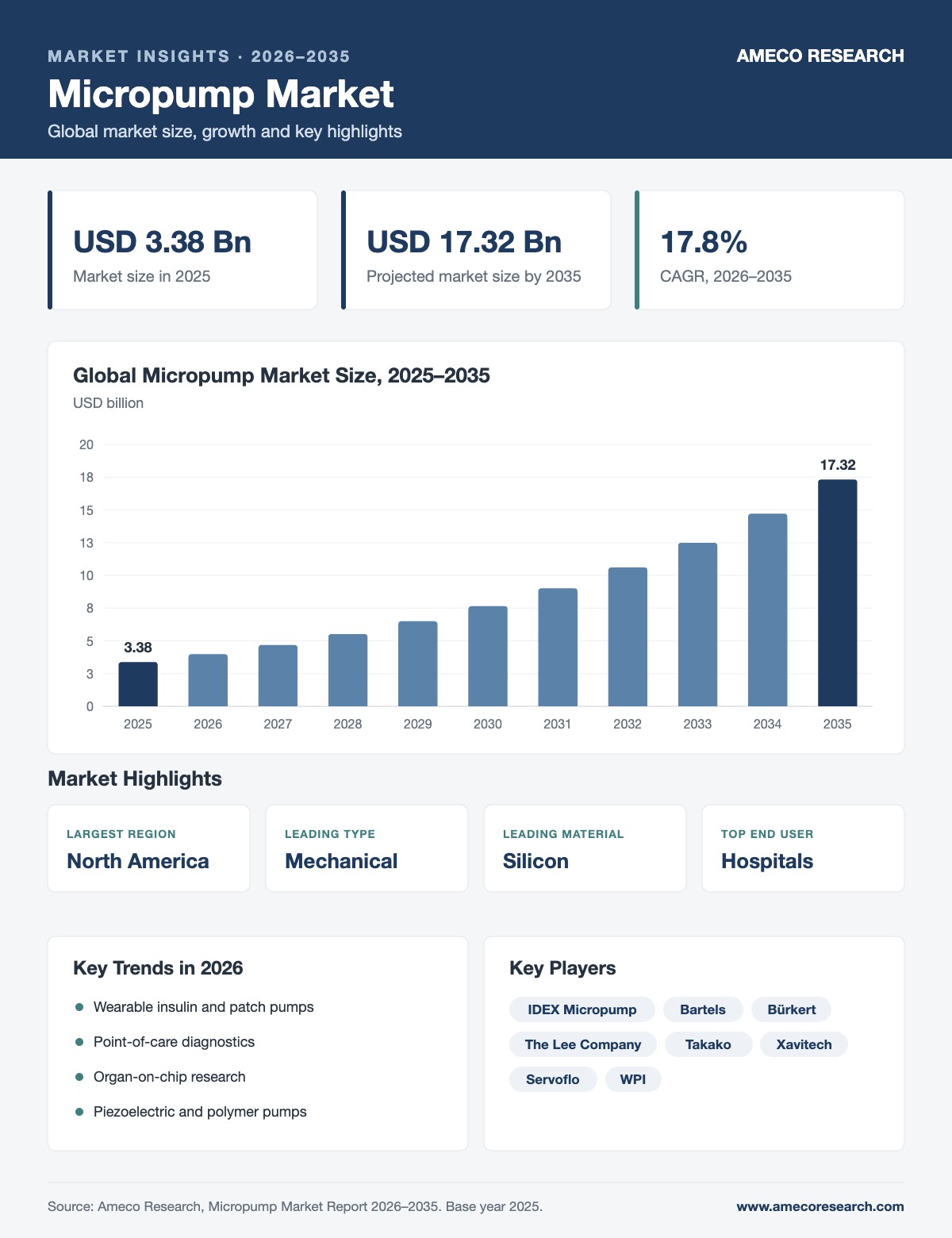 Infographic: Micropump Market Size and Growth Opportunities and Forecast till 2026 - 2035 | Ameco Research
Micropump Market Report Scope
| Report Attribute | Details |
| Micropump Market Size in 2025 | USD 3.38 Billion |
| Micropump Market Forecast by 2035 | USD 17.32 Billion |
| Micropump Market CAGR (2026–2035) | 17.8% |
| Analysis Period | 2023–2035 |
| Base Year | 2025 |
| Forecast Period | 2026–2035 |
| Segments Covered | by Product Type, by Material, by Application, by End-User, and By Region |
| Regional Scope | North America, Europe, Asia Pacific, Latin America, and Middle East & Africa |
| Key Companies Profiled | ALLDOO Micropump, Bartels Mikrotechnik GmbH, Bürkert Fluid Control Systems, Calon Cardio-Technology Ltd, World Precision Instruments, Microfluidica, Micropump Inc. (IDEX Corporation), Takako Industries, Inc., The Lee Company, TOPS Industry & Technology Co., Ltd., Xiamen AJK Technology Co., Ltd., Servoflo Corporation, and Xavitech |
| Report Coverage | Market Trends, Drivers, Restraints, Opportunities, Competitive Analysis, Player Profiling, Regulation Analysis |
Micropump Market Size Forecast, 2023–2035
The table below shows the year-by-year size of the global micropump market. Revenue is expected to grow about 5.1 times between 2025 and 2035, reaching roughly USD 7.65 billion by 2030.
| Year | Market Size (USD Billion) |
| 2023 (historical) | 2.44 |
| 2024 (historical) | 2.87 |
| 2025 (base year) | 3.38 |
| 2026 (forecast) | 3.98 |
| 2027 (forecast) | 4.69 |
| 2028 (forecast) | 5.52 |
| 2029 (forecast) | 6.50 |
| 2030 (forecast) | 7.65 |
| 2031 (forecast) | 9.01 |
| 2032 (forecast) | 10.61 |
| 2033 (forecast) | 12.49 |
| 2034 (forecast) | 14.71 |
| 2035 (forecast) | 17.32 |
Latest Micropump Market Trends (2026)
Wearable drug delivery
Insulin patch pumps, automated insulin delivery systems and on-body injectors for biologics rely on tiny, accurate and low-power micropumps, a major growth driver.
Point-of-care and microfluidic diagnostics
Compact diagnostic analyzers and lab-on-a-chip cartridges use micropumps to move samples and reagents, supporting faster testing outside central labs.
Organ-on-chip and research tools
Pharmaceutical research is adopting organ-on-chip and microphysiological systems that need continuous, gentle microfluidic flow, creating demand for precise micropumps.
Piezoelectric and polymer designs
Piezoelectric micropumps offer compact size, low noise and precise dosing, while polymer and injection-molded pumps reduce costs for disposable devices.
Electronics and industrial uses
Micropumps are being used for liquid cooling of small electronics, fuel cells, inkjet and dosing systems, and gas sampling in environmental sensors.
Regulatory and reliability demands
Medical micropumps must meet strict reliability, biocompatibility and software safety requirements, favoring experienced suppliers with strong quality systems.
Micropump Market Dynamics
Growth drivers
- Growth of wearable and implantable drug delivery
- Expansion of point-of-care and microfluidic diagnostics
- Rising diabetes and chronic disease prevalence
- Advances in MEMS and microfabrication
- Research use in life sciences
Restraints and challenges
- High development and manufacturing costs
- Strict regulatory requirements for medical devices
- Reliability challenges such as clogging and bubbles
- Integration complexity in small devices
Opportunities
Key opportunities include patch pumps for biologics and GLP-1 drugs, disposable diagnostic cartridges, organ-on-chip platforms, non-mechanical pumps for compact devices, and electronics cooling and environmental sensing.
Micropump Market Segment Analysis
By product type
The market is segmented into mechanical micropumps (peristaltic, piezoelectric and others) and non-mechanical micropumps. Mechanical micropumps hold a significant share, while non-mechanical micropumps are likely to attain the fastest CAGR.
By material
Materials include silicon, polymer and glass. Silicon held the largest share, while polymers are growing for low-cost disposable devices.
By application
Applications include in-vitro diagnostics, drug delivery, medical devices and others. In-vitro diagnostics and drug delivery are the largest applications, with drug delivery occupying a substantial share.
By end user
End users include biotechnology and pharmaceutical companies, hospitals and diagnostic centers, and academic and research institutes. Hospitals and diagnostic centers held the largest share.
Micropump Market Regional Analysis
North America held the largest share of the micropump market, supported by medical device and diagnostics innovation, high diabetes prevalence and strong research funding.
Asia-Pacific is likely to witness the fastest growth rate, driven by medical device manufacturing and healthcare expansion in China, Japan, South Korea and India. Europe is a major market with leading micropump and microfluidics developers.
Latin America and the Middle East & Africa are smaller but growing markets.
Micropump Market Segmentation
Micropump Market Leading Companies
The micropump market includes specialist micropump and microfluidics companies, fluid control groups and medical device suppliers. Companies compete on precision, size, power use, reliability, materials, cost and the ability to support customers through medical device approval. Key players profiled in this report include ALLDOO Micropump, Bartels Mikrotechnik GmbH, Bürkert Fluid Control Systems, Calon Cardio-Technology Ltd, World Precision Instruments, Microfluidica, Micropump Inc. (IDEX Corporation), Takako Industries, Inc., The Lee Company, TOPS Industry & Technology Co., Ltd., Xiamen AJK Technology Co., Ltd., Servoflo Corporation, and Xavitech.
ALLDOO MicropumpBartels Mikrotechnik GmbHBürkert Fluid Control SystemsCalon Cardio-Technology LtdWorld Precision InstrumentsMicrofluidicaMicropump Inc. (IDEX Corporation)Takako Industries, Inc.The Lee CompanyTOPS Industry & Technology Co., Ltd.Xiamen AJK Technology Co., Ltd.Servoflo CorporationXavitech
Key Questions Answered in This Report
- What is the size of the micropump market in 2025, and how large will it be by 2030 and 2035?
- What are the main growth drivers, restraints and opportunities through 2035?
- Which by product type and by material segments will grow the fastest?
- Which regions and countries offer the largest and fastest-growing opportunities?
- How are wearable drug delivery, point-of-care diagnostics and organ-on-chip research shaping demand in 2026?
- Who are the leading companies, and what strategies are they using to compete?
Research Methodology
Ameco Research built this forecast from a mix of primary and secondary research. Analysts spoke with micropump and microfluidics manufacturers, medical device and diagnostics companies, research institutes and distributors to validate pricing, volumes and demand trends, and reviewed company filings, trade statistics, regulatory documents and industry publications. The micropump market size was estimated with bottom-up and top-down approaches and validated through data triangulation, with 2025 as the base year and forecasts for 2026–2035.
Related Reports
- Electronic Drug Delivery Systems Market Report
- Intranasal Drug and Vaccine Delivery Market Report
- Nasal Drug Delivery Devices Market Report
- Medical Equipment Calibration Service Market Report
- Medical Micro Injection Molding Market Report
Micropump Market: Frequently Asked Questions
How big is the micropump market?
The global micropump market was valued at USD 3.38 billion in 2025 and is expected to reach USD 17.32 billion by 2035.
What is the growth rate of the micropump market?
The micropump market is projected to grow at a CAGR of 17.8% from 2026 to 2035.
What will the micropump market be worth in 2030?
The micropump market is projected to reach about USD 7.65 billion in 2030, growing at a CAGR of 17.8%.
What is driving growth in the micropump market?
Key drivers are wearable and implantable drug delivery, point-of-care and microfluidic diagnostics, chronic disease growth, MEMS advances and life science research.
What is a micropump?
A micropump is a miniature pump, often made with MEMS technology, that moves very small and precise volumes of fluid, used in drug delivery devices, diagnostics and research instruments.
Which region leads the micropump market?
North America holds the largest share, while Asia-Pacific is likely to grow fastest.
Which segment holds the largest share of the micropump market?
Mechanical micropumps hold a significant share, silicon is the leading material and hospitals and diagnostic centers are the largest end users.
What are the latest trends in the micropump market?
The main 2026 trends are wearable drug delivery, point-of-care and microfluidic diagnostics, organ-on-chip and research tools, piezoelectric and polymer designs, electronics and industrial uses and regulatory and reliability demands.
What are the main challenges in the micropump market?
The main challenges are high development costs, strict medical device regulations, reliability issues such as clogging and bubbles, and integration complexity.
How does a piezoelectric micropump work?
A piezoelectric element bends when voltage is applied, moving a small diaphragm that pushes fluid through one-way valves, allowing precise, low-power pumping in a compact size.
Who are the key players in the micropump market?
Leading companies include ALLDOO Micropump, Bartels Mikrotechnik GmbH, Bürkert Fluid Control Systems, Calon Cardio-Technology Ltd, World Precision Instruments, Microfluidica, Micropump Inc. (IDEX Corporation), Takako Industries, Inc., The Lee Company, TOPS Industry & Technology Co., Ltd., Xiamen AJK Technology Co., Ltd., Servoflo Corporation, and Xavitech.