Smart Switchable Glass Market Size and Growth Opportunities and Forecast till 2026 - 2035
Smart Switchable Glass Market Size, Share & Trends Report, 2026–2035
LAST UPDATED: OCTOBER 2026
The global Smart Switchable Glass Market size was valued at USD 6.9 billion in 2025 and is projected to reach USD 20.2 billion by 2035, growing at a CAGR of 11.3% from 2026 to 2035. Growth is driven by energy-efficient building codes, demand for daylight and glare control in commercial buildings, privacy glass in offices, healthcare and hospitality, larger dimmable panoramic roofs and windows in cars, and falling costs as electrochromic, SPD and PDLC production scales up.
Smart switchable glass, also called smart glass or dynamic glass, changes its light transmission, tint or opacity when voltage, light or heat is applied. Active types include electrochromic (EC), suspended particle device (SPD) and polymer dispersed liquid crystal (PDLC) glass, which are controlled by switches, sensors, apps or building management systems. Passive types include thermochromic and photochromic glass, which react to temperature or sunlight. It is used in windows, facades, skylights, partitions, vehicle sunroofs and mirrors, aircraft windows and displays.
Smart Switchable Glass Market Key Takeaways
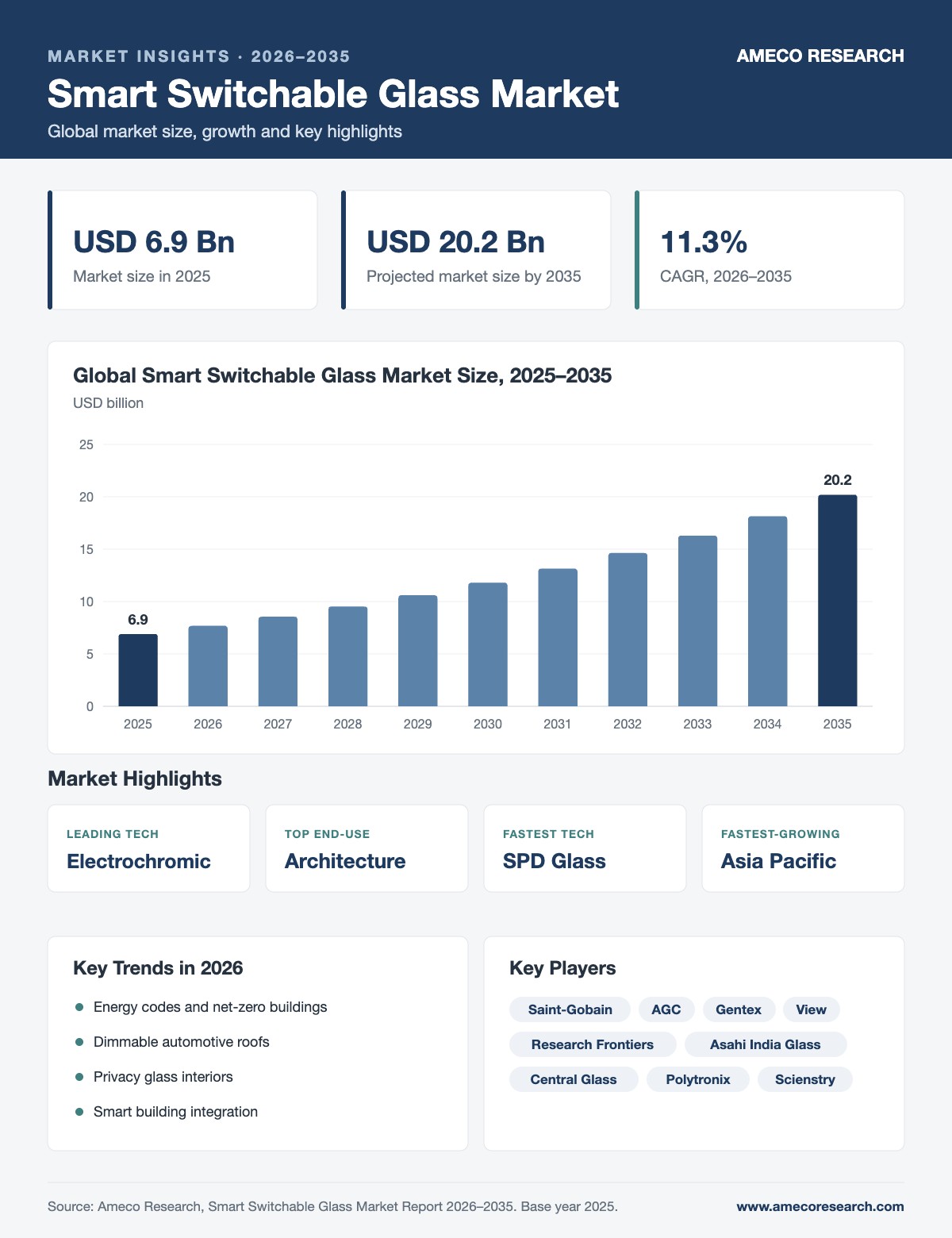 Infographic: Smart Switchable Glass Market Size and Growth Opportunities and Forecast till 2026 - 2035 | Ameco Research
Smart Switchable Glass Market Report Scope
| Report Attribute | Details |
| Smart Switchable Glass Market Size in 2025 | USD 6.9 Billion |
| Smart Switchable Glass Market Forecast by 2035 | USD 20.2 Billion |
| Smart Switchable Glass Market CAGR (2026–2035) | 11.3% |
| Analysis Period | 2023–2035 |
| Base Year | 2025 |
| Forecast Period | 2026–2035 |
| Segments Covered | by Technology, by End-User Industry, and By Region |
| Regional Scope | North America, Europe, Asia Pacific, Latin America, and Middle East & Africa |
| Key Companies Profiled | Saint-Gobain, AGC Inc., Gentex Corporation, View, Inc., Research Frontiers (SPD-SmartGlass), Asahi India Glass Ltd., Central Glass Co., Ltd., Polytronix, Inc., Scienstry, Inc., BSG Glass, Essex Safety Glass, and SPD Control Systems |
| Report Coverage | Market Trends, Drivers, Restraints, Opportunities, Competitive Analysis, Player Profiling, Regulation Analysis |
Smart Switchable Glass Market Size Forecast, 2023–2035
The table below shows the year-by-year size of the global smart switchable glass market. Revenue is expected to grow about 2.9 times between 2025 and 2035, reaching roughly USD 11.8 billion by 2030.
| Year | Market Size (USD Billion) |
| 2023 (historical) | 5.6 |
| 2024 (historical) | 6.2 |
| 2025 (base year) | 6.9 |
| 2026 (forecast) | 7.7 |
| 2027 (forecast) | 8.6 |
| 2028 (forecast) | 9.5 |
| 2029 (forecast) | 10.6 |
| 2030 (forecast) | 11.8 |
| 2031 (forecast) | 13.1 |
| 2032 (forecast) | 14.6 |
| 2033 (forecast) | 16.3 |
| 2034 (forecast) | 18.1 |
| 2035 (forecast) | 20.2 |
Latest Smart Switchable Glass Market Trends (2026)
Energy codes and net-zero buildings
Stricter building energy codes and net-zero targets favor dynamic glazing that cuts solar heat gain and cooling loads while keeping daylight, reducing the need for blinds and artificial lighting.
Dimmable automotive glass
Automakers are adding large panoramic roofs and sunroofs with SPD or PDLC dimming, especially in electric and premium vehicles, where shading also helps manage cabin heat and range.
Privacy glass in interiors
PDLC switchable glass is used for meeting rooms, hospital rooms, hotel bathrooms and retail displays, letting spaces switch between clear and opaque on demand.
Smart building integration
Smart glass is connected to building management systems, sensors and apps that tint windows automatically based on sun position, occupancy and weather.
Retrofit films and attachments
Switchable films and retrofit products let existing buildings and vehicles add smart glass features without replacing entire windows, widening the market.
Lower costs and industry consolidation
Manufacturers are working to lower costs through larger production lines and better yields, while some specialist suppliers have restructured or been acquired, shaping competition.
Smart Switchable Glass Market Dynamics
Growth drivers
- Stricter building energy codes and focus on energy efficiency
- Growth in commercial construction, renovation and smart facades
- Demand for privacy, glare control and comfort
- Automotive use in sunroofs, mirrors and windows
- Rising consumer spending and smart home adoption
Restraints and challenges
- High cost compared with conventional and low-E glass
- Installation complexity and need for wiring and controls
- Durability and switching speed concerns for some technologies
- Long sales cycles in commercial construction
Opportunities
Key opportunities include retrofit films, dimmable vehicle roofs in electric vehicles, healthcare and hospitality privacy glass, aircraft and rail windows, and growing construction markets in Asia Pacific and the Middle East.
Smart Switchable Glass Market Segment Analysis
By technology
The market is segmented into suspended particle devices (SPD), polymer dispersed liquid crystal (PDLC), electrochromic (EC), thermochromic, photochromic and others. Electrochromic glass holds the largest share, while SPD glass is expected to grow fastest because of its quick switching and wide shading range.
By end-user industry
End-user industries include automotive & transportation, architecture & construction, electronics, aerospace & defense and others. Architecture & construction holds the largest share, while automotive & transportation is among the fastest-growing segments.
Smart Switchable Glass Market Regional Analysis
North America and Europe are the largest markets, supported by high per capita income, building energy conservation rules, laminated glazing and a strong base of automakers and commercial construction.
Asia Pacific is expected to grow fastest, driven by construction, rising incomes and automotive production in China, Japan, South Korea and India.
Latin America and the Middle East & Africa are smaller markets, with demand for solar control in hot climates and premium commercial projects in the Gulf.
Smart Switchable Glass Market Segmentation
Smart Switchable Glass Market Leading Companies
The smart switchable glass market includes major flat glass producers, electrochromic specialists, SPD and PDLC technology licensors and film makers, and regional glass processors. Companies compete on switching speed, clarity, durability, energy performance, cost per square meter and integration with building and vehicle controls. Key players profiled in this report include Saint-Gobain, AGC Inc., Gentex Corporation, View, Inc., Research Frontiers (SPD-SmartGlass), Asahi India Glass Ltd., Central Glass Co., Ltd., Polytronix, Inc., Scienstry, Inc., BSG Glass, Essex Safety Glass, and SPD Control Systems.
Saint-GobainAGC Inc.Gentex CorporationView, Inc.Research Frontiers (SPD-SmartGlass)Asahi India Glass Ltd.Central Glass Co., Ltd.Polytronix, Inc.Scienstry, Inc.BSG GlassEssex Safety GlassSPD Control Systems
Key Questions Answered in This Report
- What is the size of the smart switchable glass market in 2025, and how large will it be by 2030 and 2035?
- What are the main growth drivers, restraints and opportunities through 2035?
- Which by technology and by end-user industry segments will grow the fastest?
- Which regions and countries offer the largest and fastest-growing opportunities?
- How are energy codes, dimmable car roofs and privacy glass shaping smart switchable glass demand in 2026?
- Who are the leading companies, and what strategies are they using to compete?
Research Methodology
Our estimates draw on interviews with glass manufacturers, smart glass technology companies, architects, automakers and distributors, supported by secondary data from annual reports, investor materials, trade and customs data, standards bodies and industry journals. Bottom-up estimates of company revenues and top-down estimates of application demand are reconciled through data triangulation, and the model is updated with 2026 developments to forecast the market through 2035.
Related Reports
- Glass Manufacturing Market Report
- Smart Cities Market Report
- Smart Building Market Report
- Container Glass Market Report
- Glass Fiber Reinforcement Materials Market Report
Smart Switchable Glass Market: Frequently Asked Questions
How big is the smart switchable glass market?
The global smart switchable glass market was valued at USD 6.9 billion in 2025 and is expected to reach USD 20.2 billion by 2035.
What is the growth rate of the smart switchable glass market?
The smart switchable glass market is projected to grow at a CAGR of 11.3% from 2026 to 2035.
What will the smart switchable glass market be worth in 2030?
The smart switchable glass market is projected to reach about USD 11.8 billion in 2030, growing at a CAGR of 11.3%.
What is driving growth in the smart switchable glass market?
Key drivers are building energy codes, commercial construction and renovation, demand for privacy and glare control, and automotive sunroofs and windows.
What is smart switchable glass?
Smart switchable glass is glass that changes its tint or opacity when voltage, light or heat is applied, using technologies such as electrochromic, SPD and PDLC.
Which region leads the smart switchable glass market?
North America and Europe are the largest markets, while Asia Pacific is expected to grow fastest.
Which segment holds the largest share of the smart switchable glass market?
Electrochromic glass holds the largest technology share, SPD glass is growing fastest, and architecture & construction is the largest end-use.
What are the latest trends in the smart switchable glass market?
The main 2026 trends are energy codes and net-zero buildings, dimmable automotive glass, privacy glass in interiors, smart building integration, retrofit films and attachments and lower costs and industry consolidation.
What are the main challenges in the smart switchable glass market?
The main challenges are high cost compared with conventional glass, installation complexity, durability concerns and long construction sales cycles.
What is the difference between electrochromic and PDLC glass?
Electrochromic glass gradually tints darker to block light and heat, while PDLC glass switches quickly between clear and frosted for privacy but does not tint.
Who are the key players in the smart switchable glass market?
Leading companies include Saint-Gobain, AGC Inc., Gentex Corporation, View, Inc., Research Frontiers (SPD-SmartGlass), Asahi India Glass Ltd., Central Glass Co., Ltd., Polytronix, Inc., Scienstry, Inc., BSG Glass, Essex Safety Glass, and SPD Control Systems.