Solid State Transformer (SST) Market Size, Share, Trends & Growth Opportunities Forecast to 2026 - 2035
Solid State Transformer (SST) Market Size, Share & Trends Report, 2026–2035
LAST UPDATED: NOVEMBER 2026
The global solid state transformer (SST) market size was valued at USD 192.4 million in 2025 and is projected to reach USD 1,603.7 million by 2035, growing at a CAGR of 23.4% from 2026 to 2035. The market is estimated at USD 241.7 million in 2026, as AI data centers adopt 800 V DC power, utilities modernize distribution grids and EV fast-charging and renewable projects need compact, controllable power conversion. Asia Pacific holds the largest share, while North America is the fastest-growing region.
A solid state transformer (SST), also known as a power electronic transformer or smart transformer, replaces the heavy copper-and-steel core of a conventional 50/60 Hz transformer with power semiconductors and a compact high-frequency transformer. It typically works in three stages: a rectifier converts medium-voltage AC to DC, an isolated DC/DC converter steps the voltage down at high frequency, and an output stage delivers low-voltage AC or DC. Because every stage is electronically controlled, an SST can regulate voltage, manage power flow in both directions, improve power quality and provide a native DC connection.
These capabilities make the SST a key building block for modern power systems: 800 V DC AI data centers, megawatt EV charging hubs, solar and battery plants, DC microgrids and lighter railway traction systems. Advances in silicon carbide (SiC) power devices, which switch faster and at higher voltages with lower losses, have made SSTs commercially viable, and the solid state transformer market is moving from pilots and traction niches toward volume deployment.
SST Market Key Takeaways
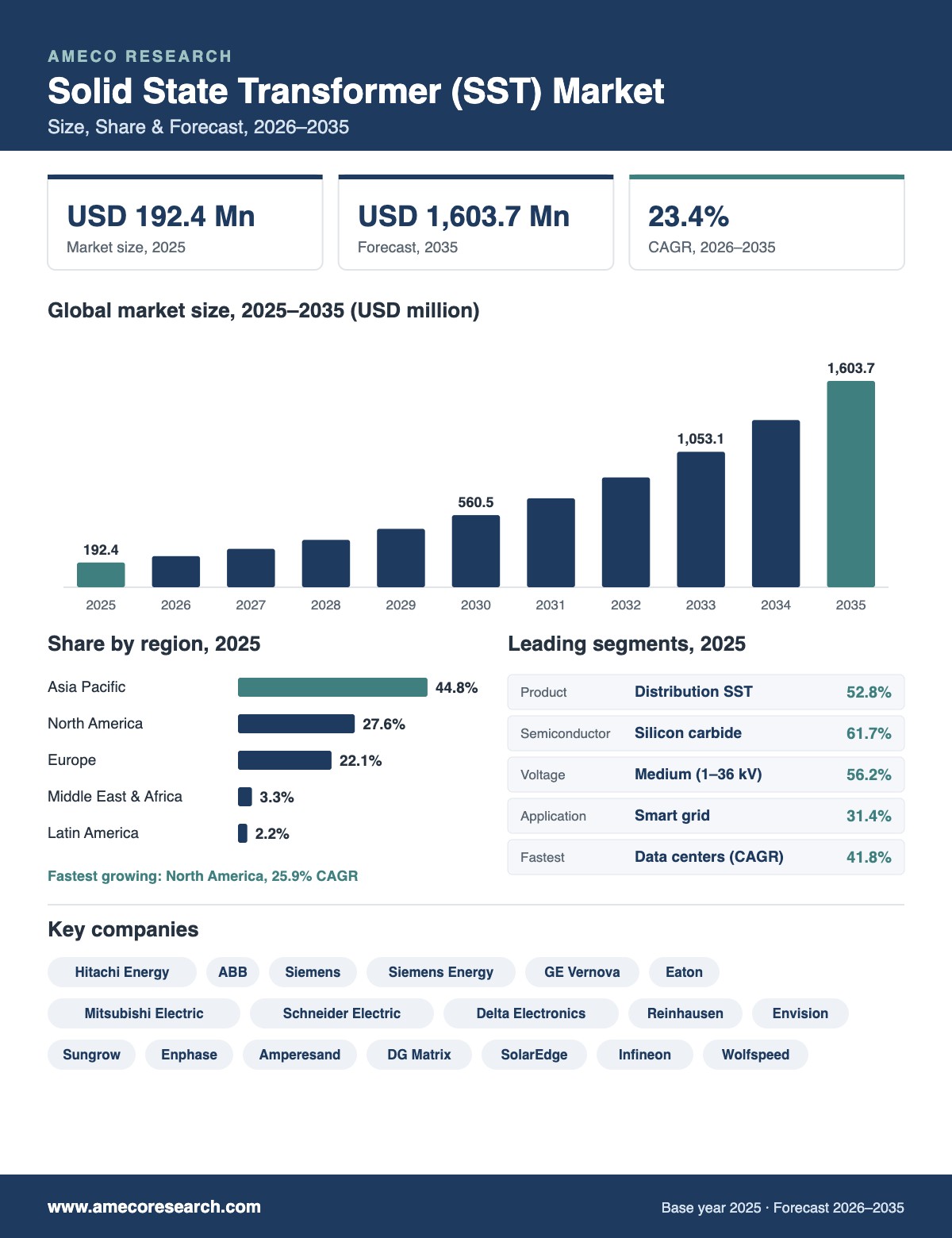 Infographic: Solid State Transformer (SST) Market Size, Share, Trends & Growth Opportunities Forecast to 2026 - 2035 | Ameco Research
SST Market Report Scope
| Report Attribute | Details |
| SST Market Size in 2025 | USD 192.4 Million |
| SST Market Size in 2026 | USD 241.7 Million |
| SST Market Forecast by 2035 | USD 1,603.7 Million |
| SST Market CAGR (2026–2035) | 23.4% |
| Historical Data | 2021–2024 |
| Base Year | 2025 |
| Forecast Period | 2026–2035 |
| Largest Region | Asia Pacific (44.8% share in 2025) |
| Fastest-Growing Region | North America (25.9% CAGR) |
| Segments Covered | Product Type, Component, Semiconductor Material, Voltage Level, Application and Region |
| Regional Scope | North America, Europe, Asia Pacific, Latin America, and Middle East & Africa |
| Key Companies Profiled | Hitachi Energy, ABB, Siemens, Siemens Energy, GE Vernova, Eaton (Resilient Power Systems), Mitsubishi Electric, Schneider Electric, Delta Electronics, Maschinenfabrik Reinhausen, Envision Energy, Sungrow, Enphase Energy, Amperesand, DG Matrix, SolarEdge, Infineon Technologies and Wolfspeed |
| Report Coverage | Market size and forecast, SST technology and topologies, SiC and GaN device analysis, cost and pricing analysis, 800 V DC data center architecture, standards, trends, drivers, restraints, opportunities, segment and regional analysis, competitive landscape, recent developments |
How Big Is the Solid State Transformer Market in 2026?
Ameco Research estimates the solid state transformer market at USD 241.7 million in 2026, up about 26% from USD 192.4 million in 2025. Growth picked up in 2026 as leading power equipment companies launched or announced medium-voltage SSTs for 800 V DC AI data centers and the first commercial 800 V DC data center went live with SSTs. The market is expected to reach about USD 560.5 million by 2030 and climb to USD 1,603.7 million by 2035, passing USD 1 billion around 2033.
| Year | SST Market Size (USD Million) |
| 2025 | 192.4 |
| 2026 | 241.7 |
| 2027 | 298.3 |
| 2028 | 368.1 |
| 2030 | 560.5 |
| 2032 | 853.4 |
| 2035 | 1,603.7 |
Latest SST Market Trends 2026
800 V DC AI data centers become the growth engine
NVIDIA’s 800 VDC architecture for next-generation AI factories, announced in May 2025, identified solid state transformers as the way to convert medium-voltage grid power directly to DC. In 2026, Siemens and Reinhausen, Eaton, Enphase and others announced SSTs for this use, and Envision began running live AI workloads on an 800 V DC system powered by SSTs at its Ulanqab campus in China.
Medium-voltage SSTs reach certification
In September 2026, Eaton introduced MVSST 2.0, built with Infineon silicon carbide devices and described as one of the first medium-voltage SST platforms to achieve IEC certification. Certification is a key step for utility and data center buyers that require proven reliability.
Silicon carbide drives cost and efficiency gains
High-voltage SiC MOSFETs and modules, including 2.3 kV and 3.3 kV devices, allow fewer conversion stages, higher switching frequency and efficiency of about 98% or more. Falling SiC prices are steadily narrowing the cost gap between SSTs and conventional transformers.
Transformer shortages open the door
Long lead times for conventional distribution and power transformers, often two to four years for large units, are pushing utilities and developers to consider SSTs that are smaller, factory-built and quicker to install.
Grid edge, EV charging and DC microgrids
SSTs are being used to connect megawatt EV charging hubs, solar and battery systems directly to medium-voltage grids, reducing equipment and footprint and enabling DC microgrids that combine generation, storage and loads.
New entrants and consolidation
Start-ups such as Amperesand, DG Matrix and SolidUltra, which raised EUR 3 million in November 2026, are attracting investment, while major players are buying technology, as shown by Eaton’s 2025 agreement to acquire SST specialist Resilient Power Systems.
SST Market Dynamics
Growth drivers
- AI data center power: rack power densities are rising toward 1 MW, driving the shift to 800 V DC distribution that SSTs are designed to supply.
- Grid modernization: utilities need voltage control, bidirectional power flow and real-time monitoring to handle rooftop solar, batteries and EVs.
- EV fast charging: megawatt charging for trucks and buses benefits from compact SSTs that connect chargers directly to medium-voltage lines.
- Renewable and storage integration: SSTs provide a DC link for solar, wind and batteries with fewer conversion steps.
- Size and weight savings: SSTs can be 50–80% smaller and lighter than conventional transformers, which matters in data centers, trains, ships and cities.
Restraints and challenges
- High upfront cost: SSTs still cost several times more per kVA than conventional transformers.
- Reliability and lifetime: utilities are used to transformers that last 30–40 years, while power electronics need proven long-term field data.
- Efficiency at full load: multiple conversion stages can make SST efficiency slightly lower than the best conventional transformers in pure AC applications.
- Standards and certification: grid codes, protection schemes and safety standards for SSTs are still developing.
- SiC supply and insulation design: high-voltage SiC devices and high-frequency insulation remain technically demanding.
Opportunities
- Hyperscale and AI campus projects adopting 800 V DC power from 2027 onward.
- Megawatt charging hubs for electric trucks, buses and fleets.
- DC microgrids for industrial sites, ports and campuses.
- Lightweight traction transformers for high-speed trains and metros.
- Offshore wind, marine and aerospace applications where weight and space are critical.
SST Market Segment Analysis
By product type
Distribution SSTs accounted for 52.8% of revenue in 2025, about USD 101.6 million, used in smart grids, EV charging, renewable integration and data centers. Power SSTs, used in substations and high-power grid links, held 28.4%, while traction SSTs for railway rolling stock held 18.8%. Distribution SSTs are also growing fastest because of data center and charging demand.
| Product Type | Share (2025) | Key Highlights |
| Distribution SST | 52.8% | Largest and fastest-growing; grid edge, data centers and EV charging |
| Power SST | 28.4% | Substations, HVDC links and utility-scale renewables |
| Traction SST | 18.8% | Lighter onboard transformers for trains and metros |
By component
Power electronic converters, including rectifiers, DC/DC stages and inverters, accounted for 44.1% of SST value in 2025. High-frequency transformers held 23.7%, control, protection and monitoring systems 17.4%, and other components such as switches, cooling systems and enclosures 14.8%.
| Component | Share (2025) | Key Highlights |
| Power Electronic Converters | 44.1% | Largest; SiC-based rectifier, DC/DC and inverter stages |
| High-Frequency Transformers | 23.7% | Compact isolation using nanocrystalline or ferrite cores |
| Control, Protection & Monitoring | 17.4% | Digital controls, grid protection and remote monitoring |
| Others (Switches, Cooling, Enclosures) | 14.8% | Thermal management and system packaging |
By semiconductor material
Silicon carbide (SiC) SSTs held 61.7% of revenue in 2025 because SiC devices handle high voltages and switching frequencies with low losses. Silicon IGBT-based SSTs held 24.6%, mainly in traction and earlier designs, while gallium nitride (GaN) and hybrid designs, at 13.7%, are the fastest-growing material segment at about a 27.3% CAGR, led by low-voltage and high-frequency stages.
| Semiconductor Material | Share (2025) | Key Highlights |
| Silicon Carbide (SiC) | 61.7% | Largest; medium-voltage data center and grid SSTs |
| Silicon (IGBT) | 24.6% | Traction and earlier SST designs |
| GaN & Hybrid | 13.7% | Fastest-growing at 27.3% CAGR; high-frequency stages |
By voltage level
Medium-voltage SSTs (1–36 kV) accounted for 56.2% of revenue in 2025, as most data center, EV charging and distribution projects connect at 10–36 kV. High-voltage SSTs above 36 kV held 26.9%, and low-voltage SSTs below 1 kV held 16.9%.
| Voltage Level | Share (2025) | Key Highlights |
| Medium Voltage (1–36 kV) | 56.2% | Largest; 10–36 kV grid to 800 V DC conversion |
| High Voltage (above 36 kV) | 26.9% | Substations and transmission-level projects |
| Low Voltage (below 1 kV) | 16.9% | Building, microgrid and residential uses |
By application: Which application is growing fastest?
Smart grid and power distribution was the largest application with 31.4% of revenue in 2025. Railway traction held 19.2%, EV fast charging 18.7%, renewable energy and storage integration 15.3%, and industrial and other uses 5.8%. Data centers, with 9.6% in 2025, are the fastest-growing application at about a 41.8% CAGR and are expected to become one of the two largest applications by 2035.
| Application | Share (2025) | Key Highlights |
| Smart Grid & Distribution | 31.4% | Largest; voltage control and bidirectional power flow |
| Railway Traction | 19.2% | Lighter, more efficient onboard power |
| EV Fast Charging | 18.7% | Megawatt charging hubs on medium-voltage lines |
| Renewable & Storage Integration | 15.3% | Solar, wind and battery DC links |
| Data Centers | 9.6% | Fastest-growing at 41.8% CAGR; 800 V DC AI power |
| Industrial & Others | 5.8% | Microgrids, marine and industrial drives |
SST Market Regional Analysis
| Region | Share (2025) | Outlook |
| Asia Pacific | 44.8% | Largest; China grid, rail, EV charging and data centers |
| North America | 27.6% | Fastest-growing at 25.9% CAGR; AI data centers and grid upgrades |
| Europe | 22.1% | Rail, renewables and data center pilots |
| Middle East & Africa | 3.3% | Gulf data center and smart city projects |
| Latin America | 2.2% | Early grid and renewable integration projects |
Why does Asia Pacific lead the SST market?
Asia Pacific accounted for about 44.8% of revenue in 2025. China leads in SST pilots for distribution grids, high-speed rail, EV charging and now 800 V DC data centers, such as Envision’s Ulanqab campus. Japan and South Korea have strong power electronics and rail industries, Taiwan’s Delta Electronics supplies data center power systems, and Singapore-based Amperesand is developing SSTs for grid and data center use.
What makes North America the fastest-growing region?
North America held about 27.6% of the market in 2025 and is forecast to grow at a 25.9% CAGR. Hyperscale AI data center construction, long lead times for conventional transformers, Department of Energy grid modernization programs and fast-growing EV charging networks are driving demand. Eaton, Enphase, DG Matrix, GE Vernova and others are developing SSTs in the U.S., with Enphase building its SST power modules in Texas.
How is Europe developing?
Europe represented about 22.1% of revenue in 2025. The region has a long history of SST research for railway traction, and companies such as Siemens, Reinhausen, ABB, Hitachi Energy and Infineon are now targeting data centers, EV charging and renewable integration. EU grid investment and electrification targets support long-term demand.
SST Market Segmentation
SST Market Leading Companies
The solid state transformer market combines large grid equipment makers, data center power companies and specialist start-ups. Hitachi Energy, ABB, Siemens, Siemens Energy and GE Vernova lead in grid and traction applications; Eaton, Delta Electronics, Schneider Electric, Envision and Sungrow are focused on data center and renewable power; and Enphase, Amperesand, DG Matrix and SolarEdge are bringing new SST designs to market. Silicon carbide suppliers such as Infineon and Wolfspeed are critical technology partners.
Hitachi Energy · ABB · Siemens · Siemens Energy · GE Vernova · Eaton (Resilient Power Systems) · Mitsubishi Electric · Schneider Electric · Delta Electronics · Maschinenfabrik Reinhausen · Envision Energy · Sungrow · Enphase Energy · Amperesand · DG Matrix · SolarEdge · Infineon Technologies · Wolfspeed
Recent developments
- November 2026: Envision Energy said its Galaxy AI data center campus in Ulanqab, China, is running live computing workloads on an integrated 800 V DC power system that uses solid state transformers to convert 10 kV AC to 800 V DC.
- September 2026: Eaton introduced its MVSST 2.0 medium-voltage solid state transformer platform for 800 V DC AI data centers, using Infineon silicon carbide devices, with initial deployment in Asia Pacific.
- September 2026: Enphase Energy said power modules for its IQ Solid-State Transformer are being built in Texas, targeting customer pilots in 2027 and volume shipments in 2028.
- August 2026: Siemens and Maschinenfabrik Reinhausen announced joint development of a modular SST that connects to grids up to 36 kV and supplies 800 V DC for AI data centers.
- April 2026: Enphase Energy announced development of a distributed IQ Solid-State Transformer for AI data centers.
- July 2025: Eaton signed an agreement to acquire Resilient Power Systems to expand its solid state transformer technology for data centers, EV charging and utilities.
- May 2025: NVIDIA unveiled its 800 VDC power architecture for AI factories, highlighting solid state transformers for direct medium-voltage to DC conversion.
SST Market: Frequently Asked Questions
How big is the solid state transformer market?
The global solid state transformer (SST) market was valued at USD 192.4 million in 2025 and is estimated at USD 241.7 million in 2026. Ameco Research projects it to reach USD 1,603.7 million (about USD 1.6 billion) by 2035, growing at a CAGR of 23.4% from 2026 to 2035.
What is a solid state transformer?
A solid state transformer, also called a power electronic transformer or smart transformer, uses power semiconductors such as silicon carbide (SiC) MOSFETs and a compact high-frequency transformer instead of a large 50/60 Hz iron-core transformer. It converts medium-voltage AC into low-voltage AC or DC, can control power flow and voltage in both directions, and is much smaller and lighter than a conventional transformer.
How is a solid state transformer different from a conventional transformer?
A conventional transformer only steps voltage up or down at grid frequency and cannot control power. A solid state transformer converts power in several electronic stages, so it can output DC directly, regulate voltage, correct power quality, isolate faults and connect batteries, solar and EV chargers. It is up to 50–80% smaller and lighter, but currently costs more per kVA.
Why are solid state transformers important for AI data centers?
AI data centers are moving to 800 V DC power to feed high-density GPU racks. A solid state transformer can convert medium-voltage grid power (10–36 kV) directly to 800 V DC in one compact unit, replacing several conversion stages and saving space, copper and energy. NVIDIA’s 800 VDC architecture, Siemens and Reinhausen’s 36 kV SST, Eaton’s MVSST 2.0 and Envision’s 800 V DC campus have made data centers the fastest-growing SST application.
Which application leads the solid state transformer market?
Smart grid and power distribution was the largest application with about 31.4% of revenue in 2025, followed by railway traction at 19.2% and EV fast charging at 18.7%. Data centers held 9.6% but are the fastest-growing application at about a 41.8% CAGR through 2035.
Which semiconductor is used in solid state transformers?
Silicon carbide (SiC) devices dominate, with about 61.7% of 2025 SST revenue, because they switch at high frequency and high voltage with low losses. Silicon IGBT-based designs held 24.6%, mainly in traction and older systems, while gallium nitride (GaN) and hybrid designs held 13.7% and are growing fastest.
Which region leads the solid state transformer market?
Asia Pacific led with about 44.8% of revenue in 2025, driven by China’s grid, rail, EV charging and data center investments and by SST manufacturers in China, Japan, Taiwan and Singapore. North America is the fastest-growing region at about a 25.9% CAGR because of AI data center construction and grid modernization.
Who are the key companies in the solid state transformer market?
Key companies include Hitachi Energy, ABB, Siemens, Siemens Energy, GE Vernova, Eaton, Mitsubishi Electric, Schneider Electric, Delta Electronics, Maschinenfabrik Reinhausen, Envision Energy, Sungrow, Enphase Energy, Amperesand, DG Matrix and SolarEdge, with SiC device suppliers such as Infineon and Wolfspeed.
Related Energy and Power Market Reports
- Data Center Battery Market Size, Share, Trends & Growth Opportunities Forecast to 2026 - 2035
- Biogas Market Growth Opportunities and Forecast till 2032
- Mobile Generators Market Growth Opportunities and Forecast till 2032
- Residual Gas Analyzers Market Growth Opportunities and Forecast till 2032
- Small Hydropower Market Growth Opportunities and Forecast till 2032