Press Release
Automotive Headlamp Reflector Market to Reach USD 1,597.1 Million by 2035 at 4.3% CAGR, Driven by LED and Adaptive Lighting
Date : Nov 04, 2026
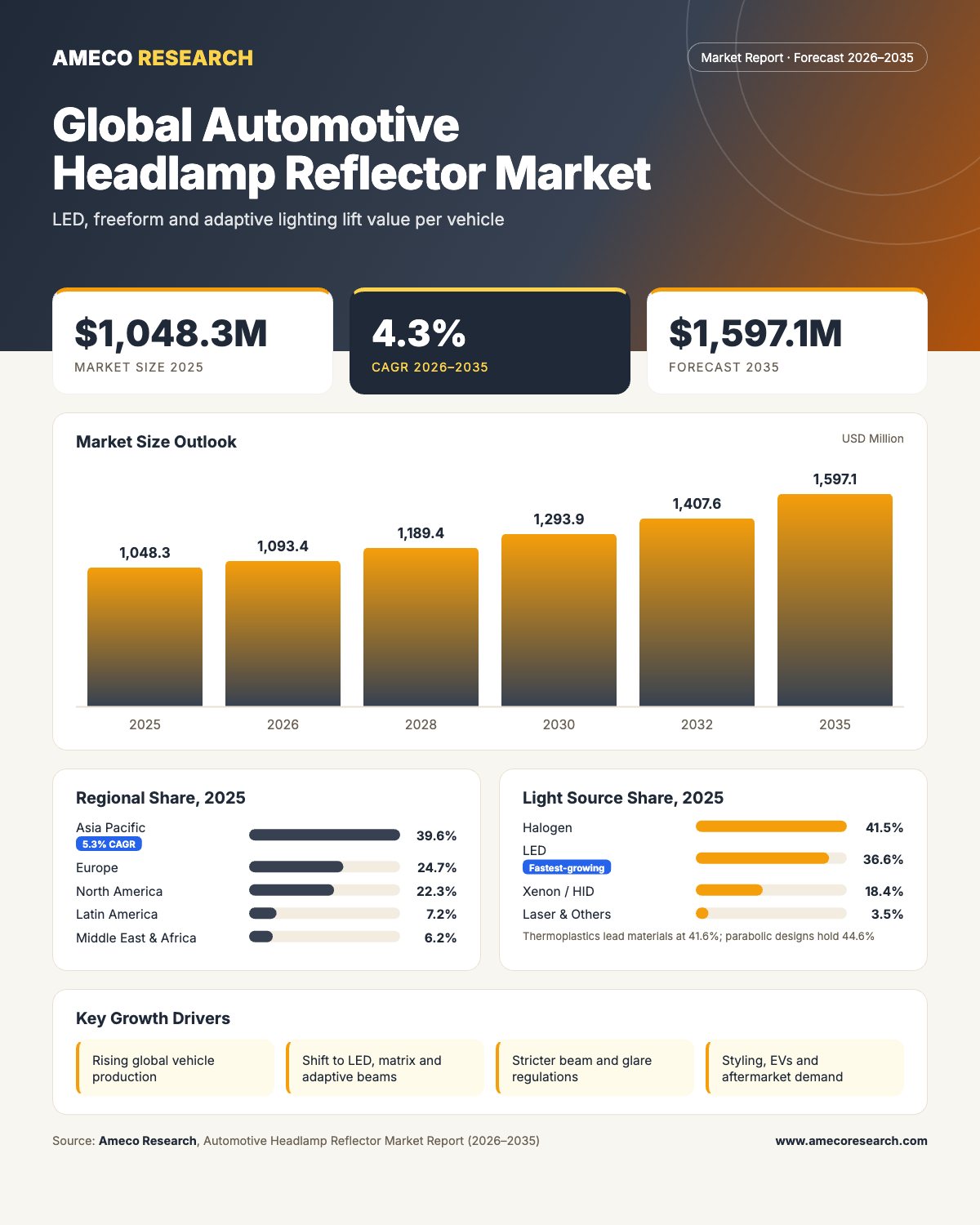
Pune, India, November 4, 2026 — The global Automotive Headlamp Reflector Market was valued at USD 1,048.3 million in 2025 and is projected to reach USD 1,597.1 million by 2035, growing at a CAGR of 4.3% from 2026 to 2035, according to the new Automotive Headlamp Reflector Market report from Ameco Research. The market is estimated at USD 1,093.4 million in 2026. Unit volumes track global vehicle production, but the shift from halogen to LED, matrix, and adaptive headlamps is turning reflectors into complex freeform optics and raising the value of each part.
The reflector decides how far and how evenly a headlamp lights the road, how much glare it causes for oncoming drivers, and whether the lamp passes ECE, SAE, and FMVSS 108 beam-pattern tests. Ameco Research's 180-page study examines materials, light sources, reflector designs, beam functions, vehicle types, manufacturing processes, sales channels, and regional demand through 2035.
What Is the Automotive Headlamp Reflector Market Worth?
An automotive headlamp reflector is the precision-shaped, mirror-coated component inside a headlamp that gathers light from a halogen bulb, HID lamp, or LED and projects it onto the road in a regulated beam pattern. Reflectors are typically injection- or compression-molded from heat-resistant thermoplastics or thermoset composites, then vacuum-metallized with aluminum to reach reflectivity above 85%.
Ameco Research expects steady, value-led growth as advanced lighting spreads from premium models into mass-market cars, SUVs, and commercial vehicles:
| Year | Market Size (USD Million) |
|---|---|
| 2025 (Base Year) | 1,048.3 |
| 2026 | 1,093.4 |
| 2028 | 1,189.4 |
| 2030 | 1,293.9 |
| 2032 | 1,407.6 |
| 2035 | 1,597.1 |
Report Highlights
- Market size 2025: USD 1,048.3 million, reaching USD 1,597.1 million by 2035
- Growth rate: 4.3% CAGR from 2026 to 2035
- Largest and fastest-growing region: Asia Pacific, with 39.6% share and a 5.3% CAGR
- Leading material: Thermoplastics, at 41.6%, followed by composites at 37.5%
- Light source: Halogen still leads at 41.5%, but LED (36.6%) grows fastest
- Reflector design: Parabolic leads with 44.6%; freeform expands fastest
- Vehicles and channels: Passenger cars take 56.4% of demand; OEM sales make up 71.5%
Key Growth Drivers
Vehicle Production and the Move to LED
Every new car, truck, and bus needs two or more headlamp reflectors, so demand follows global vehicle output, which is growing fastest in Asia. LED headlamps are now standard on most new models in Europe, China, and North America and are moving quickly into compact cars and SUVs in India and Southeast Asia. LED optics need tighter surface tolerances and more complex geometries, so reflector value per vehicle is rising.
Road Safety Regulation
UN ECE, SAE, and FMVSS 108 beam-pattern and glare rules require accurate optics. Newer rules now allow adaptive driving beams in more markets, including the U.S., which is prompting new headlamp programs for upcoming model years.
Styling, Premiumization, and the Aftermarket
Slim, signature headlamps have become a key design feature, encouraging carmakers to invest in freeform reflector designs. Collisions, ageing vehicles, and lighting upgrades also support steady replacement sales, particularly in large markets such as India.
Automotive Headlamp Reflector Market Trends in 2026
- Freeform reflectors gain ground: Computer-designed surfaces split the reflector into many segments, each aimed at a different part of the beam, giving sharper cut-off lines and more even light with fewer parts.
- Adaptive and matrix lighting adds complexity: FORVIA HELLA's matrix headlamp for the Zeekr 8X uses about 25,000 LED pixels and a 16-zone adaptive module per headlamp, showing how fast lighting content is increasing.
- India becomes a lighting hub: Valeo outlined plans to invest more than EUR 200 million in India, Marelli-Motherson opened an exterior lighting plant in Sanand, Gujarat, and Koito's Gujarat plant is designed for about 500,000 headlamps a year.
- Lightweight, high-heat polymers: Suppliers are replacing metal and glass with high-temperature thermoplastics and BMC composites that can be molded into complex shapes and metallized without a base coat.
- EVs and software-defined lighting: Electric vehicles use headlamps for brand signatures, welcome animations, and road projections, raising demand for multi-function reflector modules.
Challenges
LEDs, sensors, control units, thermal management, and calibration raise headlamp costs and can slow adoption in entry-level vehicles. Some LED projector and micro-lens array headlamps use fewer or smaller reflectors, limiting reflector content in certain models. Suppliers also face volatile prices for engineering plastics, resins, and aluminum coating materials, strict quality requirements where any defect can trigger recalls, and exposure to swings in vehicle production, tariffs, and supply chains.
Segment Analysis
By Material
Thermoplastics such as polycarbonate, PEI, and PBT accounted for 41.6% of revenue in 2025 because they are light, easy to injection-mold, and can be metallized directly. Composites, mainly bulk molding compound (BMC), held 37.5% thanks to their heat resistance near hot light sources, while aluminum, sheet steel, and other materials made up 20.9%.
By Light Source
| Light Source | Share (2025) | Key Highlights |
|---|---|---|
| Halogen | 41.5% | Low cost; dominant in entry vehicles, commercial vehicles, and the aftermarket |
| LED | 36.6% | Fastest-growing; standard in most new models; enables matrix and adaptive beams |
| Xenon / HID | 18.4% | High output; gradually being replaced by LED |
| Laser & Others | 3.5% | Long-range high beams in premium vehicles |
LED is expected to account for well over half of the market by 2035.
By Reflector Design and Beam Function
Parabolic reflectors held 44.6% in 2025 thanks to their simple, low-cost design, followed by freeform (27.5%), ellipsoidal projector (17.8%), and multifaceted designs (10.1%). Low-beam reflectors accounted for 41.4% of revenue, while combined low-and-high-beam modules (25.6%) are the fastest-growing function at a 6.3% CAGR as carmakers integrate both beams in compact LED units.
By Vehicle Type, Process, and Sales Channel
Passenger cars accounted for 56.4% of demand, light commercial vehicles 25.3%, and medium and heavy commercial vehicles 18.3%. Injection molding produced 67.4% of reflectors by value and compression molding 24.3%. OEM sales made up 71.5% of revenue, with the aftermarket at 28.5%.
Regional Insights
| Region | Share (2025) | Outlook |
|---|---|---|
| Asia Pacific | 39.6% | Largest and fastest-growing at a 5.3% CAGR; China, India, Japan, South Korea |
| Europe | 24.7% | Premium LED and matrix lighting; Germany, France, Italy, Czech Republic |
| North America | 22.3% | Adaptive driving beam approval and pickup and SUV demand in the U.S. |
| Latin America | 7.2% | Growing at a 4.3% CAGR; Brazil and Mexico production hubs |
| Middle East & Africa | 6.2% | Aftermarket demand and new assembly plants |
China is the world's largest vehicle producer; Japan and South Korea are home to Koito, Stanley Electric, Ichikoh, SL Corporation, and Hyundai Mobis; and India is attracting new lighting plants as domestic production and exports grow. Europe leads in premium LED, matrix, and pixel headlamps, while new assembly plants in Morocco, South Africa, Egypt, and Saudi Arabia support demand in the Middle East and Africa.
Competitive Landscape
The market is concentrated among global lighting suppliers that design and build complete headlamp systems for carmakers, along with regional specialists and aftermarket producers. Competition centers on optical design, LED and adaptive lighting know-how, material and metallization quality, cost, and manufacturing close to vehicle plants. Companies profiled include Koito Manufacturing, Valeo, FORVIA HELLA, Marelli, Stanley Electric, ZKW Group, OPmobility, Varroc Engineering, SL Corporation, Hyundai Mobis, Ichikoh Industries, and Lumax Industries.
Recent moves include FORVIA HELLA's locally produced SSL|HD high-definition headlamp in China and several adaptive headlamp programs won from North American carmakers for 2028–2029 production. For questions on company coverage, pricing, or methodology, Make an Inquiry.
Growth Opportunities
- Electric vehicles: EVs need efficient, lightweight lighting to protect driving range, favoring advanced polymer reflectors.
- Adaptive driving beam adoption: New rules in North America and emerging markets are opening a wave of headlamp redesigns.
- Localized manufacturing: Plants in India, Mexico, Eastern Europe, and Southeast Asia help suppliers win OEM programs close to vehicle assembly.
- Commercial vehicle upgrades: Trucks and buses moving from halogen to LED are creating a growing replacement market.
- Direct-metallization materials: Removing base-coat steps can lower production costs and improve reflector quality.
Related Ameco Research coverage includes the Lighting Market report, the Automotive Lightweight Materials Market analysis, the Specialty Lighting Market report, and the Electric Vehicle Market forecast.
Report Coverage
| Report Attribute | Details |
|---|---|
| Market Size in 2025 | USD 1,048.3 Million |
| Market Forecast in 2035 | USD 1,597.1 Million |
| CAGR (2026–2035) | 4.3% |
| Base Year | 2025 |
| Historical Data | 2021–2024 |
| Forecast Period | 2026–2035 |
| Segments Covered | Material, Light Source, Reflector Design, Beam Function, Vehicle Type, Manufacturing Process, Sales Channel, Region |
| Regions Covered | North America, Europe, Asia Pacific, Latin America, Middle East & Africa |
| Report Coverage | Market size and forecast, trends, drivers, restraints, opportunities, segment and regional analysis, competitive landscape, recent developments |
| Pages | 180 |
Who Should Use This Report?
- Headlamp and lighting suppliers planning capacity, materials, and optical design investments.
- Automakers and vehicle platform teams benchmarking lighting technology and supplier options.
- Polymer, composite, and coating producers sizing demand for reflector-grade materials.
- Aftermarket distributors and investors tracking replacement demand and supplier consolidation.
- Consultants and regional policymakers evaluating automotive component manufacturing hubs.
The study supports investment planning with ten-year forecasts, business strategy with segment shares and growth rates, market entry with regional and country analysis, and competitive intelligence with supplier profiles and recent programs. Buy the Automotive Headlamp Reflector Market Report for immediate access.
Conclusion
The Automotive Headlamp Reflector Market is growing in value faster than in volume. As LED, freeform, and adaptive lighting replace simple halogen designs, revenue is forecast to rise from USD 1,048.3 million in 2025 to USD 1,597.1 million by 2035 at a 4.3% CAGR. Suppliers that combine precise optical design, high-heat polymers, and manufacturing close to vehicle plants are best placed to win. Ameco Research's report provides the data to plan for that shift.
Explore the Full Report
Preview the data and methodology, ask about pricing and coverage, get the complete 180-page study, or request extra segments, country-level data, and research beyond the report’s scope.
About Ameco Research
Ameco Research is a market research and consulting firm that provides syndicated reports, customized research, and data-driven insight across industries including automotive and transportation, ICT, energy, healthcare, and chemicals. Its analysts help businesses, investors, and institutions find growth opportunities and make informed strategic decisions.
Contact Us
Ameco Research
201, Vaidehi-Saaket, Baner - Pashan Link Rd, Pashan, Pune, Maharashtra 411021, India
Phone: +91 898 322 5533
E-mail: [email protected]
Website: www.amecoresearch.com