Press Release
Biologics CDMO Market to Reach USD 92.87 Billion by 2035, Growing at a 10.4% CAGR on Record Capacity and ADC Demand
Date : Nov 10, 2026
Pune, India, November 10, 2026 — The global Biologics CDMO Market was valued at USD 33.84 billion in 2025 and is projected to reach USD 92.87 billion by 2035, growing at a CAGR of 10.4% from 2026 to 2035, according to the latest Biologics CDMO Market report by Ameco Research. The market is estimated at USD 38.12 billion in 2026. Demand for blockbuster antibodies, antibody-drug conjugates (ADCs), biosimilars, and obesity and metabolic drugs is driving record capacity investment, while the BIOSECURE Act is reshaping where sponsors choose to manufacture.
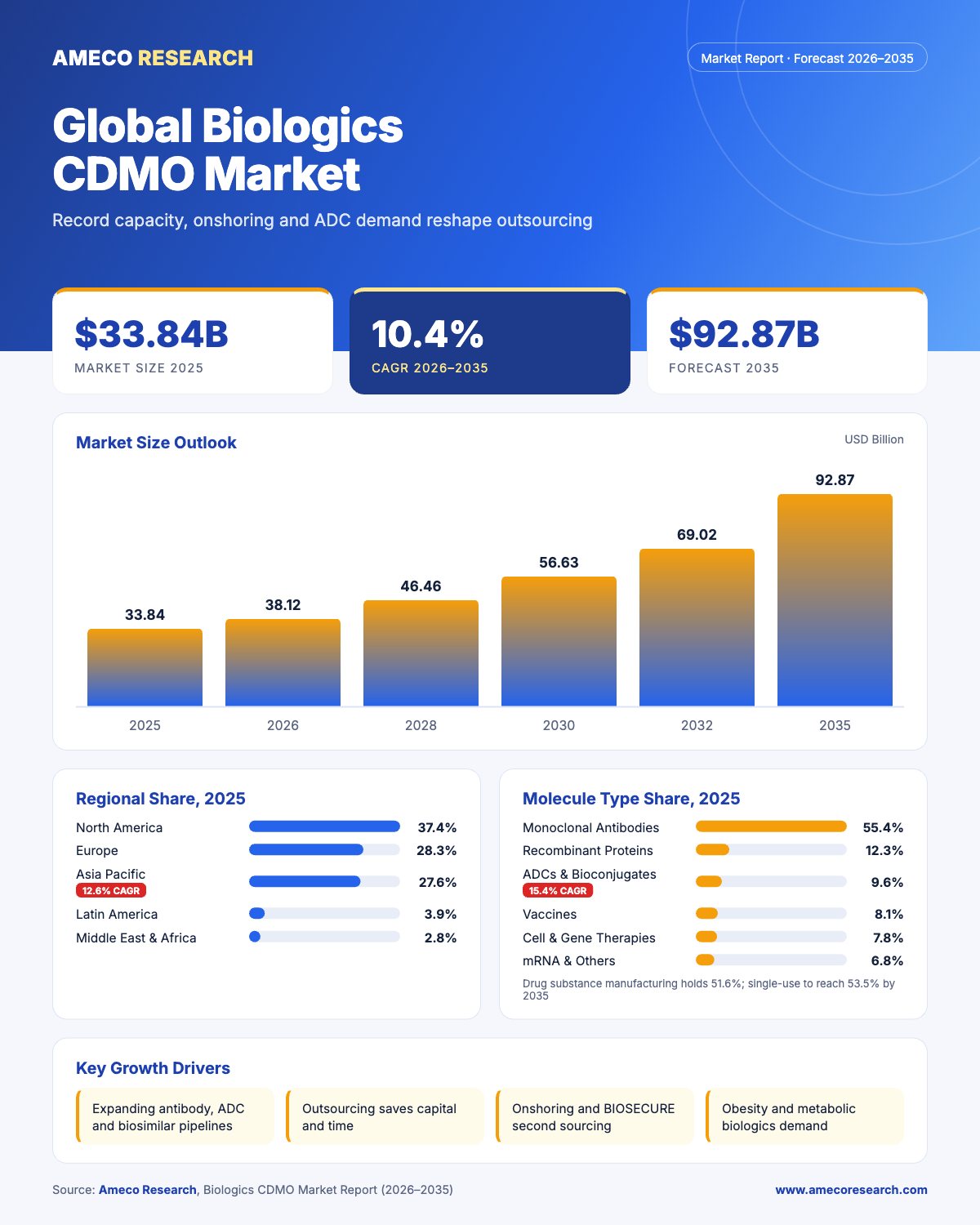
A biologics contract development and manufacturing organization (CDMO) develops and manufactures biologic medicines for pharmaceutical and biotechnology companies, including monoclonal antibodies, bispecifics, recombinant proteins, vaccines, ADCs, and cell and gene therapies. Services span cell line development, process development, drug substance manufacturing, fill-finish, and analytical testing. Building a biologics plant can cost hundreds of millions of dollars and take years, so outsourcing lets developers save capital, reach the clinic faster, and access specialized expertise. The 180-page study covers services, molecules, expression systems, technologies, development stages, therapeutic areas, customers, regions, and capacity.
Biologics CDMO Market Size and Growth
Ameco Research estimates the market grew about 12.6% in 2026 as new plants from Samsung Biologics, FUJIFILM Biotechnologies, and others came online, and expects it to approach USD 57 billion by 2030:
| Year | Market Size (USD Billion) |
|---|---|
| 2025 (Base Year) | 33.84 |
| 2026 | 38.12 |
| 2028 | 46.46 |
| 2030 | 56.63 |
| 2032 | 69.02 |
| 2035 | 92.87 |
Report Highlights
- Market size 2025: USD 33.84 billion, reaching USD 92.87 billion by 2035
- Growth rate: 10.4% CAGR from 2026 to 2035
- Leading region: North America, with about 37.4% of 2025 revenue
- Fastest-growing region: Asia Pacific, at a 12.6% CAGR
- Service: Drug substance manufacturing accounts for 51.6%; analytical and QC services grow fastest
- Molecule: Monoclonal antibodies, including bispecifics, hold 55.4%; ADCs grow fastest at a 15.4% CAGR
- Technology: Single-use systems rise from 40.8% of revenue in 2025 to 53.5% by 2035
- Customers: Large pharma holds 47.5%; small and emerging biotechs grow fastest
What Is Driving Biologics Outsourcing?
Expanding Biologics Pipelines and Complex Modalities
Antibodies, bispecifics, ADCs, biosimilars, and gene therapies make up a growing share of drugs in development and new approvals. Bispecifics, ADCs, and fusion proteins need specialized technology and know-how that many developers lack in-house.
Capital Savings and Speed
CDMOs let companies avoid large plant investments and move faster from the lab to the clinic and market. Most small and emerging biotechs rely on CDMOs entirely, while large pharma uses them for capacity and flexibility.
Biosimilars and Supply Chain Resilience
Patent expiries on major antibodies are driving demand for cost-efficient, large-scale biosimilar manufacturing, and geopolitical risk is pushing sponsors to add capacity in more locations.
Biologics CDMO Trends in 2026
- Record capacity build-out and consolidation: Samsung Biologics bought GSK's 60,000-liter Rockville, Maryland plant in March 2026, lifting total capacity to about 845,000 liters, and in July 2026 agreed to acquire PolyPeptide Group for about USD 1.8 billion.
- Onshoring to the United States: Examples include FUJIFILM's Holly Springs, North Carolina plant with a USD 2 billion, 10-year Johnson & Johnson partnership and Resilience's USD 750 million expansion with Eli Lilly in Ohio.
- BIOSECURE Act reshapes sourcing: The act became U.S. law in December 2025. Prohibitions are not expected for some time and existing contracts are grandfathered, but many sponsors are adding second sources in the U.S., Europe, South Korea, Japan, and India.
- ADCs and bispecifics need specialized capacity: High-potency containment and conjugation suites are scarce, prompting new investments in Italy and Japan.
- Single-use and continuous processing: FUJIFILM's £400 million Teesside expansion, opened in February 2026, added single-use capacity of up to 19,000 liters.
- Fill-finish becomes a bottleneck: Demand for prefilled syringes, autoinjectors, and vials, driven by GLP-1 and antibody therapies, is outpacing aseptic fill-finish capacity.
Challenges
Bioreactors, cleanrooms, and purification systems require heavy upfront investment and long payback periods. GMP compliance and inspections are demanding, and quality failures can delay programs and damage customer trust. Moving processes between sites and scales is complex, skilled bioprocess engineers and quality staff are scarce, and large new plants risk underuse if demand shifts or programs fail in the clinic.
Segment Analysis
By Service Type
| Service Type | Share (2025) | Key Highlights |
|---|---|---|
| Drug Substance Manufacturing | 51.6% | Largest; upstream cell culture and downstream purification |
| Drug Product / Fill-Finish | 20.4% | Vials, prefilled syringes, and autoinjectors; rising demand |
| Process Development | 13.3% | Scale-up, optimization, and technology transfer |
| Analytical, QC & Other | 9.9% | Fastest-growing at 11.5% CAGR; release and stability testing |
| Cell Line Development | 4.8% | High-titer clone selection and banking |
By Molecule Type
Monoclonal antibodies, including bispecifics, held 55.4% of revenue in 2025, followed by recombinant proteins and enzymes (12.3%), ADCs and bioconjugates (9.6%, the fastest-growing at about 15.4% CAGR), vaccines (8.1%), cell and gene therapies (7.8%), and mRNA and others (6.8%).
By Technology, Expression System, and Stage
Mammalian expression, mainly CHO cells, accounted for 75.6% of revenue. Stainless-steel systems held 59.2% in 2025, but single-use systems (40.8%) are expected to overtake them, reaching about 53.5% by 2035. Commercial manufacturing took 61.5% of revenue and clinical-stage work 38.5%.
By Biologic Type, Application, and End User
Innovator biologics accounted for 79.6% of revenue, while biosimilars (20.4%) are growing faster at about a 13.2% CAGR. Oncology led applications with 41.6%, and metabolic and endocrine disorders (9.2%) are the fastest-growing at about a 13.1% CAGR, driven by obesity and diabetes biologics. Large pharma held 47.5% of demand, small and emerging biotechs 30.4% (the fastest-growing customers), mid-size pharma 15.6%, and academic and government institutes 6.5%.
Regional Outlook
| Region | Share (2025) | Outlook |
|---|---|---|
| North America | 37.4% | Largest; about USD 12.66 billion in 2025; onshoring investments |
| Europe | 28.3% | Switzerland, Germany, the U.K., Ireland, and Italy hubs |
| Asia Pacific | 27.6% | Fastest-growing at a 12.6% CAGR; South Korea, China, Japan, India |
| Latin America | 3.9% | Biosimilar and vaccine production in Brazil and Mexico |
| Middle East & Africa | 2.8% | Emerging biomanufacturing in Saudi Arabia, the UAE, and South Africa |
The U.S. has the largest biotech pipeline, the deepest venture funding, and the highest biologics spending. South Korea hosts the world's largest single biomanufacturing campus in Songdo, run by Samsung Biologics, and Asia Pacific is expected to reach about a third of global revenue by 2035. In Europe, Lonza, Boehringer Ingelheim, Rentschler, and FUJIFILM anchor a strong commercial base.
Competitive Landscape
The market is moderately concentrated, with a handful of large players controlling most commercial-scale mammalian capacity and many specialists in clinical supply, microbial, ADC, viral vector, and fill-finish services. Competition centers on capacity and speed, quality and regulatory track record, technology platforms, end-to-end service, and geographic diversity. Companies profiled include Lonza Group, Samsung Biologics, WuXi Biologics, Catalent (Novo Holdings), Thermo Fisher Scientific, FUJIFILM Biotechnologies, Boehringer Ingelheim BioXcellence, AGC Biologics, Rentschler Biopharma, Charles River Laboratories, Celltrion, and National Resilience.
Want details on capacity, pricing, or methodology? Make an Inquiry with an Ameco Research analyst.
Opportunities Through 2035
- Cell and gene therapy manufacturing: Viral vectors and cell processing.
- ADC and high-potency capacity: Conjugation and containment suites.
- Advanced bioprocessing: Single-use, continuous, perfusion, and automated systems.
- Integrated end-to-end services: From cell line development to commercial fill-finish.
- Asia Pacific and India: Cost-competitive, fast-growing manufacturing hubs.
For related coverage, see Ameco Research's Pharmaceutical Manufacturing Market report, the Herceptin Biosimilar Market analysis, the Peptide Synthesis Market report, and the Biological Safety Testing Market study.
Report Scope
| Report Attribute | Details |
|---|---|
| Market Size in 2025 | USD 33.84 Billion |
| Market Forecast in 2035 | USD 92.87 Billion |
| CAGR (2026–2035) | 10.4% |
| Base Year | 2025 |
| Historical Data | 2021–2024 |
| Forecast Period | 2026–2035 |
| Segments Covered | Service Type, Molecule Type, Expression System, Manufacturing Technology, Development Stage, Biologic Type, Therapeutic Application, End User, Region |
| Regions Covered | North America, Europe, Asia Pacific, Latin America, Middle East & Africa |
| Report Coverage | Market size and forecast, capacity analysis, trends, drivers, restraints, opportunities, regulatory landscape (incl. BIOSECURE Act), segment and regional analysis, competitive landscape, recent developments |
| Pages | 180 |
Who Should Use This Report?
- Biopharma sponsors choosing outsourcing partners, second sources, and manufacturing locations.
- CDMOs and bioprocessing suppliers planning capacity, technology, and regional expansion.
- Investors and private equity firms evaluating CDMO consolidation and new capacity.
- Policymakers and economic development agencies attracting biomanufacturing investment.
- Consultants and engineering firms advising on facility design and technology transfer.
The study supports investment planning with ten-year forecasts, business strategy with segment and capacity analysis, market entry with regional insight, and competitive intelligence with company profiles and recent deals. Buy the Biologics CDMO Market Report for immediate access.
Conclusion
The Biologics CDMO Market is entering a decade of capacity expansion, onshoring, and specialization. With revenue forecast to grow from USD 33.84 billion in 2025 to USD 92.87 billion by 2035 at a 10.4% CAGR, CDMOs that combine scale, ADC and fill-finish capability, single-use flexibility, and geographic diversity will win the most programs. Ameco Research's report gives sponsors, CDMOs, and investors the data to plan ahead.
Explore the Biologics CDMO Market Report
Preview the data and methodology, ask about pricing and coverage, get the complete 180-page study, or request extra segments, country-level data, and research beyond the report’s scope.
About Ameco Research
Ameco Research is a market research and consulting firm that provides syndicated reports, customized research, and data-driven insight across industries including pharmaceuticals and healthcare, ICT, energy, automotive, and chemicals. Its analysts help businesses, investors, and institutions find growth opportunities and make informed strategic decisions.
Contact Us
Ameco Research
201, Vaidehi-Saaket, Baner - Pashan Link Rd, Pashan, Pune, Maharashtra 411021, India
Phone: +91 898 322 5533
E-mail: [email protected]
Website: www.amecoresearch.com