Biologics CDMO Market Size, Share, Trends & Growth Opportunities Forecast to 2026 - 2035
Biologics CDMO Market Size, Share & Trends Report, 2026–2035
LAST UPDATED: NOVEMBER 2026
The global biologics CDMO market size was valued at USD 33.84 billion in 2025 and is projected to reach USD 92.87 billion by 2035, growing at a CAGR of 10.4% from 2026 to 2035. The market is estimated at USD 38.12 billion in 2026, with North America holding the largest share and Asia Pacific registering the fastest growth.
A biologics CDMO (contract development and manufacturing organization) develops and manufactures biologic medicines for pharmaceutical and biotechnology companies. Biologics are large, complex molecules made in living cells, including monoclonal antibodies, bispecifics, recombinant proteins, vaccines, antibody-drug conjugates (ADCs), and cell and gene therapies. CDMOs provide cell line development, process development, drug substance manufacturing, drug product fill-finish and analytical testing, from early clinical supply to commercial launch.
Building and running a biologics plant can cost hundreds of millions of dollars and take years. Outsourcing lets drug developers avoid that capital spend, reach the clinic faster and access specialized expertise. Large pharma companies increasingly use CDMOs for capacity and flexibility, while most small and emerging biotechs rely on them entirely. Demand for blockbuster antibodies, ADCs, biosimilars and obesity and metabolic drugs is driving record capacity investment across the industry.
Biologics CDMO Market Key Takeaways
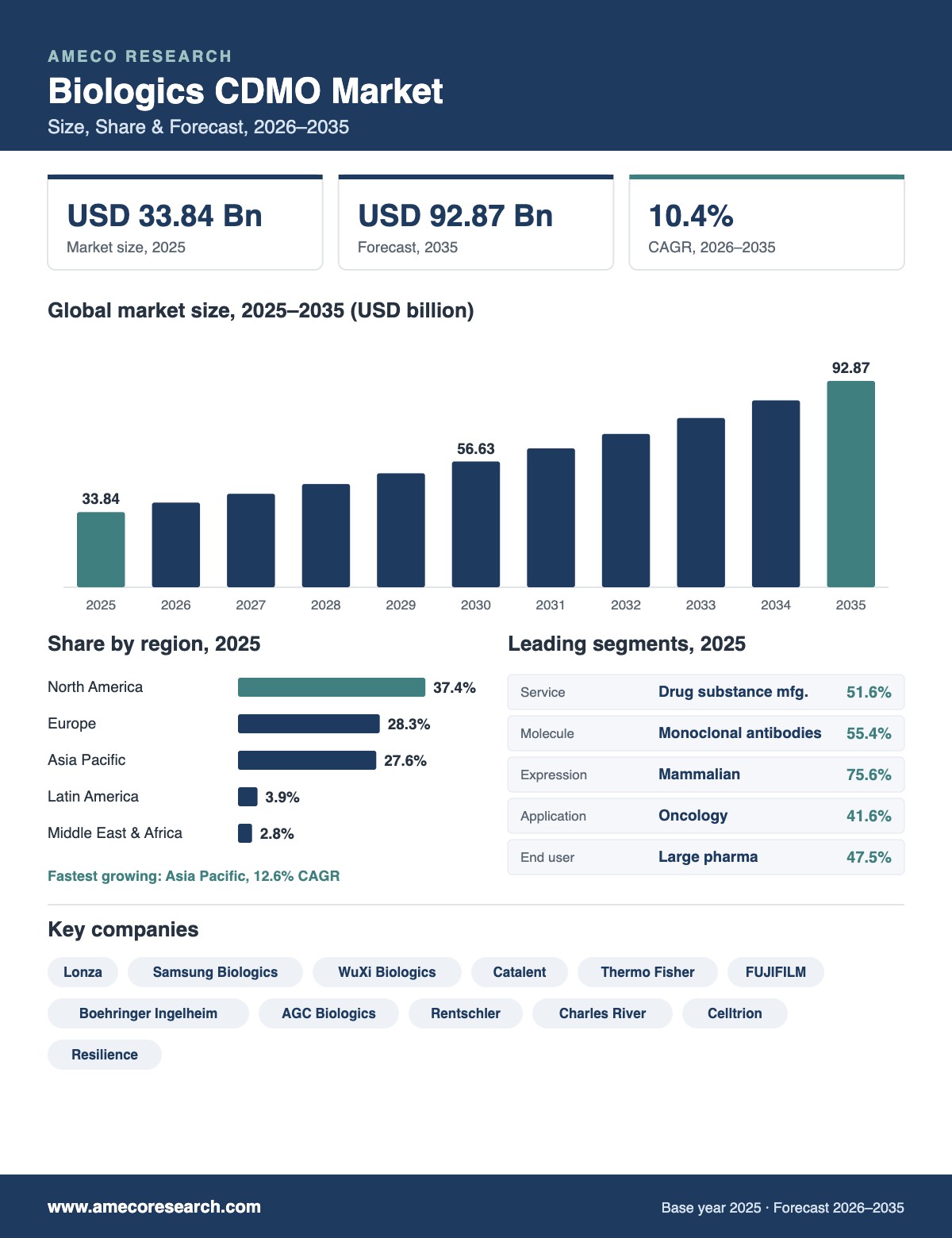 Infographic: Biologics CDMO Market Size, Share, Trends & Growth Opportunities Forecast to 2026 - 2035 | Ameco Research
Biologics CDMO Market Report Scope
| Report Attribute | Details |
| Biologics CDMO Market Size in 2025 | USD 33.84 Billion |
| Biologics CDMO Market Size in 2026 | USD 38.12 Billion |
| Biologics CDMO Market Forecast by 2035 | USD 92.87 Billion |
| Biologics CDMO Market CAGR (2026–2035) | 10.4% |
| Historical Data | 2021–2024 |
| Base Year | 2025 |
| Forecast Period | 2026–2035 |
| Largest Region | North America (37.4% share in 2025) |
| Fastest-Growing Region | Asia Pacific (12.6% CAGR) |
| Segments Covered | Service Type, Molecule Type, Expression System, Manufacturing Technology, Development Stage, Biologic Type, Therapeutic Application, End User and Region |
| Regional Scope | North America, Europe, Asia Pacific, Latin America, and Middle East & Africa |
| Key Companies Profiled | Lonza Group, Samsung Biologics, WuXi Biologics, Catalent (Novo Holdings), Thermo Fisher Scientific, FUJIFILM Biotechnologies, Boehringer Ingelheim BioXcellence, AGC Biologics, Rentschler Biopharma, Charles River Laboratories, Celltrion and National Resilience |
| Report Coverage | Market size and forecast, capacity analysis, trends, drivers, restraints, opportunities, regulatory landscape (incl. BIOSECURE Act), segment and regional analysis, competitive landscape, recent developments |
How Big Is the Biologics CDMO Market in 2026?
Ameco Research estimates the biologics CDMO market at USD 38.12 billion in 2026, up about 12.6% from USD 33.84 billion in 2025, as new plants from Samsung Biologics, FUJIFILM Biotechnologies and others come online. The market is expected to reach about USD 56.63 billion by 2030 and USD 92.87 billion by 2035.
| Year | Biologics CDMO Market Size (USD Billion) |
| 2025 | 33.84 |
| 2026 | 38.12 |
| 2028 | 46.46 |
| 2030 | 56.63 |
| 2032 | 69.02 |
| 2035 | 92.87 |
Latest Biologics CDMO Market Trends 2026
Record capacity build-out and consolidation
Leading CDMOs are adding capacity at a record pace. Samsung Biologics bought GSK’s 60,000-liter plant in Rockville, Maryland in March 2026, lifting its total capacity to about 845,000 liters, and is building Bio Campus II with 720,000 liters planned by 2032. In July 2026 it agreed to acquire PolyPeptide Group for about USD 1.8 billion to add peptide manufacturing.
Onshoring to the United States
Drug makers and CDMOs are investing in U.S. sites to secure supply and reduce trade risk. Examples include FUJIFILM’s Holly Springs, North Carolina plant with a USD 2 billion, 10-year Johnson & Johnson partnership, Resilience’s USD 750 million expansion with Eli Lilly in Ohio announced in July 2026, and Thermo Fisher’s new monoclonal antibody manufacturing in Massachusetts.
BIOSECURE Act reshapes sourcing
The BIOSECURE Act became U.S. law on December 18, 2025. In June 2026, the U.S. Department of War added WuXi AppTec to its Section 1260H list. Although prohibitions are not expected for some time and existing contracts are grandfathered, many sponsors are adding second sources in the U.S., Europe, South Korea, Japan and India.
ADCs and bispecifics need specialized capacity
Antibody-drug conjugates are the fastest-growing molecule segment, at about a 15.4% CAGR. They require high-potency containment and conjugation suites that few CDMOs offer, prompting investments such as BSP Pharmaceuticals’ ADC expansion in Italy and FUJIFILM’s future ADC capability in Toyama, Japan.
Single-use and continuous processing
Single-use bioreactors are becoming the default for new clinical and mid-scale plants. FUJIFILM’s £400 million Teesside expansion, opened in February 2026, added single-use capacity of up to 19,000 liters, while CDMOs are adopting perfusion, intensified and continuous processing to raise output.
Fill-finish becomes a bottleneck
Demand for prefilled syringes, autoinjectors and vials, driven by GLP-1 and antibody therapies, is outpacing aseptic fill-finish capacity. Lonza, Vetter, PCI Pharma Services and others announced large fill-finish investments in 2026.
Biologics CDMO Market Dynamics
Growth drivers
- Expanding biologics pipelines: antibodies, bispecifics, ADCs, biosimilars and gene therapies make up a growing share of drugs in development and new approvals.
- Outsourcing to save capital and time: CDMOs let companies avoid large plant investments and move faster from the lab to the clinic and market.
- Complex modalities: bispecifics, ADCs and fusion proteins need specialized technology and know-how that many developers lack in-house.
- Biosimilar wave: patent expiries on major antibodies are driving demand for cost-efficient, large-scale biosimilar manufacturing.
- Supply chain resilience: geopolitical risk and the BIOSECURE Act are pushing sponsors to add capacity in more locations.
Restraints and challenges
- High capital requirements: bioreactors, cleanrooms and purification systems require heavy upfront investment and long payback periods.
- Strict regulatory demands: GMP compliance, inspections and quality failures can delay programs and damage customer trust.
- Technology transfer and scale-up: moving processes between sites and scales is complex and can affect product quality.
- Talent shortages: skilled bioprocess engineers and quality staff are in short supply in many regions.
- Capacity cycles: large new plants may face underuse if demand shifts or programs fail in the clinic.
Opportunities
- Cell and gene therapy manufacturing, including viral vectors and cell processing.
- ADC and high-potency capacity for conjugation and containment.
- Advanced bioprocessing with single-use, continuous, perfusion and automated systems.
- Integrated end-to-end services from cell line development to commercial fill-finish.
- Asia Pacific and India as cost-competitive, fast-growing manufacturing hubs.
Biologics CDMO Market Segment Analysis
By service type: Why does drug substance manufacturing lead?
Drug substance contract manufacturing accounted for 51.6% of revenue in 2025, or about USD 17.46 billion, as large-scale cell culture and purification are the most capital-intensive steps to outsource. Drug product and fill-finish held 20.4%, while analytical, quality control and other services are the fastest-growing segment at about an 11.5% CAGR.
| Service Type | Share (2025) | Key Highlights |
| Drug Substance Manufacturing | 51.6% | Largest; upstream cell culture and downstream purification |
| Drug Product / Fill-Finish | 20.4% | Vials, prefilled syringes and autoinjectors; rising demand |
| Process Development | 13.3% | Scale-up, optimization and technology transfer |
| Analytical, QC & Other | 9.9% | Fastest-growing at 11.5% CAGR; release and stability testing |
| Cell Line Development | 4.8% | High-titer clone selection and banking |
By molecule type: How fast are ADCs growing?
Monoclonal antibodies, including bispecifics, held the largest share at 55.4% in 2025, or about USD 18.75 billion. Recombinant proteins and enzymes accounted for 12.3%. ADCs and bioconjugates, at 9.6%, are the fastest-growing molecules at about a 15.4% CAGR, driven by a surge in oncology pipelines and licensing deals.
| Molecule Type | Share (2025) | Key Highlights |
| Monoclonal Antibodies (incl. Bispecifics) | 55.4% | Largest; oncology and immunology blockbusters |
| Recombinant Proteins & Enzymes | 12.3% | Hormones, enzymes and fusion proteins |
| ADCs & Bioconjugates | 9.6% | Fastest-growing at 15.4% CAGR; high-potency capacity |
| Vaccines | 8.1% | Recombinant and conjugate vaccines |
| Cell & Gene Therapies | 7.8% | Viral vectors and cell processing |
| mRNA & Others | 6.8% | Nucleic acid and other novel modalities |
By expression system
Mammalian expression, mainly Chinese hamster ovary (CHO) cells, accounted for 75.6% of revenue in 2025. Microbial systems such as E. coli and yeast held 19.3%, while other systems, including insect, plant and cell-free platforms, are growing fastest at about a 12.4% CAGR.
| Expression System | Share (2025) | Key Highlights |
| Mammalian | 75.6% | Largest; CHO and HEK cell lines for antibodies |
| Microbial | 19.3% | E. coli and yeast for proteins, enzymes and fragments |
| Others (Insect, Plant, Cell-Free) | 5.1% | Fastest-growing at 12.4% CAGR |
By manufacturing technology
Stainless-steel systems accounted for 59.2% of revenue in 2025, reflecting large commercial antibody plants. Single-use systems held 40.8% and are expected to overtake stainless steel, reaching about 53.5% of revenue by 2035 as new multi-product facilities favor flexibility and faster changeovers.
| Manufacturing Technology | Share (2025) | Key Highlights |
| Stainless-Steel | 59.2% | Large-volume commercial production; share falls to 46.5% by 2035 |
| Single-Use | 40.8% | Faster-growing; 53.5% share by 2035 |
By development stage
Commercial manufacturing accounted for 61.5% of revenue in 2025 and is expected to grow at about a 10.9% CAGR, supported by long-term supply agreements. Clinical-stage work, from preclinical to Phase III, held 38.5%.
| Development Stage | Share (2025) | Key Highlights |
| Commercial | 61.5% | Long-term supply contracts; 10.9% CAGR |
| Clinical (Preclinical to Phase III) | 38.5% | Early development and clinical supply |
By biologic type
Innovator biologics accounted for 79.6% of revenue in 2025. Biosimilars, at 20.4%, are growing faster at about a 13.2% CAGR, as patents on major antibodies expire and developers seek cost-efficient commercial-scale capacity.
| Biologic Type | Share (2025) | Key Highlights |
| Innovator Biologics | 79.6% | Novel antibodies, ADCs and advanced therapies |
| Biosimilars | 20.4% | Faster-growing at 13.2% CAGR; patent expiries |
By therapeutic application
Oncology led with 41.6% of revenue in 2025, followed by immunology and inflammation at 22.4% and infectious diseases at 10.3%. Metabolic and endocrine disorders, at 9.2%, are the fastest-growing application at about a 13.1% CAGR, driven by obesity and diabetes biologics.
| Therapeutic Application | Share (2025) | Key Highlights |
| Oncology | 41.6% | Largest; antibodies, bispecifics and ADCs |
| Immunology & Inflammation | 22.4% | Autoimmune disease antibodies and biosimilars |
| Infectious Diseases | 10.3% | Vaccines and antiviral antibodies |
| Metabolic & Endocrine | 9.2% | Fastest-growing at 13.1% CAGR; obesity and diabetes |
| Neurology | 6.1% | Alzheimer’s and migraine antibodies |
| Hematology & Others | 10.4% | Rare diseases, hemophilia and others |
By end user
Large pharmaceutical companies accounted for 47.5% of demand in 2025. Small and emerging biotech companies, at 30.4%, are the fastest-growing customers at about an 11.8% CAGR, as most have no in-house manufacturing. Mid-size pharma held 15.6% and academic and government institutes 6.5%.
| End User | Share (2025) | Key Highlights |
| Large Pharmaceutical Companies | 47.5% | Capacity and flexibility for blockbusters |
| Small & Emerging Biotech | 30.4% | Fastest-growing at 11.8% CAGR; fully outsourced models |
| Mid-Size Pharma | 15.6% | Hybrid in-house and outsourced manufacturing |
| Academic & Government Institutes | 6.5% | Vaccines and early-stage programs |
Biologics CDMO Market Regional Analysis
| Region | Share (2025) | Outlook |
| North America | 37.4% | Largest; about USD 12.66 billion in 2025; onshoring investments |
| Europe | 28.3% | Switzerland, Germany, the U.K., Ireland and Italy hubs |
| Asia Pacific | 27.6% | Fastest-growing at 12.6% CAGR; South Korea, China, Japan, India |
| Latin America | 3.9% | Biosimilar and vaccine production in Brazil and Mexico |
| Middle East & Africa | 2.8% | Emerging biomanufacturing in Saudi Arabia, UAE and South Africa |
Why does North America dominate the biologics CDMO market?
North America accounted for about 37.4% of global revenue in 2025, or about USD 12.66 billion. The U.S. has the largest biotech pipeline, the deepest venture funding and the highest biologics spending in the world. Policy support for domestic manufacturing and the BIOSECURE Act are drawing new investment, including Samsung Biologics’ Rockville site, FUJIFILM’s Holly Springs plant and Resilience’s expansion with Eli Lilly.
What makes Asia Pacific the fastest-growing region?
Asia Pacific held about 27.6% of the market in 2025 and is forecast to grow at a 12.6% CAGR, reaching about a third of global revenue by 2035. South Korea is home to the world’s largest single biomanufacturing campus in Songdo, run by Samsung Biologics, along with Celltrion and SK bioscience. China remains a major base through WuXi Biologics, while Japan and India are expanding capacity through AGC Biologics’ Yokohama site, FUJIFILM’s Toyama plant and Indian CDMOs.
How is Europe positioned?
Europe represented about 28.3% of revenue in 2025. Lonza in Switzerland, Boehringer Ingelheim and Rentschler in Germany and FUJIFILM in the U.K. anchor a strong base of commercial capacity. Investments such as FUJIFILM’s £400 million Teesside expansion and Lonza’s fill-finish plant in Stein, Switzerland are adding capacity for antibodies and advanced therapies.
Biologics CDMO Market Segmentation
Biologics CDMO Market Leading Companies
The biologics CDMO market is moderately concentrated, with a handful of large players controlling most commercial-scale mammalian capacity and many specialists in clinical supply, microbial, ADC, viral vector and fill-finish services. Competition centers on capacity and speed, quality and regulatory track record, technology platforms, end-to-end service and geographic diversity.
Lonza Group · Samsung Biologics · WuXi Biologics · Catalent (Novo Holdings) · Thermo Fisher Scientific · FUJIFILM Biotechnologies · Boehringer Ingelheim BioXcellence · AGC Biologics · Rentschler Biopharma · Charles River Laboratories · Celltrion · National Resilience
Recent developments
- July 2026: Samsung Biologics agreed to acquire PolyPeptide Group for about USD 1.8 billion in an all-cash tender offer, expected to close by the end of 2026.
- July 2026: Resilience expanded its partnership with Eli Lilly with a USD 750 million investment in the Cincinnati region, with full operations expected in early 2027.
- July 2026: AGC Biologics signed a multiyear agreement covering five commercial programs at its planned Yokohama, Japan site.
- June 2026: The U.S. Department of War added WuXi AppTec to its Section 1260H list of Chinese military companies; the company has challenged the listing in court.
- March 2026: Samsung Biologics completed its acquisition of GSK’s Rockville, Maryland facility, adding 60,000 liters of drug substance capacity and bringing its total to about 845,000 liters.
- February 2026: FUJIFILM Biotechnologies opened its £400 million expansion in Teesside, U.K., adding single-use bioreactor capacity of up to 19,000 liters.
- December 2025: The BIOSECURE Act was signed into U.S. law as part of the FY2026 National Defense Authorization Act.
Biologics CDMO Market: Frequently Asked Questions
How big is the biologics CDMO market?
The global biologics CDMO market was valued at USD 33.84 billion in 2025 and is estimated at USD 38.12 billion in 2026. Ameco Research projects it to reach USD 92.87 billion by 2035, growing at a CAGR of 10.4% from 2026 to 2035.
What is a biologics CDMO?
A biologics CDMO (contract development and manufacturing organization) develops and manufactures biologic drugs, such as monoclonal antibodies, recombinant proteins, vaccines, antibody-drug conjugates and cell and gene therapies, on behalf of pharmaceutical and biotech companies. Services cover cell line development, process development, drug substance manufacturing, fill-finish and analytical testing.
What is the growth rate of the biologics CDMO market?
The market is expected to grow at a CAGR of 10.4% from 2026 to 2035, driven by growing biologics pipelines, more outsourcing by large pharma and biotech companies, demand for complex modalities such as bispecifics and ADCs, and new manufacturing capacity in the U.S. and Asia Pacific.
Who are the largest biologics CDMOs?
The largest biologics CDMOs include Lonza, Samsung Biologics, WuXi Biologics, FUJIFILM Biotechnologies, Thermo Fisher Scientific, Catalent, Boehringer Ingelheim BioXcellence and AGC Biologics. Samsung Biologics reached about 845,000 liters of total capacity after buying a U.S. plant in Rockville, Maryland in 2026.
Which service segment leads the biologics CDMO market?
Drug substance contract manufacturing is the largest service segment, with about 51.6% of revenue in 2025. Analytical, quality control and other testing services are the fastest-growing segment, at about an 11.5% CAGR.
How does the BIOSECURE Act affect biologics CDMOs?
The BIOSECURE Act was signed into U.S. law on December 18, 2025, as part of the FY2026 National Defense Authorization Act. It bars federal agencies, and companies using federal contracts or grants, from using biotechnology services from designated biotechnology companies of concern, with a grandfathering period for existing contracts. It is encouraging many drug developers to diversify their CDMO supply chains toward the U.S., Europe, South Korea, Japan and India.
Which region leads the biologics CDMO market?
North America leads with about 37.4% of revenue in 2025, supported by its large biotech base and new onshoring investments. Asia Pacific is the fastest-growing region at about a 12.6% CAGR, led by South Korea, China, Japan and India.
Why are single-use bioreactors growing in biologics manufacturing?
Single-use systems lower upfront capital costs, reduce cleaning and changeover time, cut cross-contamination risk and suit multi-product and clinical-scale facilities. Their share of biologics CDMO revenue is expected to rise from about 40.8% in 2025 to about 53.5% by 2035.
Related Pharma & Healthcare Market Reports
- Bepirovirsen (Hibsago) Market Size, Share, Trends & Growth Opportunities Forecast to 2026 - 2035
- Pharmacy Management System Market Size, Share, Trends & Growth Opportunities Forecast to 2026 - 2035
- Precision Medicine Market Growth Opportunities and Forecast till 2026 - 2035
- Healthcare Staffing Market Growth Opportunities and Forecast till 2032
- Telehealth Market Growth Opportunities and Forecast till 2032