Press Release
Leak Detection and Repair (LDAR) Market to Reach USD 35.6 Billion by 2035, Growing at 5.6% CAGR | Ameco Research
Date : Nov 26, 2026
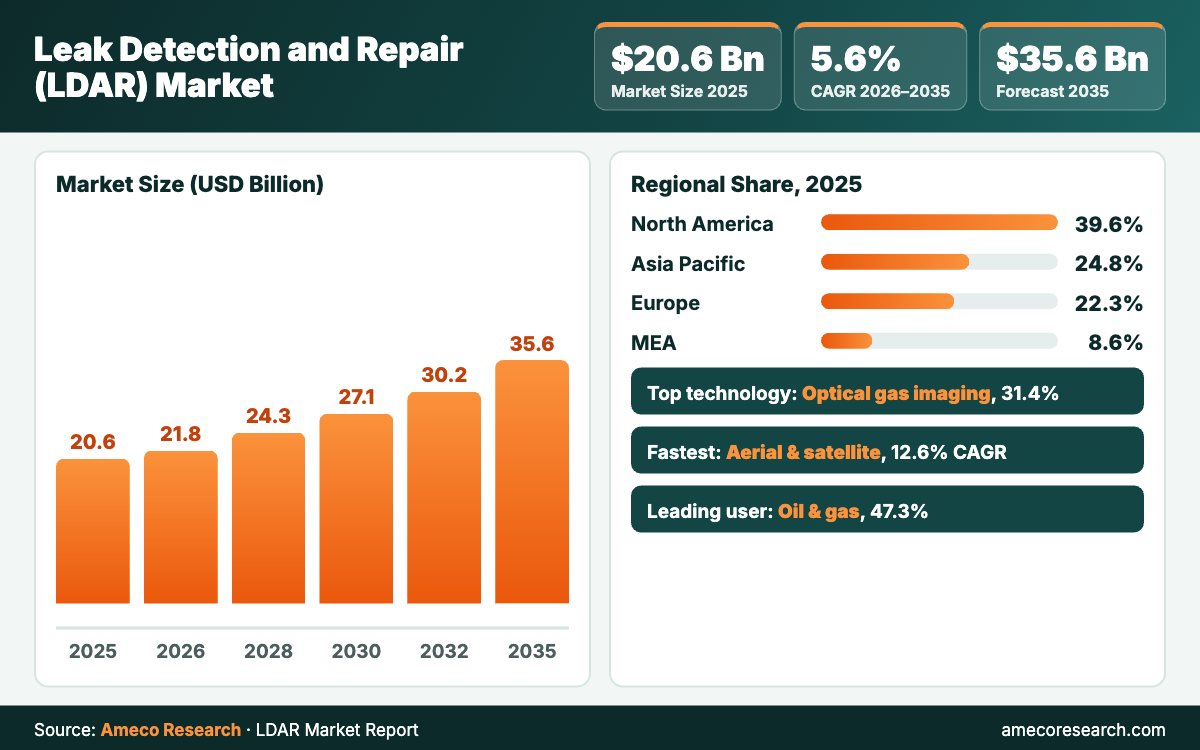
Pune, India, November 26, 2026 — The global leak detection and repair (LDAR) market is projected to grow from USD 20.6 billion in 2025 to USD 35.6 billion by 2035, at a CAGR of 5.6% from 2026 to 2035, according to the new Leak Detection and Repair (LDAR) Market report from Ameco Research. The market is estimated at USD 21.8 billion in 2026, as methane regulations, corporate emissions targets, and ageing pipeline and plant infrastructure drive demand for optical gas imaging, continuous monitoring, and aerial and satellite leak detection.
Leak detection and repair refers to the equipment, software, and services used to find and fix leaks of methane, volatile organic compounds (VOCs), hazardous gases, and liquids from valves, pumps, compressors, flanges, tanks, and pipelines. A typical LDAR programme combines regular surveys with optical gas imaging (OGI) cameras or handheld analysers, repair of leaking components within set deadlines, and detailed recordkeeping for regulators. Because methane is a potent greenhouse gas responsible for a large share of near-term warming, LDAR has become a central tool for climate action — while also cutting product losses, improving safety, and protecting nearby communities.
LDAR Market Size and Forecast
Ameco Research estimates the LDAR market at USD 21.8 billion in 2026, up about 6% from 2025. Growth continues even as regulators adjust timelines, because operators are investing in methane programmes to meet existing rules, voluntary commitments such as OGMP 2.0, buyer requirements for low-methane gas, and safety needs. The market is expected to reach about USD 27.1 billion by 2030 and USD 35.6 billion by 2035.
| Year | LDAR Market Size (USD Billion) |
|---|---|
| 2025 | 20.6 |
| 2026 | 21.8 |
| 2027 | 23.0 |
| 2028 | 24.3 |
| 2030 | 27.1 |
| 2032 | 30.2 |
| 2035 | 35.6 |
Key Takeaways
- Market size: USD 20.6 billion in 2025, about USD 21.8 billion in 2026, and USD 35.6 billion by 2035.
- Growth rate: 5.6% CAGR from 2026 to 2035.
- Leading region: North America, with about 39.6% of 2025 revenue.
- Fastest-growing region: Asia Pacific, at a 6.9% CAGR.
- Leading component: Hardware, at 61.2%; software is growing fastest at 8.9% CAGR.
- Leading technology: Optical gas imaging, at 31.4%; aerial and satellite monitoring is growing fastest at 12.6% CAGR.
- Leading end user: Oil and gas, at 47.3%.
What Is Driving the LDAR Market?
Methane and VOC regulations
U.S., Canadian, EU, and Chinese rules require periodic leak surveys, repair deadlines, and reporting. Refinery and chemical plant rules have required LDAR for decades, and newer oil and gas methane standards have extended these obligations across well sites, compressor stations, and processing plants.
Corporate climate commitments
The Oil and Gas Methane Partnership (OGMP 2.0), the Oil and Gas Decarbonization Charter, and buyer demand for certified low-methane gas are pushing operators beyond minimum compliance toward measurement-based emissions programmes.
Product recovery, safety, and ageing assets
Fixing leaks saves valuable gas and product and reduces fire, explosion, and toxic exposure risks. Older pipelines, refineries, and water networks need more frequent inspection, while new LNG export and import terminals require strict leak control across complex equipment.
Key LDAR Market Trends in 2026
- U.S. methane rules revised, not removed: On October 29, 2026, the EPA proposed a second set of revisions to its 2024 oil and gas methane standards (OOOOb/OOOOc), including quarterly audio, visual, and olfactory inspections for marginal well sites and optional OGI surveys at gas plants. The 2024 rule’s LDAR obligations remain in effect until the proposal is finalised.
- Aerial screening wins approval: In November 2026, the EPA approved GHGSat’s DATA.AIR Gen2 aircraft-based spectrometer for periodic screening under OOOOb, with a 10 kg/h detection threshold.
- Continuous monitoring: Operators are installing fixed laser, point, and camera sensors that monitor sites around the clock, using AI analytics to detect, locate, and quantify leaks faster.
- EU timeline shifts, obligations remain: In November 2026, EU institutions agreed to delay monitoring, reporting, and verification requirements for imported oil, gas, and coal to 2029, while LDAR survey obligations for EU operators continue.
- Drones, robots, and satellites: Drone-mounted OGI and laser sensors and a growing fleet of methane satellites are lowering survey costs; Germany’s AIRMO raised EUR 5 million in March 2026 for a methane satellite planned for 2027.
- Utilities adopt LDAR methods: Southern Company Gas began piloting aerial LiDAR methane detection in November 2026, and water utilities are using acoustic and satellite methods to cut non-revenue water.
Challenges
Changes to U.S. methane rules and delays in EU requirements create regulatory uncertainty that can slow investment. OGI cameras, trained technicians, and frequent surveys are expensive for smaller operators, and certified OGI operators are in short supply. Combining results from cameras, sensors, aircraft, and satellites into one compliance system is complex, and remote technologies may miss small leaks, requiring follow-up ground surveys.
From Periodic Surveys to Continuous Monitoring
Traditional LDAR relies on technicians visiting each site every few months with a handheld analyser or OGI camera, checking thousands of components one by one. Leaks that start just after a survey can continue undetected until the next visit. The new generation of LDAR changes this model in layers: satellites and aircraft screen wide areas for large emitters, drones and vehicle-mounted sensors survey sites quickly, and fixed sensors watch high-risk equipment around the clock.
Software ties these layers together, turning raw detections into prioritised work orders, tracking repairs against regulatory deadlines, and producing measurement-based emissions reports. This shift explains why software and aerial monitoring are the fastest-growing parts of a market that has long been dominated by handheld hardware and manual surveys.
Segment Analysis
| Technology | Share, 2025 | Key Highlights |
|---|---|---|
| Optical gas imaging (OGI) | 31.4% | Largest; standard for fugitive emissions surveys |
| Handheld analysers (Method 21) | 22.6% | Refineries, chemical and gas plants |
| Acoustic & ultrasonic | 14.8% | Compressed gas, steam, water leaks |
| Laser-based (TDLAS, LiDAR) | 13.2% | Remote and open-path methane detection |
| Aerial & satellite monitoring | 9.7% | Fastest growing at 12.6% CAGR |
| Fibre-optic & others | 8.3% | Pipeline distributed sensing |
By component, hardware held 61.2% (about USD 12.6 billion), services 27.4%, and software 11.4%. By platform, handheld and portable devices accounted for 52.4%, fixed and continuous monitoring systems 29.1%, and aerial platforms 18.5%, the fastest-growing platform as regulators approve alternative test methods.
| End User | Share, 2025 | Key Highlights |
|---|---|---|
| Oil & gas | 47.3% | Upstream, midstream, and downstream |
| Chemicals & petrochemicals | 17.8% | VOC and hazardous air pollutant control |
| Water & wastewater | 12.6% | Non-revenue water reduction |
| Power generation | 8.4% | Gas turbines, steam, hydrogen systems |
| Mining | 4.2% | Coal mine methane, slurry pipelines |
| Others | 9.7% | Commercial, pharma, food processing |
Regional Outlook
| Region | Share, 2025 | Outlook |
|---|---|---|
| North America | 39.6% | Largest; EPA, state, and Canadian rules |
| Asia Pacific | 24.8% | Fastest growing at 6.9% CAGR |
| Europe | 22.3% | EU Methane Regulation |
| Middle East & Africa | 8.6% | National oil company methane programmes |
| Latin America | 4.7% | Brazil, Mexico, Argentina oil and gas |
The U.S. has the most established LDAR requirements, with state programmes in Colorado, New Mexico, California, and Pennsylvania, and Canada adds federal and provincial methane rules. In Asia Pacific, China’s methane action plan and VOC controls, new refining and LNG capacity in China, India, and Southeast Asia, and Australia’s methane reporting rules are driving adoption.
Competitive Landscape
The market includes instrument makers, industrial automation companies, aerial and satellite specialists, and LDAR service providers. Teledyne FLIR and Opgal lead in OGI cameras; Honeywell, Emerson, ABB, Siemens, Schneider Electric, and Baker Hughes supply gas detection and monitoring systems; Bridger Photonics, GHGSat, and Kairos Aerospace offer aerial and satellite methane detection; Project Canary and Qube Technologies provide continuous monitoring; and Montrose Environmental, Team Inc., and Heath Consultants deliver LDAR surveys and compliance services. SENSIT Technologies and Percepto are also profiled. For company benchmarking, make an inquiry with Ameco Research.
Opportunities Ahead
- Continuous monitoring networks at well pads, compressor stations, and plants.
- AI-based leak quantification and automated work-order management.
- Satellite and aerial screening services as approved alternative test methods.
- Emerging markets in the Middle East, Asia, and Latin America adopting methane rules.
For related coverage, see Ameco Research’s Chemical Sensors Market, Petrochemicals Market, Residual Gas Analyzers Market, and Biogas Market reports.
Report Scope
| Attribute | Details |
|---|---|
| Market size (2025 / 2026) | USD 20.6 billion / USD 21.8 billion |
| Market size (2035) | USD 35.6 billion |
| CAGR (2026–2035) | 5.6% |
| Historical data / base year | 2021–2024 / 2025 |
| Segments covered | Component, technology, platform, end user, region |
| Regions covered | North America, Europe, Asia Pacific, Latin America, Middle East & Africa |
Who Should Read This Report
- Oil and gas, chemical, and utility operators managing emissions compliance.
- LDAR equipment makers, service providers, and software vendors.
- Aerial, drone, and satellite monitoring companies.
- Investors and policymakers tracking methane reduction.
The full report covers methane and VOC regulations, LDAR technology comparisons, alternative test methods, service pricing, and company profiles. To access it, buy the report.
Frequently Asked Questions
How big is the leak detection and repair market?
The LDAR market was USD 20.6 billion in 2025, is estimated at USD 21.8 billion in 2026, and is projected to reach USD 35.6 billion by 2035, according to Ameco Research.
What is the growth rate of the LDAR market?
The market is forecast to grow at a CAGR of 5.6% from 2026 to 2035.
What is leak detection and repair (LDAR)?
LDAR is a work practice in which facilities regularly inspect equipment for leaks of methane, VOCs, and other gases or liquids, repair leaks within set deadlines, and keep records for regulators.
Which technology is used most for LDAR?
Optical gas imaging (OGI) is the leading technology with a 31.4% share, while aerial and satellite monitoring is growing fastest.
Who are the leading LDAR companies?
Key players include Teledyne FLIR, Honeywell, Emerson, ABB, Baker Hughes, GHGSat, Bridger Photonics, and Montrose Environmental Group.
Conclusion
Leak detection and repair is evolving from manual compliance surveys into data-driven emissions management. With a 5.6% CAGR and a forecast value of USD 35.6 billion by 2035, the market will be shaped by methane regulation, voluntary commitments, continuous and aerial monitoring, and software that connects detection to repair.
Explore the complete Leak Detection and Repair (LDAR) Market report for detailed forecasts and competitive analysis.
About Ameco Research
Ameco Research is a market research and consulting firm that provides syndicated reports, custom research, and strategic advisory services across technology, healthcare, energy, automotive, chemicals, and consumer markets. Its analysts combine primary interviews with secondary research to help clients identify growth opportunities and make confident decisions.
Contact Us
Ameco Research
201, Vaidehi-Saaket, Baner - Pashan Link Rd, Pashan, Pune 411021
Phone: +91 898 322 5533
Email: [email protected]
Website: www.amecoresearch.com