Press Release
RF Components Market to Reach USD 134.2 Billion by 2035, Growing at 11.5% CAGR | Ameco Research
Date : Nov 13, 2026
Pune, India, November 13, 2026 — The global radio frequency (RF) components market was valued at USD 45.2 billion in 2025 and is projected to reach USD 134.2 billion by 2035, growing at a CAGR of 11.5% from 2026 to 2035, according to the updated Radio Frequency (RF) Components Market report from Ameco Research. 5G-Advanced networks, Wi-Fi 7, satellite-to-phone links, connected vehicles, and defence radar are expected to roughly triple market revenue over the next decade.
RF components are the electronic parts that transmit, receive, filter, amplify, and switch radio signals in wireless devices and systems. They include antenna switches, demodulators, duplexers, SAW and BAW filters, power amplifiers, and low-noise amplifiers, often combined into compact front-end modules. These parts are made from gallium arsenide, indium phosphide, gallium nitride, and silicon, and they sit inside smartphones, tablets, notebooks, smart TVs, set-top boxes, vehicles, base stations, satellites, and military systems. Every new wireless standard adds frequency bands and complexity, which steadily increases the value of RF content in each device.
RF Components Market Size and Forecast
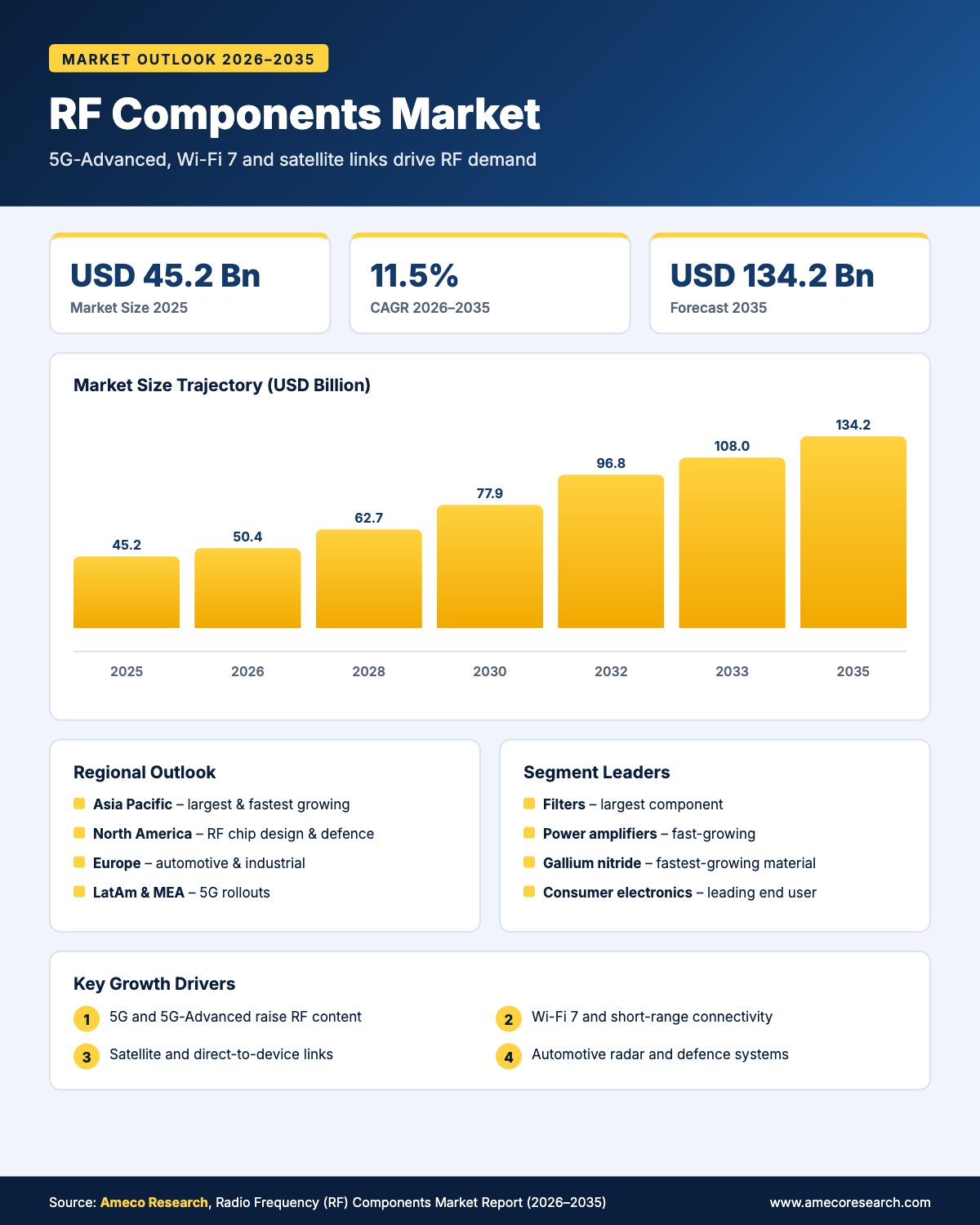
Ameco Research estimates the market grew from USD 36.4 billion in 2023 to USD 45.2 billion in the 2025 base year. Revenue is expected to reach USD 50.4 billion in 2026, about USD 77.9 billion by 2030, cross USD 100 billion in 2033, and climb to USD 134.2 billion by 2035 — about three times its 2025 size.
| Year | Market Size (USD Billion) |
|---|---|
| 2023 (historical) | 36.4 |
| 2024 (historical) | 40.5 |
| 2025 (base year) | 45.2 |
| 2026 | 50.4 |
| 2028 | 62.7 |
| 2030 | 77.9 |
| 2032 | 96.8 |
| 2033 | 108.0 |
| 2035 | 134.2 |
Key Takeaways
- Market size: USD 45.2 billion in 2025, forecast to reach USD 134.2 billion by 2035.
- Growth rate: 11.5% CAGR from 2026 to 2035.
- Largest and fastest-growing region: Asia Pacific, led by China, South Korea, Japan, and Taiwan, with fast growth in India.
- Leading component: Filters, as 5G phones need many more filters for additional frequency bands.
- Fastest-growing material: Gallium nitride (GaN), used in base stations, defence radar, and satellite systems.
- Leading end user: Consumer electronics, led by smartphones; automotive is growing quickly.
What Is Driving the RF Components Market?
5G and 5G-Advanced raise RF content per device
Each generation of mobile technology adds frequency bands, carrier aggregation combinations, and MIMO antenna paths. A 5G smartphone needs many more filters, switches, and amplifiers than a 4G phone, and 5G-Advanced extends that trend. Network operators are also deploying massive-MIMO radios that use large numbers of RF chains per base station.
Wi-Fi 7 and short-range connectivity
Wi-Fi 7 routers and devices operate across the 2.4, 5, and 6 GHz bands with wider channels, requiring higher-frequency front ends. Bluetooth, ultra-wideband, and GNSS add further RF content to phones, wearables, and smart home products.
Satellite and direct-to-device connectivity
Satellite broadband terminals and phone-to-satellite messaging need new RF components and phased-array antennas. As low-Earth-orbit constellations expand and smartphones add satellite links, this is becoming a meaningful new source of demand.
Connected cars and automotive radar
Connected vehicles use cellular V2X, Wi-Fi, and GNSS, while advanced driver assistance systems rely on radar operating at higher frequencies. Rising electronic content per vehicle makes automotive one of the fastest-growing end users.
Defence radar and electronic warfare
Higher defence budgets are funding new radar, electronic warfare, and secure communications systems, many built on high-power GaN amplifiers.
Key RF Components Market Trends in 2026
- Industry consolidation: Skyworks Solutions and Qorvo, announced in October 2025 as a combination valued at about USD 22 billion, received all regulatory clearances in September 2026, creating a larger U.S.-based RF and analog supplier.
- GaN power amplifiers: Gallium nitride delivers higher power and efficiency for base stations, radar, and satellite links.
- Module integration: Suppliers combine filters, switches, and amplifiers into compact front-end modules to save board space and simplify phone design.
- Advanced filters: BAW and high-performance SAW filters are needed for crowded spectrum and higher-frequency bands.
- Early 6G research: Work on upper-mid-band and sub-terahertz frequencies is setting the direction for next-generation RF front ends.
Challenges
RF design is becoming more complex as band counts rise and spectrum is fragmented across countries. The market depends heavily on smartphone cycles, and handset makers exert strong price pressure on component suppliers. Compound semiconductor materials such as gallium arsenide and gallium nitride are costly, and export controls and trade restrictions affect supply chains and market access, particularly between the U.S. and China. Some large customers are also bringing RF design in-house, which can shift share between suppliers.
Inside a Smartphone RF Front End
The RF front end is the part of a phone that sits between the antenna and the modem. When the phone transmits, a power amplifier boosts the signal, filters remove unwanted frequencies, and antenna switches route it to the right antenna. When the phone receives, low-noise amplifiers strengthen weak incoming signals, filters and duplexers separate the bands, and the signal passes to the transceiver for demodulation.
A premium 5G smartphone may support dozens of frequency bands and many carrier aggregation combinations, so it needs a large number of filters and multiple power amplifiers, switches, and tuners. To fit all of this into a slim device, suppliers package these parts into integrated modules that combine several functions in one footprint. This integration is one reason RF value per phone keeps rising even when smartphone unit sales are flat.
The same building blocks appear in base stations, Wi-Fi routers, vehicles, and satellite terminals, but at different power levels and frequencies. That is why gallium nitride is gaining ground in high-power infrastructure and defence systems, while gallium arsenide and silicon remain dominant in handsets.
Segment Analysis
By component, the market covers antenna switches, demodulators, duplexers, filters, power amplifiers, and others. Filters hold the largest share because of the band count of 5G phones, while power amplifiers are a large and fast-growing segment. By module, integrated multi-function modules — such as duplexer and PA modules and multi-duplexer modules — are gaining share as phones demand smaller front ends.
By material, gallium arsenide is widely used in phone power amplifiers, silicon in switches and integrated parts, and gallium nitride is growing fastest in base stations and defence. By application and end user, cellular phones and consumer electronics lead, while automotive grows quickly.
| Segment | Categories Covered | Leader / Fastest Growth |
|---|---|---|
| Component | Antenna switches, demodulators, duplexers, filters, power amplifiers, others | Filters lead; PAs grow fast |
| Module | Antenna switch, duplexer + PA, multi-duplexer, RX + duplexer, TX, RX | Integrated modules gain share |
| Material | Gallium arsenide, indium phosphide, gallium nitride, silicon | GaN grows fastest |
| Application | Cellular phones, tablets & notebooks, smart TVs, set-top boxes | Cellular phones lead |
| End user | Consumer electronics, automotive, wireless communication, military | Consumer electronics lead |
Regional Outlook
| Region | Position | Highlights |
|---|---|---|
| Asia Pacific | Largest and fastest growing | Smartphone and electronics hub; rising demand in India |
| North America | Major market | Leading RF chip designers, 5G spending, defence programmes |
| Europe | Significant market | Automotive, industrial, and defence demand |
| Latin America | Growing market | 5G rollouts and smartphone adoption |
| Middle East & Africa | Growing market | 5G networks and smartphone growth |
Competitive Landscape
The market includes RF chip designers, filter and module makers, and compound semiconductor manufacturers. Key companies profiled include Qualcomm, Broadcom, Murata Manufacturing, Skyworks Solutions, Qorvo, NXP Semiconductors, Texas Instruments, Renesas Electronics, Mitsubishi Electric, Toshiba, Rohm, and Fujitsu. Companies compete on performance, integration, power efficiency, band coverage, design wins with major handset makers, and manufacturing scale. For supplier benchmarking or share analysis, make an inquiry with Ameco Research.
Opportunities Ahead
- 5G-Advanced and 6G front-end modules.
- Satellite and non-terrestrial network terminals.
- GaN amplifiers and advanced BAW filters.
- Automotive radar, V2X, private 5G, and industrial IoT.
For related coverage, see Ameco Research’s Radio Frequency Semiconductor Market, 5G Services Market, Wireless Connectivity Technology Market, and Automotive Smart Antenna Market reports.
Report Scope
| Attribute | Details |
|---|---|
| Market size (2025) | USD 45.2 billion |
| Market size (2035) | USD 134.2 billion |
| CAGR (2026–2035) | 11.5% |
| Analysis period / base year | 2023–2035 / 2025 |
| Segments covered | Component, module, material, application, end user, region |
| Regions covered | North America, Europe, Asia Pacific, Latin America, Middle East & Africa |
Who Should Read This Report
- RF chip, filter, and module makers planning product roadmaps.
- Smartphone, network equipment, and automotive OEMs managing RF sourcing.
- Compound semiconductor foundries and materials suppliers.
- Investors tracking 5G, satellite, and defence electronics.
The full report includes year-by-year forecasts, detailed segment and country analysis, and company profiles. To access the complete study, buy the report.
Frequently Asked Questions
How big is the RF components market?
The global RF components market was valued at USD 45.2 billion in 2025 and is projected to reach USD 134.2 billion by 2035, according to Ameco Research.
What is the growth rate of the RF components market?
The market is forecast to grow at a CAGR of 11.5% from 2026 to 2035.
Which RF component has the largest share?
Filters hold the largest share, because 5G phones need many more filters to handle additional frequency bands.
Which region leads the RF components market?
Asia Pacific is both the largest and the fastest-growing region, led by China, South Korea, Japan, and Taiwan.
Who are the top RF component companies?
Key players include Qualcomm, Broadcom, Murata Manufacturing, Skyworks Solutions, Qorvo, NXP Semiconductors, and Texas Instruments.
Conclusion
With a CAGR of 11.5% and a forecast value of USD 134.2 billion by 2035, the RF components market is set to triple over the next decade. 5G-Advanced, Wi-Fi 7, satellite connectivity, automotive radar, and the shift to GaN and integrated modules will define the winners, while consolidation reshapes the supplier landscape.
Explore the complete Radio Frequency (RF) Components Market report for detailed forecasts and competitive analysis.
About Ameco Research
Ameco Research is a market research and consulting firm that provides syndicated reports, custom research, and strategic advisory services across technology, healthcare, energy, automotive, chemicals, and consumer markets. Its analysts combine primary interviews with secondary research to help clients identify growth opportunities and make confident decisions.
Contact Us
Ameco Research
201, Vaidehi-Saaket, Baner - Pashan Link Rd, Pashan, Pune 411021
Phone: +91 898 322 5533
Email: [email protected]
Website: www.amecoresearch.com