Activated Carbon Powders Market Size and Growth Opportunities and Forecast till 2026 - 2035
Activated Carbon Powders Market Size, Share & Trends Report, 2026–2035
LAST UPDATED: OCTOBER 2026
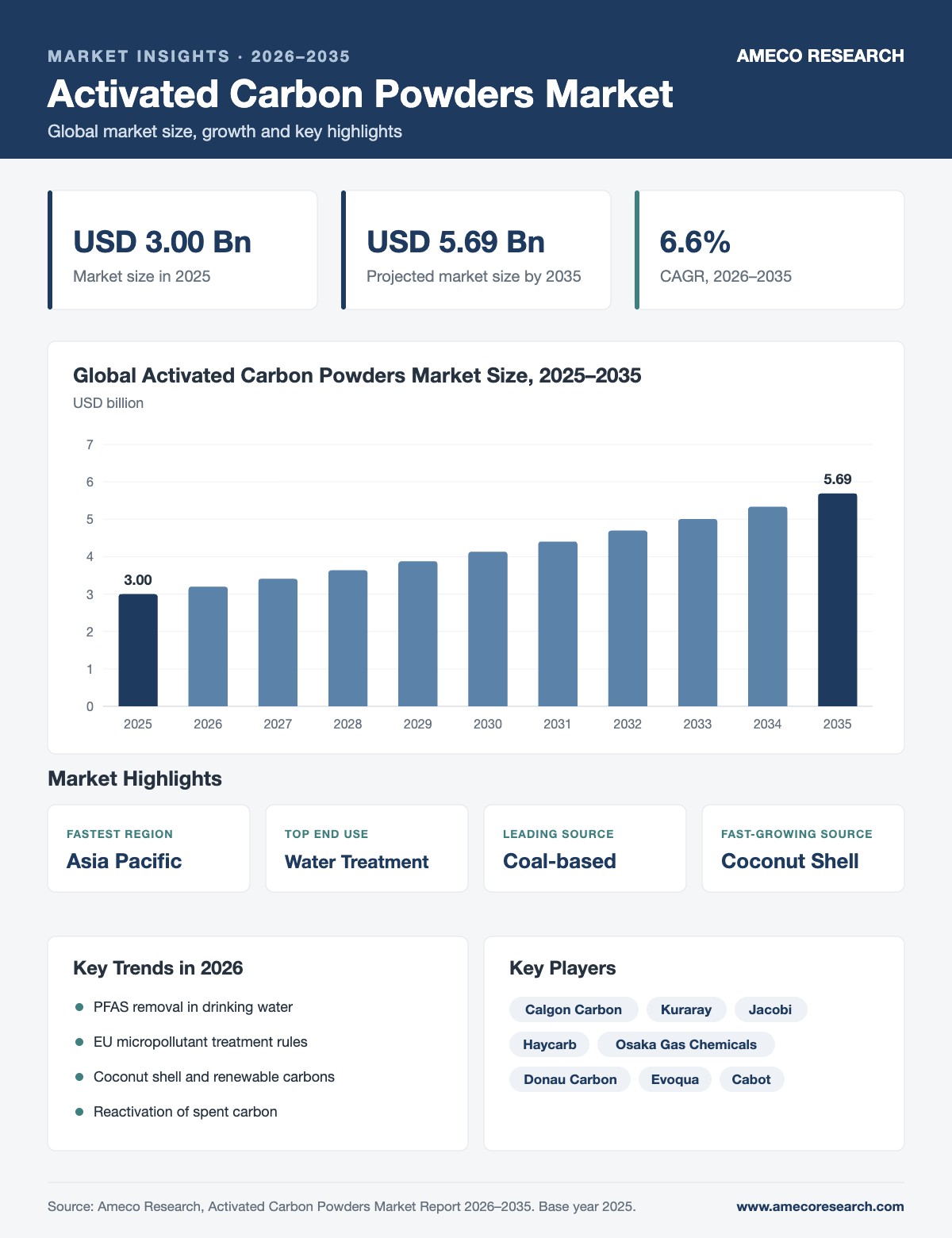
The global Activated Carbon Powders Market size was valued at USD 3.00 billion in 2025 and is projected to reach USD 5.69 billion by 2035, growing at a CAGR of 6.6% from 2026 to 2035. Growth is driven by PFAS and micropollutant removal in drinking water, stricter wastewater and air emission rules, rising use in food, beverage and pharmaceutical purification, and growing demand for sustainable coconut shell and wood-based carbons.
Activated carbon powders are highly porous forms of carbon, made by activating coal, coconut shells, wood and other raw materials, that trap contaminants on their very large internal surface area. Powdered activated carbon (PAC) is dosed directly into water or liquids and then removed, while granular activated carbon (GAC) is used in fixed filter beds. They are used for decolorization, deodorization, adsorption of chemicals and as catalyst supports in water treatment, food and beverage processing, pharmaceuticals, automotive emission control and air purification.
Activated Carbon Powders Market Key Takeaways
Activated Carbon Powders Market Report Scope
| Report Attribute | Details |
| Activated Carbon Powders Market Size in 2025 | USD 3.00 Billion |
| Activated Carbon Powders Market Forecast by 2035 | USD 5.69 Billion |
| Activated Carbon Powders Market CAGR (2026–2035) | 6.6% |
| Analysis Period | 2023–2035 |
| Base Year | 2025 |
| Forecast Period | 2026–2035 |
| Segments Covered | by Raw Material Type, by Type, by Application, by End-Use, and By Region |
| Regional Scope | North America, Europe, Asia Pacific, Latin America, and Middle East & Africa |
| Key Companies Profiled | Calgon Carbon Corporation, Cabot Corporation, Evoqua Water Technologies, Donau Carbon GmbH, Ingeos GmbH & Co. KG, Kuraray Co. Ltd., Osaka Gas Chemicals Co. Ltd., Haycarb PLC, Jacobi Carbons AB, and Silcarbon Aktivkohle GmbH |
| Report Coverage | Market Trends, Drivers, Restraints, Opportunities, Competitive Analysis, Player Profiling, Regulation Analysis |
Activated Carbon Powders Market Size Forecast, 2023–2035
The table below shows the year-by-year size of the global activated carbon powders market. Revenue is expected to grow about 1.9 times between 2025 and 2035, reaching roughly USD 4.13 billion by 2030.
| Year | Market Size (USD Billion) |
| 2023 (historical) | 2.64 |
| 2024 (historical) | 2.81 |
| 2025 (base year) | 3.00 |
| 2026 (forecast) | 3.20 |
| 2027 (forecast) | 3.41 |
| 2028 (forecast) | 3.64 |
| 2029 (forecast) | 3.88 |
| 2030 (forecast) | 4.13 |
| 2031 (forecast) | 4.40 |
| 2032 (forecast) | 4.70 |
| 2033 (forecast) | 5.01 |
| 2034 (forecast) | 5.34 |
| 2035 (forecast) | 5.69 |
Latest Activated Carbon Powders Market Trends (2026)
PFAS removal in drinking water
US federal limits for PFOA and PFOS in drinking water and similar rules in other countries are pushing utilities to install granular and powdered activated carbon treatment, one of the most proven technologies for removing PFAS.
Micropollutant treatment in Europe
The revised EU Urban Wastewater Treatment Directive requires extra treatment to remove micropollutants such as pharmaceutical residues at larger plants, creating long-term demand for powdered activated carbon dosing.
Shift to coconut shell and renewable carbons
Coconut shell-based carbon offers high micropore volume and hardness, and buyers increasingly prefer renewable raw materials. Supply from India, Sri Lanka, the Philippines and Indonesia is expanding.
Reactivation and circularity
Thermal reactivation of spent carbon cuts cost and carbon footprint, and more utilities and industrial users are adopting reactivation services.
Pharmaceutical and food purification
Powdered activated carbon is widely used to decolorize and purify sugar, sweeteners, edible oils, beverages and active pharmaceutical ingredients, with steady growth in emerging markets.
Air and emission control
Activated carbon is used for mercury capture at power and industrial plants, VOC control, automotive fuel vapor canisters and indoor air purifiers.
Activated Carbon Powders Market Dynamics
Growth drivers
- Stricter drinking water and wastewater regulations, including PFAS limits
- Rising industrial water reuse and treatment needs
- Growing food, beverage and pharmaceutical processing
- Air emission control and indoor air quality concerns
- Urbanization and water infrastructure investment in emerging markets
Restraints and challenges
- Volatile raw material supply, especially coconut shells
- Energy-intensive activation and reactivation
- Competition from membranes, ion exchange and other treatment technologies
- Changes in regulatory timelines and enforcement
Opportunities
Key opportunities include PFAS and micropollutant treatment, reactivation services, high-purity coconut shell carbons for pharma and food, impregnated carbons for gas purification, and new water and wastewater projects in Asia Pacific, the Middle East and Latin America.
Activated Carbon Powders Market Segment Analysis
By raw material type
The market is segmented into coal-based, coconut shell-based, wood-based and others. Coal-based carbon is widely used in water and air treatment, while coconut shell-based carbon is growing fastest for high-purity and PFAS applications. Wood-based carbon is preferred for decolorization in food and pharma.
By type
Types include powdered activated carbon (PAC) and granular activated carbon (GAC). PAC is valued for flexible, low-capital dosing in water treatment and purification, while GAC is used in fixed filter beds.
By application
Applications include decolorization, deodorization, adsorption, catalyst support and others. Adsorption of contaminants is the largest application.
By end use
End uses include water treatment, food and beverage, pharmaceutical and medical, automotive, air purification and others. Water treatment is the largest end use.
Activated Carbon Powders Market Regional Analysis
Asia Pacific is the fastest-growing market for activated carbon powders, led by China and India, with expanding water treatment, industrial production and coconut shell carbon supply.
North America is a major market, and the United States is the largest market in the region, supported by PFAS drinking water rules and industrial demand. Europe is driven by micropollutant removal, food processing and air treatment.
Latin America and the Middle East & Africa are growing markets, supported by water infrastructure, mining and food processing.
Activated Carbon Powders Market Segmentation
Activated Carbon Powders Market Leading Companies
The activated carbon powders market includes global activated carbon producers, coconut shell carbon specialists and water treatment companies that supply carbon and reactivation services. Companies compete on product quality, raw material access, activation capacity, reactivation networks and technical support for utilities and industry. Key players profiled in this report include Calgon Carbon Corporation, Cabot Corporation, Evoqua Water Technologies, Donau Carbon GmbH, Ingeos GmbH & Co. KG, Kuraray Co. Ltd., Osaka Gas Chemicals Co. Ltd., Haycarb PLC, Jacobi Carbons AB, and Silcarbon Aktivkohle GmbH.
Calgon Carbon CorporationCabot CorporationEvoqua Water TechnologiesDonau Carbon GmbHIngeos GmbH & Co. KGKuraray Co. Ltd.Osaka Gas Chemicals Co. Ltd.Haycarb PLCJacobi Carbons ABSilcarbon Aktivkohle GmbH
Key Questions Answered in This Report
- What is the size of the activated carbon powders market in 2025, and how large will it be by 2030 and 2035?
- What are the main growth drivers, restraints and opportunities through 2035?
- Which by raw material type and by type segments will grow the fastest?
- Which regions and countries offer the largest and fastest-growing opportunities?
- How are PFAS rules, micropollutant regulations and coconut shell supply shaping demand in 2026?
- Who are the leading companies, and what strategies are they using to compete?
Research Methodology
Ameco Research built this forecast from a mix of primary and secondary research. Analysts spoke with activated carbon producers, raw material suppliers, water utilities, treatment system providers and industrial users to validate pricing, volumes and demand trends, and reviewed company filings, trade statistics, regulatory documents and industry publications. The activated carbon powders market size was estimated with bottom-up and top-down approaches and validated through data triangulation, with 2025 as the base year and forecasts for 2026–2035.
Related Reports
- Additive Manufacturing with Metal Powders Market Report
- Metal Additives Market Report
- Phosphatases Market Report
- Display Packaging Market Report
- Wood-Based Textiles Market Report
Activated Carbon Powders Market: Frequently Asked Questions
How big is the activated carbon powders market?
The global activated carbon powders market was valued at USD 3.00 billion in 2025 and is expected to reach USD 5.69 billion by 2035.
What is the growth rate of the activated carbon powders market?
The activated carbon powders market is projected to grow at a CAGR of 6.6% from 2026 to 2035.
What will the activated carbon powders market be worth in 2030?
The activated carbon powders market is projected to reach about USD 4.13 billion in 2030, growing at a CAGR of 6.6%.
What is driving growth in the activated carbon powders market?
Key drivers are stricter drinking water and wastewater rules including PFAS limits, industrial water treatment, food and pharmaceutical purification and air emission control.
What is activated carbon powders?
Activated carbon powder is a highly porous carbon made from coal, coconut shells or wood that removes contaminants, colors and odors from water, liquids and gases by adsorption.
Which region leads the activated carbon powders market?
Asia Pacific is the fastest-growing region, while North America is a major market led by the United States.
Which segment holds the largest share of the activated carbon powders market?
Water treatment is the largest end use, adsorption is the largest application, and coal-based carbon leads by volume while coconut shell-based carbon grows fastest.
What are the latest trends in the activated carbon powders market?
The main 2026 trends are pFAS removal in drinking water, micropollutant treatment in Europe, shift to coconut shell and renewable carbons, reactivation and circularity, pharmaceutical and food purification and air and emission control.
What are the main challenges in the activated carbon powders market?
The main challenges are raw material supply volatility, energy-intensive production, competition from other treatment technologies and changing regulatory timelines.
Does activated carbon remove PFAS?
Yes. Granular and powdered activated carbon are among the most widely used and proven technologies for removing PFAS such as PFOA and PFOS from drinking water.
Who are the key players in the activated carbon powders market?
Leading companies include Calgon Carbon Corporation, Cabot Corporation, Evoqua Water Technologies, Donau Carbon GmbH, Ingeos GmbH & Co. KG, Kuraray Co. Ltd., Osaka Gas Chemicals Co. Ltd., Haycarb PLC, Jacobi Carbons AB, and Silcarbon Aktivkohle GmbH.