Wood-Based Textiles Market Size and Growth Opportunities and Forecast till 2026 - 2035
Wood-Based Textiles Market Size, Share & Trends Report, 2026–2035
LAST UPDATED: OCTOBER 2026
The global Wood-Based Textiles Market size was valued at USD 1.32 billion in 2025 and is projected to reach USD 2.56 billion by 2035, growing at a CAGR of 6.7% from 2026 to 2035. Growth is driven by brands replacing polyester and conventional cotton with renewable cellulosic fibers, rising demand for soft and breathable lyocell and modal in apparel and home textiles, biodegradable nonwovens for wipes and hygiene, and new textile recycling rules.
Wood-based textiles are fabrics made from man-made cellulosic fibers (MMCF) produced by dissolving wood pulp from trees such as eucalyptus, beech and pine and spinning it into fibers. The main fiber types are viscose (rayon), modal and lyocell, with lyocell made in a closed-loop solvent process. These fibers are soft, breathable, moisture absorbent and biodegradable, and are used in clothing, home textiles, nonwovens such as wipes and hygiene products, and industrial, packaging, filtration and geotextile applications.
Wood-Based Textiles Market Key Takeaways
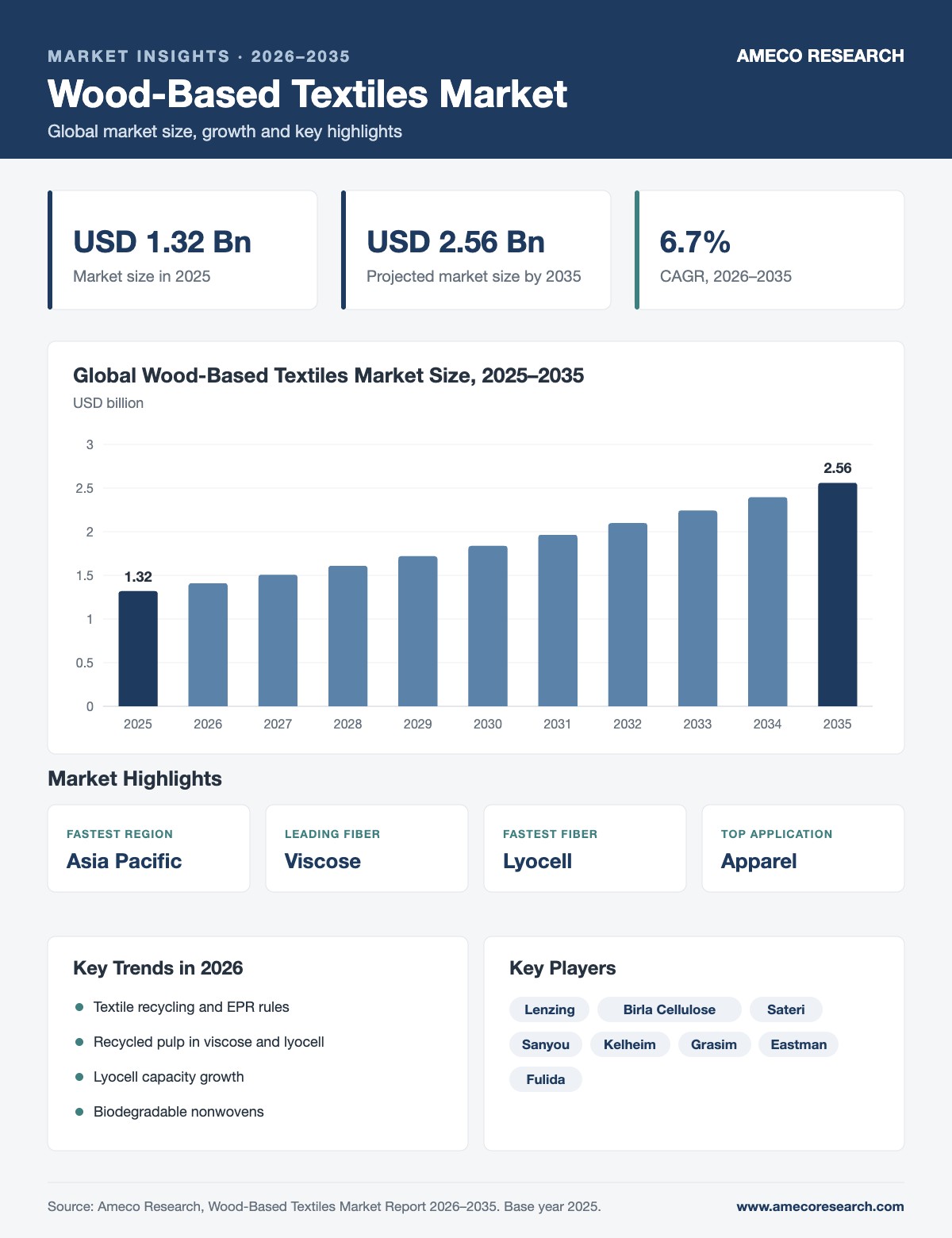 Infographic: Wood-Based Textiles Market Size and Growth Opportunities and Forecast till 2026 - 2035 | Ameco Research
Wood-Based Textiles Market Report Scope
| Report Attribute | Details |
| Wood-Based Textiles Market Size in 2025 | USD 1.32 Billion |
| Wood-Based Textiles Market Forecast by 2035 | USD 2.56 Billion |
| Wood-Based Textiles Market CAGR (2026–2035) | 6.7% |
| Analysis Period | 2023–2035 |
| Base Year | 2025 |
| Forecast Period | 2026–2035 |
| Segments Covered | by Fibre Type, by Application, and By Region |
| Regional Scope | North America, Europe, Asia Pacific, Latin America, and Middle East & Africa |
| Key Companies Profiled | Lenzing AG, Birla Cellulose, Sateri, Tangshan Sanyou Group, Kelheim Fibres GmbH, Grasim Industries Limited, Eastman Chemical Company, China Hi-Tech Group Corporation, Shandong Helon Textile Sci. & Tech. Co., Ltd., and Fulida Group Holdings Co., Ltd. |
| Report Coverage | Market Trends, Drivers, Restraints, Opportunities, Competitive Analysis, Player Profiling, Regulation Analysis |
Wood-Based Textiles Market Size Forecast, 2023–2035
The table below shows the year-by-year size of the global wood-based textiles market. Revenue is expected to grow about 1.9 times between 2025 and 2035, reaching roughly USD 1.84 billion by 2030.
| Year | Market Size (USD Billion) |
| 2023 (historical) | 1.16 |
| 2024 (historical) | 1.24 |
| 2025 (base year) | 1.32 |
| 2026 (forecast) | 1.41 |
| 2027 (forecast) | 1.51 |
| 2028 (forecast) | 1.61 |
| 2029 (forecast) | 1.72 |
| 2030 (forecast) | 1.84 |
| 2031 (forecast) | 1.96 |
| 2032 (forecast) | 2.10 |
| 2033 (forecast) | 2.24 |
| 2034 (forecast) | 2.40 |
| 2035 (forecast) | 2.56 |
Latest Wood-Based Textiles Market Trends (2026)
Textile recycling and EPR rules
The EU requires separate collection of textile waste and has adopted extended producer responsibility for textiles, pushing brands toward fibers with recycled content and better end-of-life options. Wood-based fibers made with recycled cotton or textile pulp are gaining attention.
Recycled pulp feedstock
Producers are blending pulp made from textile waste into viscose and lyocell. Circulose, the recycled pulp business relaunched after Renewcell's restructuring, and in-house programs from Lenzing and Birla Cellulose are building this supply chain.
Lyocell growth
Lyocell's closed-loop process, strength and softness make it the fastest-growing wood-based fiber, used in denim, activewear, bedding and nonwovens.
Biodegradable nonwovens
Single-use plastics rules and consumer demand are shifting wet wipes, hygiene products and medical nonwovens from polyester and polypropylene to viscose and lyocell.
Responsible forestry and traceability
Brands require certified wood sources, deforestation-free supply chains and traceable fibers, supported by the EU Deforestation Regulation and certification schemes such as FSC and PEFC.
Substitution of polyester
Concerns about microplastics and fossil-based fibers are encouraging brands to use more cellulosic fibers in blends and new collections.
Wood-Based Textiles Market Dynamics
Growth drivers
- Brand sustainability targets and demand for renewable fibers
- Comfort and performance of lyocell and modal in apparel
- Shift to biodegradable nonwovens for wipes and hygiene
- Textile recycling and extended producer responsibility rules
- Growing middle-class clothing demand in Asia
Restraints and challenges
- Price competition from polyester and cotton
- Environmental concerns about some viscose production
- Volatile dissolving pulp prices
- High capital costs for lyocell and recycling plants
Opportunities
Key opportunities include recycled-content viscose and lyocell, lyocell for denim and activewear, plastic-free wipes and hygiene nonwovens, traceable certified fibers for fashion brands, and technical uses in packaging, filtration and geotextiles.
Wood-Based Textiles Market Segment Analysis
By fiber type
The market is segmented into viscose fibers, modal fibers and lyocell fibers. Viscose is the largest segment by volume thanks to its low cost and versatility. Lyocell is the fastest-growing type because of its closed-loop production and premium performance, while modal is valued for softness in underwear and loungewear.
By application
Applications include textiles and clothing, nonwovens, industrial and others such as packaging, filtration and geotextiles. Textiles and clothing is the largest application, while nonwovens for wipes and hygiene are growing quickly.
Wood-Based Textiles Market Regional Analysis
Asia Pacific is the fastest-growing region, driven by large fiber production in China, India and Indonesia, growing textile manufacturing and rising consumer awareness.
Europe is a major market, supported by sustainable fashion brands, textile recycling rules and fiber producers such as Lenzing and Kelheim. North America shows significant growth as brands increase use of lyocell and modal.
Latin America and the Middle East & Africa are smaller markets, growing with apparel and nonwovens production.
Wood-Based Textiles Market Segmentation
Wood-Based Textiles Market Leading Companies
The wood-based textiles market is led by large integrated cellulosic fiber producers in Europe and Asia, with some vertically integrated from forests and pulp to fiber. Companies compete on fiber quality, sustainability credentials, branded fibers, recycled content, cost and partnerships with fashion and nonwoven brands. Key players profiled in this report include Lenzing AG, Birla Cellulose, Sateri, Tangshan Sanyou Group, Kelheim Fibres GmbH, Grasim Industries Limited, Eastman Chemical Company, China Hi-Tech Group Corporation, Shandong Helon Textile Sci. & Tech. Co., Ltd., and Fulida Group Holdings Co., Ltd..
Lenzing AGBirla CelluloseSateriTangshan Sanyou GroupKelheim Fibres GmbHGrasim Industries LimitedEastman Chemical CompanyChina Hi-Tech Group CorporationShandong Helon Textile Sci. & Tech. Co., Ltd.Fulida Group Holdings Co., Ltd.
Recent developments
Key Questions Answered in This Report
- What is the size of the wood-based textiles market in 2025, and how large will it be by 2030 and 2035?
- What are the main growth drivers, restraints and opportunities through 2035?
- Which by fibre type and by application segments will grow the fastest?
- Which regions and countries offer the largest and fastest-growing opportunities?
- How are textile recycling rules, lyocell growth and polyester substitution shaping demand in 2026?
- Who are the leading companies, and what strategies are they using to compete?
Research Methodology
This report combines primary and secondary research. Primary research includes interviews with cellulosic fiber producers, pulp suppliers, spinners and fabric mills, apparel and nonwoven brands. Secondary research covers company annual reports, investor presentations, government and trade association data, patent filings and industry publications. Market size is estimated using both bottom-up (company revenue and production data) and top-down (end-use demand) methods, and results are cross-checked through data triangulation before forecasts are built for 2026–2035.
Related Reports
- Antimicrobial Textiles Market Report
- E-Textiles and Smart Clothing Market Report
- Technical Textile Market Report
- Phosphatases Market Report
- Metal Hoses Market Report
Wood-Based Textiles Market: Frequently Asked Questions
How big is the wood-based textiles market?
The global wood-based textiles market was valued at USD 1.32 billion in 2025 and is expected to reach USD 2.56 billion by 2035.
What is the growth rate of the wood-based textiles market?
The wood-based textiles market is projected to grow at a CAGR of 6.7% from 2026 to 2035.
What will the wood-based textiles market be worth in 2030?
The wood-based textiles market is projected to reach about USD 1.84 billion in 2030, growing at a CAGR of 6.7%.
What is driving growth in the wood-based textiles market?
Key drivers are brand sustainability targets, the comfort of lyocell and modal, the shift to biodegradable nonwovens and textile recycling rules.
What is wood-based textiles?
Wood-based textiles are fabrics made from fibers produced from dissolved wood pulp, mainly viscose, modal and lyocell.
Which region leads the wood-based textiles market?
Asia Pacific is the fastest-growing region, while Europe is a major market and North America shows significant growth.
Which segment holds the largest share of the wood-based textiles market?
Viscose is the largest fiber type, lyocell is the fastest growing and textiles and clothing is the largest application.
What are the latest trends in the wood-based textiles market?
The main 2026 trends are textile recycling and EPR rules, recycled pulp feedstock, lyocell growth, biodegradable nonwovens, responsible forestry and traceability and substitution of polyester.
What are the main challenges in the wood-based textiles market?
The main challenges are price competition from polyester and cotton, environmental concerns about some viscose production, volatile pulp prices and high capital costs.
What is the difference between viscose, modal and lyocell?
All three are made from wood pulp. Viscose is the most common and lowest cost, modal is a softer, stronger high-wet-modulus fiber, and lyocell is made in a closed-loop solvent process and is the strongest and most sustainable of the three.
Who are the key players in the wood-based textiles market?
Leading companies include Lenzing AG, Birla Cellulose, Sateri, Tangshan Sanyou Group, Kelheim Fibres GmbH, Grasim Industries Limited, Eastman Chemical Company, China Hi-Tech Group Corporation, Shandong Helon Textile Sci. & Tech. Co., Ltd., and Fulida Group Holdings Co., Ltd..
Sources
Related Chemical & Material Market Reports
- Phosphatases Market Size and Growth Opportunities and Forecast till 2026 - 2035
- Activated Carbon Powders Market Size and Growth Opportunities and Forecast till 2026 - 2035
- Metal Additives Market Size and Growth Opportunities and Forecast till 2026 - 2035
- Display Packaging Market Size and Growth Opportunities and Forecast till 2026 - 2035
- Thermal Insulation Market Size and Growth Opportunities and Forecast till 2026 - 2035