Metal Additives Market Size and Growth Opportunities and Forecast till 2026 - 2035
Metal Additives Market Size, Share & Trends Report, 2026–2035
LAST UPDATED: OCTOBER 2026
The global Metal Additives Market size was valued at USD 1.70 billion in 2025 and is projected to reach USD 3.21 billion by 2035, growing at a CAGR of 6.5% from 2026 to 2035. Growth is driven by demand for longer-lasting, corrosion-resistant metal parts in vehicles, aircraft and infrastructure, the rise of metal additive manufacturing, electric vehicle components that need new thermal and wear protection, and stricter performance and environmental standards.
Metal additives are materials added to metals, metal powders and metalworking systems during manufacturing to improve their properties, performance and service life. They include alloying and grain-refining agents, powder metallurgy additives, and functional additives that provide anti-wear, anti-corrosion, thermal barrier and lubricity performance. Supplied as powders, pellets, tablets and granules, they are used in automotive, aerospace and defense, construction, medical and electrical and electronics applications.
Metal Additives Market Key Takeaways
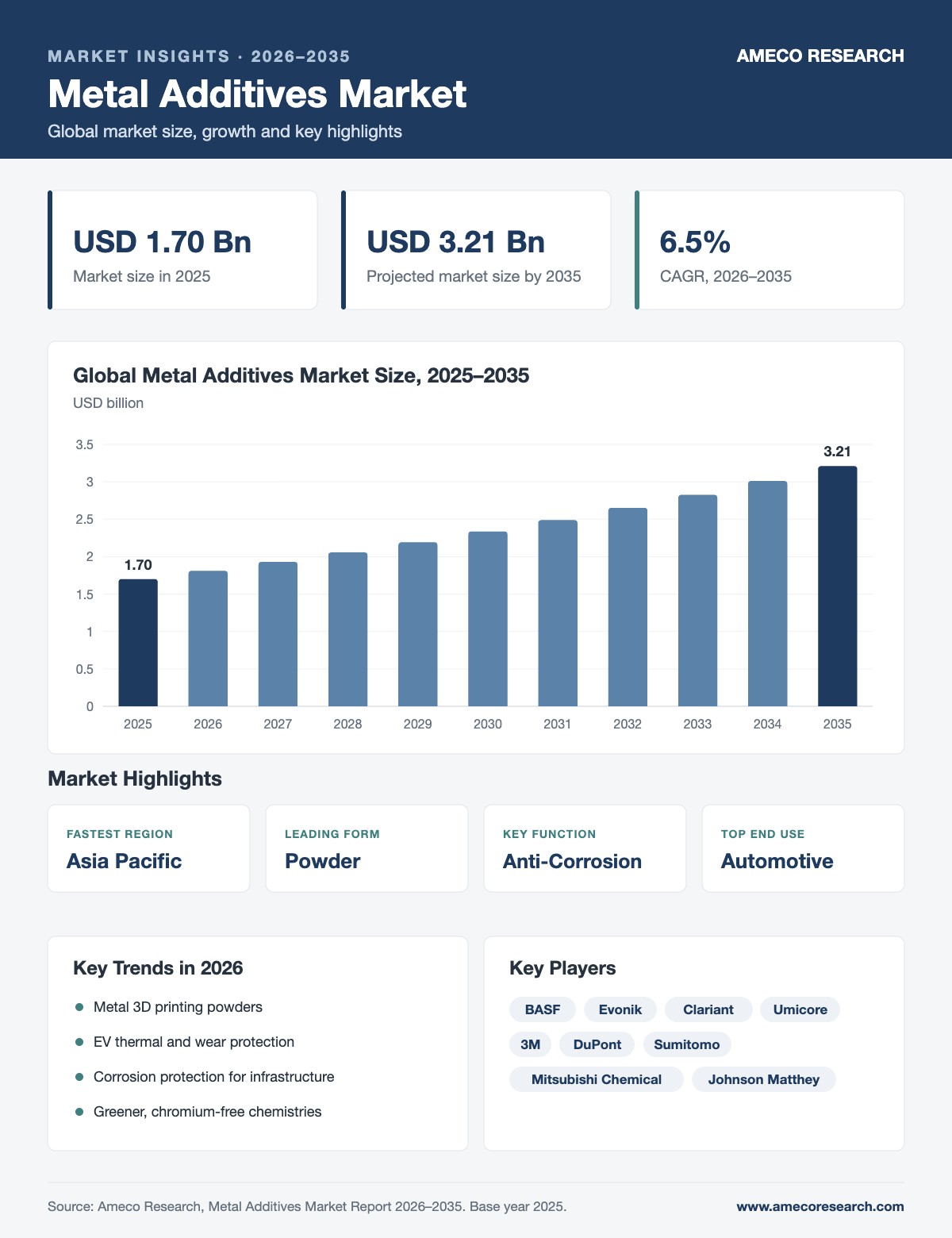 Infographic: Metal Additives Market Size and Growth Opportunities and Forecast till 2026 - 2035 | Ameco Research
Metal Additives Market Report Scope
| Report Attribute | Details |
| Metal Additives Market Size in 2025 | USD 1.70 Billion |
| Metal Additives Market Forecast by 2035 | USD 3.21 Billion |
| Metal Additives Market CAGR (2026–2035) | 6.5% |
| Analysis Period | 2023–2035 |
| Base Year | 2025 |
| Forecast Period | 2026–2035 |
| Segments Covered | by Metal Type, by Form, by Function, by End-Use Industry, and By Region |
| Regional Scope | North America, Europe, Asia Pacific, Latin America, and Middle East & Africa |
| Key Companies Profiled | 3M, DuPont, BASF, Evonik, Clariant, Umicore, Sumitomo Chemical, Mitsubishi Chemical, Sanyo Chemical, and Johnson Matthey |
| Report Coverage | Market Trends, Drivers, Restraints, Opportunities, Competitive Analysis, Player Profiling, Regulation Analysis |
Metal Additives Market Size Forecast, 2023–2035
The table below shows the year-by-year size of the global metal additives market. Revenue is expected to grow about 1.9 times between 2025 and 2035, reaching roughly USD 2.34 billion by 2030.
| Year | Market Size (USD Billion) |
| 2023 (historical) | 1.50 |
| 2024 (historical) | 1.60 |
| 2025 (base year) | 1.70 |
| 2026 (forecast) | 1.81 |
| 2027 (forecast) | 1.93 |
| 2028 (forecast) | 2.06 |
| 2029 (forecast) | 2.19 |
| 2030 (forecast) | 2.34 |
| 2031 (forecast) | 2.49 |
| 2032 (forecast) | 2.65 |
| 2033 (forecast) | 2.83 |
| 2034 (forecast) | 3.01 |
| 2035 (forecast) | 3.21 |
Latest Metal Additives Market Trends (2026)
Growth of metal additive manufacturing
Aerospace, defense, medical and energy companies are scaling metal 3D printing, which relies on tightly controlled powders and powder additives for flow, density and consistent part quality.
Electric vehicle components
EV motors, battery systems and power electronics need metals with better thermal management, wear resistance and corrosion protection, creating demand for new additive packages.
Corrosion protection for infrastructure
Spending on bridges, pipelines, water systems and renewable energy structures supports anti-corrosion additives that extend the life of steel and other metals.
Lightweight alloys
Automakers and aircraft makers are using more aluminum, magnesium and titanium alloys, which require grain refiners, modifiers and processing additives to reach target strength.
Greener and safer chemistries
Regulations on hazardous substances are pushing suppliers to replace heavy-metal and chromium-based additives with safer, more sustainable alternatives.
Defense and aerospace demand
Higher defense budgets and recovering aircraft production are increasing demand for high-performance additives in critical metal parts.
Metal Additives Market Dynamics
Growth drivers
- Demand for durable, corrosion-resistant metal parts
- Growth of metal additive manufacturing and powder metallurgy
- Electric vehicle and lightweight vehicle production
- Rising aerospace, defense and medical device output
- Stricter performance and quality standards
Restraints and challenges
- Volatile prices of metals and specialty chemicals
- Regulatory limits on hazardous additive chemistries
- High qualification costs in aerospace and medical uses
- Complex supply chains for specialty powders
Opportunities
Key opportunities include additives for metal 3D printing powders, EV thermal management and wear protection, chromium-free corrosion inhibitors, medical implant materials and fast-growing manufacturing in India and Southeast Asia.
Metal Additives Market Segment Analysis
By metal type
The market is segmented into ferrous and non-ferrous metal additives. Ferrous additives serve steel and iron production and powder metallurgy, while non-ferrous additives for aluminum, copper, titanium and nickel alloys are growing with lightweighting and aerospace demand.
By form
Forms include powder, pellets, tablets, granules and others. Powder is the most widely used form because it blends easily and is essential for powder metallurgy and additive manufacturing.
By function
Functions include anti-wear, anti-corrosion, thermal barrier, lubricity and others. Anti-wear and anti-corrosion additives hold the largest shares, while thermal barrier additives are growing in aerospace and EV applications.
By end-use industry
End-use industries include automotive, aerospace and defense, construction, medical, electrical and electronics, and others. Automotive is the largest end user, while aerospace, defense and medical are among the fastest growing.
Metal Additives Market Regional Analysis
Asia Pacific is the world's fastest-growing market for metal additives, led by China, India, Japan and South Korea, which dominate global metal production and manufacturing.
In North America, the United States is the largest market, supported by automotive, aerospace, defense and medical device production. Europe is a major market for automotive, aerospace and specialty alloy applications.
Latin America and the Middle East & Africa are smaller but growing markets, supported by metals processing, construction and oil and gas investment.
Metal Additives Market Segmentation
Metal Additives Market Leading Companies
The metal additives market includes global specialty chemical companies, materials technology groups and metal powder suppliers. Companies compete on performance, product range, technical support, regulatory compliance and close work with metal producers and manufacturers. Key players profiled in this report include 3M, DuPont, BASF, Evonik, Clariant, Umicore, Sumitomo Chemical, Mitsubishi Chemical, Sanyo Chemical, and Johnson Matthey.
3MDuPontBASFEvonikClariantUmicoreSumitomo ChemicalMitsubishi ChemicalSanyo ChemicalJohnson Matthey
Key Questions Answered in This Report
- What is the size of the metal additives market in 2025, and how large will it be by 2030 and 2035?
- What are the main growth drivers, restraints and opportunities through 2035?
- Which by metal type and by form segments will grow the fastest?
- Which regions and countries offer the largest and fastest-growing opportunities?
- How are metal 3D printing, EV components and greener chemistries shaping demand in 2026?
- Who are the leading companies, and what strategies are they using to compete?
Research Methodology
This report combines primary and secondary research. Primary research includes interviews with additive and chemical suppliers, metal producers, powder metallurgy and 3D printing companies, and manufacturers. Secondary research covers company annual reports, investor presentations, government and trade association data, patent filings and industry publications. Market size is estimated using both bottom-up (company revenue and production data) and top-down (end-use demand) methods, and results are cross-checked through data triangulation before forecasts are built for 2026–2035.
Related Reports
- Additive Manufacturing with Metal Powders Market Report
- Metal Hoses Market Report
- Non-Ferrous Metal Castings Market Report
- Metal Wire Mesh Belt Market Report
- 3D Printing Metal Market Report
Metal Additives Market: Frequently Asked Questions
How big is the metal additives market?
The global metal additives market was valued at USD 1.70 billion in 2025 and is expected to reach USD 3.21 billion by 2035.
What is the growth rate of the metal additives market?
The metal additives market is projected to grow at a CAGR of 6.5% from 2026 to 2035.
What will the metal additives market be worth in 2030?
The metal additives market is projected to reach about USD 2.34 billion in 2030, growing at a CAGR of 6.5%.
What is driving growth in the metal additives market?
Key drivers are demand for durable, corrosion-resistant metal parts, metal additive manufacturing, EV and lightweight vehicle production, and aerospace, defense and medical growth.
What is metal additives?
Metal additives are materials added to metals and metal powders during manufacturing to improve properties such as wear resistance, corrosion protection, heat resistance and lubricity.
Which region leads the metal additives market?
Asia Pacific is the fastest-growing region, while the United States is the largest market in North America.
Which segment holds the largest share of the metal additives market?
Powder is the most widely used form, anti-wear and anti-corrosion are the leading functions, and automotive is the largest end use.
What are the latest trends in the metal additives market?
The main 2026 trends are growth of metal additive manufacturing, electric vehicle components, corrosion protection for infrastructure, lightweight alloys, greener and safer chemistries and defense and aerospace demand.
What are the main challenges in the metal additives market?
The main challenges are volatile metal and chemical prices, regulations on hazardous chemistries, high qualification costs and complex specialty powder supply chains.
Who are the key players in the metal additives market?
Leading companies include 3M, DuPont, BASF, Evonik, Clariant, Umicore, Sumitomo Chemical, Mitsubishi Chemical, Sanyo Chemical, and Johnson Matthey.
Related Chemical & Material Market Reports
- Display Packaging Market Size and Growth Opportunities and Forecast till 2026 - 2035
- Thermal Insulation Market Size and Growth Opportunities and Forecast till 2026 - 2035
- Glass Fiber Reinforcement Materials Market Size and Growth Opportunities and Forecast till 2026 - 2035
- Automotive Interior Materials Market Size and Growth Opportunities and Forecast till 2026 - 2035
- Chlorotrifluoroethylene Market Size and Growth Opportunities and Forecast till 2026 - 2035