Acetone Market Size and Growth Opportunities and Forecast till 2026 - 2035
Acetone Market Size, Share & Trends Report, 2026–2035
LAST UPDATED: OCTOBER 2026
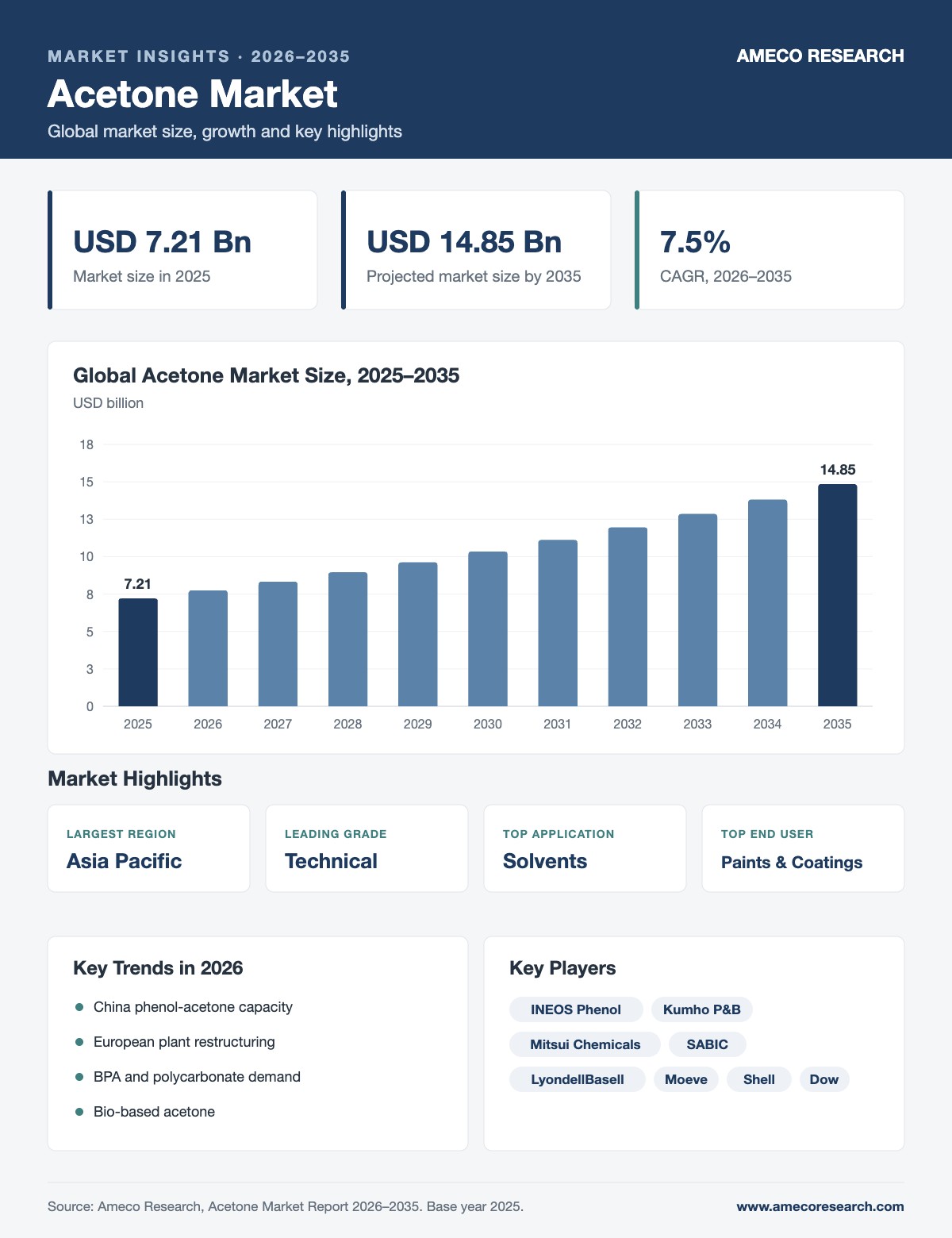
The global Acetone Market size was valued at USD 7.21 billion in 2025 and is projected to reach USD 14.85 billion by 2035, growing at a CAGR of 7.5% from 2026 to 2035. Growth is driven by solvent demand in paints, coatings, adhesives and pharmaceuticals, bisphenol-A and methyl methacrylate production for polycarbonate and acrylics, cosmetics and personal care, and electronics cleaning.
Acetone (propanone) is a clear, fast-evaporating solvent and chemical intermediate produced mainly as a co-product of phenol through the cumene process. It is supplied in technical and specialty grades. Acetone is used as a solvent in paints, coatings, adhesives, inks, cleaning and nail polish removers, and as a raw material for bisphenol-A (BPA), methyl methacrylate (MMA), isopropanol and other chemicals. End users include paints and coatings, pharmaceuticals, cosmetics and personal care, electronics and automotive industries.
Acetone Market Key Takeaways
Acetone Market Report Scope
| Report Attribute | Details |
| Acetone Market Size in 2025 | USD 7.21 Billion |
| Acetone Market Forecast by 2035 | USD 14.85 Billion |
| Acetone Market CAGR (2026–2035) | 7.5% |
| Analysis Period | 2023–2035 |
| Base Year | 2025 |
| Forecast Period | 2026–2035 |
| Segments Covered | by Grade, by Application, by End-User, and By Region |
| Regional Scope | North America, Europe, Asia Pacific, Latin America, and Middle East & Africa |
| Key Companies Profiled | Cepsa Química, S.A. (Moeve), ALTIVIA, Honeywell Chemicals, Kumho P&B Chemicals, INEOS Phenol GmbH, LyondellBasell Industries, Royal Dutch Shell Co, Mitsui Chemicals Inc., SABIC, and The Dow Chemical Company |
| Report Coverage | Market Trends, Drivers, Restraints, Opportunities, Competitive Analysis, Player Profiling, Regulation Analysis |
Acetone Market Size Forecast, 2023–2035
The table below shows the year-by-year size of the global acetone market, with figures rolled forward from the 2022 base at the report's 7.5% CAGR.
| Year | Market Size (USD Billion) |
| 2023 (historical) | 6.24 |
| 2024 (historical) | 6.71 |
| 2025 (base year) | 7.21 |
| 2026 (forecast) | 7.75 |
| 2027 (forecast) | 8.33 |
| 2028 (forecast) | 8.96 |
| 2029 (forecast) | 9.63 |
| 2030 (forecast) | 10.35 |
| 2031 (forecast) | 11.12 |
| 2032 (forecast) | 11.96 |
| 2033 (forecast) | 12.85 |
| 2034 (forecast) | 13.81 |
| 2035 (forecast) | 14.85 |
Latest Acetone Market Trends (2026)
Phenol-acetone capacity growth in China
China has added large integrated phenol-acetone and BPA capacity, making it largely self-sufficient and reshaping global trade flows and prices.
Restructuring in Europe and North America
High energy costs and weaker demand have led some Western producers to review, idle or close older phenol-acetone units, while focusing on integrated and specialty operations.
BPA and polycarbonate demand
Bisphenol-A, made from acetone and phenol, feeds polycarbonate for electronics, automotive and construction and epoxy resins for coatings and wind blades.
MMA and acrylics
Acetone is used in the acetone cyanohydrin route to methyl methacrylate, used in acrylic sheets, coatings and automotive lighting.
Bio-based and circular acetone
Producers are introducing acetone made with bio-based or recycled feedstocks under mass balance certification to help customers cut their carbon footprint.
Pharmaceutical and personal care demand
Acetone is widely used as a solvent in drug manufacturing, cosmetics and nail care, supporting steady demand for high-purity grades.
Acetone Market Dynamics
Growth drivers
- Solvent demand in paints, coatings and adhesives
- BPA and MMA production
- Pharmaceutical and cosmetic manufacturing
- Electronics cleaning and processing
- Construction and automotive growth
Restraints and challenges
- Dependence on phenol demand as a co-product
- Volatile benzene and propylene feedstock prices
- VOC regulations on solvent use
- Overcapacity and price swings
Opportunities
Key opportunities include high-purity grades for pharmaceuticals and electronics, bio-based and circular acetone, integrated BPA and polycarbonate chains, and growing coatings and personal care markets in India and Southeast Asia.
Acetone Market Segment Analysis
By grade
The market is segmented into specialty grade and technical grade. Technical grade holds the largest share and is expected to keep its position, while specialty grades serve pharmaceuticals, electronics and laboratories.
By application
Applications include solvents, bisphenol-A and others such as methyl methacrylate. Solvents held the largest share, and bisphenol-A is expected to grow significantly.
By end user
End users include electronics, automotive, pharmaceutical, paints, coatings and adhesives, cosmetics and personal care, and others. Paints, coatings and adhesives is the largest end-user category by volume.
Acetone Market Regional Analysis
Asia-Pacific is the market leader, driven by growth in paints and coatings, cosmetics and pharmaceuticals, lower infrastructure and labor costs, and large phenol-acetone capacity in China, South Korea, Taiwan and Japan.
North America and Europe are mature markets with integrated producers, though some older capacity is being restructured.
Latin America and the Middle East & Africa are growing markets, with Middle East producers expanding petrochemical capacity.
Acetone Market Segmentation
Acetone Market Leading Companies
The acetone market includes integrated phenol-acetone producers, petrochemical majors and regional chemical companies. Companies compete on cumene process scale and integration, feedstock access, product purity, logistics and long-term supply to BPA, MMA and solvent users. Key players profiled in this report include Cepsa Química, S.A. (Moeve), ALTIVIA, Honeywell Chemicals, Kumho P&B Chemicals, INEOS Phenol GmbH, LyondellBasell Industries, Royal Dutch Shell Co, Mitsui Chemicals Inc., SABIC, and The Dow Chemical Company.
Cepsa Química, S.A. (Moeve)ALTIVIAHoneywell ChemicalsKumho P&B ChemicalsINEOS Phenol GmbHLyondellBasell IndustriesRoyal Dutch Shell CoMitsui Chemicals Inc.SABICThe Dow Chemical Company
Key Questions Answered in This Report
- What is the size of the acetone market in 2025, and how large will it be by 2030 and 2035?
- What are the main growth drivers, restraints and opportunities through 2035?
- Which by grade and by application segments will grow the fastest?
- Which regions and countries offer the largest and fastest-growing opportunities?
- How are Chinese capacity, European restructuring and BPA demand shaping the acetone market in 2026?
- Who are the leading companies, and what strategies are they using to compete?
Research Methodology
This report combines primary and secondary research. Primary research includes interviews with acetone and phenol producers, chemical distributors, coatings, pharmaceutical and polymer manufacturers. Secondary research covers company annual reports, investor presentations, government and trade association data, patent filings and industry publications. Market size is estimated using both bottom-up (company revenue and production data) and top-down (end-use demand) methods, and results are cross-checked through data triangulation before forecasts are built for 2026–2035.
Related Reports
- Leather Chemicals Market Report
- Petrochemicals Market Report
- Specialty Chemicals Market Report
- Precious Metal Plating Chemicals Market Report
- Chemical Distribution System (CDS) Market Report
Acetone Market: Frequently Asked Questions
How big is the acetone market?
The global acetone market was valued at USD 7.21 billion in 2025 and is expected to reach USD 14.85 billion by 2035.
What is the growth rate of the acetone market?
The acetone market is projected to grow at a CAGR of 7.5% from 2026 to 2035.
What will the acetone market be worth in 2030?
The acetone market is projected to reach about USD 10.35 billion in 2030, growing at a CAGR of 7.5%.
What is driving growth in the acetone market?
Key drivers are solvent demand in paints, coatings and adhesives, BPA and MMA production, pharmaceutical and cosmetic manufacturing and electronics cleaning.
What is acetone?
Acetone is a clear, fast-evaporating solvent and chemical intermediate, mostly made as a co-product of phenol, used in paints, coatings, pharmaceuticals, cosmetics and to make BPA and MMA.
Which region leads the acetone market?
Asia-Pacific is the market leader, while North America and Europe are mature markets.
Which segment holds the largest share of the acetone market?
Technical grade holds the largest share, solvents are the leading application and paints, coatings and adhesives is the largest end user.
What are the latest trends in the acetone market?
The main 2026 trends are phenol-acetone capacity growth in China, restructuring in Europe and North America, bPA and polycarbonate demand, mMA and acrylics, bio-based and circular acetone and pharmaceutical and personal care demand.
What are the main challenges in the acetone market?
The main challenges are dependence on phenol demand, volatile feedstock prices, VOC rules and overcapacity.
How is acetone made?
Most acetone is made by the cumene process, in which benzene and propylene form cumene, which is oxidized and split into phenol and acetone in roughly a 1.6 to 1 ratio by weight.
Who are the key players in the acetone market?
Leading companies include Cepsa Química, S.A. (Moeve), ALTIVIA, Honeywell Chemicals, Kumho P&B Chemicals, INEOS Phenol GmbH, LyondellBasell Industries, Royal Dutch Shell Co, Mitsui Chemicals Inc., SABIC, and The Dow Chemical Company.