Advanced Analytics Market Size and Growth Opportunities and Forecast till 2026 - 2035
Advanced Analytics Market Size, Share & Trends Report, 2026–2035
LAST UPDATED: OCTOBER 2026
The global Advanced Analytics Market size was valued at USD 86.0 billion in 2025 and is projected to reach USD 532.5 billion by 2035, growing at a CAGR of 20% from 2026 to 2035. Growth is driven by generative AI and machine learning built into analytics platforms, cloud data platforms that make large-scale analysis affordable, real-time fraud and risk analytics, customer personalization, and demand from SMEs for self-service and AI-assisted analytics tools.
Advanced analytics uses statistical modeling, machine learning, data mining, forecasting, simulation and optimization to go beyond traditional reporting. It covers descriptive, diagnostic, predictive and prescriptive analytics, helping organizations understand what happened, why it happened, what is likely to happen and what action to take. Solutions include big data analytics, business analytics, customer analytics, risk analytics and statistical analysis, delivered on-premise or in the cloud.
Advanced Analytics Market Key Takeaways
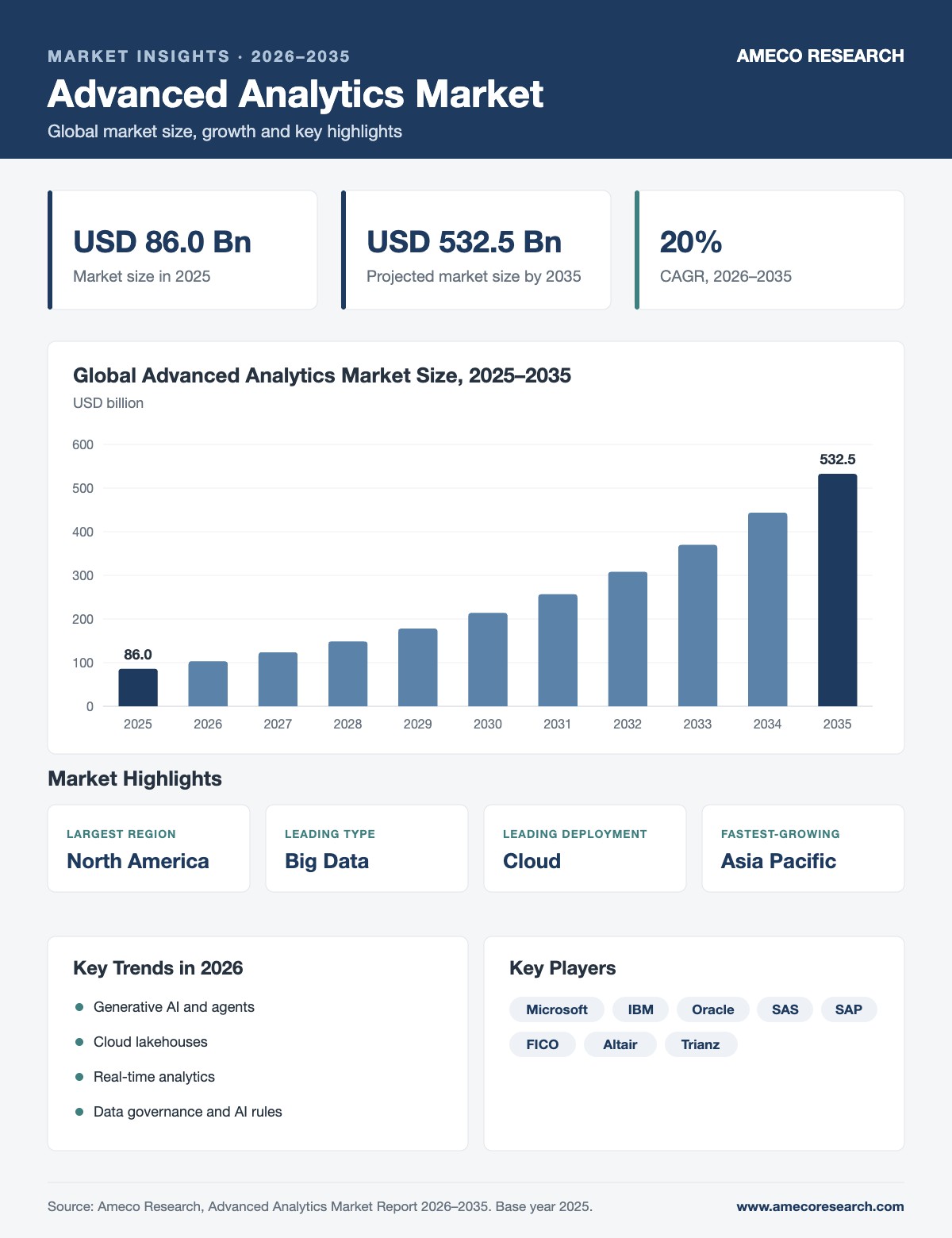
Advanced Analytics Market Report Scope
| Report Attribute | Details |
| Advanced Analytics Market Size in 2025 | USD 86.0 Billion |
| Advanced Analytics Market Forecast by 2035 | USD 532.5 Billion |
| Advanced Analytics Market CAGR (2026–2035) | 20% |
| Analysis Period | 2023–2035 |
| Base Year | 2025 |
| Forecast Period | 2026–2035 |
| Segments Covered | by Type, by Deployment, by Enterprise Size, by End-Use, and By Region |
| Regional Scope | North America, Europe, Asia Pacific, Latin America, and Middle East & Africa |
| Key Companies Profiled | Microsoft Corporation, IBM, Oracle, SAS Institute, SAP SE, FICO (Fair Isaac Corporation), Altair Engineering (Siemens), and Trianz |
| Report Coverage | Market Trends, Drivers, Restraints, Opportunities, Competitive Analysis, Player Profiling, Regulation Analysis |
Advanced Analytics Market Size Forecast, 2023–2035
The table below shows the year-by-year size of the global advanced analytics market. Revenue is expected to grow about 6.2 times between 2025 and 2035, reaching roughly USD 214.0 billion by 2030.
| Year | Market Size (USD Billion) |
| 2023 (historical) | 59.7 |
| 2024 (historical) | 71.7 |
| 2025 (base year) | 86.0 |
| 2026 (forecast) | 103.2 |
| 2027 (forecast) | 123.8 |
| 2028 (forecast) | 148.6 |
| 2029 (forecast) | 178.3 |
| 2030 (forecast) | 214.0 |
| 2031 (forecast) | 256.8 |
| 2032 (forecast) | 308.2 |
| 2033 (forecast) | 369.8 |
| 2034 (forecast) | 443.7 |
| 2035 (forecast) | 532.5 |
Latest Advanced Analytics Market Trends (2026)
Generative AI and analytics agents
Analytics platforms now let users ask questions in plain language, generate reports and code automatically, and use AI agents to monitor data and recommend actions.
Cloud data platforms and lakehouses
Organizations are moving analytics to cloud data warehouses and lakehouses that combine structured and unstructured data, lowering cost and making machine learning easier.
Real-time and streaming analytics
Banks, retailers and telecom operators analyze streaming data to detect fraud, personalize offers and manage networks in real time.
Customer personalization
Companies use customer analytics and recommendation engines to tailor offers and content across digital channels, from streaming services to e-commerce.
Data governance and AI regulation
New AI rules, privacy laws and data quality concerns are pushing companies to invest in governance, model monitoring and explainable AI.
Self-service analytics for SMEs
Cloud-based, low-code analytics tools make advanced capabilities accessible to small and mid-sized businesses without large data science teams.
Advanced Analytics Market Dynamics
Growth drivers
- Growing data volumes from digital channels, streaming and social media
- Adoption of AI and machine learning for personalization and decision-making
- Need for fraud detection and risk management
- Shift to cloud data platforms
- Lower cost and easier access to analytics tools
Restraints and challenges
- Shortage of skilled data scientists and analytics professionals
- Data privacy, security and regulatory concerns
- Data quality and integration challenges
- High cost of large-scale implementations
Opportunities
Key opportunities include generative AI analytics assistants, industry-specific solutions for healthcare and government, analytics for SMEs, real-time edge analytics, and growth in Asia Pacific and the Middle East.
Advanced Analytics Market Segment Analysis
By type
The market is segmented into business analytics, big data analytics, customer analytics, risk analytics, statistical analysis and others. Big data analytics holds the largest share, while customer and risk analytics are growing quickly with personalization and fraud prevention needs.
By deployment and enterprise size
Deployment options include on-premise and cloud, with cloud holding the larger and faster-growing share. Large enterprises hold the largest share by enterprise size, while SMEs are adopting cloud-based analytics at a strong rate.
By end-use
End-uses include BFSI, IT & telecom, government, military & defense, healthcare and others. BFSI holds the largest share because of heavy use in fraud detection, credit risk and customer analytics.
Advanced Analytics Market Regional Analysis
North America holds the largest share, supported by strong digital infrastructure, high use of AI and big data, social media and streaming data, and major analytics vendors.
Asia Pacific is expected to grow fastest, driven by rising fraud, e-commerce growth and digitalization in Singapore, India and China. Europe is a major market shaped by data protection and AI regulations.
Latin America and the Middle East & Africa are growing markets, supported by digital banking and government data programs.
Advanced Analytics Market Segmentation
Advanced Analytics Market Leading Companies
The advanced analytics market includes large software and cloud companies, specialist analytics vendors and IT services firms. Companies compete on AI capabilities, scalability, ease of use, integration with data platforms, industry expertise and pricing. Key players profiled in this report include Microsoft Corporation, IBM, Oracle, SAS Institute, SAP SE, FICO (Fair Isaac Corporation), Altair Engineering (Siemens), and Trianz.
Microsoft CorporationIBMOracleSAS InstituteSAP SEFICO (Fair Isaac Corporation)Altair Engineering (Siemens)Trianz
Key Questions Answered in This Report
- What is the size of the advanced analytics market in 2025, and how large will it be by 2030 and 2035?
- What are the main growth drivers, restraints and opportunities through 2035?
- Which by type and by deployment segments will grow the fastest?
- Which regions and countries offer the largest and fastest-growing opportunities?
- How are generative AI, cloud lakehouses and real-time analytics shaping advanced analytics in 2026?
- Who are the leading companies, and what strategies are they using to compete?
Research Methodology
Ameco Research built this forecast from a mix of primary and secondary research. Analysts spoke with analytics software vendors, cloud providers, enterprise users, IT services firms and industry publications to validate pricing, volumes and demand trends, and reviewed company filings, trade statistics, regulatory documents and industry publications. The advanced analytics market size was estimated with bottom-up and top-down approaches and validated through data triangulation, with 2025 as the base year and forecasts for 2026–2035.
Related Reports
- Transportation Analytics Market Report
- Predictive Analytics Market Report
- Vehicle Analytics Market Report
- Healthcare Analytics Market Report
- Automation Software Market Report
Advanced Analytics Market: Frequently Asked Questions
How big is the advanced analytics market?
The global advanced analytics market was valued at USD 86.0 billion in 2025 and is expected to reach USD 532.5 billion by 2035.
What is the growth rate of the advanced analytics market?
The advanced analytics market is projected to grow at a CAGR of 20% from 2026 to 2035.
What will the advanced analytics market be worth in 2030?
The advanced analytics market is projected to reach about USD 214.0 billion in 2030, growing at a CAGR of 20%.
What is driving growth in the advanced analytics market?
Key drivers are growing data volumes, AI and machine learning adoption, fraud and risk management needs, cloud data platforms and easier access to analytics tools.
What is advanced analytics?
Advanced analytics uses machine learning, statistical modeling, data mining and optimization to predict outcomes and recommend actions, going beyond traditional reporting.
Which region leads the advanced analytics market?
North America holds the largest share, while Asia Pacific is expected to grow fastest.
Which segment holds the largest share of the advanced analytics market?
Big data analytics is the leading type, cloud is the leading deployment, and BFSI is the largest end-use.
What are the latest trends in the advanced analytics market?
The main 2026 trends are generative AI and analytics agents, cloud data platforms and lakehouses, real-time and streaming analytics, customer personalization, data governance and AI regulation and self-service analytics for SMEs.
What are the main challenges in the advanced analytics market?
The main challenges are skills shortages, data privacy and regulation, data quality and integration, and high implementation costs.
What is the difference between predictive and prescriptive analytics?
Predictive analytics forecasts what is likely to happen, while prescriptive analytics recommends the best action to take based on those predictions.
Who are the key players in the advanced analytics market?
Leading companies include Microsoft Corporation, IBM, Oracle, SAS Institute, SAP SE, FICO (Fair Isaac Corporation), Altair Engineering (Siemens), and Trianz.