India's AI Data Center Boom: Where Is the Next Wave of Infrastructure Investment Going?
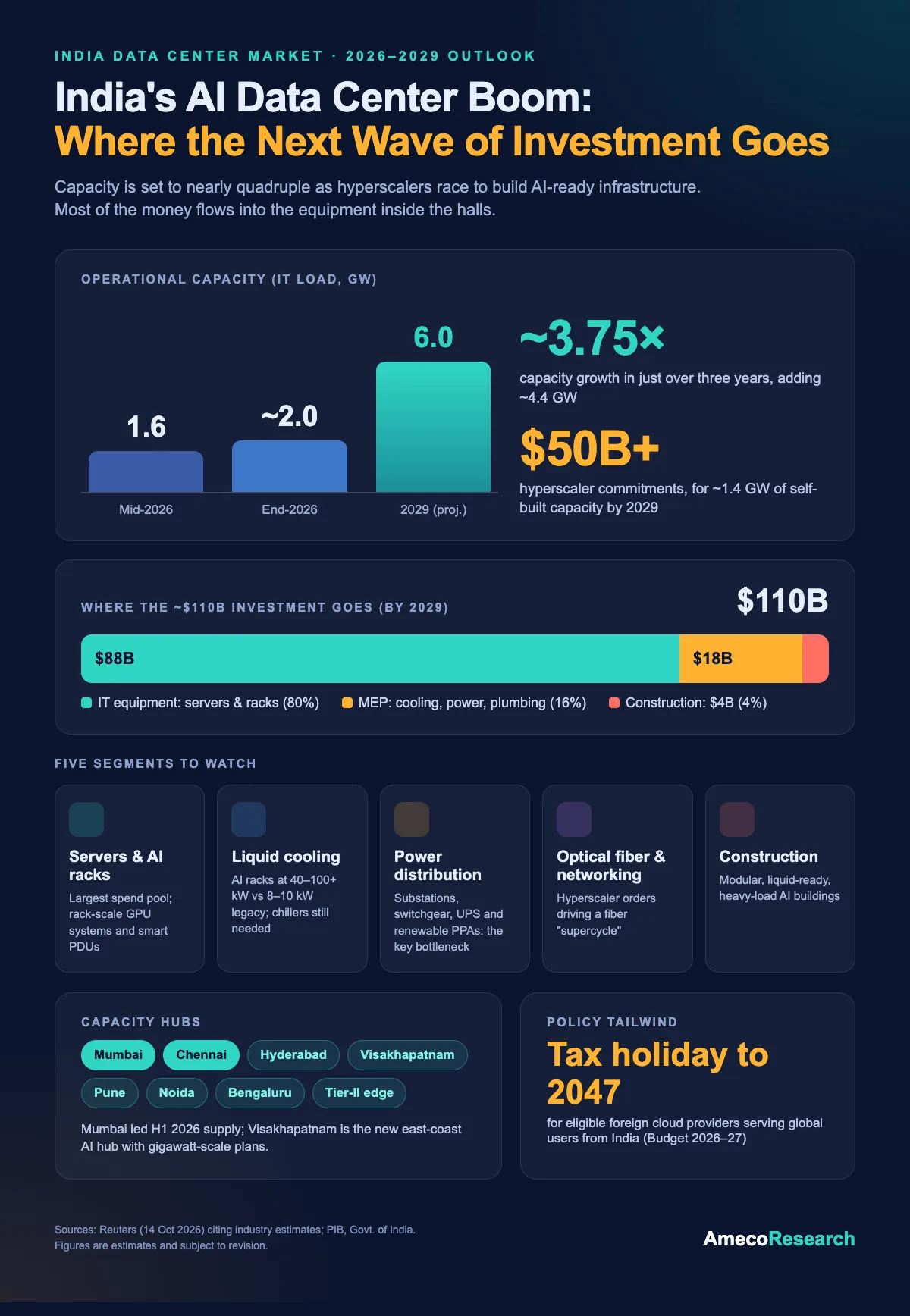
Quick answer: The India data center market is entering a gigawatt-scale build cycle. Capacity stood at about 1.6 GW in mid-2026 and is projected to reach roughly 6 GW by 2029, according to industry estimates cited by Reuters on 14 October 2026. Global hyperscalers have committed more than USD 50 billion, and the full build-out needs an estimated USD 110 billion. Most of that money will go not into buildings but into the equipment inside them: servers, racks, cooling, power distribution, optical fiber and networking gear.
Key Takeaways for Investors and Stakeholders
- Capacity is set to nearly quadruple: from about 1.6 GW (mid-2026) to about 6 GW by 2029, adding roughly 4.4 GW in just over three years.
- The money is in the equipment: of an estimated USD 110 billion requirement, around USD 88 billion is tied to IT equipment such as servers and racks, USD 18 billion to mechanical, electrical and plumbing (MEP) systems, and only about USD 4 billion to real estate construction.
- Hyperscalers are building for themselves: more than USD 50 billion in commitments are expected to deliver about 1.4 GW of self-built capacity by 2029.
- Policy is a tailwind: the Union Budget 2026–27 introduced a tax holiday until 2047 for eligible foreign cloud providers serving global customers from Indian data centers.
- Public markets have noticed: Indian suppliers of optical fiber, power equipment and fuel cells have been among 2026's strongest performers as hyperscaler orders flow in.
Why India's Data Center Market Is Accelerating Now
India has long been described as a country that produces far more data than it stores. That gap is now closing fast, and artificial intelligence is the reason. Training and running AI models takes dense clusters of accelerators that draw several times more power per rack than the enterprise servers most Indian facilities were designed around. Operators cannot simply squeeze AI into old halls; they need new campuses, new power connections and new cooling designs.
Three forces are converging. First, hyperscale cloud and AI demand: big global platforms want capacity close to more than a billion internet users and increasingly want to serve other regions from India too. Second, data localisation and digital public infrastructure, which keep sensitive and government workloads inside the country. Third, a deliberate policy push that treats data centers as strategic infrastructure rather than ordinary real estate.
The result is a shift in scale. Announcements now routinely talk in hundreds of megawatts, and Google's planned AI hub in Visakhapatnam, developed with AdaniConneX and Airtel, is described as India's first gigawatt-scale campus, backed by about USD 15 billion of investment over 2026–2030.
The Numbers: How Big Is the India Data Center Market Opportunity?
The headline figures, as reported by Reuters this week and in recent industry tracking, frame the opportunity clearly:
| Metric | Value | What it means |
|---|---|---|
| Operational capacity, mid-2026 | ~1.6 GW | Base from which the build cycle starts |
| Projected capacity, 2029 | ~6 GW | Almost 4x growth in about three years |
| Total investment needed by 2029 | ~USD 110 billion | Combined spend on land, buildings, MEP and IT |
| Hyperscaler commitments | >USD 50 billion | Supports ~1.4 GW of self-built capacity |
| Capacity expected by end-2026 | ~2 GW | Over 200 MW forecast to go live in H2 2026 |
Two details matter for anyone sizing a market. One is that capacity figures refer to IT load, so the actual electrical demand at the grid connection is higher once cooling and losses are counted. The other is that announced projects and operational capacity are not the same thing: a "1 GW campus" may take most of a decade to fill. Stakeholders should track energised megawatts, not press-release megawatts.
Where the Money Goes: Mapping the AI Data Center Infrastructure Market
The most useful lens for investors is the cost stack. Roughly four-fifths of the projected spend lands on IT equipment, with the rest split between MEP systems and the building shell. Here is how each segment of the AI data center infrastructure market in India is positioned.
1. Servers, Racks and Compute: The Largest Pool of Spend
With an estimated USD 88 billion linked to IT equipment, servers and accelerator systems are the single biggest bucket. AI changes the product mix sharply: GPU and custom-accelerator servers cost far more per unit than general-purpose machines, and they arrive in fully integrated, rack-scale systems.
Opportunity: rack-scale AI systems, high-density racks, intelligent rack power distribution units, and lifecycle services such as installation, maintenance and refresh. For global sizing and vendor landscape, see our Server Market report.
2. Cooling: From Air to Liquid, Built In From Day One
Cooling is where AI rewrites the rulebook. Legacy Indian halls were planned for racks of roughly 8–10 kW. AI racks commonly need 40 kW to well over 100 kW, beyond what air alone can handle efficiently. That is pushing the data center cooling market toward direct-to-chip liquid cooling, rear-door heat exchangers and, for the densest deployments, immersion systems.
India adds two local twists. Hot, humid climates mean chillers usually remain necessary even alongside liquid loops, so demand for chillers, cooling towers and coolant distribution units grows rather than shrinks. And water scarcity in several data center hubs is making water-efficient designs, such as closed-loop and adiabatic systems, a selection criterion rather than a nice-to-have.
Opportunity: coolant distribution units, cold plates, liquid-ready chillers, heat exchangers, thermal interface materials, and retrofit services for older facilities. Related reading: our Chillers Market report and Thermal Interface Materials Market report.
3. Power Distribution and Energy: The Real Bottleneck
Ask any developer what slows a project down and the answer is usually power, not land. Adding about 4.4 GW of IT load means new substations, high-voltage connections, transformers, switchgear, UPS systems, busways and backup generation. Within the roughly USD 18 billion MEP slice, electrical systems take a large share.
Clean energy is part of the brief. Hyperscalers want renewable power to meet their own climate targets, which favours states that can deliver green open-access power and transmission at scale. That is one reason power producers, transmission companies and makers of electrical equipment have rallied alongside data center stocks this year.
Opportunity: substations, circuit breakers and switchgear, UPS and battery systems, generators, and renewable power purchase agreements. See our Substation Market, Circuit Breaker Market and Mobile Generators Market reports.
4. Optical Fiber and Networking: The Quiet Winner
AI clusters are only as fast as the links between their accelerators. Inside a campus, that means far more fiber and high-speed optics per rack than conventional data centers use. Between campuses, it means long-haul and metro fiber, plus subsea cable landing stations. Brokerage analysts have described the current phase as a demand "supercycle" for optical fiber cable.
Indian manufacturers are already capturing this. Reuters reported that HFCL secured a five-year contract worth up to USD 1.1 billion from a global hyperscaler in March, Sterlite Technologies signed supply agreements potentially worth more than USD 2 billion combined this year, and Black Box won a USD 131 million data center order from a US-based hyperscaler.
Opportunity: high-fiber-count cables, structured cabling, optical transceivers, data center switches, and cable landing infrastructure.
5. Construction and the Building Shell
At about USD 4 billion, construction is the smallest bucket, but it sets the pace for everything else. AI-ready buildings need heavier floor loading, taller halls for liquid-cooling pipework, and modular, prefabricated designs that shorten delivery times. Engineering, procurement and construction firms that can deliver repeatable, fast-track designs are best placed.
Geography: Where the Next Wave of Capacity Will Land
Mumbai remains India's dominant hub thanks to its subsea cable landings and grid strength, and it accounted for the overwhelming majority of new supply in the first half of 2026. Chennai is the second anchor, with its own cable landings. The growth story, however, is spreading:
- Hyderabad: strong state incentives and a large self-build pipeline from hyperscalers.
- Visakhapatnam: the new east-coast contender, anchored by Google's planned gigawatt-scale AI hub and new subsea connectivity.
- Pune, Noida and Bengaluru: enterprise and edge demand, plus overflow from Mumbai.
- Tier-II cities: Ahmedabad, Bhopal, Patna and others are attracting edge and latency-sensitive deployments as 5G spreads.
Policy Tailwinds Behind India Data Center Investment
The single biggest policy signal came in the Union Budget 2026–27. The government proposed a tax holiday until 2047 for eligible foreign companies that provide cloud services to customers worldwide using data center services procured in India. A 15% cost-based safe harbour was also introduced for related-party data center entities, reducing the risk of tax disputes.
These measures sit alongside state-level data center policies offering land, power and stamp-duty benefits, as well as the India Semiconductor Mission and electronics component schemes that support local hardware supply. Together they lower the long-term risk premium on India data center investment.
Risks Every Stakeholder Should Weigh
- Power and transmission delays: grid connections can lag building completion by months, stranding capital.
- Water stress: cooling designs that rely on evaporation face growing scrutiny in drought-prone cities.
- Import dependence: accelerators and high-end chips are imported, exposing projects to export controls and currency swings.
- Execution and talent: liquid-cooled, high-density facilities need skills that are still scarce.
- Announcement risk: not every pledged gigawatt will be built on schedule; valuations that price in every announcement may disappoint.
Our Outlook: How to Position for 2026–2029
India's data center build-out is best understood as an equipment cycle wrapped in a real estate story. The investors and suppliers most likely to benefit are those positioned in the layers where spending is largest and technical change is fastest: AI servers and racks, liquid cooling, electrical infrastructure and optical connectivity. Companies that localise manufacturing, secure renewable power and offer water-efficient designs will have an edge as hyperscalers scale their Indian footprints.
For strategic planning, the key indicators to watch are energised capacity (not announced capacity), the share of liquid-cooled deployments, renewable power contracts signed by operators, and order books at Indian fiber and electrical equipment makers. To go deeper into the underlying hardware demand, explore our Server Market and Physical AI Market reports, or contact Ameco Research for a customised India data center market study.
Frequently Asked Questions
How big is the India data center market?
India had about 1.6 GW of operational data center capacity in mid-2026, expected to reach around 2 GW by the end of 2026 and about 6 GW by 2029. Reaching that level requires an estimated USD 110 billion in investment.
Why is India's data center capacity growing so fast?
AI workloads, hyperscale cloud expansion, data localisation rules and new tax incentives are all driving demand. Hyperscalers alone have committed more than USD 50 billion to Indian capacity.
Which segments benefit most from India data center investment?
IT equipment such as servers and racks accounts for the largest share, about USD 88 billion of the projected spend. Mechanical, electrical and plumbing systems, including cooling and power distribution, account for about USD 18 billion, followed by optical fiber and networking.
Why does AI need liquid cooling?
AI racks often draw 40 kW to over 100 kW, far beyond the 8–10 kW that legacy air-cooled halls were built for. Liquid cooling removes heat more efficiently and allows much denser racks, which is why new AI facilities in India are designing it in from the start.
Which Indian cities lead data center development?
Mumbai leads by a wide margin, followed by Chennai. Hyderabad, Visakhapatnam, Pune, Noida and Bengaluru are the main growth hubs, with tier-II cities emerging for edge deployments.
What is the India data center tax holiday?
Announced in the Union Budget 2026–27, it offers eligible foreign cloud providers a tax holiday until 2047 if they serve global customers using data center services procured in India.
Sources: Reuters, "India's proxy AI trade shines in a bleak year for stocks" (14 October 2026); Press Information Bureau, Government of India, Budget 2026–27 note on cloud and AI infrastructure; Google company announcement on the Visakhapatnam AI hub. Figures are industry estimates and may be revised. This article is for information only and is not investment advice.