Automotive AC Compressor Market Size and Growth Opportunities and Forecast till 2026 - 2035
Automotive AC Compressor Market Size, Share & Trends Report, 2026–2035
LAST UPDATED: OCTOBER 2026
The global Automotive AC Compressor Market size was valued at USD 9.85 billion in 2025 and is projected to reach USD 15.60 billion by 2035, growing at a CAGR of 4.7% from 2026 to 2035. Growth is driven by rising vehicle production, near-universal fitment of air conditioning, and the rapid shift to electric vehicles, which need high-voltage electric compressors and heat pumps for both cabin comfort and battery cooling.
An automotive air conditioning (AC) compressor is the heart of a vehicle's climate system. It compresses low-pressure refrigerant gas into high-pressure, high-temperature gas, which then releases heat through the condenser, expands and evaporates to cool the cabin. Conventional compressors are belt-driven by the engine through a clutch, while electric compressors in hybrids and EVs run on high-voltage power and also manage battery and power-electronics temperatures.
Automotive AC Compressor Market Key Takeaways
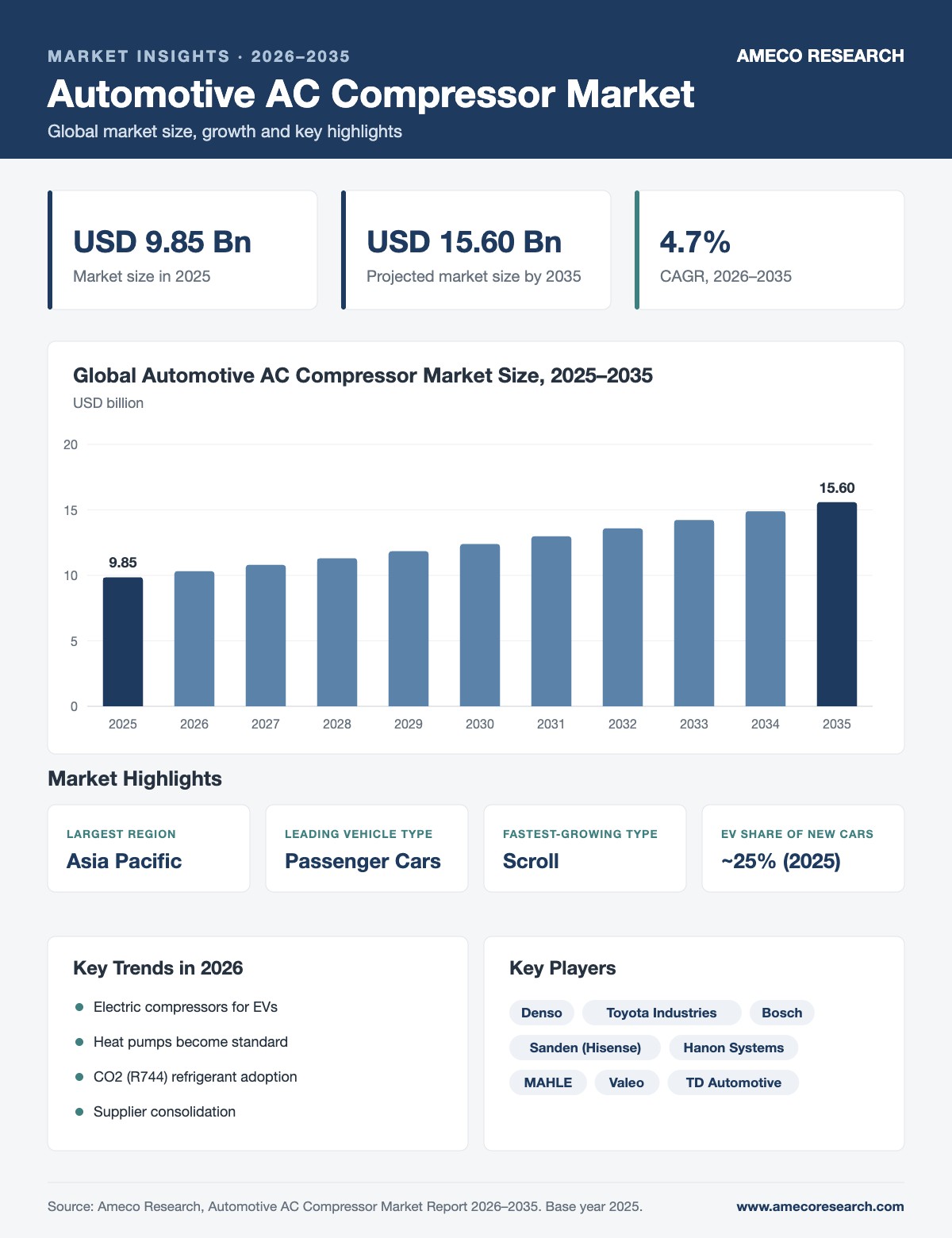 Infographic: Automotive AC Compressor Market Size and Growth Opportunities and Forecast till 2026 - 2035 | Ameco Research
Automotive AC Compressor Market Report Scope
| Report Attribute | Details |
| Automotive AC Compressor Market Size in 2025 | USD 9.85 Billion |
| Automotive AC Compressor Market Forecast by 2035 | USD 15.60 Billion |
| Automotive AC Compressor Market CAGR (2026–2035) | 4.7% |
| Analysis Period | 2023–2035 |
| Base Year | 2025 |
| Forecast Period | 2026–2035 |
| Segments Covered | By Type, By Vehicle Type, and By Region |
| Regional Scope | North America, Europe, Asia Pacific, Latin America, and Middle East & Africa |
| Key Companies Profiled | Denso Corporation, General Auto, Gardner Denver, Michigan Automotive Compressor Inc., Robert Bosch GmbH, Sanden (Hisense), TD Automotive Compressor, and Toyota Industries |
| Report Coverage | Market Trends, Drivers, Restraints, Opportunities, Competitive Analysis, Player Profiling, Regulation Analysis |
Latest Automotive AC Compressor Market Trends (2026)
Electric vehicles shift demand to e-compressors
According to the IEA's Global EV Outlook 2026, global electric car sales rose 20% to more than 20 million in 2025, about a quarter of all new cars, and are expected to reach around 23 million (28% of sales) in 2026. Every EV needs an electric, high-voltage compressor instead of a belt-driven unit, so compressor value per vehicle is rising even as conventional compressor volumes slow.
Heat pumps become standard in EVs
Automakers increasingly fit heat pumps that use the compressor to both cool and heat the cabin, improving winter driving range. Volkswagen says its CO2 heat pumps can cut cabin-heating energy use by up to 40% below 0°C, and compressors now sit at the center of integrated thermal management systems that also condition the battery and power electronics.
Natural refrigerant CO2 (R744) gains ground
Concerns over PFAS chemicals and global-warming potential are pushing a move from synthetic refrigerants toward CO2 (R744). Hanon Systems has built more than 1 million R744 e-compressors, and Volkswagen plans to use R744-based thermal management in all its battery-electric vehicles by 2030. R744 systems run at much higher pressures, requiring new compressor designs.
Supplier consolidation and new ownership
The compressor supply base is consolidating around thermal-management specialists. Hankook & Company Group completed its acquisition of Hanon Systems in January 2025, and Sanden is now majority-owned by Hisense, giving these suppliers stronger backing to invest in electric compressor capacity.
China drives scale and cost
Electric cars made up nearly 55% of new car sales in China in 2025, making it the largest and most competitive market for electric compressors. Chinese suppliers are scaling rapidly and pushing down prices, raising competitive pressure on established Japanese, Korean and European players.
Efficiency, noise and the aftermarket
Variable-displacement and inverter-driven designs are improving efficiency and reducing noise, which matters more in quiet EV cabins. Meanwhile, a large and aging fleet of combustion vehicles in hot climates sustains strong aftermarket demand for replacement compressors.
Automotive AC Compressor Market Dynamics
Growth drivers
- Growth in global vehicle production and near-universal fitment of air conditioning
- Rapid adoption of EVs and hybrids that require electric compressors and heat pumps
- Rising consumer demand for cabin comfort, especially in hot and humid regions
- Stricter emissions and refrigerant regulations driving more efficient, low-GWP systems
- Steady replacement demand from the global vehicle parc
Restraints and challenges
- Declining demand for belt-driven compressors as combustion vehicle sales fall
- High cost and engineering complexity of high-voltage and CO2 (R744) compressors
- Price pressure from new Chinese suppliers
- Exposure to cyclical vehicle production, tariffs and raw-material prices
How the compressor works
The compressor raises refrigerant pressure and temperature so heat can be released through the condenser. The refrigerant then passes through an expansion valve, cools sharply and absorbs heat and humidity in the evaporator, chilling cabin air. In heat-pump mode, the cycle is reversed to warm the cabin.
Automotive AC Compressor Market Segment Analysis
By type
The market is segmented into rotary vane, swash plate and scroll compressors. Swash plate compressors remain widely used in conventional engine-driven systems, while scroll compressors are the fastest-growing type because they are the preferred design for compact, quiet and efficient electric compressors in EVs and hybrids. Rotary vane compressors serve smaller vehicles and cost-sensitive applications.
By vehicle type
The market is divided into passenger cars and commercial vehicles. Passenger cars account for the majority of demand thanks to high production volumes and rising comfort expectations, while commercial vehicles, including trucks and buses, add steady demand, with electric buses and vans driving growth in high-capacity electric compressors.
Automotive AC Compressor Market Regional Analysis
Asia Pacific is the largest automotive AC compressor market, supported by high vehicle production in China, Japan, South Korea and India, rapid EV adoption in China, rising incomes and hot, humid climates that make air conditioning essential.
North America is driven by strong demand for SUVs and pickup trucks with large cabins, hot summers and growing EV and hybrid production, while Europe leads in low-GWP and CO2 refrigerant adoption, heat pump fitment and strict emissions rules.
Latin America and the Middle East & Africa offer growth from rising vehicle ownership and very hot climates, along with strong aftermarket demand for replacement compressors.
Automotive AC Compressor Market Segmentation
Automotive AC Compressor Market Leading Companies
The automotive AC compressor market is concentrated among large tier-1 thermal-management suppliers that compete on efficiency, noise, durability, electric compressor technology and long-term automaker contracts. Key players profiled in this report include Denso Corporation, General Auto, Gardner Denver, Michigan Automotive Compressor Inc., Robert Bosch GmbH, Sanden (Hisense), TD Automotive Compressor, and Toyota Industries. Other notable suppliers include Hanon Systems, MAHLE and Valeo.
DensoGeneral AutoGardner DenverMichigan Automotive CompressorRobert BoschSanden (Hisense)TD Automotive CompressorToyota Industries
Recent developments
Automotive AC Compressor Market: Frequently Asked Questions
How big is the automotive AC compressor market?
The global automotive AC compressor market was valued at USD 9.85 billion in 2025 and is expected to reach USD 15.60 billion by 2035.
What is the growth rate of the automotive AC compressor market?
The automotive AC compressor market is projected to grow at a CAGR of 4.7% from 2026 to 2035.
What is driving growth in the automotive AC compressor market?
Key drivers are rising vehicle production, demand for cabin comfort, the shift to electric vehicles and heat pumps, and stricter refrigerant and efficiency rules.
Which region leads the automotive AC compressor market?
Asia Pacific is the largest market, led by vehicle production and EV adoption in China, Japan, South Korea and India.
How are electric vehicles changing AC compressors?
EVs use high-voltage electric compressors, mostly scroll designs, that also power heat pumps and cool the battery, raising the value of the compressor in each vehicle.
What are the latest trends in automotive AC compressors?
The main 2026 trends are electric compressors for EVs, heat pumps, CO2 (R744) refrigerant, integrated thermal management, supplier consolidation and rising Chinese competition.
Who are the key players in the automotive AC compressor market?
Leading companies include Denso, Toyota Industries, Sanden (Hisense), Robert Bosch, Michigan Automotive Compressor and TD Automotive Compressor, along with Hanon Systems, MAHLE and Valeo.
Related Automobile & Transportation Market Reports
- Automotive Seat Market Size and Growth Opportunities and Forecast till 2026 - 2035
- Autonomous Forklift Market Growth Opportunities and Forecast till 2030
- Automotive Aluminum Alloy Market Growth Opportunities and Forecast till 2030
- Tire Pressure Monitoring System Market Growth Opportunities and Forecast till 2030
- Automotive Cooling Fan Market Growth Opportunities and Forecast till 2030