Bioplastics Films Market Size and Growth Opportunities and Forecast till 2026 - 2035
Bioplastics Films Market Size, Share & Trends Report, 2026–2035
LAST UPDATED: OCTOBER 2026
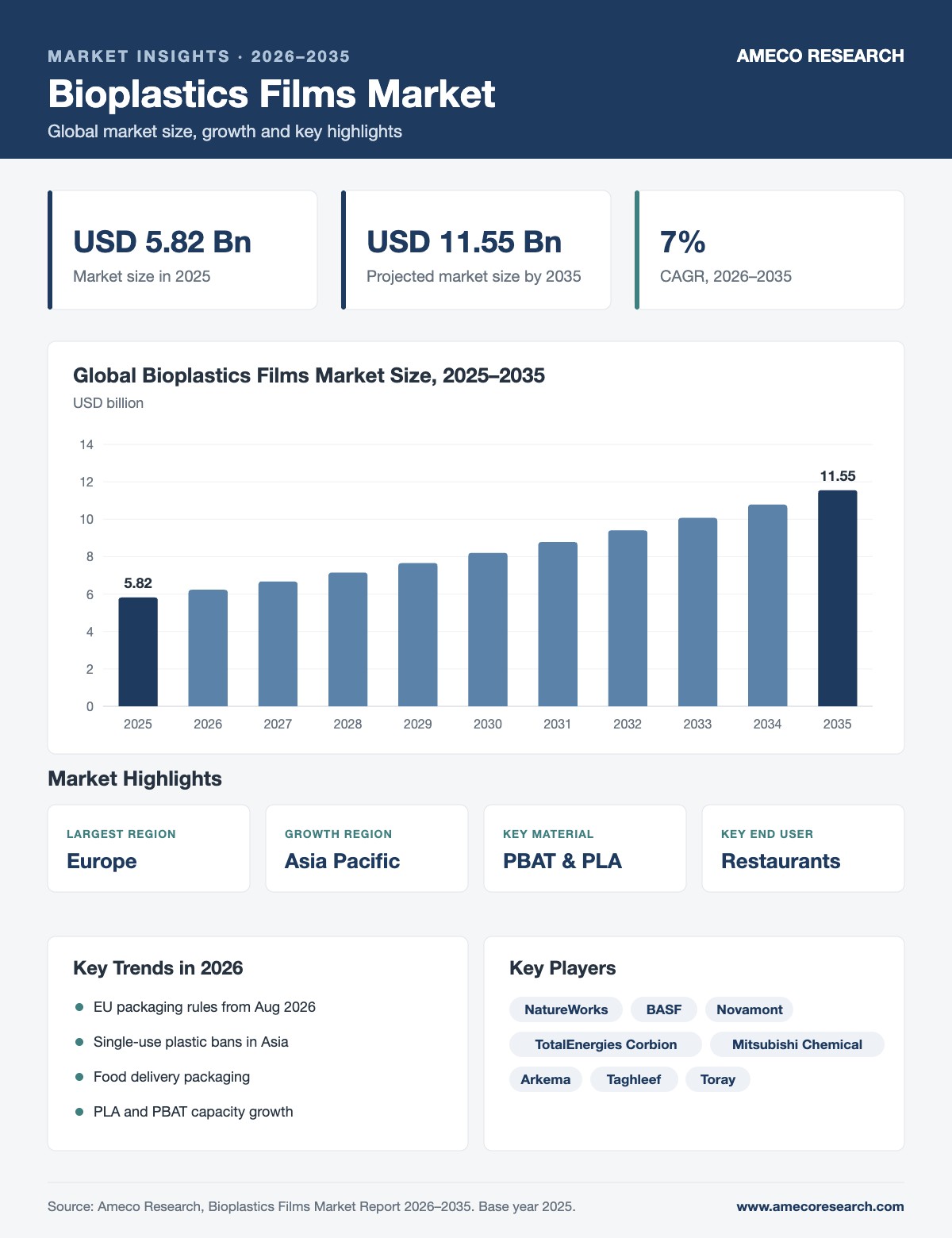
The global Bioplastics Films Market size was valued at USD 5.82 billion in 2025 and is projected to reach USD 11.55 billion by 2035, growing at a CAGR of 7% from 2026 to 2035. Growth is driven by restrictions on single-use plastics, compostable food service packaging, EU packaging rules, demand from restaurants and delivery platforms, and improving performance and cost of PLA, PBAT and starch-based films.
Bioplastics films are thin plastic films made wholly or partly from biobased and/or biodegradable polymers such as polylactic acid (PLA), polybutylene adipate terephthalate (PBAT), polybutylene succinate (PBS) and starch blends. They are used to make trays, clamshells, cups, pouches and sachets, bags, wraps and liners, especially for food service, takeaway and delivery. Compostable films can be processed with food waste in industrial or home composting, while biobased films reduce reliance on fossil feedstocks.
Bioplastics Films Market Key Takeaways
Bioplastics Films Market Report Scope
| Report Attribute | Details |
| Bioplastics Films Market Size in 2025 | USD 5.82 Billion |
| Bioplastics Films Market Forecast by 2035 | USD 11.55 Billion |
| Bioplastics Films Market CAGR (2026–2035) | 7% |
| Analysis Period | 2023–2035 |
| Base Year | 2025 |
| Forecast Period | 2026–2035 |
| Segments Covered | by Material Type, by Application, by End-User, and By Region |
| Regional Scope | North America, Europe, Asia Pacific, Latin America, and Middle East & Africa |
| Key Companies Profiled | NatureWorks LLC, BASF SE, Arkema S.A., Novamont S.p.A. (Versalis), Mitsubishi Chemical Holdings Corporation, Corbion N.V., Total Corbion PLA, Plantic Technologies Limited, Taghleef Industries Group, and Toray Industries, Inc. |
| Report Coverage | Market Trends, Drivers, Restraints, Opportunities, Competitive Analysis, Player Profiling, Regulation Analysis |
Bioplastics Films Market Size Forecast, 2023–2035
The table below shows the year-by-year size of the global bioplastics films market. Revenue is expected to grow about 2.0 times between 2025 and 2035, reaching roughly USD 8.20 billion by 2030.
| Year | Market Size (USD Billion) |
| 2023 (historical) | 5.07 |
| 2024 (historical) | 5.43 |
| 2025 (base year) | 5.82 |
| 2026 (forecast) | 6.23 |
| 2027 (forecast) | 6.68 |
| 2028 (forecast) | 7.15 |
| 2029 (forecast) | 7.66 |
| 2030 (forecast) | 8.20 |
| 2031 (forecast) | 8.78 |
| 2032 (forecast) | 9.40 |
| 2033 (forecast) | 10.07 |
| 2034 (forecast) | 10.78 |
| 2035 (forecast) | 11.55 |
Latest Bioplastics Films Market Trends (2026)
EU packaging rules from August 2026
The EU Packaging and Packaging Waste Regulation applies from August 2026 and requires certain items, such as tea bags, coffee pods and fruit stickers, to be compostable within set timelines, while promoting reduced packaging overall. This supports targeted growth for compostable films.
Single-use plastic bans in Asia
India's ban on many single-use plastic items and China's restrictions on non-degradable bags and food service plastics are creating demand for compostable films and bags.
Food delivery and takeaway
Restaurants, cafes and delivery platforms are switching to compostable bags, pouches, liners and cutlery wraps to meet customer expectations and local rules.
Capacity growth for PLA and PBAT
New PLA plants and large PBAT capacity, especially in China and Thailand, are improving supply and lowering costs.
Home-compostable and marine-degradable films
Brands are testing films that break down in home compost or natural environments, though certification and claims are closely regulated.
Industry restructuring
Novamont is now part of Eni's chemicals arm Versalis, and other producers are consolidating to scale up biobased polymers.
Bioplastics Films Market Dynamics
Growth drivers
- Bans and taxes on single-use plastics
- Corporate sustainability and packaging commitments
- Growth of food delivery and takeaway
- Organic waste collection and composting programs
- Falling costs of PLA, PBAT and starch blends
Restraints and challenges
- Higher price than conventional plastic films
- Limited industrial composting infrastructure
- Confusion over compostable and biodegradable claims
- Performance limits in barrier and heat resistance
Opportunities
Key opportunities include compostable food service packaging, bags for organic waste collection, agricultural mulch films, high-barrier biobased laminates, and fast-growing markets in India, China and Southeast Asia.
Bioplastics Films Market Segment Analysis
By material type
The market is segmented into polybutylene adipate terephthalate (PBAT), starch blends, PBS, polylactic acid (PLA) and others. PBAT and starch blends lead in flexible films and bags, while PLA is widely used for rigid, clear food packaging.
By application
Applications include trays, clamshells, cups, pouches and sachets, and others. Pouches, sachets and bags are the largest flexible uses, while trays, clamshells and cups serve food service.
By end user
End users include non-chain restaurants, chain restaurants, non-chain cafes, chain cafes, independent sellers and kiosks, delivery catering and others. Chain restaurants and delivery catering are leading adopters.
Bioplastics Films Market Regional Analysis
Europe is the largest market for bioplastics films, supported by the EU single-use plastics rules, packaging regulation and widespread organic waste collection.
The Asia Pacific region is expected to witness significant growth in the coming years, driven by plastic bans and new PLA and PBAT capacity in China, India and Thailand. North America is growing with state-level bans and composting programs.
Latin America and the Middle East & Africa are emerging markets as plastic restrictions spread.
Bioplastics Films Market Segmentation
Bioplastics Films Market Leading Companies
The bioplastics films market includes biopolymer producers, film manufacturers and packaging converters. Companies compete on polymer performance, certifications for compostability and biobased content, film processing know-how, cost and partnerships with food service and retail brands. Key players profiled in this report include NatureWorks LLC, BASF SE, Arkema S.A., Novamont S.p.A. (Versalis), Mitsubishi Chemical Holdings Corporation, Corbion N.V., Total Corbion PLA, Plantic Technologies Limited, Taghleef Industries Group, and Toray Industries, Inc..
NatureWorks LLCBASF SEArkema S.A.Novamont S.p.A. (Versalis)Mitsubishi Chemical Holdings CorporationCorbion N.V.Total Corbion PLAPlantic Technologies LimitedTaghleef Industries GroupToray Industries, Inc.
Key Questions Answered in This Report
- What is the size of the bioplastics films market in 2025, and how large will it be by 2030 and 2035?
- What are the main growth drivers, restraints and opportunities through 2035?
- Which by material type and by application segments will grow the fastest?
- Which regions and countries offer the largest and fastest-growing opportunities?
- How are EU packaging rules, plastic bans in Asia and food delivery shaping demand in 2026?
- Who are the leading companies, and what strategies are they using to compete?
Research Methodology
Our estimates draw on interviews with biopolymer producers, film manufacturers, packaging converters, food service operators and composting organizations, supported by secondary data from annual reports, investor materials, trade and customs data, standards bodies and industry journals. Bottom-up estimates of company revenues and top-down estimates of application demand are reconciled through data triangulation, and the model is updated with 2026 developments to forecast the market through 2035.
Related Reports
- Display Packaging Market Report
- Spoon in Lid Packaging Market Report
- Heat Transfer Films Market Report
- PVDC Coated Films Market Report
- Bioplastics & Biopolymers Market Report
Bioplastics Films Market: Frequently Asked Questions
How big is the bioplastics films market?
The global bioplastics films market was valued at USD 5.82 billion in 2025 and is expected to reach USD 11.55 billion by 2035.
What is the growth rate of the bioplastics films market?
The bioplastics films market is projected to grow at a CAGR of 7% from 2026 to 2035.
What will the bioplastics films market be worth in 2030?
The bioplastics films market is projected to reach about USD 8.20 billion in 2030, growing at a CAGR of 7%.
What is driving growth in the bioplastics films market?
Key drivers are single-use plastic bans, corporate sustainability targets, food delivery growth, organic waste composting and falling biopolymer costs.
What is bioplastics films?
Bioplastics films are films made from biobased and/or biodegradable polymers such as PLA, PBAT, PBS and starch blends, used mainly for compostable packaging.
Which region leads the bioplastics films market?
Europe is the largest market, while Asia Pacific is expected to witness significant growth.
Which segment holds the largest share of the bioplastics films market?
PBAT and starch blends lead in flexible films and PLA in rigid packaging, with restaurants and delivery catering as leading users.
What are the latest trends in the bioplastics films market?
The main 2026 trends are eU packaging rules from August 2026, single-use plastic bans in Asia, food delivery and takeaway, capacity growth for PLA and PBAT, home-compostable and marine-degradable films and industry restructuring.
What are the main challenges in the bioplastics films market?
The main challenges are higher prices than conventional films, limited composting infrastructure, confusion over claims and performance limits.
Are bioplastic films biodegradable?
Not all are. Films made from PLA, PBAT, PBS and starch blends can be certified compostable, while some biobased films, such as bio-PE, are not biodegradable but reduce fossil carbon use.
Who are the key players in the bioplastics films market?
Leading companies include NatureWorks LLC, BASF SE, Arkema S.A., Novamont S.p.A. (Versalis), Mitsubishi Chemical Holdings Corporation, Corbion N.V., Total Corbion PLA, Plantic Technologies Limited, Taghleef Industries Group, and Toray Industries, Inc..
Related Chemical & Material Market Reports
- Guar Meal Market Size and Growth Opportunities and Forecast till 2026 - 2035
- Lactic Acid and Derivatives Market Size and Growth Opportunities and Forecast till 2026 - 2035
- Pharmaceutical Membrane Technology Market Size and Growth Opportunities and Forecast till 2026 - 2035
- Caustic Soda Flake Market Size and Growth Opportunities and Forecast till 2026 - 2035
- Synthetic Colored Opals Market Size and Growth Opportunities and Forecast till 2026 - 2035