Lactic Acid and Derivatives Market Size and Growth Opportunities and Forecast till 2026 - 2035
Lactic Acid and Derivatives Market Size, Share & Trends Report, 2026–2035
LAST UPDATED: OCTOBER 2026
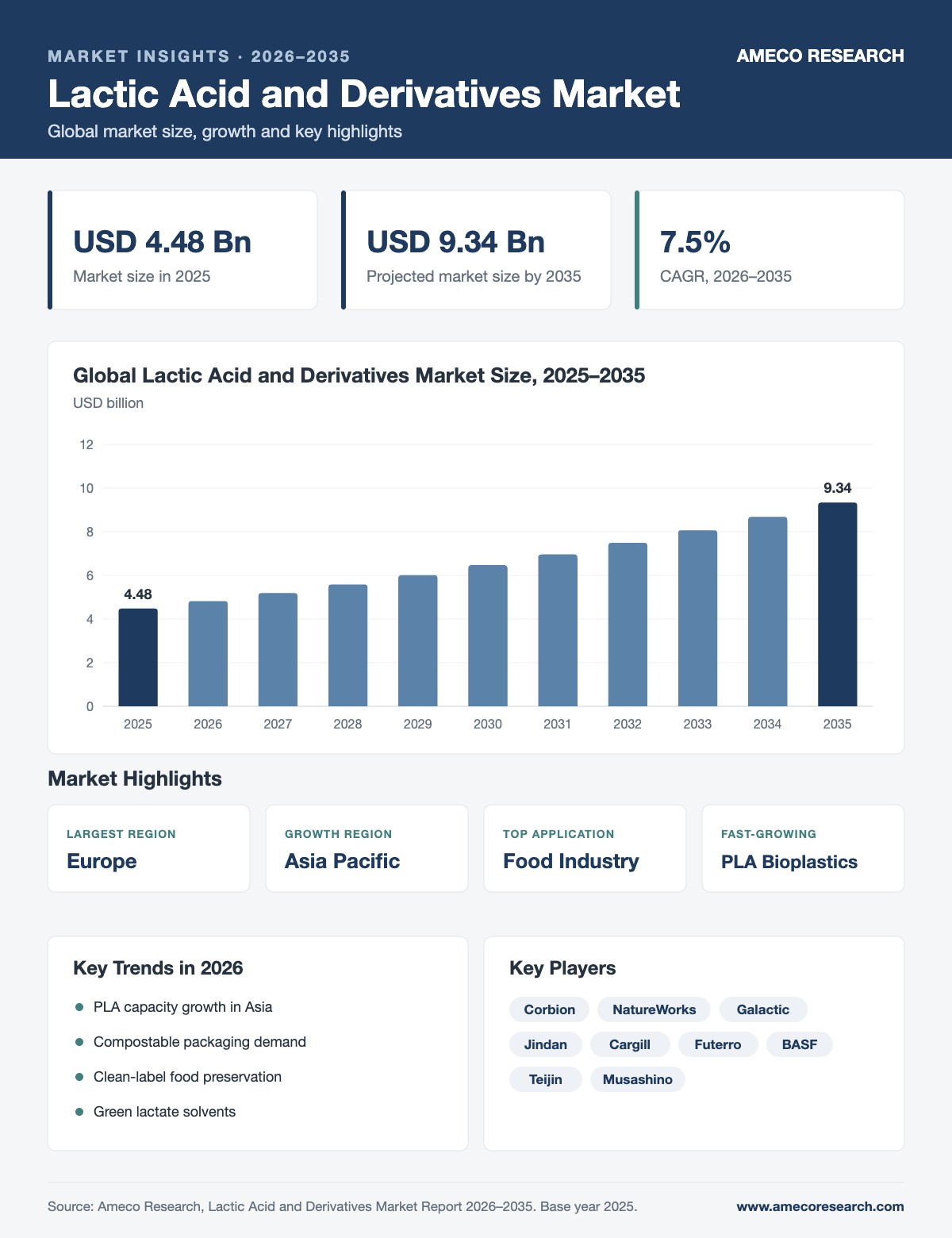
The global Lactic Acid and Derivatives Market size was valued at USD 4.48 billion in 2025 and is projected to reach USD 9.34 billion by 2035, growing at a CAGR of 7.5% from 2026 to 2035. Growth is driven by polylactic acid (PLA) bioplastics for packaging and fibers, natural preservatives and acidulants in food and beverages, green solvents such as ethyl lactate, and pharmaceutical and personal care uses.
Lactic acid is an organic acid produced mainly by fermenting sugars from corn, sugarcane, cassava and other crops. Its derivatives include lactate salts such as calcium, sodium and potassium lactate, lactate esters such as ethyl lactate, lactide and polylactic acid (PLA). Lactic acid and its derivatives are used as acidulants, preservatives and flavor enhancers in food and beverages, as building blocks for biodegradable PLA plastics, as green solvents and cleaners in the chemical industry, and in pharmaceuticals, cosmetics and personal care.
Lactic Acid and Derivatives Market Key Takeaways
Lactic Acid and Derivatives Market Report Scope
| Report Attribute | Details |
| Lactic Acid and Derivatives Market Size in 2025 | USD 4.48 Billion |
| Lactic Acid and Derivatives Market Forecast by 2035 | USD 9.34 Billion |
| Lactic Acid and Derivatives Market CAGR (2026–2035) | 7.5% |
| Analysis Period | 2023–2035 |
| Base Year | 2025 |
| Forecast Period | 2026–2035 |
| Segments Covered | by Type, by Application, and By Region |
| Regional Scope | North America, Europe, Asia Pacific, Latin America, and Middle East & Africa |
| Key Companies Profiled | Corbion N.V., BASF SE, NatureWorks LLC, Galactic S.A., Henan Jindan Lactic Acid Technology Co., Ltd., Cargill, Incorporated, Futerro SA, Teijin Limited, Synbra Technology B.V., and Musashino Chemical Laboratory, Ltd. |
| Report Coverage | Market Trends, Drivers, Restraints, Opportunities, Competitive Analysis, Player Profiling, Regulation Analysis |
Lactic Acid and Derivatives Market Size Forecast, 2023–2035
The table below shows the year-by-year size of the global lactic acid and derivatives market. Revenue is expected to grow about 2.1 times between 2025 and 2035, reaching roughly USD 6.47 billion by 2030.
| Year | Market Size (USD Billion) |
| 2023 (historical) | 3.87 |
| 2024 (historical) | 4.16 |
| 2025 (base year) | 4.48 |
| 2026 (forecast) | 4.82 |
| 2027 (forecast) | 5.19 |
| 2028 (forecast) | 5.58 |
| 2029 (forecast) | 6.01 |
| 2030 (forecast) | 6.47 |
| 2031 (forecast) | 6.96 |
| 2032 (forecast) | 7.49 |
| 2033 (forecast) | 8.06 |
| 2034 (forecast) | 8.68 |
| 2035 (forecast) | 9.34 |
Latest Lactic Acid and Derivatives Market Trends (2026)
PLA capacity growth in Asia
Producers are building large lactic acid and PLA plants in Asia, including NatureWorks' integrated Ingeo PLA complex in Thailand announced in 2023, to meet demand for biobased plastics.
Packaging rules and compostable plastics
Restrictions on single-use plastics and new packaging rules encourage PLA for compostable food service items, tea bags, coffee capsules, films and labels, though rules on compostable labelling vary by country.
Clean-label food preservation
Food makers use lactic acid and lactates as natural acidulants, flavor enhancers and shelf-life extenders in meat, bakery, dairy and beverages, replacing synthetic preservatives.
Green solvents and cleaners
Ethyl lactate and other lactate esters are replacing petroleum-based solvents in coatings, electronics cleaning and household products.
Feedstock diversification
Producers are exploring non-food feedstocks such as agricultural residues and second-generation sugars to lower costs and address food-versus-material concerns.
Pharmaceutical and personal care demand
Lactic acid is used in skin care exfoliants, intravenous solutions and biodegradable polymers for drug delivery and implants.
Lactic Acid and Derivatives Market Dynamics
Growth drivers
- Demand for biobased and compostable plastics
- Natural preservatives and acidulants in food
- Green solvent and cleaning applications
- Pharmaceutical and personal care uses
- Government support for bioeconomy and biobased products
Restraints and challenges
- Price competition with fossil-based plastics and chemicals
- Volatile sugar and corn prices
- Limited industrial composting infrastructure
- High capital cost of fermentation and PLA plants
Opportunities
Key opportunities include PLA for packaging and fibers, high-heat and durable PLA grades, lactate esters as green solvents, clean-label food ingredients, and medical-grade lactic acid polymers.
Lactic Acid and Derivatives Market Segment Analysis
By type
The market is segmented into lactic acid and lactic acid derivatives. Lactic acid itself serves food and chemical uses, while derivatives such as PLA, lactates and lactate esters are the fastest-growing part of the market.
By application
Applications include the food industry, chemical industry and pharmaceutical industry. The food industry is the largest application, while chemical uses including PLA and green solvents are growing fastest.
Lactic Acid and Derivatives Market Regional Analysis
Europe is the largest market for lactic acid and its derivatives, supported by bioplastics policies, a large food processing industry and producers such as Corbion, Galactic and Futerro.
The Asia Pacific region is expected to witness significant growth in the coming years, with expanding fermentation and PLA capacity in Thailand, China and India. North America is a major market with large PLA production.
Latin America, with abundant sugarcane, and the Middle East & Africa are emerging markets.
Lactic Acid and Derivatives Market Segmentation
Lactic Acid and Derivatives Market Leading Companies
The lactic acid and derivatives market includes fermentation specialists, PLA producers, agribusiness groups and chemical companies. Companies compete on fermentation efficiency, feedstock access, product purity, PLA performance and partnerships with packaging, food and pharmaceutical customers. Key players profiled in this report include Corbion N.V., BASF SE, NatureWorks LLC, Galactic S.A., Henan Jindan Lactic Acid Technology Co., Ltd., Cargill, Incorporated, Futerro SA, Teijin Limited, Synbra Technology B.V., and Musashino Chemical Laboratory, Ltd..
Corbion N.V.BASF SENatureWorks LLCGalactic S.A.Henan Jindan Lactic Acid Technology Co., Ltd.Cargill, IncorporatedFuterro SATeijin LimitedSynbra Technology B.V.Musashino Chemical Laboratory, Ltd.
Key Questions Answered in This Report
- What is the size of the lactic acid and derivatives market in 2025, and how large will it be by 2030 and 2035?
- What are the main growth drivers, restraints and opportunities through 2035?
- Which by type and by application segments will grow the fastest?
- Which regions and countries offer the largest and fastest-growing opportunities?
- How are PLA capacity, packaging rules and clean-label food trends shaping demand in 2026?
- Who are the leading companies, and what strategies are they using to compete?
Research Methodology
This report combines primary and secondary research. Primary research includes interviews with lactic acid and PLA producers, food and chemical companies, packaging converters and distributors. Secondary research covers company annual reports, investor presentations, government and trade association data, patent filings and industry publications. Market size is estimated using both bottom-up (company revenue and production data) and top-down (end-use demand) methods, and results are cross-checked through data triangulation before forecasts are built for 2026–2035.
Related Reports
- Bioplastics Films Market Report
- Mandelic Acid Market Report
- Bioplastics & Biopolymers Market Report
- Food Service Packaging Market Report
- Frozen Food Packaging Market Report
Lactic Acid and Derivatives Market: Frequently Asked Questions
How big is the lactic acid and derivatives market?
The global lactic acid and derivatives market was valued at USD 4.48 billion in 2025 and is expected to reach USD 9.34 billion by 2035.
What is the growth rate of the lactic acid and derivatives market?
The lactic acid and derivatives market is projected to grow at a CAGR of 7.5% from 2026 to 2035.
What will the lactic acid and derivatives market be worth in 2030?
The lactic acid and derivatives market is projected to reach about USD 6.47 billion in 2030, growing at a CAGR of 7.5%.
What is driving growth in the lactic acid and derivatives market?
Key drivers are demand for biobased and compostable PLA plastics, natural food preservatives, green solvents and pharmaceutical and personal care uses.
What is lactic acid and derivatives?
Lactic acid is an organic acid made by fermenting sugars, and its derivatives include lactates, lactate esters and polylactic acid (PLA) used in food, plastics, solvents and medicine.
Which region leads the lactic acid and derivatives market?
Europe is the largest market, while Asia Pacific is expected to witness significant growth.
Which segment holds the largest share of the lactic acid and derivatives market?
The food industry is the largest application, while derivatives such as PLA are the fastest-growing segment.
What are the latest trends in the lactic acid and derivatives market?
The main 2026 trends are pLA capacity growth in Asia, packaging rules and compostable plastics, clean-label food preservation, green solvents and cleaners, feedstock diversification and pharmaceutical and personal care demand.
What are the main challenges in the lactic acid and derivatives market?
The main challenges are price competition with fossil-based products, volatile feedstock prices, limited composting infrastructure and high plant costs.
How is PLA made from lactic acid?
Lactic acid is converted into lactide, a ring-shaped molecule, which is then polymerized into polylactic acid (PLA), a biobased plastic used in packaging, fibers and 3D printing.
Who are the key players in the lactic acid and derivatives market?
Leading companies include Corbion N.V., BASF SE, NatureWorks LLC, Galactic S.A., Henan Jindan Lactic Acid Technology Co., Ltd., Cargill, Incorporated, Futerro SA, Teijin Limited, Synbra Technology B.V., and Musashino Chemical Laboratory, Ltd..
Related Chemical & Material Market Reports
- Pharmaceutical Membrane Technology Market Size and Growth Opportunities and Forecast till 2026 - 2035
- Caustic Soda Flake Market Size and Growth Opportunities and Forecast till 2026 - 2035
- Synthetic Colored Opals Market Size and Growth Opportunities and Forecast till 2026 - 2035
- Chlorinated Rubber Coating Market Size and Growth Opportunities and Forecast till 2026 - 2035
- Tin Foil Market Size and Growth Opportunities and Forecast till 2026 - 2035